Materiales de Construcción Journal (@MaterialesdeCo3) header
Materiales de Construcción Journal (@MaterialesdeCo3) profile picture

Materiales de Construcción is a JCR-indexed scientific journal published by @IETorroja @CSIC in Construction and Materials Science.

Madrid (Spain)
Joined April 2021
Photo by Materiales de Construcción Journal (@MaterialesdeCo3)Photo by Materiales de Construcción Journal (@MaterialesdeCo3)Photo by Materiales de Construcción Journal (@MaterialesdeCo3)Photo by Materiales de Construcción Journal (@MaterialesdeCo3)Photo by Materiales de Construcción Journal (@MaterialesdeCo3)Photo by Materiales de Construcción Journal (@MaterialesdeCo3)Photo by Materiales de Construcción Journal (@MaterialesdeCo3)Photo by Materiales de Construcción Journal (@MaterialesdeCo3)Photo by Materiales de Construcción Journal (@MaterialesdeCo3)Photo by Materiales de Construcción Journal (@MaterialesdeCo3)
📑Since 1949, Materiales de Construcción has published key research in Construction, Materials Science and Technology - A @CSIC Journal - Edited by the @IETorroja - SJR Q2 ranking - Indexed in WoS/JCR & SCOPUS 🔗Find our author guidelines: bit.ly/3Li56YC
1
2
2
308
What happens when pine wood particles are combined with recycled PET to manufacture particleboard? 🌲♻️ This study evaluated two composite solutions using hot pressing, comparing panels with and without polyurethane resin (PUR). 📰 doi.org/10.3989/mc.2026.3912…
2
1
1
2
71
1️⃣ The panels containing 10% PUR showed physical and mechanical properties above the minimum values recommended by the relevant standards. SEM images also indicated effective envelopment of the wood 🪵 particles at 160 °C.
1
1
20
Oyster shells 🦪 are a growing waste problem for the aquaculture industry — but could they become a useful material in road pavements ♻️? A study tests oyster shell powder (OSP) as a partial substitute for fine aggregate and filler in asphalt concrete.
1
1
1
38
1️⃣ 6% of the fine aggregate and filler was replaced with OSP 🧪 in asphalt concrete, tested against natural aggregate with and without hydrated lime 🧱. Marshall, tensile strength, moisture and abrasion tests were run on all three mixes.
1
1
12
Recycled asphalt pavement (RAP) 🛣️ usually ends up as waste — could it become a building block for greener concrete instead ♻️? A study tests RAP as a partial substitute for natural aggregate in geopolymer concrete. 📰 doi.org/10.3989/mc.2026.3932…
1
1
2
48
1️⃣ Natural coarse aggregate was replaced with RAP 🧪 at 0-100% in fly ash and dolomite geopolymer concrete, then tested for compressive, flexural and split tensile strength, plus ultrasonic pulse velocity 📊 at 28 and 56 days.
1
2
23
Can asphalt be produced at a lower temperature 🌡️ and with a smaller environmental footprint without losing strength? A study tests sodium silicate as a binder modifier and recycled concrete aggregate ♻️ in warm-mix asphalt. #MaterConstrucc #RecycledAggregate #Sustainability
1
1
1
34
1️⃣ 🧪 1% sodium silicate proved optimal as a binder additive while replacing coarse natural aggregate with recycled concrete aggregate 🪨. Full mechanical testing confirmed strong performance (Marshall, ITS, modulus, deformation, fatigue & Cantabro). 🚗💨
1
20
Can we 🖨️ automate earth construction while drastically reducing cement? A new study successfully 3D printed low-plasticity sandy soils 🌾 by replacing up to 87% of Portland cement. Here is how it works. 👇 #MaterConstrucc #3Dprinting #Earthconstruction
1
1
1
67
1️⃣ Earth construction is eco-friendly 🌍, but 3D printing usually requires cohesive clay soils. Sandy soils 🏜️ typically demand unsustainable amounts of cement to avoid pump blockages or fresh structural collapse.
1
2
21
Can we 🖨️ 3D print with sandy soil using 87% less cement? A new study shows that replacing cement with metakaolin and limestone filler 🧪 reaches 16 stable continuous layers 🧱 while keeping structural viability! 🔗doi.org/10.3989/mc.2026.3942… #MaterConstrucc #3Dprinting
1
1
42
Can truck wash waste build greener #concrete? Replacing 20% of cement with processed truck slurry waste yields C50 high-strength concrete at 54 MPa, reducing net #cement consumption 📉 by 10.24% and water absorption by 63.8%! 🧪 🔗 doi.org/10.3989/mc.2026.4160… #MaterConstrucc
1
2
46
Can natural rubber latex 🌱 help geopolymer mortar survive sulfate and acid attack? A fly ash mix with field Para rubber latex (FPRL) and different heat-curing times ⚗️ was tested against 5% magnesium sulfate and sulfuric acid for 90 days. #MaterConstrucc #Geopolymer #Mortar
1
1
1
67
1️⃣ Mortars combined 0–5% FPRL 🧪 with heat curing at 80°C for 0.5 to 4 hours, then were submerged for 90 days. Compressive strength, expansion and microstructure were tracked via XRD and SEM 🔬 to see how each mix resisted chemical attack.
1
1
32
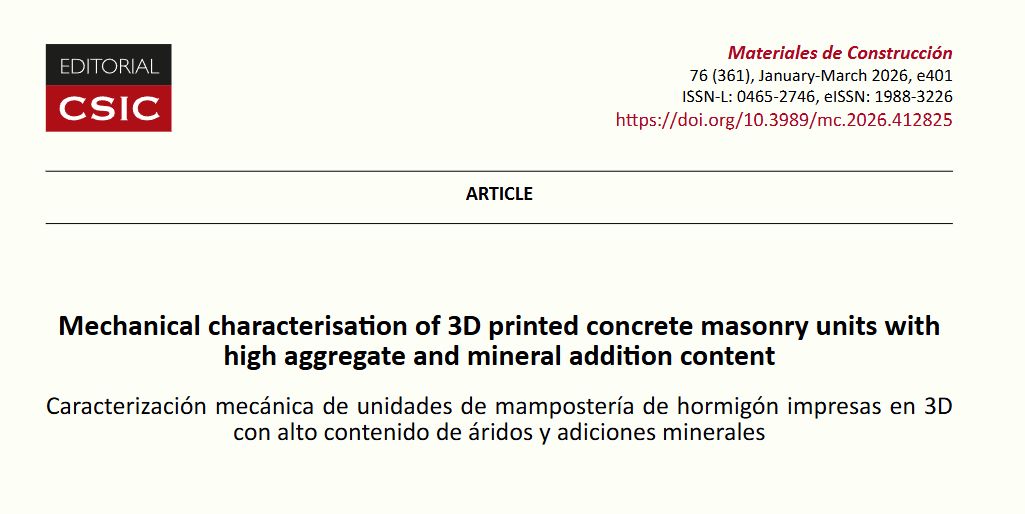
Can 3D printed masonry be sustainable? 🧱 New study shows 3D-printed hollow concrete blocks with up to 47% less #cement achieve 9.67 MPa compressive strength, doubling structural standards with just 20.72 kg/m² cement consumption 🔬 doi.org/10.3989/mc.2026.4128… #MaterConstrucc
1
1
44
How can we prevent 🧫 mold degradation in concrete? Adding 🧪 TiO₂ and ZnO nanoparticles achieves up to 62.96% fungal inhibition by tuning the C-S-H gel Ca/Si ratio to 2.5–2.9. 🔗 doi.org/10.3989/mc.2026.4149… #MaterConstrucc #Nanoparticles #Antifungal
1
2
52
Can a microscopic change in crystal symmetry slash the massive energy bills of heavy industry? 🏭 A new study from a Spanish cement plant reveals how hidden mineralogy is optimizing cement production. 👇 #MaterConstrucc #Clinker
1
1
1
55
1️⃣ Grinding clinker into cement in horizontal ball mills consumes enormous amounts of electricity ⚡due to low efficiency. Producing softer, easier-to-grind clinker is key to cutting plant costs and reducing indirect CO₂ emissions. 🌍
1
1
15
Did you know a microscopic crystal shift can cut heavy industry energy use? 🔬 A Spanish cement plant proved that keeping the C3S_M1 alite phase above 18% in clinker reduces mill electricity by >5% without losing strength. 🏭 🔗 doi.org/10.3989/mc.2026.4226… #MaterConstrucc #Clinker
1
1
2
51
3D printing in construction often relies on high-cement mixtures, driving up carbon emissions. But can we build structural masonry 3D elements with minimal #cement and local sands without sacrificing strength or stability? 🧱 #MaterConstrucc #Aggregate #Sustainability
1
1
59
1️⃣ Conventional 3D concrete printing uses high-binder mixes or complex internal truss lattices to support fresh layers. This increases material costs, slows printing, and elevates environmental impact.
1
1
31
🧪 Turning waste into a solution for cleaner water 💧 👉 Worth a read! ✍️ @IETorroja
From hazardous waste to clean water: a study co-authored by @IETcc_CSIC shows waste-derived #zeolite removes up to 99.9% of toxic metals from mine-impacted water. Curious about the details? Read more: 🔗 tinyurl.com/35zs86nb
3
23
Fungi and mold 🧫 colonize concrete surfaces, producing acids that degrade building materials. A new study explores how incorporating nanoparticles turns cement pastes into autonomous 🔬 biocidal barriers. A thread 🧵 #MaterConstrucc #Nanoparticles #Antifungal
1
1
1
55
1️⃣ Species like Penicillium and Aspergillus secrete 🧪 oxalic acid when growing on damp walls. This acid attacks the alkaline cement matrix, increasing porosity, reducing mechanical strength, and posing indoor health risks.
1
1
10
A pioneer of reinforced concrete engineering. His work remains a landmark in the history of concrete construction. 🏗️
Robert Maillart (1872 – 1940) fue un ingeniero civil suizo que innovó en el uso del hormigón armado, creando el arco triarticulado, el arco con tablero armado para puentes y losas sin vigas con columnas en forma de seta para naves industriales. victoryepes.blogs.upv.es/202…
66
What if a simple wall coating could cut heat transfer through façades by half? 🏙️🔥 A new study tests this idea by replacing natural sand in mortars with expanded vermiculite ♻️
1
43
1️⃣ Traditional mortars conduct too much heat 🌡️ forcing buildings to rely on energy intensive systems ⚡ The challenge: improve insulation without adding weight or losing mechanical performance 🧱
1
14
What if coal-mining waste could become a material that improves building insulation? 🏗️♻️ New research explores turning industrial residues into porous aggregates with enhanced thermal performance 🔍
1
30
1️⃣ Construction relies on dwindling natural aggregates 🌍 while coal gangue and fly ash pile up unused. The challenge: engineer a lightweight aggregate that insulates well without losing strength or sustainability ⚙️
1
11
Why does Roman cement 🏛️, used since imperial times, remain a headache in restoration? The problem: it sets so fast ⏱️ there's barely time to apply it.
1
25
1️⃣ Natural cement sets in 7-10 minutes after adding water 💧. Though key for heritage and more sustainable than Portland cement (lower CO2 🌱), application is nearly impossible without chemical retarders difficult to dose precisely.
1
14