

distributed machine learning @ google | sometimes mathematician
Seattle
Joined September 2012
- Tweets985
- Following437
- Followers1.4K
- Likes1.4K





Zachary Charles retweeted

Tinker’s Dimuon is Muon with delayed diagonal conditioning, Polar Express and a rank-dependent update norm. I recovered its update rule through the API, borrowing @mrtnm’s approach to StableReinforce. Here’s how 🧵


Dimuon is a new optimizer we built for LoRA fine-tuning. In our SFT tests, it often reaches lower loss in fewer steps than AdamW. We're still experimenting with Dimuon; you can Tinker with it today and share your feedback!
See our optimizers guide at tinker-docs.thinkingmachines…
Zachary Charles retweeted

I agree with this and adopted this stance unilaterally on a recent review. I encourage you to adopt it in your reviewing — it’s reasonable to write reviews that say “this is dense unreadable slop, my review isn’t detailed and I recommend rejection solely on that basis.”

Some thoughts on reviewing: spylab.ai/blog/reviewing/
First for @satml_conf where we trialed an early reject phase which cut submissions by ~40%.
Then more generally about how not everything deserves peer-review, and why we should reward writing things that people actually read.

Zachary Charles retweeted

People really have no idea what string theory is, most have never talked to a string theorist nor bother to read up on it. Its public perception is driven by remarkably confident statements constructing a bogeyman that has nothing to do with the actual research




Zachary Charles retweeted

If you want evidence that capitalism is a force for good, just visit a grocery store.
My ode to the humble American supermarket, for @WSJFreeEx


Zachary Charles retweeted

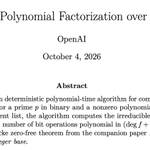
An idea: any paper where all creative mathematical contributions are due to an AI model should be positioned as "an exposition of a proof by Model X". That'd be intellectually honest. It would also add value, rather than DDoS-ing arXiv with daily conjectures. Example below.


Zachary Charles retweeted

Songlin Yang's video explanations
youtube.com/watch?v=d0HJvGSW…
youtube.com/watch?v=RTJKXK5L…
Songlin Yang's blog post
Design intuition
sustcsonglin.github.io/blog/…
Kernel algorithm (I skipped to "A Chunkwise Algorithm for DeltaNet" section)
sustcsonglin.github.io/blog/…
FlashKDA
github.com/MoonshotAI/FlashK…
I prompted Codex to explain it to me, only after that the deep dive made sense
github.com/MoonshotAI/FlashK…
vLLM serving explanations
vllm.ai/blog/2026-07-22-kimi…
vllm.ai/blog/2026-07-27-k3#p…
The great Zhihu post for explaining AttnRes
Training
zhihu.com/question/201699309…
Inference
zhuanlan.zhihu.com/p/2017528…
Jianlin Su's MoE 環遊記 series
kexue.fm/tag/moe/1/
Explains the concept of MoE from math first principles
Papers
Kimi Linear, LatentMoE, Kimi K3 tech report
N/

Zachary Charles retweeted

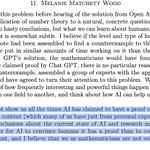
It's nice that the FrontierMath: Open Problems all come with a prospective notability rating from mathematicians. The ratings are highly imperfect, but at least it gives us non-mathematicians a line in the sand. Thread with some (non-mathematical) thoughts on the Astra results.

Zachary Charles retweeted

I've seen this sentiment from several mathematicians, and it is understandable, but I feel it is also dangerously wrong. I say this because I think mathematicians need to adapt hard and fast, instead of wishing that the disruption from AI will somehow go away.
There is a science to large language models and it predicts that with the linear scaling rate we are seeing now, capabilities will increase over the next 5 years at a similar rate as the last 5 years. To get a sense of what that means, one of the main benchmarks 5 years ago was GSM8K, whose questions you can see for yourself at huggingface.co/datasets/open….
There also seems to be a misconception that frontier labs are emphasizing math right now, and spending a lot on solving open math problems, in order to advertise the intelligence of their models. There was some truth to this 7-10 months ago, but that time has passed and most labs are now focused on coding agents. The continued improvements in math are largely a side effect.
In the past, the path to a math Ph.D. cultivated resilience, resourcefulness, critical thinking, and a healthy skepticism. These qualities are still needed today, perhaps more than ever, but suddenly you can produce a passable Ph.D. thesis with the push of a button. This signals that the field needs to completely overhaul itself, starting now.
My recommendation is that the future role of humans in mathematics, and similar theoretical fields, should be preserving and disseminating knowledge in oral and social forms; written papers will be the domain of AI. Over the coming months I will be involved in workshops that aim to produce more concrete proposals. But people need to come to terms ASAP with the fact that drastic change and compromise are needed to prevent the disenfranchisement of humanity from knowledge work.


Zachary Charles retweeted
I'm not so sure about the displayed isomorphism between (26) and (27), in the proof of your Theorem 7.1. The justification seems to be just a citation to Theorem 7.2.1 of arxiv.org/pdf/2306.04631, but if you go to that reference you only see a short exact sequence. GPT 5.6's confusion is understandable here, because the Theorem says "which is an isomorphism" after the exact sequence, an obvious grammatical mistake: (which map are they referring to?). But if you check the proofs, it appears to be the rightmost map to the Grothendieck--Witt group, not leftmost map \nu_{d,*}, which is an isomorphism. (For example, in the proof of the previous theorem it is explicitly stated that the map to GW is an epimorphism for j \geq d-3.)
P.S. I think you should have quietly checked with experts before publicly declaring a counterexample on X. This is obviously not a venue for serious mathematics and it is highly prone to spreading misinformation, which is harmful for mathematics.
P.P.S. Please nobody take this to mean that I am willing to check other AI generated solutions, or that any lack of comment from me represents failure to find an error. I just happened to be kind of interested in this one problem. I have not looked at any of the other claimed AI solutions posted on this website.