

Blog on Applied Mathematics | Blog divulgativo di matematica applicata .
Joined January 2015
- Tweets6.7K
- Following3.4K
- Followers2.1K
- Likes2.4K




Math is in the Air retweeted

Yann LeCun and Randall Balestriero just Proved the Platonic Representation Hypothesis, and found a better way to achieve it.
The Platonic Representation Hypothesis suggests that AI models trained on different modalities, like images and text, eventually learn similar representations of the world. But this paper shows that how models are trained matters more than simply scaling them up.
So they mathematically show that, under certain conditions, two JEPAs trained completely separately can learn essentially the same underlying representation of the world. One learns from different images of the same scene, while the other learns from different descriptions of that scene, without ever being trained on image-text pairs.
Their approach achieves the same image-text alignment with 42x fewer training samples than next-token prediction. A 109M-parameter text JEPA even outperforms LLMs up to 72B parameters on cross-modal alignment benchmarks.
alphaxiv.org/abs/2610.39302

Math is in the Air retweeted

"Theories of Deep Learning" is a 2026–27 mathematics course offered by the University of Oxford that examines the mathematical foundations of deep neural networks.
The course consists of 16 freely available lectures covering neural network architectures, nonlinear transformations, convolutional structures, pooling, optimization, dictionary learning, transferability of learned features, adversarial examples, random matrix theory, learning invariances, and more.
The lectures explore mathematical theories that help explain how deep neural networks learn and why they perform as they do. I consider this a particularly valuable resource for anyone interested in the mathematics underlying modern AI systems.
courses.maths.ox.ac.uk/cours…

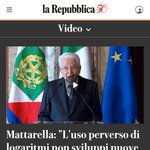
Poveri logaritmi.. che hanno fatto di male!
Idea magari giusta ma espressa non in modo corretto da Presidente.

Math is in the Air retweeted

My mathematician daughter was browsing in a used bookstore this weekend ... and found this:
writings.stephenwolfram.com/…

Math is in the Air retweeted

Writing is a form of thinking.
So don't let AI do it all for you.


Math is in the Air retweeted

Fantastic video by @3blue1brown on the future of mathematics.
I fully agree with his view that there never has been a better time to go into math. Everything will change, yet this creates opportunities to contribute to redefining the subject – which could be very exciting for early-career researchers. Also, in the long term, I am sure as a society we will value human understanding of intricate topics and that being a mathematician will remain a meaningful profession.
Honoured to feature briefly around minute 17:30 showing my excitement about AI generated math 😊 The short excerpt is part of a longer conversation I had with Grant at @the_IAS that actually took place in Einstein's office. Here a picture of the two of us after the conversation.
youtube.com/watch?v=LKrwhjOI…

Math is in the Air retweeted

Attention explained!!

I put together a handbook on how attention works, from the Q/K/V equation up through how it actually runs in modern LLMs.
Self vs. cross-attention, causal masking, multi-head attention, RoPE, KV caching, MHA/MQA/GQA/MLA, FlashAttention, worked through by hand, with citations back to the original papers.
Made it to be the explanation I wish I'd had.

Math is in the Air retweeted

🏫 密歇根大学把新开的 AI 编程课讲义全放 GitHub 上了,eecs498-aase/materials,想学怎么带着 agent 做软件工程的可以直接抄作业。
这是该校 2026 年秋季 EECS 498-016《应用型智能体软件工程》的官方课程仓库,讲义、实验、课堂演示代码全套都在,还挂着课程官网 eecs498-aase.github.io。
有意思的是这仓库自己就是一份「agent 干活」的样本:翻一下它的 PR 列表,十三个 PR 全是 claude[bot] 提的,改讲义、重排幻灯片、把临近的作业截止日期同步进去,老师基本是在 review agent 的产出。
eecs498-aase/materials 里的东西是跟着课程进度长的。讲座按 L01、L02 编号分好,每讲都有 slides.md 源文件和编好的 pdf、pptx;labs 目录是配套实验;demos 目录放的是课堂上真跑的代码库,比如一个命令行笔记工具、一份会议记录分析。还有个 egm 目录装着五个叫 Elephant-Goldfish Model 的 skill。幻灯片在每次上课前后发布,所以你是跟着课表在同步拿材料。
想系统学怎么和 agent 一起写代码,这可能是眼下最新鲜的一份公开讲义。
GitHub:github.com/eecs498-aase/mate…
Math is in the Air retweeted
Some reflections on AI in math. I found it helpful to simply list out the various parts of what a mathematician does, why math is valuable, and where the funding comes from. From there, what happens if AI gets more capable?
youtu.be/LKrwhjOI8Nc

Math is in the Air retweeted

Mathematician Terence Tao:
"we're seeing the end of the romantic era of mathematics, the age of heroes. we're moving into an industrial era where math becomes large-scale, done in big teams like the other sciences"
We're entering, rather unwillingly, a new era where exciting new things are possible, but some things are being lost

Math is in the Air retweeted

Fields medallist Hugo Duminil-Copin was deeply shaken by OpenAI’s release of more than 700 AI-generated mathematical manuscripts, including work on 16 questions directly relevant to his research.
“On Tuesday night, I cried, and it woke up my daughter”
“They have annihilated my field of research.”
lemonde.fr/sciences/article/…

Math is in the Air retweeted
Backpropagation is easiest to understand when the network is small enough that you can follow every number by hand.
The example below has one input, two hidden ReLU units and a linear output. We begin with a normal forward pass. The input is multiplied by the hidden-layer weights, ReLU produces the two hidden activations, and the output layer combines them into a prediction. Comparing that prediction with the target gives a loss of 0.5.
Now comes the part we actually need for training. We want to know how sensitive the loss is, locally, to each weight in the network. A hidden-layer weight does not touch the loss directly, so we have to follow the route through which it affects the result. It changes a hidden unit, that hidden unit changes the prediction, and the prediction changes the loss. The chain rule gives us a way to combine those effects.
This is what backpropagation is doing as it moves through the computation graph. At each step it takes the gradient arriving from later in the network and combines it with the local derivative of the operation at that point. If a value contributes to several later computations, the gradient contributions from those paths are added before propagation continues.
The ReLU units in this example also show why activation derivatives matter. Both hidden pre-activations are positive, so the local ReLU slope is 1 and the gradient can pass through those activations without additional scaling. Had one of those pre-activations been negative, the local ReLU slope would have been zero and that path would have contributed no gradient to the weight behind it for this example.
After working backward through the network, we have a gradient for each of the four weights. Backpropagation has done its job at that point. Plain SGD then uses those gradients to update the parameters. The important detail is that all four gradients are computed at the same original parameter values, before any of the weights are changed.
Running the network again with the updated weights gives a prediction of -0.49 and a loss of 0.12005, down from 0.5 in this particular step. The decrease is useful for the example, although a gradient update with an arbitrary learning rate is not guaranteed to reduce the loss on every step.
The networks used in practice are much larger, but the underlying calculation is the same. Forward computation produces the loss, reverse-mode differentiation propagates sensitivities backward through the graph, and the optimizer uses the resulting gradients to change the parameters.
Backpropagation computes the gradients. SGD is what changes the weights.

Math is in the Air retweeted

Akademisyenler için Claude Code’u nasıl kullanacağınıza dair basit bir giriş.
Alessandro Spina'ya ait sunum slaytları ve GitHub deposu.
🔗 github.com/aspi6246/Claude-C…

Math is in the Air retweeted

Lecture notes in Linear Algebra, by Terence Tao
Download 271-page PDF here: terrytao.wordpress.com/wp-co…

Math is in the Air retweeted

When he was in his 20s, Alexander Grothendieck’s ideas changed the course of mathematics. Then in 1970, he quit. Eventually, he moved to a small village in the Pyrenees, where he lived as a hermit until his death in 2014. quantamagazine.org/how-alexa…

Math is in the Air retweeted

I curated 125 free math textbooks, written by the mathematicians who teach the courses and shared on their own university pages. No sign-up, no paywall, no pirated copies. From high school algebra to graduate analysis. 👇
abakcus.com/book-lists/free-…

Math is in the Air retweeted

The idea of an intelligence explosion caused by recursive self improvement has been around for a long time but until very recently it did not seem imminent. Now many leading researchers think it may happen quite soon. You can read our paper about it here:
casp.ac/reports/intelligence…

Math is in the Air retweeted
Nobel ödüllü Thomas J. Sargent tarafından yazılan, yapay zeka ile makine öğrenmesinin kökenleri ve bunların istatistik ve ekonomi ile ilişkisi üzerine oldukça iyi bir çalışma…
🔗 tomsargent.com/research/AI_S…
