

cofounder @ProximalHQ
San Francisco, CA
Joined March 2021
- Tweets1.3K
- Following935
- Followers9.2K
- Likes3.7K






Pinned Tweet
If I had to name one thing that we’ve done right at Proximal, it would be hiring.
Outside of raw technical talent, I’ve never seen a place at which people care as much and have as much fun together (I’ve been told that coming to the office feels like going back to college)


Proximal builds infrastructure that enables AI to improve from real-world experience.
In the past year, we have grown to more than $200M in annualized revenue helping frontier labs and enterprises improve coding agents. Now, we are expanding beyond software engineering.
Recent progress in mathematics demonstrates what happens when models are trained in domains with massive amounts of public data and easy verifiability, making it easy to find weaknesses, generate training tasks, and iterate quickly.
We build infrastructure that enables this feedback loop in other domains: we are excited about a world in which AI systems design targeted drugs, accelerate chip design, and rewrite legacy software that still runs hospitals, power grids, governments, and other critical infrastructure.
Since starting, we have assembled a small team of researchers and engineers and built world-class infrastructure for post-training and synthetic data research to overcome the challenges of scaling manual data curation.
Our team comes from Cursor, Google DeepMind, Meta Superintelligence, Prime Intellect, Citadel, and Jane Street. More than half are former founders.
We’re fortunate to be backed by investors who share that vision, including @generalcatalyst who led our $15M Seed Round at a $300M valuation, as well as @chemistry, @svangel, @dvlamoen and individuals like @LiamFedus, @kevinweil, and @bernhardsson

Congrats! Aryaman and I met as undergrads at NAACL 2022, so I've been lucky enough to have a front-row seat to his PhD journey and watch him become a leading interpretability researcher.
Outside of this, he is a great person. I'm sure he will do extremely well at Anthropic!

I defended my Ph.D. @stanfordnlp a few months ago, and recently started @AnthropicAI on the Interpretability team!
(pictured: my awesome defence committee members)

I love how broad the space of possible valid solution strategies is for this task. It provides a great way to measure technical decision making in models!
We are hiring for the following roles (DMs open!):
1) Research Engineer: Run eval and training experiments to understand how to improve model capabilities
2) Platform Engineer: Build infrastructure to orchestrate millions of agents and sandboxes per day
3) Technical Generalist: Work closely with our enterprise and frontier lab customers and own projects end to end
Justus Mattern retweeted

During rollouts, sandboxes spend most of their time idle.
To improve bin packing, we aggressively overcommit resources and prioritize scheduling sandboxes on more full nodes. To optimize latency, we schedule sandboxes in an image cache-aware fashion and compress images with zstd (instead of gzip).
Justus Mattern retweeted

Generational technology if we want it to be.

“Owning your intelligence is owning your future.”
@latkins, CTO of @arcee_ai, on open weights and everything built on top of them.
Open Intelligence Summit keynote streams live Oct 13: do.co/4zo4nZS
Justus Mattern retweeted

highly recommend folks to take a peek here some very interesting alpha is being thrown at your screen
Justus Mattern retweeted

PSA to data cos: you need to build frontier-level training infra if you want to prove the value of your training data
the data game is past its slop era
Justus Mattern retweeted

Today, we are sharing more about our post-training infrastructure @ProximalHQ
We build on top of @modal GPUs and Kubernetes to support our experiments. Had a ton of fun working on this, and we tried to make the blog as educational as possible!
More cool details below :)

To make agents competent in the real world, we increasingly care about design choices, decision making and other skills that are not strictly "verifiable".
I cannot trust my agent to autonomously handle open-ended, long-horizon tasks like "please reduce our infra costs" without making decisions that will come to bite us later
Capturing the nuances required to improve these skills, and training on increasingly longer-horizon tasks in which we'd like to rely on more dense feedback requires non-conventional choices w.r.t reward design.
To validate and experiment with these design choices, training is absolutely crucial. Companies that work on data should look more like research labs than what most of them look like today.


Congratulations to the Reflection team! It is great to see more strong open source models released by American companies

Introducing Beam: a highly efficient agentic open model with 501B total parameters and 23B active.
- Frontier reasoning efficiency
- Advances the Western open frontier on coding & agentic tasks
- Trained end-to-end from scratch
Full weights release this month.
Learn more about Beam: reflection.ai/beam

Justus Mattern retweeted

let me break down what’s actually happening in this market
two ways companies work in this space, some a mix of both: you either have the lab tell you what to work on and what they need or you tell the labs what you think they need
the former is more of a commodity but players that are large, at scale, and can react quickly usually win these deals and do well (kinda what eli mentioned here)
very few are doing the latter and it’s largely greenfield - data has many open ended research problems and a competent team can definitely find something that even the labs have not worked on. this approach is much harder (requires research + engineering talent that is better than or atleast on par with the labs), but is much more interesting / valuable long term
as you can tell Proximal is set up for the second approach, our goal is to be the very best in understanding where models need improvements in capabilities and what data will make them improve. this looks much more like a post training and evals team at a lab than a human data company, if this is exciting we are hiring

selling data to labs is the modern version of selling to the government
there are just a handful of buyers. you hustle to get connected to a researcher, get approved as a vendor, and setup a shared slack channel
you’ll get an endless stream of RFPs and be ruthlessly evaluated against 20 other companies for every project
but once you’ve delivered a good product and are considered a credible vendor, they’ll keep sending you business - until their research direction changes, or a better vendor replaces you
Justus Mattern retweeted
If you are interested in:
- Post-Training
- Data Research
- Infra at tremendous scale
or just generally want to know more about what we do @ProximalHQ, please reach out, I would love to chat :)

Excited to share i’ve joined @ProximalHQ here in SF! I think that there is a ton of interesting open problems related to data and post training at large. There is no better team to work with than the one we have and I am extremely excited to share our work :)
Justus Mattern retweeted

We extend @cognition’s SWE-2 reward function to steer the Pareto frontier, not just improve it.
SWE-2 uses S − λₑC, where λₑ is cleverly the frontier’s derivative at that effort.
We show that adapting λₑ can target a desired score/cost improvement balance. See below!
The goal here is not at all to dunk on CyberGym btw. Building good evals is super hard and pretty much every benchmark (including FrontierSWE - we are working on fixes) has issues
I agree with @alexgshaw that evals should be treated like open source projects / products that are continuously updated - part of this should be making it acceptable to openly acknowledge problems (assuming they will be fixed!) without triggering an online mob

Building robust benchmarks and training tasks in any domain is very difficult
In cybersecurity benchmarks that purely rely on differential execution to understand the validity of a PoC, we observe a high rate of false positives and negatives
Great work by @_anishlk!
Building robust benchmarks and training tasks in any domain is very difficult
In cybersecurity benchmarks that purely rely on differential execution to understand the validity of a PoC, we observe a high rate of false positives and negatives
Great work by @_anishlk!

Justus Mattern retweeted
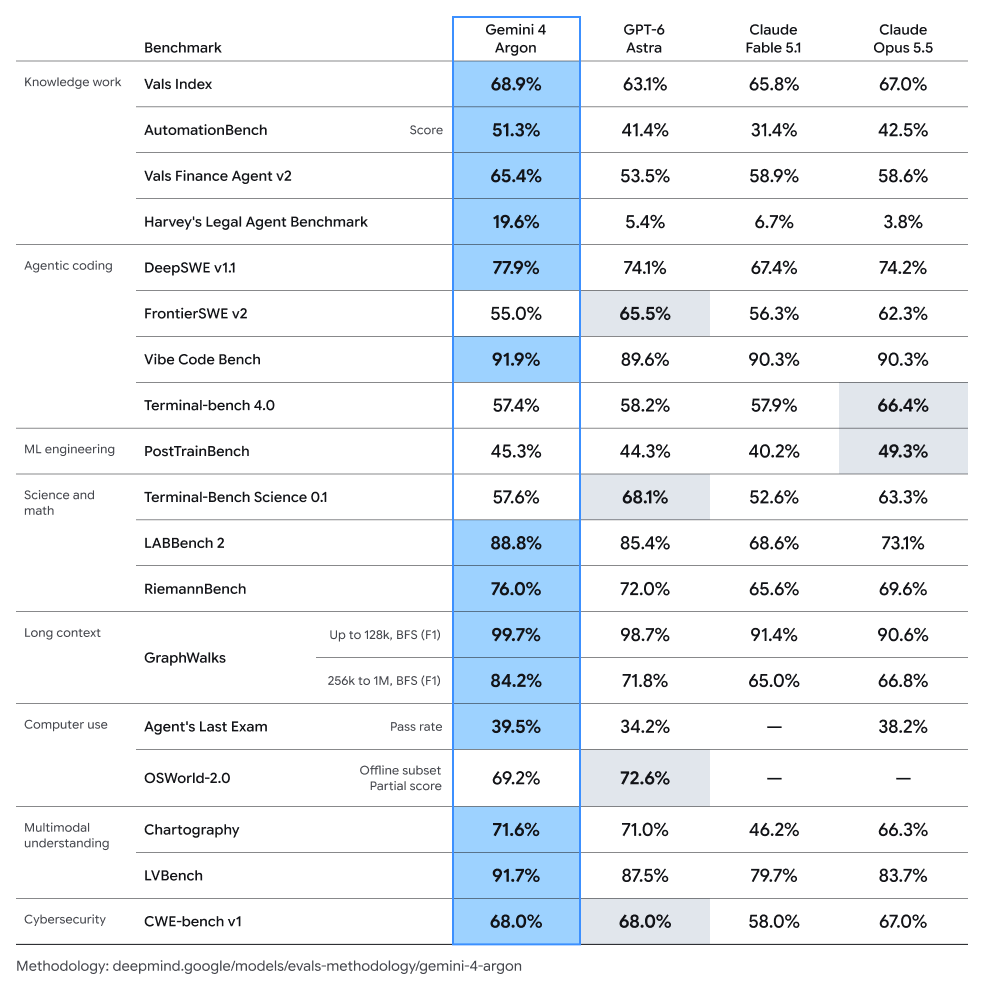
Gemini 4 Argon scores 55.0% on FrontierSWE
The model is close to Fable 5.1 and only outperformed by Opus 5.5 and GPT-6 Astra


Gemini 4 is extremely impressive!
Argon blows Gemini 3.x out of the water on long-horizon coding capabilities. It jumped to 55.0% on FrontierSWE v2 compared to ~20% for 3.7 and 3.8.
Very excited to see GDM focus on these capabilities. Congratulations to the team!


Justus Mattern retweeted

I'm psyched for Proximal's public launch, for them to get the credit they deserve after all this time building in stealth. This is one of the most impressive teams I've ever had the privilege to get to know. I'm lucky enough to have known Calvin since his first company, where I was his YC partner. When I first met Justus and the rest of the team and they taught me in depth about RL environments, all I could think when I left was "holy shit."
This is a true case where even though they're at $200M+ ARR, it's very much still early days. This is a world-class team, fit for a frontier lab, and I think we'll be seeing a lot more from them very soon.
Proximal builds infrastructure that enables AI to improve from real-world experience.
In the past year, we have grown to more than $200M in annualized revenue helping frontier labs and enterprises improve coding agents. Now, we are expanding beyond software engineering.
Recent progress in mathematics demonstrates what happens when models are trained in domains with massive amounts of public data and easy verifiability, making it easy to find weaknesses, generate training tasks, and iterate quickly.
We build infrastructure that enables this feedback loop in other domains: we are excited about a world in which AI systems design targeted drugs, accelerate chip design, and rewrite legacy software that still runs hospitals, power grids, governments, and other critical infrastructure.
Since starting, we have assembled a small team of researchers and engineers and built world-class infrastructure for post-training and synthetic data research to overcome the challenges of scaling manual data curation.
Our team comes from Cursor, Google DeepMind, Meta Superintelligence, Prime Intellect, Citadel, and Jane Street. More than half are former founders.
We’re fortunate to be backed by investors who share that vision, including @generalcatalyst who led our $15M Seed Round at a $300M valuation, as well as @chemistry, @svangel, @dvlamoen and individuals like @LiamFedus, @kevinweil, and @bernhardsson