
Research Economist @bundesbank ‖ PhD @EUI_EU ‖ Macro, Monetary Policy, Macro-Finance ‖ Views are my own
Joined May 2020
- Tweets222
- Following922
- Followers1.4K
- Likes801



Pinned Tweet
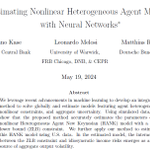
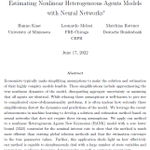
🚨How can we use machine learning techniques to solve and estimate HANK models?🚨
We updated our paper on estimating nonlinear HANK with neural networks.
Now with a first set of example codes for our method! Check out github.com/tseep/estimating-…
@HannoKase and @LeonardoMelosi

Matthias Rottner retweeted

Highly relevant!
"The macroeconomics of stablecoins" by Boris Hofmann, Matthias Kaldorf, and Matthias Rottner.
"What are the macroeonomic implications of stablecoins? As stablecoin market capitalisation has grown rapidly and is projected to expand further, this question has become increasingly important. We develop a quantitative macroeconomic model with stablecoins and show that they affect the economy through two countervailing channels: a bank lending channel and a fiscal space channel. Calibrated to the U.S., the model predicts a modest decline in long-run output, although the net effect depends on reserve regulation, public debt and foreign demand."
bundesbank.de/en/publication…

Matthias Rottner retweeted

New CEPR Discussion Paper - DP21794
Coherent shocks: External identification and internal validation with an application to geopolitical risk
Yves Schüler @bundesbank, Sarah Arndt @ecb, Yevheniia Bondarenko, Vivien Lewis @bundesbank, @MatthiasRottner @BIS_org @bundesbank
ow.ly/JJIh50Zv12G
#CEPR_MEF #EconTwitter

Matthias Rottner retweeted

AI is blurring the lines between demand and supply, complicating economic signals for central banks. How will this debt-fuelled investment surge and uneven productivity gains impact financial stability? Read our new #BISBulletin: bit.ly/3RRpcg7

Matthias Rottner retweeted
New CEPR Discussion Paper - DP21773
The Perils of Narrowing Fiscal Spaces
@HannoKase @ecb, @LeonardoMelosi @EUI_EU @EUI_ECO, @seb_rast @DNB_NL, @MatthiasRottner @BIS_org @bundesbank
ow.ly/l3Wg50ZsbEO
#CEPR_MEF #CEPR_MG #EconTwitter

Matthias Rottner retweeted
The macroeconomic effects of stablecoins operate through bank lending and fiscal space channels. The relative strength of these channels depends on the regulatory framework and other structural economic factors. bit.ly/44CACXN

Matthias Rottner retweeted

New paper: 🚨Equilibrium World Models 🚨(Andreas Schaab/@UCBerkeley ).
@MarlonAzinovic @YuchengYang1993 @NunoGalo @HECLausanneEcon
Link: arxiv.org/abs/2606.23463

Matthias Rottner retweeted
Super interesting!
"The macroeconomics of stablecoins" by Boris Hofmann, Matthias Kaldorf, and Matthias Rottner.
"Our analysis suggests that stablecoin adoption affects the economy through two main channels: a bank lending channel and a fiscal space channel. The bank lending channel operates through banks' deposit funding and credit supply, while the fiscal space channel operates through stablecoin issuers' demand for Treasury bills and the government budget constraint. These channels have opposing effects on output. Calibrated to the United States, the model predicts that, in the long run under our baseline specification, the contractionary effect of the bank lending channel dominates slightly. The net effect, however, depends on stablecoin regulatory design, the strength of foreign demand for stablecoins and fiscal conditions. The model also implies that the fiscal space channel acts more quickly during the transition and that stablecoins can amplify monetary policy transmission through bank lending."
bis.org/publ/work1363.htm

Matthias Rottner retweeted

The impact of geopolitical risk on the euro area economy: Past experience and future prospects
Yevheniia Bondarenko, Nayeon Kang, Vivien Lewis @bundesbank, @MatthiasRottner, Yves Schüler @bundesbank
ow.ly/kOXh50Z5szG

Matthias Rottner retweeted
Central bank framework reviews have gained increasing prominence in recent years. But how do private agents learn new monetary policy strategies, especially amid significant inflationary and deflationary shocks? bit.ly/4tK5GiB

Matthias Rottner retweeted
A new euro area-specific index of geopolitical risk indicates that geopolitical shocks are stagflationary for the euro area. Scenario analysis shows that the euro area economic outlook is highly sensitive to future geopolitical risk developments. bit.ly/4dDktGP

Matthias Rottner retweeted
Super interesting!
"The perils of narrowing fiscal spaces" by Hanno Kase, Leonardo Melosi, Sebastian Rast, and Matthias Rottner.
"When public debt is elevated, the fiscal cost of fighting inflation rises sharply, as interest rate hikes increase government interest expenditures. We formalize this mechanism in a nonlinear New Keynesian model with a state-dependent fiscal constraint on monetary policy. High debt may dampen the monetary response to inflation, generating an inflationary bias even though government debt remains fully fiscally backed. The interaction between high debt and inflationary cost-push shocks makes the fiscal limit more likely to bind, amplifying inflation. In demand-driven downturns, the fiscal constraint may become more restrictive than the zero lower bound, forcing the central bank to either print money to purchase excess debt or accept fiscal dominance."
bis.org/publ/work1328.htm

Matthias Rottner retweeted

New paper out 📉📄 Large public debt can seriously constrain central banks’ ability to fight inflation. Comments welcome! Coauthored with @HannoKase @MatthiasRottner @seb_rast.

Rising government debt makes rate hikes fiscally costly and may intensify pressure on central banks. A new model with an endogenous upper bound on the interest rate coming from debt service constraints shows how an easing bias can fuel persistent inflation bis.org/publ/work1328.htm

Matthias Rottner retweeted
Rising government debt makes rate hikes fiscally costly and may intensify pressure on central banks. A new model with an endogenous upper bound on the interest rate coming from debt service constraints shows how an easing bias can fuel persistent inflation bis.org/publ/work1328.htm
Matthias Rottner retweeted
Using generative economic modelling, a novel method to solve economic models, we examine whether aggregate risk amplifies economic dynamics in a macroeconomic model with heterogeneous agents and financial frictions.
bit.ly/3M3hRXL

Matthias Rottner retweeted
The BIS Multisector Model, a new macroeconomic model featuring a detailed production network and accompanied by a ready-to-use toolbox, analyses economic dynamics and monetary policy reactions in more than 80 economies. bit.ly/48f0UT8

Matthias Rottner retweeted
How does the inflation environment shape the effects of monetary policy? High-frequency data show that, in a high-inflation regime, monetary policy shocks strongly amplify labour income inequality and aggregate consumption bis.org/publ/work1271.htm

Matthias Rottner retweeted

I have a new working paper on solving complex life-cycle models with deep learning.
Paper: drive.google.com/file/d/1txC…
Python toolbox: github.com/NumEconCopenhagen…

Matthias Rottner retweeted
Climate Minsky moments: Why they may matter less than expected
Matthias Kaldorf @matthiaskaldorf @bundesbank, Matthias Rottner @MatthiasRottner @BIS_org
ow.ly/2TEe50UTPYW

Matthias Rottner retweeted
Can artificial intelligence be used to solve and estimate HANK models? A neural-network-based approach to estimate a non-linear HANK model highlights the crucial interaction between aggregate and idiosyncratic risk bis.org/publ/work1241.htm

Excited to see our paper now available as a BIS Working Paper as well!📄✨
If you are interested in our method, we have also released an initial set of example codes—check them out!
github.com/tseep/estimating-…

Can artificial intelligence be used to solve and estimate HANK models? A neural-network-based approach to estimate a non-linear HANK model highlights the crucial interaction between aggregate and idiosyncratic risk bis.org/publ/work1241.htm