

Co-Founder @QuantroSecurity. Host on @noise2signalpod Building AI-Native Cyber Defense Team.
Atlanta
Joined February 2013
- Tweets231
- Following171
- Followers240
- Likes321






Pinned Tweet
"Most people who do pentesting figure out that you are not winning because you are particularly good. You are winning because the world is bad at defending"
In a world full of noise, @haroonmeer is one of those founders who is all signal, no noise. To me, he is a founder's founder. Pitch him your product, and he will give you the most practical, applicable advice without any jargon that you can apply right away. So it's no wonder he is closing out Season 2 of @Noise2SignalPod
Haroon has had an epic journey building @ThinkstCanary with no VC funding, way out there in South Africa, completely bootstrapped to millions of dollars in ARR. He recognizes the game and plays it as he sees it, which is to build the best product he can, ignore everything else (including all the fakery), and along the way hack away at all the challenges business throws at him. I had a great time interviewing Haroon.
Here are some highlights:
- Real vs. fake cybersecurity companies
- SensePost pentesting, South Africa, and business as a series of hacks
- Getting talks accepted to Black Hat and DEF CON
- The RSAC playbook: selling companies, not products
- Buying fake awards and the fake CMO
- Doing conferences right
- AI hype and advice for founders
Go watch it.

Mehul retweeted

This chat with @MehulRevankar was a lot of fun.
You can catch us talking about building cyber security startups, bootstrapping vs raising, and building products that people love.
youtu.be/5wlYXiM0fOk?si=qBl0…
"Machine-speed defense" is such BS.
Said @Jhaddix on the @Noise2SignalPod podcast.
We both argue, if the definition of machine-speed defense is to just create tickets or alerts at machine speed, then that is not machine-speed defense 😁. Also if an organization is AI-first because it gave Co-pilot access to all its employees, then that is not being AI-first either 😅.
we discuss all of that and the future of AI-native defense, and what it means to be truly AI-native.
One of the things I love to do is bring authentic voices on the pod and have an in-depth, long-form interview with them. There is just no way to "AI slop" your way into it. Jason brings that authenticity, with no jargon or BS, and practical advice based on what he is seeing in his engagements and how organizations can defend themselves against AI-native threats. Whether you are 10-yr old or a expert there is something for every one in this episode.
Go Watch it.
noise2signal.io/episode/23/
Here are some highlights :
- AI is middle to middle, not end to end
- The 10-year-old CTF prodigy and the future of junior talent
- AI-pilled builders vs. enterprises still rolling out MFA
- "Machine-speed defense" is BS
- Offense vs. defense, budget cuts and the Vulnpocalypse
- Domain plus AI engineering: the AI-native future
episode link in comments.

1
1
50
I am pleased to welcome Fernando Montenegro to the @Noise2SignalPod .
This is a different type of interview than what I have typically done. Different in the sense that if you are a student of economics and somehow stumbled onto this interview, you will feel right at home.
We talk about Hayek, the study of scarcity, the principal-agent problem, and many other economics subjects, and somehow manage to relate it all to cyber and AI. And if you are into cybersecurity, you will walk away with more knowledge about economics than you had before. There were times during the interview when I wondered if this was an economics podcast 😀, and whether I should interview Lyn Alden next 😅.
Either way, this is a really fun interview. And if that wasn't enough, we also find a way to talk about movies and TV, from Moneyball to The West Wing. And through all of it, still manage to raise the level of debate.
Go listen.
Here are some highlights :
- From AI Winter to AlexNet
- State of the Union on Cyber Offense & Defense
- The Principal-Agent Problem, from Claude to AI Agents
- Theory of Constraints and Attacker Economics
- Moneyball, Buying Outcomes, and What's Next
Full Episode : lnkd.in/dgS2ZVMn

55
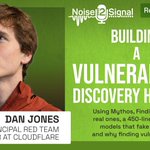
I am pleased to welcome Dan Jones, principal red team engineer @Cloudflare to the @Noise2SignalPod
The entire landscape of finding, validating and exploiting vulnerabilities is changing beneath our very feet, and very few organizations understand how profound that change is.
From writing code (which AI agents are increasingly doing) to deploying it and securing it in production — to put a word on it, it's all getting agentic. Even the attackers are now agentic.
The only way to deal with this onslaught is for defenders to become agentic too and take control of the situation before the attackers do. That's why I invited Dan on the pod to discuss the vulnerability discovery and verification harness he and his team built at Cloudflare to secure their organization. They were one of first organizations to get access to #Mythos.
This isn't something every organization can build for itself, but if you can't I'd recommend investing in tools that do with an AI-native architecture. Products that bolt AI agents onto legacy architecture, give their AI agents silly names and call it agentic simply don't get it. As Nico Popp (who is coming to the pod soon) brilliantly put it recently: they are all dead men walking.
I learnt quite a bit from this interview. At Quantro we built our own harness, but pointed it towards a different use case (vulnerability exploitation).
If your organization is experimenting with building an agentic cyber defense, this is the approach I'd recommend. The entire architecture of cyber defense is changing, and directionally this is the right approach.
Here are some highlights :
- Leveraging Mythos for Vulnerability discovery.
- Why Standalone Agents Fail at Security
- The Two-Stage Architecture (VDH & VVS)
- Initiative success
- The Human Review Bottleneck, and future
Full Episode : noise2signal.io/episode/19/

2
71
I'm pleased to welcome @s_crawford to the @Noise2SignalPod.
Scott has had a fascinating career. He started out running cybersecurity for the Comprehensive Nuclear-Test-Ban Treaty Organization (CTBTO) in Vienna, back when the CISO role wasn't even a defined job. From there he went on to nearly 30 years in the industry, much of it as one of the most respected analysts covering cybersecurity.
So with everything changing around AI, I wanted his take. He doesn't disappoint. He compared AI to Dave Barry's dog syndrome. It's a fun and entertaining episode. Go watch it.
Topics we cover:
→ Security before the CISO role existed
→ Platformization, and why security data lives in puddles, not lakes
→ Confidently incomplete AI, and Dave Barry's dog syndrome
→ Cyber offense in the age of AI
→ Retirement and the future of work
Full Episode : noise2signal.io/episode/18/

1
1
108


I am pleased to welcome @jayjacobs, Chief Data Scientist at empirical security on the @Noise2SignalPod
The title of this episode is a play on the EPSS score, which ranges from 0 to 1. But the episode itself is designed to provide a comprehensive overview of EPSS, from its origins to what comes next. I consider myself fairly plugged in to the vulnerability management ecosystem, yet I still came out learning a lot more about EPSS. It has been a seven-year overnight success ;)
We use EPSS here at @QuantroSecurity as well, as do hundreds of other organizations driving the vulnerability management programs for thousands of enterprises. If you've ever wondered what goes on behind the scenes in making the score, this episode is for you.
Here are some highlights :
- Origin story of EPSS
- Why only 2-5% of vulns matter?
- Score transition to First organization
- EPSSv5
- Future in AI-Driven exploitation
- The EPSS score threshold to prioritize on.
Full Episode : noise2signal.io/episode/17/

27
It's my pleasure to welcome my friend @ashimmy , CEO @TechstrongGroup to the Noise2Signal podcast.
While I was doing the interview, I realized I had stumbled onto a glitch in the matrix. Alan has interviewed thousands of entrepreneurs and founders over his career, but I've yet to see an in-depth interview of him, when he's the one who has all the insights and opinions. Over 30+ years in the industry, he's been part of and played a role in every wave: early web hosting, blogging, cyber, @devopsdotcom and now AI.
AI is the new shiny object on the hill, but by the end I realized that the more we think things have changed, underneath its more of the same, all the ups and downs, the bubbles and the eventual busts. That's where pattern recognition and 30 years of it become the killer advantage.
Towards the end he said something which is cliche and yet profound at the same time. if you do what you love, you never work a day in your life. I feel that way building @QuantroSecurity
It's a fascinating interview. Go watch it.
@bfeld and @RealGeneKim get a special mention in this episode.

Mehul retweeted
hard to overstate the demand for cyber defense solutions at various nation state/large enterprises.
from Mythos/Fable/OAI-HF, these past few months have really energized this idea we need a totally different set of solutions.
I am pleased to welcome @ayampolskiy to the @Noise2SignalPod
In an alternate world, Aleks would've been a Bitcoin maxi and a BTC billionaire, but he chose a higher purpose and built SecurityScorecard instead 😅
I've always been fascinated by how a startup can scan the entire internet every day, something the traditional players never pulled off at scale. Turns out all it takes is a dose of blind optimism and an insatiable drive to get it done. I also wanted to understand the narrative around why security ratings companies get called the "mafia", and Aleks does a great job explaining when they're right and when they're wrong.
Here are few highlights :
- Origin Story of Security Scorecard
- How he almost became a BTC billionaire.
- Landing customer #1
- Running and scaling internet wide scans
- Future of security ratings with AI
Full Episode : noise2signal.io/episode/15/

52
I am pleased to welcome @alexcpsec to @Noise2SignalPod .
Every year, the @Verizon Data Breach Investigations Report (DBIR) comes out (19 years and counting), and every year, I wait patiently to read it. The thing that strikes me the most about the DBIR report is that it takes a dry, dreadful topic such as data breaches and transforms it into fun, entertaining enjoyable read. Every single time.
So I wanted to get behind the scenes, and talk to the authors on how they create the report.
I asked Alex Pinto, one of the primary authors, to come on the pod to discuss the report. I’ve always had so many questions about the DBIR. I wanted to know: Who actually writes those jokes 😉 ? What do the authors really think about long-term trends?
This interview tries to answer all of that and more.
Here are few highlights:
- An in-depth, behind-the-scenes look at how the report is made
- Who writes the jokes in the DBIR?
- Why ransomware is the "yoga pants" of cybersecurity
- Top trends of 2026
- Why vulnerability exploitation became the #1 vector for compromise
- What launch day is actually like for the DBIR team
Full Episode : noise2signal.io/episode/14/
Looking forward to contributing Quantro Security AI CVE exploitability data to DBIR next year.
#DBIR

Mehul retweeted

Preview : Inside the @Verizon DBIR with @alexcpsec
Tune in on Aug 11th, 10 AM ET.
Mehul retweeted

The bottleneck for AI progress was never compute, it was always the verifier. Recursive self-improvement is limited by verification, not computation. Compute buys proposals - verifiers buy knowledge. My second post on the recent OpenAI math results
medium.com/@vishalmisra/the-…

Mehul retweeted
Whenever @halvarflake speaks in public, the biggest mistake you can make is not to listen. Thanks to Halvar and Mehul for sharing these insightful thoughts.

I am excited to welcome Thomas Dullien (@halvarflake ) on the @Noise2SignalPod podcast!
This episode's title was inspired by Thomas Ptacek’s excellent write-up, "Vulnerability Research is Cooked," which is equal parts inspiring and depressing. Inspiring because finding vulnerabilities in codebases has become so accessible; depressing because we risk losing a generation of experts skilled in the fine art of reverse engineering, which, as Thomas notes, is fundamentally an exercise in endurance.
Fortunately, Thomas Dullien brings a much more uplifting perspective on the future of cyber offense and defense with AI. His take: a human equipped with a tool will continue to outperform the tool alone for the foreseeable future.
Having spent the early part of my career in vulnerability research before founding @QuantroSecurity, I’ve long looked up to pioneers like Halvar and HD Moore (from Season 1). It was fascinating to dive into how they came up through the cracking and hacking scene of late 90's and early 2000's.
A few episode highlights:
- How Thomas Dullien became Halvar Flake.
- The 90s cracking and hacking scenes.
- The origins of BinDiff (and the crazy stories of shadowy figures trying to buy it)
- Google’s acquisition of BinDiff and the comedy of errors that followed.
- Founding Optimyze
- How AI will reshape the future of cyber offense and defense
Listen to the full episode here noise2signal.io/episode/13/
Thomas joins @OpenAI next week to "better cyber". Wish him luck. 🙌 🙏
New Season Premiere. Vulnerability Research is Not Cooked with @halvarflake on @Noise2SignalPod

Excited to welcome @halvarflake on @Noise2SignalPod.
The interview drops tomorrow.
noise2signal.io/#upcoming

Mehul retweeted

An in-depth behind the scenes look into latest research from Vulnerability Research Labs (VRL) around the economics of vulnerability exploitation with AI.
We discuss the key findings, why we did this research, and how the research was done.
youtu.be/qK5j9vZBphA

