

Memetic Money Theory (MMT): A cybernetic framework for modeling monetary network dynamics.
Joined February 2021
- Tweets4K
- Following1.9K
- Followers1.8K
- Likes9.8K


Pinned Tweet
Money is the medium, not the message.
Most people spend their lives attempting to master it. Few stop to ask what it's for.
A short film on why Memetic Money Theory exists.
Full essay on Substack ↓
£22bn fund goes on-chain.
£22bn is the whole fund run by UK insurer Aviva. £50m is what Aviva put into its new tokenised share class.
The big number travels. The small one is the news 🫠
source: avivainvestors.com/en-gb/abo…
An AI company may change its plans, but its bills may not change with them. Even after an exit, they may still owe payments tied to building value or reserved power.
The Price of the Exit. Details in this week's article: memeticmoney.substack.com/p/…

A company can look more indebted without borrowing another dollar. The Fed’s new accounts move many existing private-credit loans from miscellaneous liabilities into measured corporate debt. The obligation predates the label.
federalreserve.gov/econres/n…

Mastercard is launching a service that checks stablecoin payments for fraud and sanctions risks before funds move on-chain.
Banks can change how money travels without giving up the decision about which payments to approve.
mastercard.com/global/en/new…
A lender cut a fund’s borrowing cost and extended its maturity, then cut what software loans count for as collateral.
That’s how credit tightens before anything breaks.
A deeper dive in this week's Memetic Money Weekly:
memeticmoney.substack.com/p/…

The Fed's Waller says more hikes may come without happening at every meeting. Lenders price expected future rates into new loans today, so borrowing costs can rise before the next vote.
A pause on the Fed's calendar doesn't mean relief on yours.
A new mortgage-lender survey from the MBA found lower rates but higher upfront fees on some adjustable mortgages. The fee-adjusted rate rose.
Don't be fooled. A friendlier interest rate can still ask for a bigger check at the door. 🫠
Memetic Money retweeted

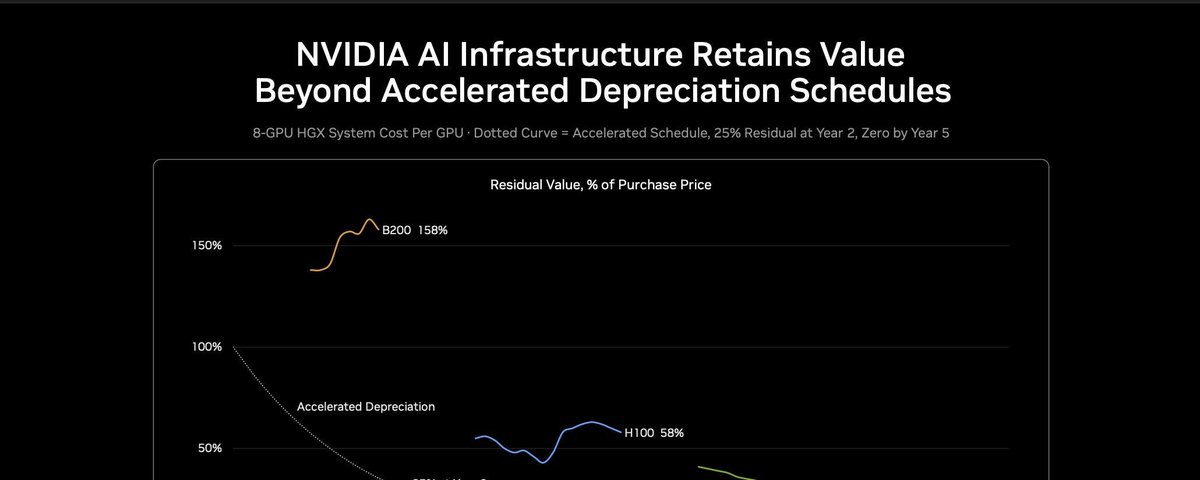
"Don't believe your lyin' eyes." Nvidia just told the market its GPUs don't depreciate fast. @michaeljburry sees the 1968 rhyme.
The pitch: B200s trade at 158% of MSRP a year after launch. H100 rental rates are up 22% in a month. A100s are still earning 9 years later. So why not borrow against them?
That's exactly what Nvidia is doing. A $500 billion financing plan with Blackstone, Apollo, and KKR to lend against chip collateral.
But banks underwrite GPUs over 3-4 years. Nvidia claims 10. Nvidia's residual guarantee? No more than 25%. Banks eat the rest.
Michael Burry says hyperscalers are understating depreciation by $176 billion between 2026 and 2028. Jim Chanos asked Huang the obvious question: "Then why not rent them out yourself? Or simply keep raising prices?"
The 1968 parallel: Billy the Kid bought computer leasing stocks with 3% cash, banked the convertibles, bought more. "The need for computers is practically infinite." The Great Winfield called it a kids' market. It was - until it wasn't.
Morningstar flagged the structural echo: "Vendor financing and circular deals... played a role during the dot-com boom and bust."
The depreciation debate isn't accounting trivia. It's the collateral question. And $500 billion is riding on the answer. $NVDA $SOXX #AIBubble

An idea is a message with no carrier. A dollar is a carrier with no message. Both are cheap to produce.
Execution is where they meet, and it's the one thing you can't print and can't pitch.
Memetic Money retweeted

🚨Sunday Article:
From Gold to Data: The Changing Architecture of Economic Value
(Full Article: w3-starter.com/from-gold-to-…)
Looking Toward 2030
Using the adoption curve as a framework rather than a fixed timetable, I have been watching the period approaching 2030 as a probable transition point between experimentation and broader implementation.
My expectation is not that cryptocurrency suddenly replaces fiat currency or that blockchain becomes the foundation of every economic transaction. Both predictions require considerably more enthusiasm than systems analysis. I expect a gradual migration of specific economic functions as cryptographic infrastructure becomes integrated into systems that already exist.
The experimentation that began around 2009 has already moved through several cycles of speculation, failure, consolidation, institutional participation, regulatory response, and infrastructure development. The more relevant question for the remainder of this decade is which components survive long enough to become sufficiently ordinary that we stop identifying them primarily as blockchain applications.
By 2030, I expect the distinction between a "digital asset" and a conventional asset to become increasingly less useful as traditional securities, contracts, credentials, ownership records, intellectual property, physical assets, and other forms of economic state acquire cryptographically verifiable components. The underlying asset does not need to become cryptocurrency for its ownership, provenance, authorization, or transfer to become cryptographically represented.
I also expect interchain architecture to become more important than individual chains. A fragmented collection of networks cannot constitute an interoperable economic system simply because each network independently functions. Broader adoption requires assets and their associated state to move between heterogeneous systems without repeatedly surrendering verification to another centralized intermediary.
The transition approaching 2030 may therefore be less visible than the speculative cycles that preceded it because infrastructure adoption is generally measured through integration rather than public enthusiasm. The meaningful indicators will be integration into existing financial and commercial systems, interoperability standards, institutional settlement, tokenization of conventional assets, regulatory treatment, digital identity and provenance systems, and the ability to move verifiable economic state between networks.
From there, the longer six-year period I originally considered becomes more useful as a review horizon rather than a deterministic cycle. If 2030 represents an implementation threshold within this model, approximately 2036 provides a reasonable point from which to examine whether these systems achieved broader infrastructural adoption or remained specialized technologies operating alongside conventional markets.
Within my adoption model, 2030 therefore represents an implementation threshold rather than a predicted date of monetary replacement. The more significant transition would occur when adoption becomes less dependent upon people deliberately choosing "crypto" and more dependent upon conventional systems incorporating cryptographic verification beneath services they already use.
The Architecture of Value
Seen from this perspective, 2030 is not an endpoint but a useful marker for determining whether the current technological cycle has begun migrating from experimentation into economic infrastructure.
The progression from 1913 to the present is not a neat succession of monetary systems. New mechanisms have historically operated alongside existing ones, absorbing particular functions until enough economic activity migrated for the underlying architecture to become materially different.
Gold provided physical scarcity and convertibility. Bretton Woods institutionalized a monetary relationship between gold, the dollar, and participating currencies. The post-Bretton Woods dollar system expanded around sovereign credibility, global commerce, financial markets, debt instruments, institutional settlement, and international demand for dollars. Information technology digitized increasing portions of those systems, while distributed cryptographic systems introduced additional mechanisms for independently verifying economic information.
Economic transitions rarely produce complete replacement. Gold, cash, banks, institutional ledgers, conventional databases, and newer distributed systems can coexist because different functions migrate at different rates according to cost, efficiency, regulation, security, liquidity, and practical usefulness.
Interoperability may determine whether cryptographically verifiable systems remain isolated technological implementations or become part of broader economic infrastructure. Framing the transition simply as gold → dollar → crypto implies a sequence of replacements that economic history does not support particularly well. A more useful progression examines how verification itself has changed through physical mechanisms, institutional mechanisms, digital records, and increasingly cryptographic methods operating alongside one another.
The adoption curve cannot identify exactly when that transition occurs, and market capitalization alone tells us relatively little about infrastructural maturity. Economic systems shift when new mechanisms become sufficiently useful, reliable, interoperable, secure, and economically viable that functions begin migrating from the previous architecture into the new one.
Viewed across the longer economic cycle, the history of money becomes more than a history of what societies have chosen to use as currency. It is also a history of how economic value is represented, how ownership is recorded, how transactions are verified, where trust is placed, and how those mechanisms change as the infrastructure supporting them evolves. "

