

Economist & engineer; Asst Dir & Policy Fellow, State & Local Gov Init @HooverInst; Prev: JEC, Mercatus, OSU; Views expressed are mine & you can't have them.
Stanford University
Joined May 2012
- Tweets9.9K
- Following582
- Followers1.2K
- Likes19.8K




Pinned Tweet
File this under "Yet more evidence that firm location decisions are based on region-specific advantages, not economic development subsidies"
wral.com/why-geography-doome…

Michael D. Farren retweeted

Does California need more revenue? Hoover Senior Fellow @JoshRauh argues it doesn't. Debating UC Berkeley economist Gabriel Zucman on California's proposed billionaire tax, he notes general fund spending is up 79 percent in seven years and says the state's problem is the efficiency of its spending.
Watch on YouTube: youtube.com/shorts/DA9cnSz7p…

Michael D. Farren retweeted
California's proposed billionaire tax is premised on a state budget crisis. Hoover Senior Fellow @JoshRauh pushed back on that claim in his CNBC debate with UC Berkeley economist Gabriel Zucman, noting $75 billion more on the state's balance sheet than in 2019 and arguing that last year's reconciliation bill slows the growth of federal Medi-Cal funding rather than cutting it.
Watch on YouTube: youtube.com/shorts/NFPeLtzSj…

Michael D. Farren retweeted

New blog from me on a paper from JCT economists, which finds that the top of the Laffer curve may be much lower than suggested by previous estimates
taxfoundation.org/blog/laffe…

Michael D. Farren retweeted

I've been pointing out since the early 2010s that Thomas Piketty, Emmanuel Saez, and Gabriel Zucman have a bad habit of biasing their data construction to fit their politics.
Whenever they make a suspect call in how to handle stats, it ends up showing that inequality is on the rise. They almost never go in the other direction. The errors are non-random and almost invariably reinforce their political claims about rising income and wealth concentration since 1980.
Piketty did this throughout his book Capital in the 21st Century.
Piketty and Saez did this throughout their famous 2003 paper on inequality in the US.
Piketty, Saez, and Zucman Saez and Zucman did this in their Distributional National Accounts paper that Auten and Splinter dissected.
Saez and Zucman did this in their 2019 book on tax incidence and inequality.
Saez and Zucman did this in their flurry of "studies" and white papers to support Elizabeth Warren's wealth tax proposal, California Prop 40, a new wealth tax in France, and dozens of other similar examples.
A new AI report (linked below) audited 138 papers by Saez and Zucman. It found thousands of errors, 194 of which were serious. A whopping 97% of the serious errors went in the same direction: they showed inequality rising faster or made it higher.
But there's a bigger scandal at play here. Despite these clear biases, Piketty, Saez, and Zucman have enjoyed a stream of praise and prestige within the economics profession. They get expedited and friendly reviews in top econ journals even though a more serious peer review should have caught many of these errors (the Quarterly Journal of Economics is a recurring offender in this regard). Journals regularly give them a pass after the errors in their old work come to light - they're never expected to correct any of it, and just keep on using it as if nothing changed. Their non-peer reviewed data claims are also treated as gospel by major media outlets such as the New York Times and the Washington Post. And they get showered with prizes - Saez and Zucman are both Clark Medal winners from the AEA, and Zucman got his prize in 2023 after evidence of major data shenanigans in his work came to light in 2019.
Until now, those of us who have been trying to correct the record have had to wade through the PSZ trio's cluttered, disorganized, and often non-transparent replication packages (almost all of which are convoluted piles of Excel spreadsheets) to find the problems. I did a line-by-line replication of Piketty and Saez's entire 2003 US income inequality series to use one example, and found it was riddled with errors - almost every single one of which biased their results in favor of their political story.
We had the means to catch this stuff as it was happening, but the economics profession failed to do its job. And it failed precisely because its elite ranks wanted to believe the Piketty-Saez-Zucman story for political reasons.
Michael D. Farren retweeted

Tyler Cowen:
'I am not even sure what to say at this point. We need a radical revaluation of this work, and of the associated policy arguments. More generally, this is only a single step in the story of how AI is going to revise economic science, and indeed past research more generally. As I stress in many of my recent talks, there will be significant gains and losses in status, with the losses often outweighing the gains. I see this as one of those cases.'


Errors in the research of Emmanuel Saez and Gabriel Zucman marginalrevolution.com/margi…

Michael D. Farren retweeted

Writeup on the Sqawk Box debate: Empty threats, false claims that billionaires don’t pay taxes, and imaginary wealth tax revenue, all a couple hours before the AI audit controversy.
fiscalrealitycheck.substack.…
🤖 Made with AI

Michael D. Farren retweeted

Full Letter: Economists Against The California Wealth Tax (Prop. 40)
We, the undersigned economists, write to express our opposition to Proposition 40, a proposal on the November 3 ballot to impose a 5% wealth tax in California on covered wealth of billionaires.
We believe that a wealth tax would introduce significant economic costs, administrative challenges, legal uncertainty, and unintended consequences that could undermine California's long-term economic prosperity.
A wealth tax risks discouraging investment, entrepreneurship, and economic growth. By taxing accumulated wealth rather than realized income or consumption, such a tax could reduce future incentives to save, invest, and build businesses. The potential economic costs and revenue uncertainty associated with a wealth tax warrant particular caution. The ultimate fiscal benefits and costs of the wealth tax would depend on behavioral responses that are difficult to predict, including changes in investment, residency, and tax planning. California already has the highest state income tax rate in the nation making behavioral responses to further taxation particularly acute. There is already evidence that a considerable number have already left California to avoid any possibility of paying a potential Prop 40 wealth tax.
There is no guarantee or commitment device that can ensure that a wealth tax can only be imposed once. There is always a risk that another wealth tax could be imposed again. Such reputational harm could further drive capital and taxpayers out of California.
From an administrative perspective, wealth taxes present substantial valuation and compliance challenges. Accurately valuing privately held businesses, intellectual property, and other illiquid assets on a recurring basis is inherently difficult. These challenges could impose significant costs on taxpayers and tax administrators, while increasing uncertainty and disputes. These effects may be particularly consequential for entrepreneurs and business owners whose wealth is tied up in illiquid assets. Dealing with such illiquid assets and how a tax would be paid on them poses a further challenge to such a tax.
From a legal perspective, there are several legal questions about the retroactive nature of the tax, interstate taxation, and constitutional restrictions on taxing intangible property.
California operates within a highly integrated national economy in which individuals, businesses, and investment capital can relocate across state lines. A state-level wealth tax could create incentives for high-net-worth individuals and entrepreneurs to relocate or shift future investment elsewhere, potentially weakening the state's long-term tax base. California's economic success, from Hollywood to Silicon Valley, has historically depended in substantial part on its ability to attract talent, capital, innovation, and entrepreneurial activity. Tax policy should seek to preserve these advantages while providing stable public revenues.
For these reasons, we urge California voters to reject Proposition 40. We instead recommend approaches to taxation that minimize economic distortions, promote investment and growth, and provide a more predictable and administratively workable revenue base.
List of signatories: antiwealthtax.com/
Michael D. Farren retweeted
Ahead of Tuesday's vote, I put together a group of economists including Nobel Laureates, fmr senior govt officials & academic economists who oppose the California wealth tax and signed this letter: "Economists Against The California Wealth Tax (Prop. 40)" antiwealthtax.com/

Michael D. Farren retweeted
As I keep pointing out, the AI audit confirmed similar issues to what several of us have been saying for over a decade.
I'd respond to @gabriel_zucman on his thread about this directly. But he blocked me in 2019 after I pointed out that his tax rate stats in the NYT were different than his 2018 published paper.
nitter.gq/PhilWMagness/status/21…

Michael D. Farren retweeted

The AI response may well be imperfect, but it does raise a legitimate concern: your choice of which criticisms to engage with seems to consistently lean in one direction. Which is the criticism I made for years in many peer-reviewed papers.
Rather than focusing on the AI response, appeals to authority, or rhetorical flourishes, I would welcome a substantive engagement with the arguments that Phil Magness (@PhilWMagness) and I have developed across multiple papers, which have so far gone largely unanswered.
The same applies to the work of Auten and Splinter, Josh Rauh, and Sylvain Catherine.
I think there is a basic principle of scholarly debate at stake here. It is difficult to invoke the importance of serious academic criticism while declining to engage with substantive objections from researchers who have devoted considerable effort to examining your work. This is particularly true when those objections are sometimes characterized in ways that do not accurately reflect the arguments being made.
We are serious scholars raising serious questions. Surely, it is reasonable to expect that these arguments receive the same consideration as criticisms you have chosen to address.
I am not asking for much—simply a fair and substantive engagement with our actual arguments. Ignore how mean Tyler was to you. That is not important to scholarship debates!

Hello @elonmusk and @tylercowen ,
You have just decided to publicly attack our research, six days before the vote on the California billionaire wealth tax.
Your attempt to discredit our work and that of our numerous academic colleagues is pathetic.
Let’s take a look. 🧵

Michael D. Farren retweeted

Whatever the quality of the AI audit, I'm not sure "doing it risks discrediting a political cause I champion" is the best response if you want to be treated as a disinterested empirical scientist.
Hello @elonmusk and @tylercowen ,
You have just decided to publicly attack our research, six days before the vote on the California billionaire wealth tax.
Your attempt to discredit our work and that of our numerous academic colleagues is pathetic.
Let’s take a look. 🧵
Michael D. Farren retweeted

My basic read of Piketty-Saez-Zucman is that the empirical estimates of tax incidence and revenue are largely beside the point. They think large fortunes are bad, and view destroying those fortunes as a positive good even if doing so lowers tax collections and GDP.
Michael D. Farren retweeted

Meet the four academics who dreamed up California’s billionaire tax on the ballot Tuesday as Prop. 40 on.wsj.com/4eV9qcf

Michael D. Farren retweeted
As public university employees, taxpayers pay all of their salaries, compelled to do so whether they support the political advocacy or not. Thanks to the reporter for asking me to respond to their name-calling.

Michael D. Farren retweeted
Golden State or Golden Exit? Golden State or Golden Exit? I debate the California wealth tax with @gabriel_zucman on @SquawkCNBC
cnb.cx/4zah0YN

Michael D. Farren retweeted

Errors in the research of Emmanuel Saez and Gabriel Zucman marginalrevolution.com/margi…
Michael D. Farren retweeted

Error-prone French socialists shouldn’t decide American policy, especially when the errors are very far from random. For that matter they shouldn’t decide French policy, but that is their problem.
marginalrevolution.com/margi…

Michael D. Farren retweeted
My @HooverInst colleague @joshrauh brilliantly debates @gabriel_zucman on the California Prop 40 wealth tax with @andrewrsorkin @JoeSquawk @BeckyQuick “Golden State or Golden Exit? Experts debate the California wealth tax” via @CNBC
cnbc.com/video/2026/10/28/go…

Michael D. Farren retweeted
I have been pointing out this exact problem with Zucman and Saez's work for the past decade, as has @VincentGeloso

Michael D. Farren retweeted

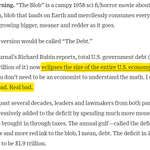
Zucman called this @HooverInst study by Jaros and @joshrauh on California’s billionaire tax “spectacularly misleading.” But his arguments here are wrong on (at least) three counts🧵
This Hoover Institution study, which has fueled the deluge of ads (more than $200 million spent by billionaires so far) to defeat the California billionaire tax, is spectacularly misleading.
Let me explain its crucial flaw. 🧵
Readers added context they thought people might want to know
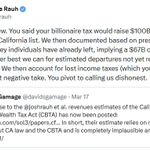
Zucman argues that the tax will raise his projected revenue because billionaires who leave CA after 1/1/26 will be taxed anyway.
At least $542B of net worth (Page, Brin, Thiel) departed the state by 12/31/25.
The entire thread is a misleading denial of this fact.
ft.com/content/d66976…
nytimes.com/2026/04/27/us/…
forbes.com/sites/forbeswe…