

Assoc Prof Materials Eng @KU_Leuven | ERC grantee | Formerly Engineer @Apple, Postdoc @Stanford, PhD @EPFL. Printed/flexible/stretchable electronic materials.
Leuven, Belgium
Joined April 2019
- Tweets294
- Following358
- Followers517
- Likes197




F. Molina-Lopez retweeted

Paying peer reviewers = 85% faster editorial decisions.
And payments gave high-quality reviews.
(the story is described in Nature)
At Biology Open, peer reviewers were paid for high quality reviews.
$290 per peer review.
Miraculously, the time to editorial decisions DROPPED:
- Unpaid reviews: 38 days.
- Paid reviews: 5-6 days.
And review quality WENT UP.
📍How it works:
“When researchers apply to become paid reviewers for Biology Open, we screen their CVs and check whether they’re legitimate and have peer-review experience. We currently have 500 pre-contracted reviewers from all over the world. Ideally, what I envision is a system where reviewer applicants undertake a manuscript-reviewing test. And we’d review that review, so if it scored high enough, we’d hire them.” - Editor-in-chief Daniel Gorelick.
Nature: “Do you think paying reviewers could work in other journals and in other disciplines?”
Editor-in-chief: “Absolutely. There’s been such a profound aversion to paying peer reviewers, whether it’s on principle or because people think it will never work. We’ve demonstrated that it works.”
So...
At last, there’s light at the end of the tunnel.
__

F. Molina-Lopez retweeted

📢📢Interested in transition metal complexes' photophysics? PhD opening at @LudoTroian 's lab (UCL, Louvain-la-Neuve) and at my lab (KU Leuven). Please RT

F. Molina-Lopez retweeted

Very pleased to present a talk titled ‘Photometric, Photovoltaic and Photoluminescent Approaches in Energy-Autonomous Sensing Systems’ at a symposium session on ‘Flexible Energy-Autonomous Systems’ at the MRS Meeting this morning here in Boston. I spoke about some unpublished, systems level examples of power management in wireless devices for optical sensing, in three different specific scenarios – highlighting practical implementations of some general considerations that apply to all related technologies that aim for energy-autonomy. Very much appreciate the collaboration with Prof. Kyeongha Kwon @KwonKyeongha (Korea Advanced Institute of Science and Technology @kaistpr , former postdoc) for developing the adaptive electronics component of these systems, and to Dr. Chanho Park (postdoc) for leading the effort. Thanks to the organizers Derya Baran @DeryaBaranB (KAUST), Francisco Molina-Lopez (KU Leuven @leuvenresearch), Luisa Petti @LuisaPetti (Free University of Bozen-Bolzano) and Ana Claudia Arias @ana_arias (@UCBerkeley) for inviting me and thanks to the audience for showing up at an early morning talk on a Thursday, toward the end of the meeting.


F. Molina-Lopez retweeted

Safe the date: July 7-10, 2025: #ICOE2025 in beautiful, beautiful Portugal. It can not be missed! It is one of the prime venues for the broader organic and inorganic/organic hybrid electronics research! Spread the word!


F. Molina-Lopez retweeted

We have two new #Vacancies at Materials Engineering! Will you be our new research professor?
-BOFZAP Sustainable High Temperature Metallurgical Processing
-BOFZAP Electrochemical Processing and Characterization for Materials in the Energy Transition
Contact us for more info✉️
F. Molina-Lopez retweeted

Lets welcome @MolinaLopezLab from @KU_Leuven, our @IIfetc awards co-chair! @IEEEEDS & @IEEEorg RFID council!

F. Molina-Lopez retweeted

Towards the future with wearable electronics that do more than just fit—they belong. Developing a skin companion that bends, flexes, and adjusts—skin-conformal nanocomposites with tunable mechanical, electrical, and thermal properties @MolinaLopezLab @mtm_kuleuven @KU_Leuven

F. Molina-Lopez retweeted

Our PhD candidate, Sonia Gómez-Gijón, is doing a research stay at @KU_Leuven with Prof. @MolinaLopezLab to characterize thermoelectric materials
#thermoelectrics #science @UGRinvestiga


F. Molina-Lopez retweeted

My group @PurdueChemistry likes to have a synthetic chemist with an open mind to work on semiconducting polymers as a postdoc fellow. Please email me directly with a research summary on your synthetic expertise. Check jianguomei.com for our group. Please help spread!


F. Molina-Lopez retweeted
Rejection of your paper or grant has NO relevance to the opinion of #research community. It is nothing but the opinion of one person.
Several examples:
1. The first paper on graphene was rejected from Nature because “it did not constitute a sufficient scientific advance”. Later, it was awarded a Nobel prize.
2. The first manuscript showing the microbiome-brain connection was published after 7 submissions that took 3 years. Today, this field has exploded. I expect it will get a Nobel prize in the future.
3. Theodore Maiman tried to publish a paper describing the first operating laser in Physical Review Letters and… got a rejection!
4. Peter Ratcliffe, who worked on cells’ response to changes in oxygen levels, got his key paper rejected from Nature (see photo). Later, he was awarded a Nobel Prize for this work.
And there are many other examples…
.
And yet I see so many young scientists stressing about rejections. For some reason, they seem to genuinely expect that the editors should know which study is truly worth it.
As a result, many rejections are met with surprise and disbelief:
“How could they reject it? They publish so much trash, and yet they think our detailed 3-year-long study is not interesting to the community! WHY?”
.
Well, the reality is:
- Most editors have very little time to delve into your study. They can easily FAIL to recognize the potential impact of your study. Proper communication in the cover letter and clear writing style can help (although only to a limited degree).
- Many reviewers have little idea about the science in your paper. But they can have a big ego. So, if they have a bad day or were rejected recently, it’s easy for them to find 1000 technical reasons to reject your paper as well.
- Most scientists genuinely don’t know if your discovery can make any impact. If we could predict the course of science, we would be living very differently!
My message is simple:
Forget about objectivity. Academia is a very subjective world. Fight for objectivity but don’t take it for granted.
A great study will be found, cited and recognized. Disregard of where it’s published.
A bad study requires a high-impact journal to be found and cited. But the long-time recognition might be a problem.
High-IF journals are simply billboards. Their rejections do NOT represent the opinion of a scientific community.
You can get rejected but don’t reject yourself!
Believe in your results.
#AcademicTwitter #AcademicChatter

F. Molina-Lopez retweeted
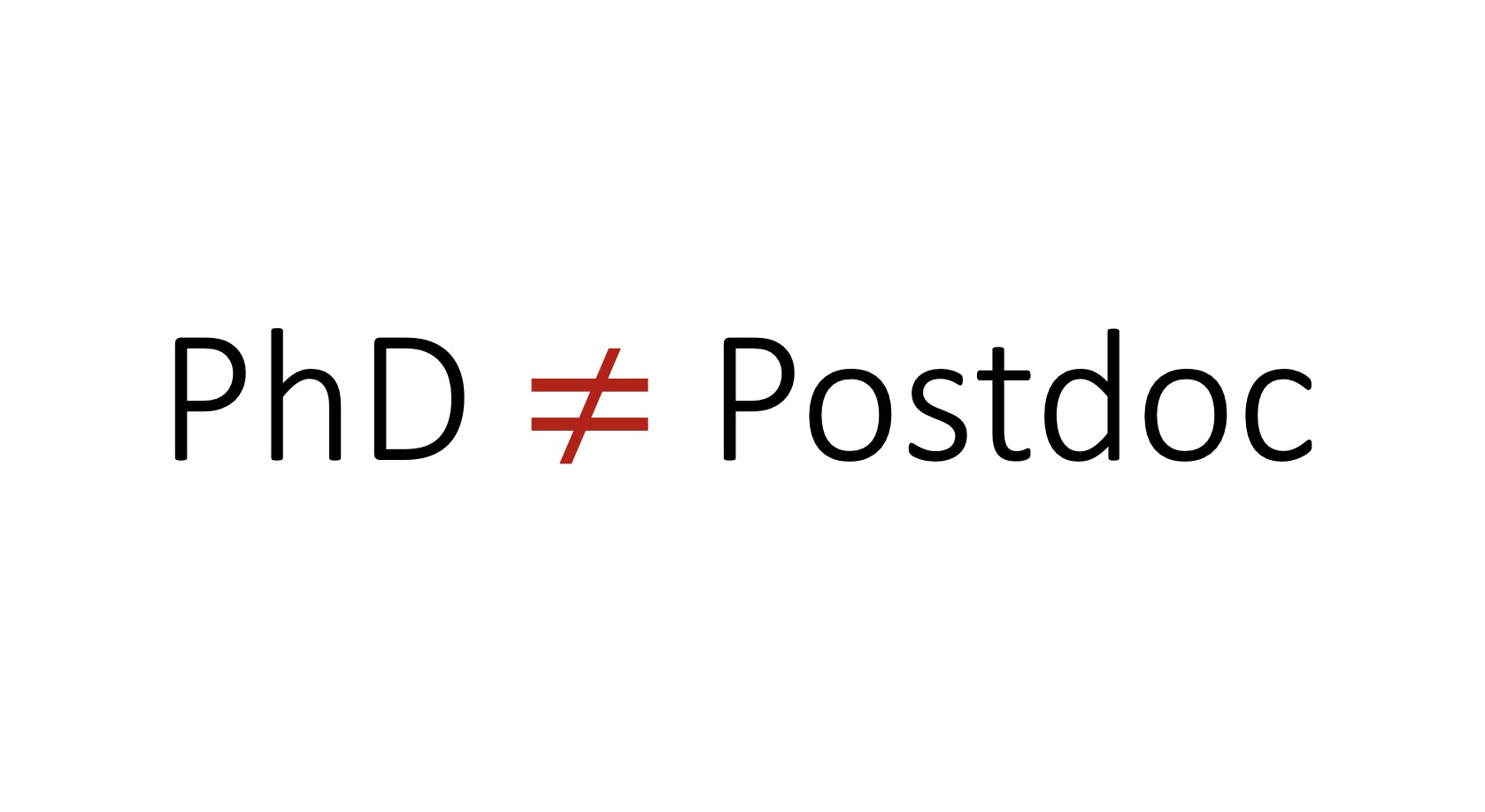
Postdoc is conceptually different from a #PhD position. Below are some key points to keep in mind before starting postdoc.
1️⃣ The harsh reality of being a postdoc:
1. Postdoc is a contractual (not educational) position. Your postdoc duties are defined by your contract & agreement with your advisor.
2. Usually, a contract is given for 1 year and renewed annually. It does NOT offer the same job security that PhD students enjoy. Be prepared to start searching for a new position in 1st year and leave anytime.
3. Postdoc is inherently a position for academia (with a few exceptions like in bio). Often, companies will assume that you’ve chosen an academic track, not industry. They’d rather hire a fresh PhD graduate from the same field than a postdoc. So, your job search outside academia may become challenging, especially if you do fundamental research.
4. If you want to be a faculty, your postdoc may require a lot more efforts than you originally expected, making it the most intense time of your life. Be prepared.
_________
2️⃣ If you take postdoc because you want to be more competitive for senior academic positions, keep in mind that:
0. Choosing the right lab & advisor is statistically MORE important than simply working hard and publishing papers during postdoc (esp. in the U.S.). However, working with an advisor who can write an excellent recommendation letter does NOT mean that you will also get prepared for a faculty life and become a great scientist. Your advisor should be a good mentor for this.
1. As the competition for faculty positions can easily reach over 1/300 and you have ~1 year before applying for positions, postdoc time often turns into a “race”. The worst part is that hard work does NOT necessarily lead to success.
2. Postdoc is NOT a must for being a faculty. Some students secure professor positions at the end of their PhDs (esp. at the top universities in the U.S.).
3. Postdoc lasts 1-3 years. If you’re a first-year postdoc and apply for faculty positions, committees will be OK with you showing your PhD work during interview. But starting from your 2nd year, they expect you to show successful postdoc results.
4. Some committees expect that a 3-year postdoc should complete as much work as a 5-year PhD student. It’s like a fast-track PhD.
5. Often (esp. in STEM), the expected number of “postdoc papers” is on average 1 paper per 1 year, unless the work is unusually complex. NOT 10 papers/year.
6. Publishing a lot of papers is normally viewed negatively. Coauthoring tens of papers will send a RED flag to the committee. For decent universities, it's (almost always) quality over quantity.
7. Doing a second postdoc is rarely helpful in landing a faculty position.
8. Ideally, postdoc should be in a different field than your PhD. Switching fields is viewed positively and can be helpful in landing a faculty position. But it is much more challenging because your time is very limited but you must do outstanding research. Also, I know many people who didn’t change fields but became faculties nonetheless.
Good luck!
#AcademicTwitter #AcademicChatter
F. Molina-Lopez retweeted
Time flies when you're immersed in new frontiers in research! I am thrilled to mark my 1.5 months milestone as part of the incredible KU Leuven community as a postdoctoral researcher. @mtm_kuleuven
It has been an enriching and rewarding experience so far with @MolinaLopezLab

F. Molina-Lopez retweeted

Our #S23MRS EL18 Symposium just kicked off at Moscone 3018. Come to check out what is happening for flexible, stretchable, and printed #electronics !


F. Molina-Lopez retweeted

#S23MRS MRS 50th Anniversary: A Half-Century of Progress in Materials Research
Celebrating the possibilities for our community in the next 50 years—and beyond!
Get Involved! MRS.org/50-Years


F. Molina-Lopez retweeted
In this paper published in @NatureMaterials today, we report a new design path for high-efficiency stretchable light-emitting polymers, which, at a fundamental level, allow stretchable OLEDs to achieve efficiency on the level with commercialized OLEDs.
nature.com/articles/s41563-0…
F. Molina-Lopez retweeted

We opened a postdoc position for next-generation display technologies. Importantly, this opening is intended for young French researchers or permanent residents in France or foreign researchers who have defended their thesis in France. abg.asso.fr/fr/candidatOffre…
F. Molina-Lopez retweeted

Ready for @innoLAE! @MolinaLopezLab, Valeria Criscuolo, Miriam Seiti, Akash Verma! @santorof14 we are missing you!!

F. Molina-Lopez retweeted

Welcome Heyi Xia to the CONNECT team. He will be working as a Ph.D. candidate @MolinaLopezLab in the TEM material characterization and transfer printing of electrodes on thin-film semimetal crystals.
@TherSpinMol
molina-lopezresearchlab.com/
