


I suspect the intelligence revolution might reverse one of the most important consequences of the Industrial Revolution.
Industrialization brought people, capital, and production into increasingly centralized structures. Factories required cities, cities required large institutions, and much of modern civilization developed around the economics of concentration.
But what happens when intelligence becomes abundant, energy can be produced locally, and increasingly sophisticated technologies become accessible to individuals and small communities?
I think we might see the emergence of entirely new forms of human organization. Smaller, highly capable communities, new kinds of villages, and institutions that would have been economically impossible just a generation ago.
The experiments around pop-up cities, network communities, and new forms of coordination are particularly interesting to me. I suspect we’re witnessing the earliest manifestations of something much larger.
The future might not necessarily be more centralized. It might allow us to rediscover the advantages of being small, without sacrificing the capabilities of being large.
96
Mø retweeted

The people who put in the training data are automating themselves out of work aka funding their own retirement due to the great deflation of all things
Good governance will have a smooth transition to post scarcity

I’m starting to get increasingly uncomfortable with the economics of AI as it is currently happening
It seems fundamentally wrong that a small number of people with access to a huge amounts of VC money can vacuum up all the contributions of humanity, often paying nothing for it, then turn around and get enormously rich while the many people who put all the work into creating the training data get nothing
I am generally pro-AI, but the way it is happening is seeming increasingly parasitic to me
Mø retweeted

One of the best renditions of poetry ever recorded.
Actor Michael Sheen delivers a powerful performance of Dylan Thomas’s 1951 poem, "Do not go gentle into that good night.”


Mø retweeted

Machiavelli on reading:


"We live in an age of maximum information but minimum reflection."
New guest essay from Devin Stauffer, Professor of Government at @UTAustin and Cosmos Founding Fellow on why reading the Great Books is more urgent than ever.
blog.cosmos-institute.org/p/…


Mø retweeted

this is pure f*cking treasure
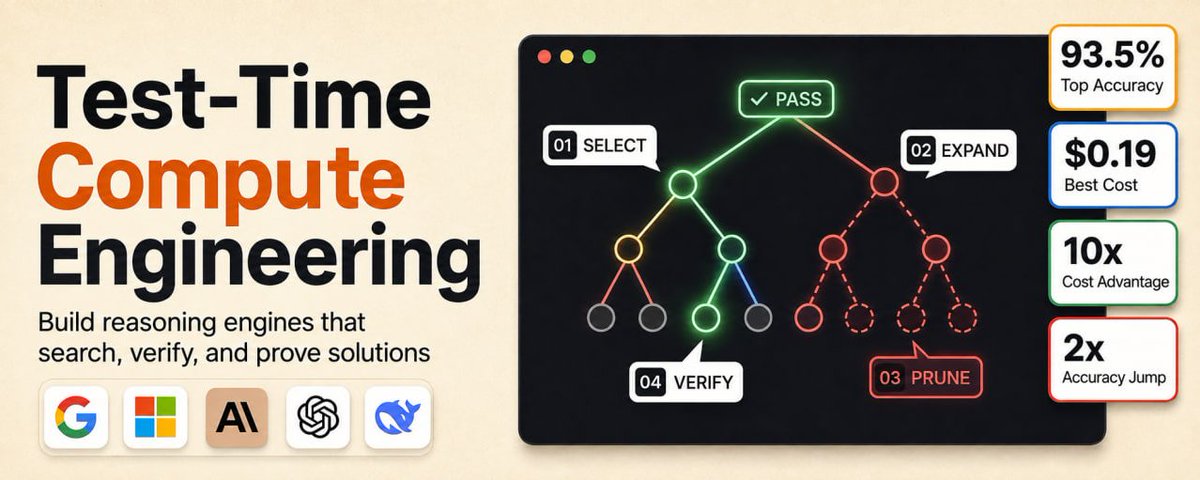
A Stanford research group found how to orchestrate Claude Opus 5.5 and GPT-6 Astra together, and it completely breaks the resampling wall
most developers think test-time compute means running 32 blind retries on one model. you burn API tokens repeating the same 2-3 error clusters in loops
Stanford's paper (arXiv:2608.05643) splits the compute between two different brains:
> breadth search: GPT-6 Astra runs high-entropy exploration (T=0.8) to discover divergent solution paths
> step audit: Claude Opus 5.5 scans each step at T=0.0 and catches the exact logic fallacy
> local surgery: Opus rewrites only the broken step instead of dumping the whole reasoning chain
> verifier-free consensus: majority voting locks the proof without relying on drift-prone PRMs
the benchmark metrics outclass standard Best-of-N sampling:
> 91.2% recovery rate on detected reasoning flaws
> under 1.8% regressions on correct branches
> MATH500 jumps from 29.6% to 58.0% (+28.4% absolute gain)
> AMC-2023 improves by +7.5% with zero reward models
Astra explores the maze. Opus repairs the logic
you stop burning tokens on blind retries. you run verified reasoning depth

Readers added context they thought people might want to know
arXiv:2608.05643 does not orchestrate GPT-6 Astra and Claude Opus 5.5. One open-weight model generates, critiques, and corrects. MATH500 29.6% to 58.0% and the +7.5 AMC gain are for Qwen2.5-1.5B. Two coauthors are at Stanford. arxiv.org/abs/2608.05643


Mø retweeted

Can complex multi-step reasoning emerge purely from cells that only talk to immediate neighbors?
Happy to share our paper “Reasoning with Neural Cellular Automata (NCA)”, from our team at Google, Paradigms of Intelligence 🧵👇

Mø retweeted
For years, maybe a decade, I've wanted to build a writing tool that just did a few things I couldn't find anywhere else.
A system that mimicked how I think when I write. A system that provided clear affordances, features, and places to do the things I wanted to do. A way to play with my writing as I'm writing it. A way to settle into just the right way to say something.
It never made sense to make it a 37signals product because it's not commercially viable, nor would it be worth pulling people off their other work to hack on this. Plus, it would have taken months the old way.
So this weekend I just made it myself, with Claude's help.
It's called Write_On and the short video walks you through it.
Essentially it's "alternative control" at the word, sentence, and paragraph level, plus a way to dim stuff back, and stash stuff near by. Not version control, but alternative control. You'll see what I mean when you watch the video below.
So here it is. Write_On.


Mø retweeted

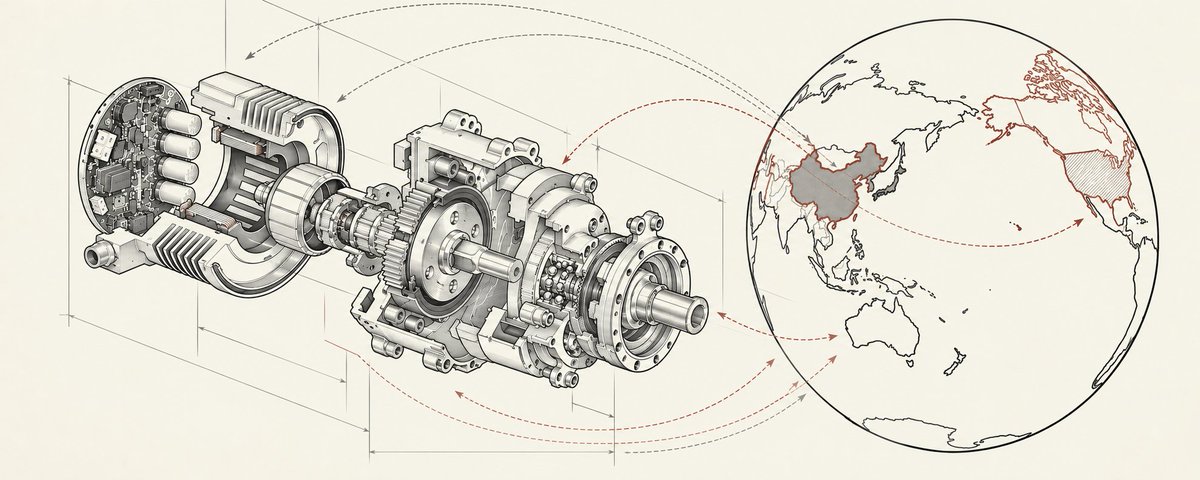
China's actuator supply base is being built by companies arriving from 5 overlapping industrial backgrounds:
1/ Reducer and motion specialists extending their core gearbox technology.
2/ Precision-transmission companies adding actuators, joint modules, motors, drives or roller screws.
3/ Joint-module vendors packaging motors, reducers, encoders and drives into integrated products.
4/ Automotive suppliers expanding into linear and rotary robot actuators.
5/ Linear-motion companies entering through planetary roller screws.
The starting point matters because it shapes where each company may have an advantage: precision gearing, module integration, automotive production or linear motion.
This map tracks 18 companies and preserves the stage each has disclosed.


Mø retweeted

Here is my 2nd lecture for the Columbia course "Quantitative Investing". This one is on Linear Models of Returns (mostly ch.3 of Elements of Quantitative Investing). It's kind of a long scaffold lecture. It will be complemented by a presentation on alpha fusion later in the course. Link in reply.


Background: I am co-teaching (with Kent Daniel) a grad course at Columbia titled "Quantitative Investing". I can share my slides, starting with the ones on market structure (ch.1 in my 2nd book). Below are a few representative slides.
I will share the lecture on linear return models this weekend.
At some point also one lecture on very high-dimensional linear models, which are interesting.
For now link to first deck is in reply. Enjoy.


