

building @deltadotnetwork | venture partner @hi_reverie | prev: Fidelity
Boston
Joined March 2011
- Tweets753
- Following3.7K
- Followers2.3K
- Likes6.5K


Walmart connecting personal agents to their first party agent, Sparky, is exactly the model I argued for earlier this month. Let general-purpose agents aggregate intent and delegate execution to first-party agents on the platforms where the work gets done.
Walmart gets a new distro channel while keeping the customer account and control over checkout. Personal agents get a first-class way to access and execute reliably with the larger retailer in the world. It’s a win-win model.
The bigger "so what" is how nicely this model extends to enable even more sensitive use cases -- namely banking and financial services.
Banks that currently block external agents should adopt this model -- let personal agents delegate an authorized task to the FI’s first-party agent, using the same secure API gateways that were created for Open Banking (e.g. Akoya, @Plaid). The FI executes the task on their platform and hands the receipt object back to the personal agent.
For an important class of use cases, this is the only model that can end the game of agent scraping whackamole and expand what personal agents can execute reliably and safely for users.

Today, general-purpose agents and first-party agents are at odds, competing over the interface and user relationship (e.g. Amazon blocking Muse). But the better model is clearly one where they complement each other.
- External general-purpose agents are natural aggregators, but weak at execution for most tasks.
- First-party specialists agents are weak aggregators, but have a structural execution advantage via controlling the data, systems and permissions required to complete tasks on their platforms
The more complex and high-stakes the task, the larger this structural advantage becomes.
Without a model that combines them, we risk a hitting capability and adoption ceiling. Agents with distribution will be limited to a relatively small set of low value tasks, and specialist agents will struggle to gain adoption.
The better model is clearly one that combines them -- general-purpose agents aggregate intent and delegate to specialist agents to execute the job on their own platforms.
Aggregators will compete interface quality and the surface area of useful work they can facilitate reliably. Specialist agents expand that surface area for aggregators, and compete on discovery and execution quality, much like they do already today.
This model results in a number of win win outcomes for users, aggregators, and merchants/services:
1) Merchants and services retain what they care most about — owning the user’s account and control over execution, including checkout and fulfillment
2) Aggregators expand the range of jobs they can reliably complete, including high-stakes tasks users would only trust the underlying service, eg their bank, to execute directly
3) As a byproduct, the liability problem is solved for all sides. Assuming the merchant agent can verify delegated intent, it can stand behind executing that instruction correctly. This is a huge improvement versus today, where all liability is dumped onto the external agent’s user

More detail here: xitter.cf/noyesclt/status/211467…


Today, general-purpose agents and first-party agents are at odds, competing over the interface and user relationship (e.g. Amazon blocking Muse). But the better model is clearly one where they complement each other.
- External general-purpose agents are natural aggregators, but weak at execution for most tasks.
- First-party specialists agents are weak aggregators, but have a structural execution advantage via controlling the data, systems and permissions required to complete tasks on their platforms
The more complex and high-stakes the task, the larger this structural advantage becomes.
Without a model that combines them, we risk a hitting capability and adoption ceiling. Agents with distribution will be limited to a relatively small set of low value tasks, and specialist agents will struggle to gain adoption.
The better model is clearly one that combines them -- general-purpose agents aggregate intent and delegate to specialist agents to execute the job on their own platforms.
Aggregators will compete interface quality and the surface area of useful work they can facilitate reliably. Specialist agents expand that surface area for aggregators, and compete on discovery and execution quality, much like they do already today.
This model results in a number of win win outcomes for users, aggregators, and merchants/services:
1) Merchants and services retain what they care most about — owning the user’s account and control over execution, including checkout and fulfillment
2) Aggregators expand the range of jobs they can reliably complete, including high-stakes tasks users would only trust the underlying service, eg their bank, to execute directly
3) As a byproduct, the liability problem is solved for all sides. Assuming the merchant agent can verify delegated intent, it can stand behind executing that instruction correctly. This is a huge improvement versus today, where all liability is dumped onto the external agent’s user

Vertical personal agents and account ownership
I don't buy that there will be one general-purpose personal agent. I think there will be specific agents for:
•productivity / work
•food and grocery
•money
•health
Each of these will be owned by whoever controls the system of record and the right to act. Take money. The money agent should be your bank account and execute transactions on your behalf. It has the ledger, the license, the fraud models, and the liability when something goes wrong. A general agent that "logs into" your bank is a screen scraper with ambition. The bank that becomes an agent is the agent.
The same pattern repeats:
•Food and grocery: Whoever owns the cart, the inventory, and the last mile. The agent knows what's in your fridge because it put it there.
•Health: Whoever holds your records, your labs, and a relationship with a licensed provider. Advice without the chart is a guess. Action without a license is a lawsuit.
•Productivity / work: Whoever owns your calendar, inbox, and docs. Context is the moat, and it already lives somewhere.
Agents win on three things: data, permission, and accountability. A horizontal agent can borrow the first, beg for the second, and has none of the third.
Trust isn't general either. I'll let an agent book my dinner without asking. I won't let the same agent wire $50K or change my medication. Each domain has its own risk tolerance, its own regulation, and its own definition of "done." One agent can't hold all of those thresholds at once.
The general-purpose agent doesn't disappear. It becomes the router. It's the front desk that knows which specialist to call. That's a real product, but it's thin. Routers commoditize, and the specialists capture the value.
The question isn't "who builds the best assistant?" It's "who owns the account the assistant acts on?" The incumbents with licenses and ledgers have a bigger head start than they realize. The startups that win will either become the system of record in a vertical or make themselves impossible to route around.
The future isn't one agent that does everything. It's a handful of agents that each own something.
Couldn’t agree more — bounded autonomy with purchase protection guarantees it is exactly what @deltadotnetwork enables our partners to offer:
- The goal should be the payments version of --dangerously-skip-permissions, without any actual danger. Personal or knowledge-worker agents that act as autonomously as coding agents but can’t waste your money. Anything that the agent needs to complete its mandate should feel auto-approved, and anything outside of that is blocked or routed to review
- None of this scales to mass market adoption without financial recourse for "agent bought the wrong thing." plausible but wrong is the biggest risk. consumer trust is fragile — all it takes is one missed constraint for the user to feel burned. Intent enforcement and a guarantee to back it is what will win consumer trust

Myles O'Neil retweeted

We’re excited to join the APA as a founding member.
An agent can follow every guardrail and still buy the wrong thing. Agentic commerce needs intent enforcement to prevent errors, and recourse for consumers if things go wrong.
We’ll help APA partners earn consumer trust by making these protections the industry standard.


Myles O'Neil retweeted

Delegate betting to your agent
With delta Mandate it's impossible for it to make a bet you didn't approve
In time for the quarterfinals 🇸🇯


I’ve always wanted to be able to tell an agent what bet to make let it handle the rest
But I’d never trust it enough to run in dangerous-skip all permissions mode with real money on the line. And if I’m forced to manually approve every trade, what's the point?
So we built this demo to show a mode of dangerous-skip permissions mode with no actual danger
Prompt the bet you want to make, the agent finds what it believes is the right trade, and delta Mandate verifies the proposed trade against the instructions to evaluate block or release
Myles O'Neil retweeted
Micropayments only make sense if you don't have to manually approve every subcent tx
We need dangerous --skip all permissions but with no actual danger:
knowledge worker agents that act as autonomously as modern coding agents but don't waste your money

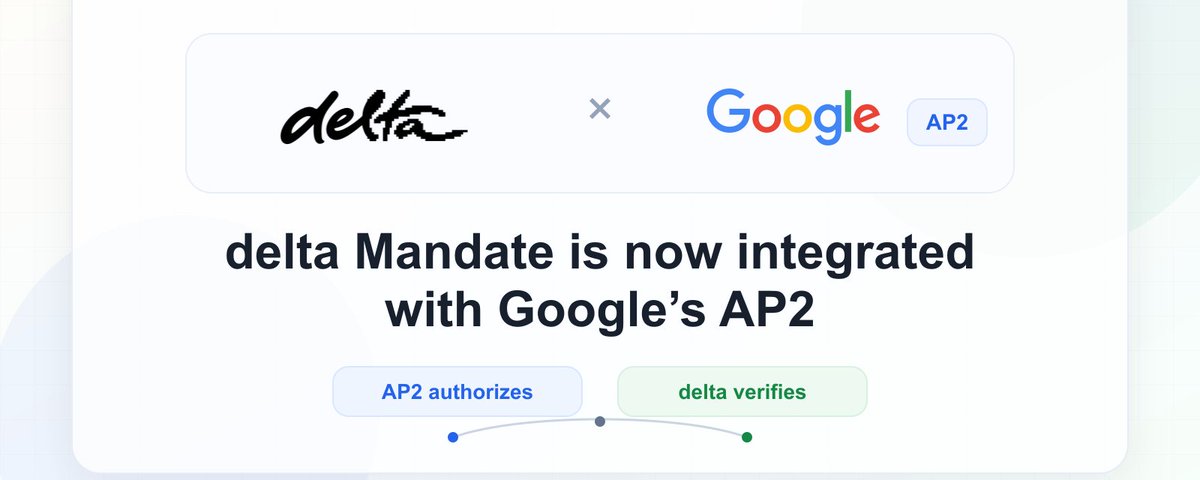
Today we’re announcing @deltadotnetwork integration with @Google's AP2. Link in the comments below, but here's why we're excited:
AP2 creates a verifiable chain for user authorization, merchant commitment, and payment intent. But it has two significant shortcomings:
1) it does not verify that the agent’s action satisfies the substance of what the user authorized
2) it requires issuers and merchants to blindly trust the platform's attestation without having any way to verify the user's purchasing intent
AP2 with delta Mandate addresses both of these problems.
The user authorizes an intent mandate, the agent discovers a product, and the merchant only signs the checkout after delta has verified the proposed purchase against evidence from the actual product. This check sits outside the agent, so issuers and merchants do not need to blindly trust the platform.
This matters for liability. Issuer banks are not going to underwrite delegated purchases if they cannot independently verify that the agent stayed inside the user’s mandate. They need more than an audit trail showing what happened after the fact. They need a pre-release control that ties authorization, execution, and evidence together before money moves.
AP2 gives agentic commerce a much-needed authorization and transaction artifact chain. delta Mandate adds the enforcement + evidence layer required for issuers, merchants, and wallets to trust that chain at scale.
Full announcement here:
xitter.cf/deltadotnetwork/status…
Myles O'Neil retweeted

Cool recognition from Delta from one of the most iykyk payments bloggers, lfg!
Disclaimer: small but proud bagholder.
Awesome to see my favorite payments blogger, @noyesclt, cover @deltadotnetwork.
Core point: consumer trust is fragile. Without a solution like delta in place, agent errors will be frequent, consumers will get burned, and it will take years to rebuild trust.
As Tom writes, delta is the only solution in market delivering the three components that agentic commerce needs to avoid this scenario and scale safely:
1) Neutral verification: a third party checking evidence, not platform attestations
2) Pre-release enforcement: errors caught before payment, not after
3) Financial accountability: someone takes the loss when mandate verification fails
For those building agentic commerce and finance solutions: if your users are going to trust agents with spend, intent enforcement has to happen before release, and users need guarantees that they will be made whole if something goes wrong.
See the full piece here: blog.starpointllp.com/2026/0…
Myles O'Neil retweeted

Great read on the intent mandate issue I've been writing about w/ hard Shopify data (28.8% of its purchases were wrong). Now tracking fintech delta. linkedin.com/pulse/we-gave-a…

Myles O'Neil retweeted
New Blog - How to Stop the Agentic Apocalypse - Intent Data. blog.starpointllp.com/2026/0… Hard data from Delta Network and Overview of their solution (no I'm not an investor "yet")
Awesome to see my favorite payments blogger, @noyesclt, cover @deltadotnetwork.
Core point: consumer trust is fragile. Without a solution like delta in place, agent errors will be frequent, consumers will get burned, and it will take years to rebuild trust.
As Tom writes, delta is the only solution in market delivering the three components that agentic commerce needs to avoid this scenario and scale safely:
1) Neutral verification: a third party checking evidence, not platform attestations
2) Pre-release enforcement: errors caught before payment, not after
3) Financial accountability: someone takes the loss when mandate verification fails
For those building agentic commerce and finance solutions: if your users are going to trust agents with spend, intent enforcement has to happen before release, and users need guarantees that they will be made whole if something goes wrong.
See the full piece here: blog.starpointllp.com/2026/0…
Myles O'Neil retweeted

Equipping an agent with a card is very easy, and so is making it able to purchase. If the other merchant does not expose APIs, you can simply rely on browser use.
However, even if at first it is simple to make the execution work, new nuances arise in the card-network mechanisms when agents are involved.
And one of the most important is how to manage chargebacks.
Disputes most valuable data decay with agent purchases, and so from here you can see:
A) data-analysis providers that do not cover agentic transactions.
B) merchants that do not want to accept these types of payments because of the high dispute costs.
C) buyers that become vulnerable to injection attacks and, mainly, to the agents' own preferences.
New providers like Delta are on the way to solving this gap.


Agents can now discover products and check out. But should you actually trust them with real money to buy the right thing? Our research shows that you shouldn’t, at least without delta Mandate.
Without delta’s intent enforcement, agent’s bought the wrong item 28.8% of the time on average, and the failure rate increased to 71.4% failure rate for harder intents. With delta Mandate in place, wrong purchase rate fell to zero.
This is the enforcement layer behind the Mandate Guarantee that we offer via the platforms we partner with — if something slips through our policy engine, we’ll make the user whole.
Use the docs in the comment below to connect download our MCP endpoint and try it with your own agent. If you want to offer the Mandate Guarantee to your customers, reach out and we’ll get you onboarded!