

I wish none but those who desire to be actively engaged. COME ON BOYS, IF YOU WANT A HEAP OF FUN AND TO KILL SOME YANKEES.
S.E. Louisiana
Joined July 2021
- Tweets11.4K
- Following702
- Followers9.8K
- Likes72K





Bedford Forrest retweeted

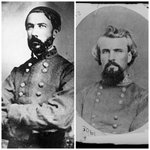
BLACK CONFEDERATES
Here is an interesting report:
In writing about the fight above Vicksburg, at Chickasaw Bayou - "Union Brigade Commander David Stewart explained that "The enemy, and especially their armed negroes, did dare to rise and fire, and did serious execution on our men". "
This quote is from, Early Struggles for Vicksburg, by Timothy B. Smith. page 342.
In 36 years of research on Confederate troops, I have read many, many reports of such happenings.

Bedford Forrest retweeted

(Sidebar): THE BULL PUPS — Forrest, Morton, and the Steel Guns That Barked
THE CAPTURE
On December 18, 1862, at Lexington, Tennessee, Forrest's cavalry routed a Federal force under Colonel Robert G. Ingersoll and captured two artillery pieces. They weren't ordinary guns.
They were 3-inch steel rifles manufactured by the Singer-Nimick Company of Pittsburgh, Pennsylvania — serial numbers 1 and 5, inspector's initials J.S., cast in 1862, each weighing 834 pounds. They were part of a six-gun battery originally ordered by General John C. Frémont.
In appearance, they were dead-ringers for the standard Union 3-Inch Ordnance Rifle. But there was a critical difference: standard ordnance rifles were wrought iron. The Singer-Nimick guns were cast steel — a relatively new and expensive manufacturing process. The result was a gun that was lighter, more accurate, and easier to handle than its iron cousins. Perfect for fast-moving cavalry operations.
The men who served them gave them a nickname that stuck: "Bull Pups." Compact. Sharp-voiced. They didn't boom like heavier battery guns — they barked.
THE MAN WHO COMMANDED THEM
The Bull Pups were assigned to Captain John Watson Morton, Chief of Artillery under Forrest. Morton was only twenty years old when he took command, but he proved one of the most capable artillerists in the Western Theater.
Morton rode those guns through every major engagement of Forrest's command for the next two and a half years. The Bull Pups saw action at Chickamauga, Brice's Crossroads, Harrisburg, and dozens of smaller fights. They were at Johnsonville in November 1864, when Forrest's artillery helped sink Union gunboats and destroy a Federal supply depot on the Tennessee River — one of the only instances in military history of cavalry-led artillery defeating a naval operation.
After the war, Morton would write The Artillery of Nathan Bedford Forrest's Cavalry: "The Wizard of the Saddle" (1909), documenting the service of his beloved guns in detail.
AFTER APPOMATTOX — A GUNNER'S DEVOTION
Morton retired to Nashville and built a successful career as a businessman. He eventually served as Tennessee's Secretary of State. But he never forgot the Bull Pups.
In his official capacity, Morton became aware that the two steel rifles still existed — in Federal possession. He managed to obtain them from the U.S. Government. For a time, they were stored in the basement of the Tennessee State Capitol, waiting.
Then came Morton's final act of stewardship.
In 1889 or 1890, Morton was appointed to the commission establishing the Chickamauga-Chattanooga National Military Park. He personally helped place the Bull Pups at positions on the battlefield where he had fought with them during the September 1863 battle.
And there the two of them remain today.
WHERE THEY ARE NOW
Serial Numbers 1 and 5 stand at Chickamauga, identified as 3-inch cast steel rifles by Singer-Nimick. They are two of only three surviving Singer-Nimick rifles known to exist. The third is at Gettysburg National Military Park.
Morton, unable to keep the Bull Pups for himself, settled for a standard 3-Inch Ordnance Rifle to decorate the lawn of his Nashville estate, "Melrose." That gun — Phoenix Iron Works, serial number 675 — had its own strange odyssey over the following century, passing through multiple hands, suffering decay and near-loss, before finally being recovered in 2006 and returned to its rightful owner. It now awaits restoration and display on the Franklin battlefield.
Morton's presentation sword — a rare Confederate piece made by the College Hill Arsenal in Nashville — is on display in the artillery section of the Tennessee State Museum.
WHY THE BULL PUPS MATTER
The Bull Pups are more than a footnote. They're a symbol of what Forrest's December 1862 raid actually accomplished.
He didn't just wreck rails. He captured capability — turning Federal equipment against its former owners. Two rare, high-quality guns, seized from a routed garrison, served the Confederacy for the rest of the war, and ultimately returned to the ground where they'd been used in battle.
Light. Accurate. Sharp-voiced.
They barked for Forrest. And their echo is still there, if you know where to look.

Bedford Forrest retweeted
THIS IS WHAT HATE LOOKS LIKE
Union General Andrew J. Smith came to Oxford, Mississippi looking to capture or kill Nathan Bedford Forrest. Forrest knew he was coming, so he flanked Smith by heading West, and then North, and Forrest took Smith's base at Memphis. Smith was sitting on his horse on the North side of the Oxford Courthouse when a rider came up to him with the news that Forrest had taken Memphis the night before. Out of pure anger, Smith ordered the Courthouse, the whole Square, the University of Mississippi, and several houses burned.
Fortunately for Ole Miss, the two young yankee Captains sent to burn the University, "refused to carry out such a vandal order", after finding only literary material, and scientific apparatus, at the University.
Smith and his men had already taken part in Sherman's Mississippi, Meridian Raid. Eleven Mississippi towns, and probably 100 country houses were burned on that raid. Then Smith and his men were the last to leave Alexandria, Louisiana when it was 90 percent burned to the ground. One month before Smith burned Oxford, he and his men burned Ripley, Mississippi in the same manner as Oxford.
There was a total of at least 50 towns burned in Mississippi during the War. There were also at least another 100 burned country homes, between Oxford, and the Tennessee State line. That was just ONE invasion route for Union troops into Mississippi.
After all that burning, after the War, General Smith is sent West to KILL Indians. Then, he is rewarded with the postmaster's job of St. Louis.
Anger and hate.

Bedford Forrest retweeted
FIFTY BURNED TOWNS IN MISSISSIPPI DURING THE CIVIL WAR
Here are the FIFTY burned towns I have documented in Mississippi during the Civil War. I am sure there are more that I have not found. The very small towns are generally hard to find a complete history.
What is a "burned" town? I only know of one town where every building in it was burned down. That was the very small, dying town of Wyatt, in Lafayette County. Burned towns to me are where the business district was nearly all burned, along with several houses, and maybe even Churches. Oxford for example had the Courthouse, the business Square, and five houses burned. The train depot always gets burned down, usually with the warehouses around it. One Church was set on fire and put out, three houses were set on fire, and put out, and the University was ordered burned, but the two young yankee Captains sent to burn it, decided not to "carry out such a vandal order." They had guts and integrity! God Bless 'em.
Jackson, the State Capitol was burned FOUR times, until almost nothing was left. After the War, it was nick named "Chimneyville". Fourteen County Courthouses were burned. That is 23 percent of 60 total courthouses. Nobody has been able to explain to me yet, how burning up Courts, Judges Chamber's, County land deeds, probate records, and the Sheriff's office is a valid military target.
Another shocking part of this that I have found are the reports that between Oxford, Mississippi, and Grand Junction, Tennessee, all but a half dozen Country homes were burned during the War. That is a 55 mile stretch. Conservatively, that has to be 100 Country homes. Holly Springs along that route was about one third burned, including the Courthouse, and about half the Square. About half the Holly Springs Square burning was done accidently by the Confederates.
Also, on Sherman's 1864 Meridian Raid, from Vicksburg to Meridian, 11 towns were burned as part of the 50, and many country houses were burned. That is a distance of 135 miles. I can only guess that 100 country homes were burned along that route.
This has been a side project for me. I have not spent that much time on it. It has pretty much shocked me, and any Mississippian I have ever shown it to. Nobody EVER knew this. And if nobody ever knew this, nobody ever taught this.
As I have told you all before, not the half of what really happened in the War, has ever been told.

Bedford Forrest retweeted

“People want to know why the South is so interested in the Civil War. I had maybe, it’s a rough guess, about fifty fistfights in my life. Out of those fifty fistfights, the ones that I had the most vivid memory of were the ones I lost. I think that’s one reason why the South remembers the war more than the North does.” - Shelby Foote

Bedford Forrest retweeted
After the battle of Sharpsburg, 3rd Lieutenant Robert Gaston (18 years old) was buried in a separate grave and not put in a mass pit of bodies which usually happens after a battle. He was honored by Union soldiers who admired his brave acts during the advance of the 1st Texas Infantry at Miller's Cornfield that morning. He was the farthest soldier to penetrate within Federal lines.
On his wooden headstone the Federals wrote "Tears for the Gray from the Union Blue." – at Louisiana, USA

Bedford Forrest retweeted
The Audacity of General Robert E. Lee after the battle of Sharpsburg. As told by Walter Montgomery of the 12th North Carolina:
"The battle was splendidly fought by Lee and his lieutenants. The Confederates used all their forces, except about two brigades. Nearly two Corps of the Federals took no part in the action. Each attack of the Union forces was foiled and the Army of the Potomac brought to a stand when night set in.
Its conclusion found General Lee the most pugnacious spirit (as he always was) in the Confederate army. Cool, calm, deliberate always, and most respectful in his language toward his foe, he yet could not endure the sight of a blue coat on the soil of Virginia, and whenever they made their appearance in his front there was a battle. General Stephen D. Lee gave in writing to a friend, Major Hotchkiss, an account of the council of war which General R.E. Lee held with his lieutenants after dark on the field of Sharpsburg. He inquired of each division command, 'How is it on your part of the line?'
Longstreet replied, 'As bad as can be;' Hill, 'My division is cut to pieces.' Hood declared with great emotion that he had no division left. General S.D. Lee asserted that all of these officers advised that the army should cross the Potomac, and that Lee after a profound pause, said: Gentlemen, we will not cross the Potomac tonight. You will go to your respective commands, strengthen your lines, send two officers from each brigade toward the ford, collect your stragglers and bring them up. Many others have come up. I have had the proper steps taken to collect all the men who are in the rear. If McClellan wants to fight in the morning I will give him battle again."
2nd Lieutenant Walter A. Montgomery - 12th North Carolina
Painting: Until Sundown by Don Troiani. Gordon in the Sunken Rd, Antietam (Sharpsburg). – at Madisonville, LA

Bedford Forrest retweeted

General Alexander P. Stewart was born OTD in 1821. An 1842 graduate of West Point, Stewart resigned his commission in 1845 to pursue his love of teaching. He became a professor of mathematics at Cumberland University and later at the University of Nashville.

Bedford Forrest retweeted
Saber and Pistol: The Last Duel of Nathan Bedford Forrest
Ebenezer Church, Alabama – April 1, 1865
By the spring of 1865, the Southern Confederacy was dying fast—and it knew it. The war's great engines were grinding to a close, and now the Federal cavalry—fast, well-mounted, and carrying Spencer 7-shot repeating carbines—was galloping deep into Alabama to finish the job.
Major General James H. Wilson, a hard-driving West Pointer and Grant protégé, had assembled a strike force of over 13,000 seasoned troopers drawn from the cream of the Union cavalry. Their mission was destruction: crack the iron spine of the Confederacy by burning its heart—Selma.
And riding to stop him was a man whose name still stirred fear and awe in the Federal ranks.
Lieutenant General Nathan Bedford Forrest, commander of the last great Southern cavalry force in the West, was short of nearly everything: men, mounts, ammunition, even time. He had just 2,500 or so effectives—many of them state militia and home guards with little fight left in them—and they were scattered across flooded rivers and spring-churned roads. But Forrest still had one thing: will.
He planted his line near a sleepy crossroads called Ebenezer Church, about 20 miles north of Selma. It wasn’t much—just a shallow rise, a few fieldpieces, and worn-out men behind makeshift works. But it was here, on April 1, 1865, that Forrest stood in the path of Wilson’s advance. And it was here that he fought his final personal duel.
The Charge
The Federals came on with force. One of Wilson’s most trusted commanders, Brig. Gen. Eli Long, pushed his column directly down the main road. Four companies of the 17th Indiana Mounted Infantry—veterans of Wilder’s Lightning Brigade—were ordered forward on horseback, sabers drawn, with dismounted troopers covering them with Spencer carbines from the flanks. Forrest had seen this tactic before, but he had no reserves to counter it and no depth to his line.
The charge struck like a hammer. The 17th Indians slashed through the abatis, leaped the ditch, and toppled one Confederate field gun. For a moment, they looked unstoppable. But Forrest wasn’t behind the lines giving orders—he was right there at the guns, revolver in hand.
The moment the Federal line crested the works, Forrest and a knot of his hard-bitten veterans fired from point-blank range into the charging mass. It was hand-to-hand chaos—sabers, pistols, and bare fists. The road to Selma was being bought by inches.
“A Terrific Hand-to-Hand Conflict”
The 17th Indiana began to recoil, men falling from the saddle in clumps. But one officer didn’t break.
Captain James D. Taylor, a brave and determined young officer from Company G, surged ahead alone. His comrades later remembered it clearly: Taylor’s horse was lathered, his saber already bloodied, and his face set like stone. As others fell back, he rode straight for the knot of officers by the gun—and for Forrest.
The general saw him coming.
As Taylor closed, he swung his saber in a blinding arc. One blow sliced across Forrest’s left forearm, disabling it. Another gashed open Forrest’s scalp, blood running down the side of his face. A third blow nicked the barrel of Forrest’s revolver, so close were the two men locked in.
Forrest, bleeding, reeling, barely kept his balance.
And then he fired.
The shot struck Taylor in the chest. The young captain fell from the saddle and was dead before he hit the dirt.
“If that boy had known enough…”
A few days later, the dust of Selma’s fall still settling, Forrest and Wilson met briefly under a flag of truce. Forrest, still bandaged from the wounds Taylor had given him, made no boast. Instead, with a soldier’s blunt candor, he told Wilson:
“If that boy had known enough to give me the point of his saber instead of the edge, I should not be here to tell you about it.”
That line—half lament, half compliment—has echoed down through the years as the final punctuation mark on Forrest’s long, brutal record of personal combat.
The Last Man
It wasn’t the first time Forrest had killed a man at close range. All through the war, the Tennessean had made a name for leading from the front—fighting elbow to elbow with his men. Over four years of hard riding and harder fighting, 29 horses were shot out from under him, and by all serious estimates, he killed or seriously wounded over thirty men in personal combat. *
James D. Taylor was the last.
There would be no more duels. The war was nearly over.
Aftermath
The fight at Ebenezer Church—like so many of Forrest’s last stands—was gallant, but hopeless. With the line broken, Forrest pulled back toward Selma. The next evening, April 2, Wilson’s converging columns stormed the city’s outer defenses at dusk, overwhelmed the defenders in brutal street fighting, and turned Selma into a furnace.
The Confederacy’s great ironworks, the naval foundry, and the arsenal that had once supplied a third of its shells went up in flames. Forrest escaped with a fragment of his cavalry, wounded and exhausted; the battle was lost—and so was the war.
Yet still, that duel remains.
Two men, one saber, one pistol.
And a few savage seconds that became a kind of symbol—for courage, for desperation, for the closing violence of a war in its death throes.
* By war’s end, Nathan Bedford Forrest had 29 horses shot out from under him, a number widely documented in both wartime records and postwar accounts. As for men killed in personal combat, most contemporary and postwar estimates place the number at 30 or more, with some Southern veteran sources claiming it was as high as 33. According to that tradition, Captain James D. Taylor of the 17th Indiana, who slashed Forrest at Ebenezer Church before being shot dead by the general himself, was counted as the last of them.
Graphics: 1) Lieutenant General Nathan Bedford Forrest; 2) Historical Marker - Battle of Ebenezer Church and the 17th Indiana Mounted Infantry; 3) Map of the battle of Selma; 4) Destroyed Confederate Naval Foundry at Selma; 5) *No known photo of Captain Taylor exists, unfortunately.


Bedford Forrest retweeted
The Sound of Southern Defiance: Unraveling the Mystery of the Rebel Yell
"At last it grew too dark to fight. Then away to our left and rear some of Bragg's people set up 'the rebel yell'. It was taken up successively and passed around to our front, along our right and in behind us again, until it seemed almost to have got to the point whence it started. It was the ugliest sound that any mortal ever heard -- even a mortal exhausted and unnerved by two days of hard fighting, without sleep, without rest, without food and without hope..." - Narrative of then-Lieutenant Ambrose Bierce, 2nd Brigade, 2nd Division, XXI Corps, Army of the Cumberland, at the Battle of Chickamauga (Last Union defenses on Horseshoe Ridge, September 20, 1863)
The Rebel Yell
This distinctive battle cry, emblematic of Southern defiance and ferocity, was more than a mere shout. It functioned as a psychological weapon that bolstered Confederate morale even as it unnerved and “chilled the hearts” of their Union foes. Its exact sound remains a matter of legend – described variously as a high-pitched shriek, a “falsetto yelp,” or “a foxhunt yip mixed up with sort of a banshee squall” – but all agree it was markedly different from the deep, unified “huzzah” cheer of Federal troops.
Here, we will explore the Rebel Yell’s origins and its battlefield use through authentic voices of the period. Drawing on primary accounts from Confederate and Union soldiers, as well as contemporary observers, we can begin to understand how this eerie scream was born from Southern culture and how it echoed across Civil War battlefields as both a cry of courage and a weapon of terror.
Origins in Hunting Calls and War Whoops
The roots of the Rebel Yell run deep into antebellum Southern culture. Long before 1861, Southerners were accustomed to wordless, piercing cries in everyday life – in hunting, herd calling, and even play. Rural hunting traditions were especially influential. A Mississippi Confederate later explained that “hunting fox, ’coons, ’possums, rabbits etc. has been all but universal in the South… Once the dog or dogs were on the track, yelling to them was inevitable… I have heard and given this yell since a mere lad. The so-called ‘rebel yell’ was only the hunter’s yell, merged into the army.”
In other words, the cacophonous cries used to urge packs of hounds during a chase – a practice known as “yelling on the pack” in the coon-hunting vernacular – naturally found their way into the camps and charges of citizen-soldiers who had grown up with those sounds. Even decades after the war, Confederates recognized the battle yell as essentially an extension of their old fox hunt hollers and hunting whoops.
Frontier and folk influences further shaped this crying tradition. Many noted a similarity to Native American war whoops that had been imitated by white frontiersmen for generations. As early as the Revolutionary War, colonial fighters charging with shrill whoops unsettled their enemies. During the Battle of King’s Mountain in 1780, for example, Loyalist commander Abraham DePeyster grew alarmed at the approach of the backwoods militia and warned his superior, “These things are ominous — these are the damned yelling boys.”
His colorful remark testified to the ferocity of the Tennessee riflemen’s unbridled shouts, which one 19th-century writer said “rang out… like the whoop of Indians!” and struck fear in British ranks. Indeed, white Americans had often adopted or parodied indigenous war-cries. James Adair, an 18th-century trader who lived among the Native Americans, recounted how while scouting against the Choctaw in 1775 “I immediately put up the war whoop” upon spotting danger. In another Revolutionary anecdote, Loyalist James Moody described his men “well skilled in the Indian war-whoop” using hideous yells to panic patriots during a raid.
Such examples show that by the 19th century, white Southerners were familiar with unleashing wordless, high-pitched battle cries akin to Native shouts. This habit continued in the antebellum military. During the Second Seminole War (1835–1842), U.S. troops faced Seminole warriors’ shrill war-whoops – and replied in kind. An army officer, John T. Sprague, described one 1837 fight in Florida where American infantry charged and “the soldiers returned it with redoubled energy… Yell after yell reverberated through the dense foliage… the whoop… became louder and louder until the shrill voice of the savage was lost in the repeated imitations and shouts of the soldiers… the troops returning yell for yell.”
In popular culture too, the trope of the frontier “Indian yell” was well known. A Davy Crockett almanac of 1847 advised frontiersmen to “pierce the heart of the enemy… and tarrify him with a rale injun yell.” By the eve of the Civil War, the South’s distinctive aural heritage – part hunting cry, part imitation Indian whoop, seasoned with the Celtic “war cry of the Gael” from Scotch-Irish ancestors – had given birth to a unique, feral shriek. This would be unleashed to terrible effect once Americans took up arms against each other.
“Yell Like Furies!” – The Rebel Yell in Battle
When the Civil War began, Confederate soldiers quickly made the Yell their signature battle cry. Far from a formal drill or cadence, it was often a spontaneous eruption driven by excitement, fear, or aggression. Southern troops raised the yell especially during charges and counterattacks – moments when they needed to summon courage and intimidate the foe. On July 21, 1861, at First Manassas (Bull Run), General Thomas J. “Stonewall” Jackson reputedly cemented the yell’s place in history. As his brigade prepared to charge, Jackson exhorted them: “Give them the bayonet… and in Jackson’s words, ‘yell like furies!’". Charge they did, with a banshee-like scream that many claimed was the first true Rebel Yell of the war. One Confederate remembered that as they rushed the enemy, “the world heard for the first time the scream” that would become famous.
Whether or not this was truly the “birth” of the Rebel Yell, Jackson clearly understood its value. Thereafter, officers often instructed their men to yell when attacking. The piercing cacophony could unnerve opposing troops. It also helped sustain the momentum of a charge – a wall of sound carrying the men forward. Confederate soldiers themselves recognized the practical and psychological advantages of their wild battle cry. Major Arthur Fremantle, a British observer with Lee’s army in 1863, noted that even Southern officers believed in its efficacy. “The Yankee cheer is much more like ours,” Fremantle wrote of the Union’s hearty “hurrah.” “But the Confederate officers declare that the Rebel yell has a particular merit, and always produces a salutary and useful effect upon their adversaries.”
Indeed, a Confederate charge delivered with that unearthly shriek often had an outsized impact on Union morale. General Jubal A. Early, after the Fredericksburg campaign, likewise contrasted Southern and Northern battle cries in an official report: Confederate troops attacked “with the cheering peculiar to the Confederate soldier, and which is never mistaken for the studied hurrahs of the Yankees.”
Early’s point was that the Yankee “hurrah” – a coordinated, baritone cheer – could not match the chilling, peculiar rebel scream in passion or effect. One Georgia soldier, comparing the two, said the Union men charged “heads erect, shoulders squared… with a firm stride,” shouting hurrahs, whereas Confederates came on “half bent… filling up gaps and trotting on with their never-ceasing ‘ki-yi’” – unstoppable despite casualties.
The Rebel Yell, often described as “individualistic, shrill and wild,” symbolized the Southern fighting spirit: decentralized but fierce, more pack of hunters than drilled regiment. The yell was not reserved only for offensive charges. Confederates employed it at various times: when repelling enemy assaults, to celebrate successes, or even as an emotional release in camps. It often spread organically. Veterans recounted how a single regiment’s yell could ripple down a line of battle or through a column on the march.
One Confederate officer described a scene in late 1864 when, after repulsing a Union attack, “confident and rejoicing, they raised the rebel yell in Anderson’s corps and took it up along the whole line… one could hear it on the right, then in front and then dying away in the distance on the left… Again the shout arose on the right – again it rushed down upon us… we caught it and flung it joyously to the left… The effect was beyond expression. It filled every heart with new life… men seemed fairly convulsed with fierce enthusiasm.”
This tremendous wave of sound, recalled in a postwar account and later quoted by historian Douglas Southall Freeman, shows how the yell could unify and electrify Confederate men. What sounded to the enemy like something “ghoulish” was to the Southern soldier “the sweetest music” of victory and camaraderie.
Notably, despite its prevalence on battlefields, the Rebel Yell is scarcely mentioned in official military correspondence or after-action reports. Civil War officers typically focused on maneuvers, casualties, and objectives, not the din of battle. The yell was such a common feature of Southern attacks that it went without saying – literally. As one postwar writer observed, it “did not need mentioning, being as natural as gun-smoke on the field.” Furthermore, because each unit’s yell might differ, officers may have seen it as an informal soldier habit rather than a tactical detail worth recording. But in letters, diaries, and veteran reminiscences, the yell roars across the pages, attesting to its ubiquity. A Union lieutenant at the 1863 Battle of Chickamauga remembered how at nightfall the sound circled them: “Some of Bragg’s people set up ‘the rebel yell’. It was taken up successively and passed around to our front, along our right and in behind us… until it seemed almost to have got to the point whence it started.” And with that terrifying enveloping cry, he said, “it was the ugliest sound that any mortal ever heard.”
“The Ugliest Sound” – Union Soldiers Confront the Yell
For those on the receiving end, the Rebel Yell was often a harrowing experience. Union troops, unaccustomed to such a noise, struggled to describe it, frequently resorting to comparisons with beasts or demons. Private Ambrose Bierce of the 9th Indiana (who later became a famous writer) fought at Shiloh and Chickamauga and never forgot the sound. He branded the rebel scream “the ugliest sound that any mortal ever heard — even a mortal exhausted and unnerved by two days of hard fighting, without sleep, without rest, and without hope.”
That “ugliest sound” seemed to pierce through the chaos of battle and gnaw at a soldier’s courage. Veterans from a Wisconsin regiment, decades later, concurred in colorful terms. “And that yell,” they recalled, “there is nothing like it this side of the infernal region, and the peculiar corkscrew sensation that it sends down your backbone… can never be told.”
Hearing it, one Union man said, made your blood run cold – “you have to feel it.” Northern soldiers joked early in the war that the high-pitched rebel cry sounded “like a lot of schoolboys at play,” or a pack of yelping foxhounds, even deriding it as effeminate. But familiarity bred respect. As Union officer Gilbert Hays admitted, “though we made fun of it at first, we grew to respect it before the war was over.” The men who emitted that shrill “ki-yi” were deadly serious.
First encounters with the yell often proved decisive. At the Battle of Chancellorsville (May 1863), the Union Eleventh Corps was surprised by Confederates erupting from the wilderness with their eerie scream. An Ohio soldier from the 55th Regiment, caught in that rout, described the moment with vivid detail: “At last the storm signal reached us. From away to our rear and close at hand upon our right came the ‘Rebel yell. Comrades of the Fifty-Fifth have all heard that shrill note and know how it stirs the blood and calls out all the impulses of resistance. [But] the men on the right… began to come back in panic.”
The yell heralded an onslaught, and in this case it contributed to an immediate breakdown of the Union line. A French volunteer observing the same battle from General Hooker’s headquarters was struck by the unearthly chorus of triumph. He reported that the Confederates “all… roar like beasts,” and he watched in astonishment as packs of Union soldiers – “close-packed ranks rushing like legions of the damned” – fled before the oncoming howls.
Time and again, Federals recorded similar impressions: “a wild, weird, penitentiary sort of scream”, “the shrill yells of the Rebels, mingled with the hoarser cheers of our own men”, or “a womanish scream like a panther’s caterwaul”. One Union doctor described being startled at dusk by “the 'Ki-yi! Ki-yi!'… that peculiar yell they have. It sounds like a lot of school boys just let loose.”
Such accounts reveal both the visceral fright the yell could instill and the struggle to liken it to any familiar sound. To Northern ears, the Rebel Yell seemed to erupt from the primitive depths of the human throat. Many likened it to animal or supernatural noises – “like the scream of a cougar,” or “like demons howling.” A Union artilleryman at Gettysburg said the Confederate charge came on with the familiar “Hi-yi!” – “a savage courage of baited bulls” driving them.
Even far from the battlefield, the sound carried dread. During the 1863 siege of Vicksburg, a Northern-born civilian woman wrote in her diary of the terrible din: muskets cracking, artillery thundering, and “added to all this is the indescribable Confederate yell, which is a soul-harrowing sound to hear.” Little wonder that veterans later recalled a common saying in the Union ranks: “If you claim you heard the Rebel Yell and weren’t scared, that means you never heard it.”
In short, the yell left an indelible mark on those who faced it, a sound that could make even seasoned soldiers feel a “peculiar sensation” of fear along their spines.
Vivid Voices: Describing the Indescribable
What exactly did the Rebel Yell sound like? Contemporary descriptions vary, but all emphasize its high pitch, its unbridled, almost feral quality, and its effect on the listener. Some Confederate accounts provide poetic attempts to capture it. Sidney Lanier – a young Georgia soldier (and later poet) – penned an evocative description in his war-time novel Tiger Lilies. He wrote of a charge where: “From the right of the ragged line now comes up a single long cry, as from the leader of a pack of hounds who has found the game. This cry has in it the uncontrollable eagerness of the sleuth-hound, together with a dry, harsh quality that conveys an uncompromising hostility… It is a howl, a hoarse battle-cry, a cheer, and a congratulation, all in one.” As Lanier suggests, the sound combined contradictory emotions – excitement, fury, joy, bloodlust – into one chilling chorus.
Another Confederate, Colonel Keller Anderson of the Kentucky Orphan Brigade, recalled not the content of the yell (there were no words) but its astonishing timbre. “Then arose that do-or-die expression, that maniacal maelstrom of sound; that penetrating, rasping, shrieking, blood-curdling noise that could be heard for miles and whose volume reached the heavens — such an expression as never yet came from the throats of sane men, but from men whom the seething blast of an imaginary hell would not check while the sound lasted.”
Here, in a single breathless sentence, Anderson conveys the otherworldly madness that the yell embodied – a sound seemingly beyond mortal capability, fueled by a battle-frenzy that bordered on the insane. Even journalists and foreign observers, presumably more detached, were mesmerized by the Rebel Yell. William Howard Russell, a correspondent for the London Times, attended early battles and noted that “the Southern soldiers cannot cheer… What passes muster for that jubilant sound is a shrill, ringing scream with a touch of the Indian war-whoop in it.”
Another British officer, Lieutenant Colonel Arthur Fremantle, witnessed Pickett’s Charge at Gettysburg and later wrote that a Confederate assault was invariably accompanied by that “yell in a manner peculiar to themselves.” He observed that a Southern regiment’s quality was sometimes measured by its shouting.
Union observers too, when not in immediate peril, tried to articulate the sound. Surgeon George T. Stevens noted “the vigorous, manly cheers of the Northern soldiers, so different from the shrill yell of the Rebels.” Another Federal described it as a high-pitched “ki-yi”, not a deep-chested cheer but almost a canine yelp. The New Orleans Times-Picayune, hearing Confederate troops, wrote: “It paragons description, that yell! How it starts deep and ends high, how it rises into three increasing crescendos and breaks with a command of battle.”
Such accounts concur that the yell often came in waves or yodeling ululations, rising and falling across the ranks rather than one sustained roar. This gave it a startling, inhuman character – more akin to packs of animals baying than to any European battle cheer.
Legacy of the Yell
By war’s end in 1865, the Rebel Yell had secured its place in American memory. In the postwar decades, it became an object of pride and nostalgia for Confederate veterans and a subject of curiosity (even romanticism) for later generations. Aging former Rebels would occasionally “let loose that piercing yell” at reunions or when stirred by a tune like “Dixie,” startling onlookers and instantly transporting themselves back to their youth. A famous example occurred at the 50th and 75th Gettysburg anniversary gatherings, when old men in gray – thin-voiced but unmistakably authentic – demonstrated the yell for posterity. These eerie audio recordings (from the 1930s) revealed a “wa-woo-woohoo” shriek, a chilling echo of the past that confirmed the Rebel Yell was no mere “yee-haw” cowboy shout.
The persistence of the yell in veteran culture underscores how deeply it had imprinted itself on those who lived through the war. Beyond the veterans, the Rebel Yell became an enduring symbol of the Confederacy in Southern lore and American popular culture. Novelists and artists incorporated it in their depictions of battle – from Margaret Mitchell’s Gone With the Wind to paintings like the late Mort Künstler’s With a Rebel Yell.
The very phrase “Rebel Yell” entered the lexicon, often signifying wild enthusiasm or a defiant spirit. Businesses and products (even a brand of bourbon whiskey) took on the name, trading on its romanticized association with bold Southern fervor. Yet, despite this later cultural overlay, the historical reality of the yell remains compelling.
Modern attempts to pinpoint its origins suggest a multi-layered inheritance – part Celtic war-cry, part frontier whoop, part hunting call – just as we have seen. As historian Grady McWhiney observed, the yell also served a practical purpose for those who used it: it helped soldiers master their fear. One Confederate admitted, “I always said if I ever went into a charge, I wouldn’t holler! But the very first time I fired off my gun I hollered as loud as I could and I hollered every breath till we stopped.”
The act of yelling gave men courage when courage was most needed. Over 160 years later, the Rebel Yell still fascinates and haunts us. It remains, as Craig Warren called it, “a ferocious and unnerving battle cry” whose “power… made its way from memory to legend.”
We may never recreate the exact sound that sent that “corkscrew sensation” up Union spines, but through the testimonies above we catch a glimpse of its essence. The Rebel Yell was the sound of Southern defiance – a raw, fearsome howl born of hunts and wars, terror and triumph. It symbolized the Confederate soldier’s unique elan on the battlefield, a cry at once “ghoulish” to enemies and “sweet music” to friends. In the end, the echoes of the Rebel Yell remind us that the Civil War was not only a clash of armies and ideals, but also a clash of cultures – one of which expressed its fierceness in an uncanny scream that, once heard, was never forgotten.
Painting: "With a Rebel Yell" by Mort Künstler

Bedford Forrest retweeted

In the Ken Burns series on the Civil War, one of the biggest mistakes was the assertion that the Confederacy stopped prisoner exchanges because, once the Union army began the use of black troops, Davis and Lee did not want to exchange black troops for white ones. This is completely false. By that point, the South was starved for manpower, especially late in the war, and needed every man they could get. The North stopped the prisoner exchanges to deprive the South of additional troops.
Here is what General Grant had to say about it:
“It is hard on our men held in Southern prisons not to exchange them; but it is humane to those left in the ranks to fight our battles. If we commence a system of exchanges which liberates all prisoners taken, we will have to fight on until the whole South is exterminated. If we hold those caught, they count for no more than dead men.”
“I did not deem it justifiable or just to reinforce the enemy; and an immediate resumption of exchanges would have had that effect, without any corresponding benefit.”

Bedford Forrest retweeted
WILLIAM FAULKNER AND SHELBY FOOTE at SHILOH
I found another needle in a haystack. Shelby Foote's novel Shiloh was due out around the 90th anniversary of the Battle of Shiloh in 1952. To celebrate, he drove over to Shiloh from Greenville, Mississippi on Sunday, April 6, 1952, to listen to several speeches at the Battlefield on the Battle's anniversary. Foote stopped in Oxford to pick up Mr. Faulkner. They found a bottle of something? in Corinth, Mississippi on the way. Thus, now well lubricated for the rest of the trip, they traveled on. Oh, to have been in that car!
Somebody snapped this picture of Faulkner, and a young, beardless, Shelby Foote, there on the Battlefield that day. Shelby had no idea what lay in front of him.
This photo is in the Rhodes College (Memphis) Archives. They have posted it online. I found it by chance. I had heard about this trip for the last 20 years, but I never dreamed there was a picture of those two there at Shiloh!
I have long been amazed how my love of Ole Miss, and my love for the War are intersected. Here is another one of thousands of examples. Ole Miss is forever welded to that War. The University Greys, and all the other Confederate Veteran students and alumni, sealed that with their lives and blood.

Bedford Forrest retweeted
'Get Down You Damn Fool!' - The Battle Where Lincoln Nearly Died
OTD 161 years ago - The Battle of Fort Stevens: Early's Raid on Washington, July 11, 1864
The Strategic Situation
By the summer of 1864, the Confederate cause in the Eastern Theater appeared increasingly desperate. General Ulysses S. Grant had General Robert E. Lee's Army of Northern Virginia pinned in the trenches around Petersburg, slowly strangling the life from the Confederacy's most important army. Recognizing that he needed to relieve this pressure, Lee dispatched Lieutenant General Jubal Early with the Second Corps—approximately 15,000 battle-hardened veterans—on a daring mission. Early's orders were to clear Union forces from the strategically vital Shenandoah Valley and, if the opportunity presented itself, to threaten Washington itself.
The audacity of the plan cannot be overstated. While Grant commanded over 100,000 men besieging Petersburg, Lee was sending away a significant portion of his army on what many might have considered a fool's errand. Yet Early had already demonstrated his capabilities by defeating Union General David Hunter at Lynchburg in June, sending Federal forces fleeing into West Virginia. This victory opened the Valley corridor—that great natural highway that had served Confederate invasions so well in 1862 and 1863—for yet another thrust into the North.
The Battle of Monocacy: Trading Blood for Time
On this day 161 years ago, the fate of Washington hung in the balance following the Battle of Monocacy on July 9th. Lieutenant General Jubal Early had won the day at a cost of fewer than 700 casualties. Major General Lew Wallace, commanding only about 5,800 men—many of them raw militia and "hundred days men" (short-term volunteers)—had lost 1,300, mostly captured. But Wallace had gained something far more important than a stretch of Maryland river: time.
The battle had raged along the Monocacy River bridges throughout July 9th, with particularly fierce fighting at the Worthington Farm and around the stone bridge. Despite being outnumbered nearly three-to-one by Early's 15,000 veterans, Wallace's makeshift force held their ground for most of the day. His command had been reinforced at the last moment by veteran troops from the VI Corps under General James Ricketts, whose arrival transformed what might have been a brief skirmish into a day-long battle. By the time the pursuit had petered out and the Confederates had regained a semblance of order, it was too late to continue the march on Washington. Wallace had delayed Early by one full day—a delay that would prove decisive.
The majority of the Northern force retired on Baltimore, there still being some uncertainty as to the objective of Early's advance. Wallace was initially relieved of command but was later reinstated by Grant when it became clear how important the delay had been. Those precious hours had allowed Washington's defenders to rush troops from Grant's army at Petersburg into the capital's fortifications.
Early Before Washington
By the morning of July 11th, there were 10,000 men inside the Washington defenses with 15,000 more due from Grant's force at Petersburg at any moment. Early arrived in front of the weakly manned Fort Stevens at noon. The fort was part of a 37-mile ring of defenses around Washington, but by July 1864, most positions were manned by clerks, convalescents, and government employees hastily pressed into service. When Early's advance guard under General Rodes arrived, they could see the Capitol dome shimmering in the distance—a tantalizing prize that seemed almost within reach.
Early's original plan had included an even more ambitious objective that might have changed everything: freeing the 17,000 Confederate prisoners held at Point Lookout, Maryland. This prison camp, located where the Potomac River meets the Chesapeake Bay, held more Confederate soldiers than Early commanded in his entire force. Had cavalry commander Bradley Johnson succeeded in this mission, Early's army could have more than doubled in size, creating a force capable of genuinely threatening Washington. However, Union forces discovered the plan through intelligence networks, heavily reinforced the prison, and Johnson's cavalry raid was diverted to cutting telegraph lines and burning bridges. The raid ultimately failed to reach Point Lookout, depriving Early of the reinforcements that might have turned a demonstration into a genuine assault on the capital.
Early immediately ordered an assault on Fort Stevens, but his men were too few and too tired. The Confederates probed the defenses with skirmishers and sharpshooters, testing for weaknesses. Nothing had been achieved by midafternoon when a division of Sixth Corps took over the defense of Fort Stevens from the militia. The arrival of these veteran troops transformed the situation—suddenly Early faced hardened soldiers rather than amateur defenders.
Early's Washington raid was effectively over when the first Union veteran sighted down his barrel at the skirmishing Rebels. Although he remained in place for the whole of July 12th, Jubal Early had decided to retreat on the evening of the 11th.
Lincoln Under Fire
The one point of dramatic interest on July 12th was how close Abraham Lincoln came to losing his life. The fighting that day involved Confederate sharpshooters occupying houses along Seventh Street (now Georgia Avenue) exchanging fire with Union defenders, while Early desperately sought a weakness in the fortifications that he could exploit.
The President had never seen a battle firsthand and was apparently unperturbed by the bullets striking the parapet which partially shielded him from Confederate fire. Lincoln visited Fort Stevens twice during the battle, and his appearance on July 12th nearly resulted in catastrophe. Standing on the parapet to observe the fighting, Lincoln's six-foot-four frame made him an obvious target for Confederate sharpshooters. A Union surgeon standing near him was shot and killed. It was not until someone—possibly a youthful Colonel Oliver Wendell Holmes Jr. (the future Supreme Court Justice)—saw Lincoln and shouted "Get down you damn fool, before you get shot" that the President agreed to sit rather than stand behind the parapet. The identity of Lincoln's savior remains historically disputed, but the President's brush with death was very real. This remains the only time in American history that a sitting president came under direct enemy fire in battle.
The Retreat and Pursuit
The Confederates slipped away on the evening of July 12th. Whereas Early had achieved everything he could from the raid, the Union commanders still had an opportunity to turn a narrowly averted defeat into a strategic triumph. Hunter's Army had moved through West Virginia and on July 14th it once again marched into Harpers Ferry.
If Early had retired by the same route he had advanced upon, he would have been caught between Wright, the VI Corps commander who was vigorously pursuing the Southerners, and Hunter. The Southern commander sensibly chose to retire by a different route to the one he used to approach the capital. Crossing the Potomac at the mouth of the Monocacy River, Early moved to Leesburg closely pursued by Wright.
Although Hunter was technically the superior, Grant had had enough of incompetent subordinates and placed Wright in charge of operations against Early. Hunter protested and was allowed to resign his command in favor of General Crook.
The two Union forces moved swiftly to catch Early between them but were unable to prevent the rapid marching Confederates from passing through the Blue Ridge Mountains at Snickers Gap and getting across the Shenandoah River. Wright followed, and as he was starting to move across the Shenandoah, Early turned and counterattacked. The lead elements of the Union force were thrown back and the two armies eyed each other warily across the wide stretch of water.
Cavalry reinforcements were sent through Harpers Ferry to cut Early off from his communications. This movement proved successful and Early retired down the valley. In the process of doing so, he detached Ramseur's Division to strike at the cavalry on his flank. Ramseur was young and eager for glory. He attacked Averell's cavalry only to find that it had been reinforced by infantry and that he was outnumbered. His assault was heavily repulsed.
With a solid force once again blocking any Confederate movement north through the Shenandoah, Wright's infantry was withdrawn and Hunter was once again placed in command of Union troops in the Valley. Before Hunter could rejoin his army, it was attacked at Stonewall Jackson's old battleground of Kernstown. The three Union divisions were poorly coordinated on the battlefield and were broken by a well-executed Confederate assault. As they had already done many times in the past few years, the Union Army of the Shenandoah retired across the Potomac River into Maryland.
There was one postscript to the Washington raid. Early detached his cavalry on raids into Maryland and Pennsylvania. But the days when the Union cavalry were unable to prevent even the most daring Southern depredations were over. On August 7th, Early's cavalry was caught in a dawn attack and lost 500 men. When Phil Sheridan took over operations in the valley, the Union cavalry superiority obtained on August 7th was to have a very great effect.
Assessing the Strategic Impact
At the outset, Jubal Early had desired to occupy, at least temporarily, Washington or at very least to prompt Grant to launch a suicidal assault on the works at Petersburg in an attempt to take Richmond before he himself could take Washington. Neither of these aims had been realized, but had that made Early's Washington raid a failure?
Early returned to Lee with 1,000 prisoners and $220,000 U.S. dollars (equivalent to over $4.4 million in today's dollars). He had beaten the Union in a battle a day's march from Washington and, more importantly, he had forced Grant to shift troops from Petersburg, thus delaying the inevitable fall of that city. Foreign observers were in admiration of the bold stroke even if they contributed nothing to the Confederacy other than words. Furthermore, Union civilians who had been willing to see the huge casualty lists from the 40-Days Campaign wondered what all the blood had been spilt for if the army leaders couldn't prevent yet another invasion of the North.
"We didn't take Washington," Early reportedly said after the battle of Fort Stevens, "but we scared Abe Lincoln like Hell."
Militarily, Early's raid was nothing more than a nuisance to Grant and an excuse for him to remove Hunter from the Shenandoah Valley. However, as Napoleon had said, "in war the moral is to the physical as three is to one." With a Presidential election looming, Lincoln could not afford to have it thought that the Confederacy was anything other than a spent force. In hindsight, it is easy to see how militarily bankrupt the South was in July 1864, but it was simply not that obvious to the voters who were fast becoming the only weapon the South had left if it was not to lose its quest for independence.
The Eastern Theater: A Broader Perspective
Early's Washington Raid, though it failed to capture the capital, achieved several Confederate objectives that significantly prolonged the war. Grant was forced to detach the entire VI Corps and part of the XIX Corps from Petersburg—nearly 20,000 men—substantially weakening his stranglehold on Lee. This diversion delayed the fall of Petersburg and Richmond by several months, extending the war at a cost of thousands of additional casualties on both sides.
The political impact proved even more significant than the military consequences. Coming just months before the 1864 presidential election, the raid created a crisis of confidence in the North. It made Lincoln appear vulnerable and incompetent, strengthening the Peace Democrats who advocated for negotiating with the Confederacy rather than continuing the war. The psychological impact was enormous: if the Union couldn't protect its own capital after three years of war and hundreds of thousands of casualties, how could it claim to be winning? Northern newspapers were filled with criticism of the administration, and Lincoln himself believed he would lose the upcoming election.
Early's subsequent operations in the Shenandoah Valley would continue to tie down Union forces until Philip Sheridan's decisive campaigns in autumn 1864. In essence, Early's Valley Army, though relatively small—never more than 20,000 men at its peak—exercised an influence far beyond its numbers. It forced the Union to fight a two-front war in the Eastern Theater when Grant desperately wanted to concentrate everything against Lee at Petersburg.
This strategic diversion may have extended the war by six months. While the Confederacy was ultimately doomed by its inferior resources and manpower, Early's audacious raid on Washington stands as one of the war's great "what ifs." Had Wallace not delayed him at Monocacy, had the Point Lookout raid succeeded, had Early arrived just one day earlier at Washington's gates—any of these factors might have changed the political calculus of 1864 and altered the course of American history. Instead, Early's raid became the Confederacy's last great offensive thrust in the Eastern Theater, a bold gamble that came tantalizingly close to success but ultimately served only to postpone the inevitable.
Graphics: 1) Lt. Gen. Jubal Early, Commander, Second Corps, Army of Northern Virginia; 2) Maj. Gen. Lew Wallace, Union commander at the battle of Monocacy, delaying Early by a full day from reaching Washington - also post-war military Governor of New Mexico and author of the novel, Ben Hur: A Tale of the Christ; 3) Battle Map of Fort Stevens; 4) Lincoln's close call at Fort Stevens.


Bedford Forrest retweeted

Robert E. Lee & Slavery FAQ
1. What was Lee’s role in the Custis estate?
Lee was the executor of his father-in-law George Washington Parke Custis’s will after Custis’s death on October 10, 1857. The will included approximately 196 slaves at Arlington, White House, and Romancoke plantations, which Lee managed but never owned.
2. Did Lee profit from slavery as executor of the Custis estate?
No, Lee did not personally profit. He used the labor of the Custis slaves to pay off the estate’s debts, as required by the will, which prioritized financial stabilization before manumission.
3. Did Lee break up slave families in the Custis estate?
No, Lee could not sell the Custis slaves, as the will prohibited their sale. This prevented breaking up families through sales, though some slaves were relocated among the estate’s plantations.
4. What was the Custis will’s stance on slavery?
The will stipulated that the slaves be emancipated within five years of Custis’s death (by 1862), provided the estate’s debts were settled. Lee complied, freeing the slaves on December 29, 1862.
5. Did Lee rent out Custis slaves?
Yes, renting slaves was permitted by the Custis will and was a common practice. This was comparable to George Washington bringing Custis slaves to Philadelphia during his presidency (1789–1797), where they worked under temporary arrangements.
6. Why did Lee track down runaway slaves from the Custis estate?
As executor, Lee was legally obligated to recover runaways, as they were part of the estate’s assets. Failing to do so would have violated his fiduciary duty to manage the estate responsibly.
7. Did Lee inherit slaves from his mother?
There are not precise records, however, shortly after his mother's death he had only one adult slave and her children in his possession. In a letter dated December 15, 1835, Lee wrote to his cousin Hill Carter, “Nancy and her children are well,” indicating they were likely slaves he inherited from his mother
8. What happened to the slaves Lee inherited from his mother?
Beyond the 1835 letter, records of these slaves are scarce. Robert E. Lee Jr.’s 1870 letter claims, “He freed all the slaves he ever owned,” and by 1860, Lee owned no slaves. We do not have records of their emancipation or Lee's continued ownership.
9. Did Lee’s management of the Custis slaves involve harsh treatment?
There is no direct evidence that Lee treated the slaves harshly. An abolitionist newspaper published an anonymous letter claiming otherwise. The inconsistencies and known errors led historians to reject this evidence. Lee's private letters deny such an incident.
10. Was Lee anti-slavery?
Yes, In a letter to his wife Mary on December 27, 1856, Lee wrote, “Slavery as an institution, is a moral & political evil in any Country,” but added, “I think it however a greater evil to the white man than to the black race” and believed its end would come through “a wise & merciful Providence." Modern Historians incorrectly view Lee's concern for whites as not sufficiently anti-slavery but this is false. Antipslavery rhetoric in the 1850's often emphasized concerns for white and it was central to the emerging Republican party.
11. Why did Lee free the Custis slaves in 1862?
The Custis will required emancipation within five years, contingent on settling estate debts. Lee fulfilled this by manumitting the slaves on December 29, 1862.
12. How should we view Lee’s relationship with slavery today?
Lee’s role as executor and limited slave ownership reflect the legal and social realities of his time. Many people had a connection to slavery because it was part of their lives. Grant managed his father-in-laws slaves and directly profited from their labor but modern historians do not spend as much time on his actions for political reasons, whereas Lee's involvement is often distorted.
13. Did Lee support protections for slavery?
Yes but it was in the same way that Abraham Lincoln supported such protections. Lee never advocated for new protections or laws related to slavery. He made it clear in 1860 that he opposed the slave trade, for example.
14. Did Lee "fight for slavery?"
We have multiple letters to family and friends from Lee and none suggest he cared for slavery. In fact, he found no cause for secession! Therefore, any historian who claims Lee "fought for slavery" ignores primary source evidence and substitutes the judgment of others.
15. Did Lee support emancipation during the war?
Yes, Lee was asked his opinion in October of 1864 regarding the arming of slaves. Lee responded that the slaves should be armed and the states should move towards an emancipation plan for the Black soldiers and their families. We do not know if Lee held this view at an earlier date.
#history #ushistory #slavery

Bedford Forrest retweeted
The Measure of a Man: How Lee's Darkest Hour Revealed His True Character - Gettysburg, July 4th, 1863
Even his enemies admired General Lee. By the evening of July 3, 1863, Lee's Army of Northern Virginia had suffered one of the most devastating defeats in Confederate military history. Pickett's Charge, the culminating assault of the three-day Battle of Gettysburg, had been repulsed with catastrophic losses—over 6,500 casualties from the 12,500 men who participated in the doomed attack. Lee's army had lost nearly 28,000 men over three days, representing one-third of his entire force, and faced the grim reality that continued offensive operations were impossible.
On July 4th, as Lee made the painful decision to retreat from Pennsylvania, he personally took responsibility for the disaster, telling his broken soldiers "It is my fault" as they straggled back from the failed assault. It was during this darkest hour of Confederate fortunes, as Lee organized one of the most difficult retreats in military history while evacuating over 8,000 wounded soldiers, that an incident occurred which speaks volumes to his character. The below account, from Marcus J. Wright's first-hand testimony found in "Civil War Treasury" edited by B.A. Botkin, reveals the measure of Lee's humanity even in defeat:
“I was at the battle of Gettysburg myself, and an incident occurred there which largely changed my views of the Southern people. I had been a most bitter anti-Southman, and fought and cursed the Confederates desperately. I could see nothing good in any of them. The last day of the fight I was badly wounded. A ball had shattered my left leg. I lay on the ground not far from Cemetery Ridge, and as General Lee ordered his retreat, he and his officers rode near me. As they came along, I recognized him and, though faint from exposure and loss of blood, I raised up my hands, looked Lee in the face, and shouted as loud as I could, ‘Hurrah for the Union!’"
"The General heard me, looked, stopped his horse, dismounted and came toward me. I confess that I at first thought he meant to kill me. But as he came up he looked down at me with such a sad expression upon his face that all fear left me, and I wondered what he was about. He extended his hand to me, and grasping mine firmly and looking right into my eyes said, “My son, I hope you will soon be well.”
"If I live a thousand years I shall never forget the expression on General Lee’s face. There he was, defeated, retiring from a field that had cost him and his cause almost their last hope, and yet he stopped to say words like those to a wounded soldier of the opposition who had taunted him as he passed by! As soon as the General had left me, I cried myself to sleep there upon the bloody ground.” - Marcus J. Wright
Painting: "The Noble General" by William Maughan

Bedford Forrest retweeted

Essay: Why Didn't Maryland Secede?
The final session of Maryland's 1861 legislature was set for 17 September, but Lincoln arrested a majority of her members thereby preventing any action for want of a quorum. The setting is the basis for my novel The Despot's Heel.
#AmericanHistory
On September 12, 1861—five days before the Maryland legislature was to convene for its final session of the year—the entire front page of The New York Herald was occupied by a map of northern Virginia and Maryland. It depicted a Confederate Army ready to pounce on Washington City, or the state of Maryland. The locations of the Rebel units are identified in detail, including the headquarters for Confederate Generals Beauregard and Joe Johnston. The headline read, “The National Battleground – Encampments of Over 300,000 Armed Men – Scene of Coming Decisive Conflict.” An accompanying article estimated the Confederate army alone at 150,000 – 200,000.”
With a circulation of 250,000, The Herald was one of the country's two largest newspapers. During the next four days more newspapers across the country picked up the story. Some elaborated upon it in detail and others reported new information and often misimformation. Among them was the New York Times—a Republican newspaper—which reported that a draft secession ordinance had been found in the papers of one of the legislators. It was the beginning a massive campaign against the Maryland's legislature carried in newspapers in both the North and Europe.
It was all phony. A review of reports in the War of Rebellion, Official Records of the Union and Confederate Armies shows Union commanders obviously did not have the situational awareness of the of the location and strength of the Confederate units depicted in the The Herald's map. The size of the Confederate army was also overstated by a factor of three or more. Finally, the War of Rebellion records show the Union commanders had little concern or any intelligence of a Confederate attack against Washington.
But the story served a purpose. It was only a couple of months after the Union debacle at Bull Run and Northerners were apprehensive of another disastor. It provided Lincoln cover to start arresting politicians and legislators presumed to be Southern sympathizers.
War Secretary Simon Cameron had only recently telegraphed General Banks watching Maryland's temporary legislative capital at Frederick that “the passage of any act of secession by Maryland’s legislature must be prevented. If necessary, you are to arrest all Assembly members suspected of aiding the movement.”
Not wanting to take any chances, Cameron also messaged Major General John Dix—commanding in Baltimore where a third of Maryland's population resided—to start arresting suspected Southern leaning members. Dix also promptly arrested two influential newspaper editors and a sitting Congressman, Henry May.
A report compiled by General McClellan and presented to Secretary of State William Seward on 20 September, showed that half of Maryland's State Senators and more than half of her House of Delegates members had been arrested. As a result of the detentions—and the deterrence effect of them on the members who chose not to go to Frederick—the scheduled 17 September legislative session never happened, officially for want of a quorum.
Abraham Lincoln was keenly aware of the power to be obtained from media manipulation. During his debates with Stephan A. Doulgas in 1858 he once remarked, "Public sentiment is everything. With public sentiment, nothing can fail; without it nothing can succeed"


Bedford Forrest retweeted
(Sidebar) - Private Sam Watkins of the 1st & 27th Tennessee Consolidated Regiment at the "Dead Angle" in His Own Words - an extract from "Company Aytch: Or, a Side Show of the Big Show," (1900), pp. 135-138.
DEAD ANGLE
The First and Twenty-seventh Tennessee Regiments will ever remember the battle of "Dead Angle," which was fought June 27th, on the Kennesaw line, near Marietta, Georgia. It was one of the hottest and longest days of the year, and one of the most desperate and determinedly resisted battles fought during the whole war. Our regiment was stationed on an angle, a little spur of the mountain, or rather promontory of a range of hills, extending far out beyond the main line of battle, and was subject to the enfilading fire of forty pieces of artillery of the Federal batteries. It seemed fun for the guns of the whole Yankee army to play upon this point. We would work hard every night to strengthen our breastworks, and the very next day they would be torn down smooth with the ground by solid shots and shells from the guns of the enemy. Even the little trees and bushes which had been left for shade, were cut down as so much stubble. For more than a week this constant firing had been kept up against this salient point. In the meantime, the skirmishing in the valley below resembled the sounds made by ten thousand wood-choppers.
Well, on the fatal morning of June 27th, the sun rose clear and cloudless, the heavens seemed made of brass, and the earth of iron, and as the sun began to mount toward the zenith, everything became quiet, and no sound was heard save a peckerwood on a neighboring tree, tapping on its old trunk, trying to find a worm for his dinner. We all knew it was but the dead calm that precedes the storm. On the distant hills we could plainly see officers dashing about hither and thither, and the Stars and Stripes moving to and fro, and we knew the Federals were making preparations for the mighty contest. We could hear but the rumbling sound of heavy guns, and the distant tread of a marching army, as a faint roar of the coming storm, which was soon to break the ominous silence with the sound of conflict, such as was scarcely ever before heard on this earth. It seemed that the arch-angel of Death stood and looked on with outstretched wings, while all the earth was silent, when all at once a hundred guns from the Federal line opened upon us, and for more than an hour they poured their solid and chain shot grape and shrapnel right upon this salient point, defended by our regiment alone, when, all of a sudden, our pickets jumped into our works and reported the Yankees advancing, and almost at the same time a solid line of blue coats came up the hill. I discharged my gun, and happening to look up, there was the beautiful flag of the Stars and Stripes flaunting right in my face, and I heard John Branch, of the Rock City Guards, commanded by Captain W. D. Kelly, who were next Company H, say, ''Look at that Yankee flag; shoot that fellow; snatch that flag out of his hand !" My pen is unable to describe the scene of carnage and death that ensued in the next two hours. Column after column of Federal soldiers were crowded upon that line, and by referring to the history of the war you will find they were massed in column forty columns deep; in fact, the whole force of the Yankee army was hurled against this point, but, no sooner would a regiment mount our works than they were shot down or surrendered, and soon we had every "gopher hole" full of Yankee prisoners. Yet still the Yankees came. It seemed impossible to check the onslaught, but every man was true to his trust, and seemed to think that at that moment the whole responsibility of the Confederate government was rested upon his shoulders. Talk about other battles, victories, shouts, cheers, and triumphs, but in comparison with this day's fight, all others dwarf into insignificance. The sun beaming down on our uncovered heads, the thermometer being one hundred and ten degrees in the shade, and a solid line of blazing fire right from the muzzles of the Yankee guns being poured right into our very faces, singeing our hair and clothes, the hot blood of our dead and wounded spurting on us, the blinding smoke and stifling atmosphere filling our eyes and mouths, and the awful concussion causing the blood to gush out of our noses and ears, and above all, the roar of battle, made it a perfect pandemonium. Afterward I heard a soldier express himself by saying that he thought "Hell had broke loose in Georgia, sure enough."
I have heard men say that if they ever killed a Yankee during the war they were not aware of it. I am satisfied that on this memorable day, every man in our regiment killed from one score to four score, yea, five score men. I mean from twenty to one hundred each. All that was necessary was to load and shoot. In fact, I will ever think that the reason they did not capture our works was the impossibility of their living men passing over the bodies of their dead. The ground was piled up with one solid mass of dead and wounded Yankees. I learned afterwards from the burying squad that in some places they were piled up like cord wood, twelve deep.
After they were time and time again beaten back, they at last were enabled to fortify a line under the crest of the hill, only thirty yards from us, and they immediately commenced to excavate the earth with the purpose of blowing up our line. We remained here three days after the battle. In the meantime the woods had taken fire, and during the nights and days of all that time continued to burn, and at all times, every hour of day and night, you could hear the shrieks and screams of the poor fellows who were left on the field, and a stench, so sickening as to nauseate the whole of both armies, arose from the decaying bodies of the dead left lying on the field. On the third morning the Yankees raised a white flag, asking an armistice to bury their dead, not for any respect either army had for the dead, but to get rid of the sickening stench. I get sick now when I happen to think about it. Long and deep trenches were dug, and hooks made from bayonets crooked for the purpose, and all the dead were dragged and thrown pell mell into these trenches. Nothing was allowed to be taken off the dead, and finely dressed officers, with gold watch chains dangling over their vests, were thrown into the ditches. During the whole day both armies were hard at work, burying the Federal dead.
Every member of the First and Twenty-seventh Tennessee Regiments deserves a wreath of imperishable fame, and a warm place in the hearts of their countrymen, for their gallant and heroic valor at the battle of Dead Angle. No man distinguished himself above another. All did their duty, and the glory of one is but the glory and just tribute of the others.

Bedford Forrest retweeted
Junteenth FAQ
1. What was the Emancipation Proclamation?
The Emancipation Proclamation was a military order issued by President Abraham Lincoln on January 1, 1863, declaring slaves in Confederate states in rebellion to be free. It was a temporary wartime measure, not a law, and ceased with the end of hostilities.
2. Was the Emancipation Proclamation a law?
No, it was a military order, not a law. As a military order, it could not permanently alter the legal status of slaves or the relationship between slave and master, as Lincoln lacked the authority to change property laws unilaterally.
3. Could the Emancipation Proclamation change the status of slaves as property?
No, a military order cannot change the status of property. Slaves were considered property under U.S. law, and only legislative action, such as the Thirteenth Amendment, could permanently abolish slavery. The Proclamation’s effect was limited to areas under Union military control.
4. Why was the Emancipation Proclamation issued?
Lincoln issued the Proclamation as a military measure to weaken the Confederacy by disrupting its labor force. However, he emphasized it was not about changing slavery’s legal status but about preserving the Union.
5. What did Lincoln say about military necessity and emancipation?
When overturning General John C. Frémont’s 1861 emancipation order in Missouri, Lincoln stated that Frémont’s actions were “purely political, and not within the range of military law, or necessity,” reserving the authority to determine such necessity for himself as Commander-in-Chief.
6. Why did Lincoln overturn Frémont’s emancipation order in Missouri?
Lincoln revoked Frémont’s order because it exceeded military authority and risked alienating loyal slaveholding border states like Missouri. He argued that emancipation was not a military necessity and could drive states like Kentucky to the Confederacy, stating, “to lose Kentucky is nearly the same as to lose the whole game.”
7. What role did the Confederate Secretary of War play in the context of Juneteenth?
The Confederate Secretary of War, such as James Seddon, oversaw policies that utilized enslaved labor to support the Confederate war effort, including fortifications and supply chains. The Emancipation Proclamation aimed to disrupt this labor, but its temporary nature meant it did not immediately alter Confederate policies until Union forces enforced it, as seen in Texas on Juneteenth.
8. How does international law relate to the Emancipation Proclamation?
Because of the War of 1812, international law, as understood at the time, held that slaves could not be freed by military action alone, as they were considered property under domestic law. This precedent suggested that the Emancipation Proclamation’s legal standing was questionable without legislative backing, reinforcing its temporary status.
9. Did the Emancipation Proclamation free all slaves?
No,it didn't free any slaves! In fact, it only targeted slaves in Confederate states still in "rebellion" as of January 1, 1863, excluding border states (Missouri, Kentucky, Maryland, Delaware) and Union-controlled Confederate areas. Slavery in these regions ended through state actions or the Thirteenth Amendment in 1865.
10. Why was the Proclamation’s effect delayed in Texas until Juneteenth?
Texas, being geographically distant and under Confederate control, did not see Union enforcement of the Proclamation until June 19, 1865, when General Gordon Granger announced General Order No. 3 in Galveston, declaring slaves free under the Proclamation’s terms. Ultimately, Granger simply told the slaves to stay with their masters and accept wages.
11. What was the significance of the Thirteenth Amendment?
The Thirteenth Amendment, ratified on December 6, 1865, permanently abolished slavery across the United States, addressing the legal limitations of the Emancipation Proclamation, which Lincoln knew could be overturned after the war.'
12. Did Lincoln believe he had the power to abolish slavery?
Lincoln believed he lacked the constitutional authority to abolish slavery outright, stating in 1864, “I have never understood that the Presidency conferred upon me an unrestricted right to act officially upon this judgment and feeling.” He issued the Proclamation as a war measure, not a legal reform.
13. How did the border states react to emancipation efforts?
Border states like Missouri and Kentucky resisted early emancipation attempts, such as Frémont’s proclamation, fearing it would push them toward the Confederacy. Lincoln’s careful approach, including overturning Frémont’s order, aimed to maintain their loyalty to the Union.
14. How should we understand Juneteenth in historical context?
Juneteenth symbolizes the delayed enforcement of a limited military order in Texas, not the universal end of slavery. It highlights the temporary nature of the Emancipation Proclamation and the need for the Thirteenth Amendment to achieve permanent abolition, reflecting Lincoln’s strategic balance between military necessity and constitutional limits.
#juneteenth2025 #juneteenthday #history #slavery
