

Account based inUnited States
About this account
- Account based in
- United States
- Connected via
- United States App Store
Account-level information from X, not a live location or the device used for a specific post.
NEJM AI is a new journal on medical artificial intelligence and machine learning from NEJM Group, the publisher of @NEJM.
- Tweets1.7K
- Following331
- Followers13.6K
- Likes1K




ALT Dark navy image with an illustration of a doctor using technology to evaluate diagnostic and imaging results. Below the illustration reads the following: Reinventing Clinical Guidelines in the AI Era October 21, 2026 Free Virtual Event The NEJM AI logo is centered at bottom.

ALT Illustration of an AI-generated, layperson-friendly summary of medical findings provided before outpatient consultations. On the left, a physician in a white coat and stethoscope speaks and gestures, set against a faded table of clinical trial statistics and medical terms. On the right, a patient in a hospital gown smiles and gestures back. A blue line connects a glowing pen icon with sparkles to a document icon labeled “Discharge Report Summary."

ALT Promotional image for episode 47 of the NEJM AI Grand Rounds podcast featuring Dr. Michal Nedoszytko. The left side includes the title: "Abridge’s Dr. Michal Nedoszytko on Physicians Who Build Software." A photo of Dr. Nedoszytko is on the right.

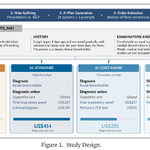
ALT This image is a diagram titled "Study Design" for a clinical presentation MTS_0481. It outlines a comparative study across four scenarios: Physician, AI-Generalist, AI-Cost-Aware, and AI-Parsimonious. Each scenario includes details on diagnosis, diagnostic orders, and costs in US dollars. The scenarios focus on acute bronchiolitis. The diagram also features stages like case selection, note splitting, plan generation, order extraction, and Medicare pricing.


ALT The image features a quote from an NEJM AI editorial by Adam A. Markovitz , M.D., Ph.D., and Alexander M. Chaitoff, M.D., M.P.H.: " It is easy to imagine AI lowering spending . . . . It is just as easy to imagine AI increasing spending.” A colorful silhouette of a face with horizontal lines is on the left. The NEJM AI logo is at the bottom right.

ALT This figure shows a hypothetical clinical interface in which AI generates diagnostic and management recommendations while the physician evaluates their appropriateness, incorporates patient priorities, and judges when to defer or intervene. Displayed findings and confidence estimates are illustrative.

ALT A flowchart consisting of three panels showing the iterative development, validation, and locked evaluation of an ensemble-based AI system. Panel A shows population-based outcome studies that provided whole-slide images of p16/Ki-67 DS cytology prepared with SurePath or ThinPrep. Panel B shows image tiles spanning unstable LH ranges being extracted in batches and processed using Cytoreader-Core for automated labeling. Panel C shows relabeled tiles being used to construct a deep ensemble with predefined parameters.


ALT The image contains text on a gradient purple and blue background with a quotation: "The rapidly evolving technology landscape requires leaders to thoughtfully integrate digital health tools and artificial intelligence within their organizations, which can be challenging in established organizations with entrenched policies and workflows." Below the quote reads the article headline "New Leadership Approaches for Health System Transformation in a Time of Rapid Change" by R. Bonesteel, et al. The image is from NEJM Catalyst | Innovations in Care Delivery.

ALT The image is page 1 of the editorial "Where Are the Prepared Minds? The Impact of AI on Scientific Thinking" published in NEJM AI. A dark blue banner at the bottom encourages readers to access the full editorial at ai.nejm.org.

ALT A bar chart showing the average large language model–patient agreement (blue bars) compared with average human proxy–patient agreement (horizontal brown and black dotted lines) across 10 repetition trials (±95% confidence intervals).

ALT A bar chart showing the mean adjudicator score (±95% bootstrapped confidence intervals) assessing the accuracy of large language model value profile generation (score out of 10) for each patient in the electronic health record cohort across the three reading levels: fifth grade, eighth or ninth grade, and college graduate level.

ALT A bar chart showing the adjudication of large language model treatment recommendations at the three reading levels (fifth grade, eighth/ninth grade, or college graduate level) averaged across adjudicators and the 35 electronic health record cohort patients.


ALT A collection of digital tissue samples is being analyzed by a stylized robotic device. The headline reads: "Closing the Automation Gap in HPV-Based Cervical Cancer Screening: Independent External Validation of an AI Model for Dual-Stain Triage," dated September 24, 2026.

ALT The image features a quote from an NEJM AI editorial by Roxana Daneshjou, M.D., Ph.D.: "As trainees move to become more seasoned scientists, they can choose how to safely incorporate AI without compromising their cognitive capabilities." A colorful silhouette of a face with horizontal lines is on the left. The NEJM AI logo is at the bottom right.

ALT A quote from a Perspective published in NEJM AI reads as follows: “Clinical AI is unlikely to follow a single regulatory or evidentiary template. . . . Even so, a staged evidentiary model analogous in principle to those used for drugs and devices offers a practical way to align innovation with clinical readiness.” The Perspective is titled “From Technical Performance to Clinical Readiness: A Phase-Based Framework for Evidence Standards in Clinical Artificial Intelligence” and the authors are I. Nenadic et al. The background color is dark blue and includes the NEJM AI logo.

ALT A quote from a Policy Corner article published in NEJM AI reads as follows: “In a rapidly evolving clinical AI marketplace, coordinated action between the CMS and FDA is necessary to balance fiscally responsible reimbursement standards with the preservation of market competition and diversity.” The article is titled “How Repeal of the NTAP Alternative Pathway will Impact U.S. Clinical AI Innovation” and the authors are A. Wong et al. The background color is orange and includes the NEJM AI logo.