

New Algebraic Topology papers from https://xitter.cf/t.co/Hzue3spPO0: homotopy theory, homological algebra. Thank you to arXiv for use of its open access interoperability.
- Tweets9K
- Following2
- Followers68
- Likes2

ALT We demonstrate that higher categories with adjoints behave like homotopy types. By the homotopy hypothesis, homotopy types can be regarded as higher categories in which all cells are invertible. We show that replacing invertibility by the existence of higher adjoints still supports a homotopy theory that is at least as rich as classical homotopy theory. The basic invariants of this theory are the homotopy monoidal categories Πₙ(X,x)=Ho(Ωⁿ(X,x)) associated to a based (∞,∞)-category with adjoints (X,x). These invariants are monoidal categories with duals and replace iterated loops with iterated endomorphisms. The classical homotopy groups of the classifying space are recovered as the isomorphism classes of objects in the groupoid completion. We prove a Whitehead theorem for homotopy monoidal categories and show that fibrations of higher categories give rise to long oriented exact sequences of homotopy monoidal categories. To develop homological algebra of higher categories with adjoints,

ALT In this paper, we give complete classifications of the finite groups G for which the constant Eilenberg–Mac Lane spectra Hℤ and HF₂ are Anderson self-dual up to a virtual representation shift, and we determine all such shifts. For both of these spectra, we determine the representation periodicity lattice for every finite group. As applications, we obtain RO(G)-graded universal coefficient theorems relating equivariant homology and cohomology, together with formulas for the Anderson duals of Hℤ-modules. In the HF₂ self-dual cases, we identify the graded F₂-linear dual of the coefficient ring π⋆ᴳ HF₂ with a representation shift of the ring as a module over itself. This gives perfect multiplication pairings and graded self-injectivity.

ALT Generalizing known results for G=C₂ and constant F₂-coefficients, we show the RO(G)-graded Bredon cohomology of a point with constant k-coefficients is self-injective whenever G is a finite subgroup of SO(3) and k is a finite field. Self-injectivity holds more generally for the RO(G)-graded homotopy of the Eilenberg–MacLane spectrum associated to a k-linear commutative Green functor M, whenever the spectrum HM is Anderson self-dual.

ALT Based on the theory of multicomplexes and other ideas by Gromov, we describe the flipping principle. This is an easy geometric criterion that forces the vanishing of the Gromov norm of homology classes. We use it to provide proofs based on a common geometric principle of the Vanishing Theorem and the Amenable Reduction Lemma by Gromov in the case of amenable and boundedly acyclic covers and colorings. We also strengthen the conclusion of the Amenable Reduction Lemma by showing that it implies the ℓ¹-invisibility of the homology classes and not only the vanishing of their Gromov norm.

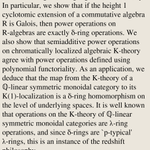
ALT We recast the theory of power operations in chromatic height 1 using higher semiadditivity. In particular, we show that if the height 1 cyclotomic extension of a commutative algebra R is Galois, then power operations on R-algebras are exactly δ-ring operations. We also show that semiadditive power operations on chromatically localized algebraic K-theory agree with power operations defined using polynomial functoriality. As an application, we deduce that the map from the K-theory of a ℚ-linear symmetric monoidal category to its K(1)-localization is a δ-ring homomorphism on the level of underlying spaces. It is well known that operations on the K-theory of ℚ-linear symmetric monoidal categories are λ-ring operations, and since δ-rings are `p-typical' λ-rings, this is an instance of the redshift philosophy.

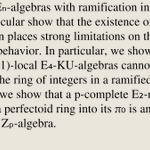
ALT We study Eₙ-algebras with ramification in their π₀ and in particular show that the existence of ramification places strong limitations on their chromatic behavior. In particular, we show that π₀ of nonzero K(1)-local E₄-KU-algebras cannot have a map from the ring of integers in a ramified extension of Qₚ, and we show that a p-complete E₂-ring with a map from a perfectoid ring into its π₀ is an associative Zₚ-algebra.

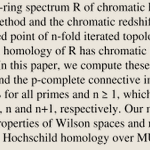
ALT For an E∞-ring spectrum R of chromatic height k, the trace method and the chromatic redshift imply that Tⁿ-fixed point of n-fold iterated topological Hochschild homology of R has chromatic height at most k+n. In this paper, we compute these heights for HFₚ, Hℤ and the p-complete connective image-of-J spectrum jₚ for all primes and n≥1, which are exactly n-1, n and n+1, respectively. Our method is based on properties of Wilson spaces and relative topological Hochschild homology over MU.

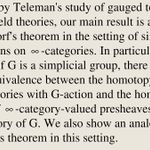
ALT Motivated by Teleman's study of gauged topological quantum field theories, our main result is an analog of Elmendorf's theorem in the setting of simplicial group actions on ∞-categories. In particular, we prove that if G is a simplicial group, there is a Quillen equivalence between the homotopy category of ∞-categories with G-action and the homotopy category of ∞-category-valued presheaves on the orbit category of G. We also show an analog of Whitehead's theorem in this setting.

ALT Every nonempty connected finite-dimensional CW topological semigroup admits a continuous associative multiplication on its universal cover that lifts the multiplication of the base. Such a multiplication is unique up to a deck transformation: in fact, any two associative lifts are conjugate whenever they exist. We show that the finite-dimensional hypothesis cannot be dropped in general: a connected, countable, infinite-dimensional CW topological semigroup is constructed for which continuous lifts of multiplication exist, but none is associative. The counterexample has nonabelian fundamental group isomorphic to Thompson's group F. Thus finite dimensionality is sufficient for associative lifting in the CW setting, whereas the unrestricted infinite-dimensional statement fails.

ALT We study higher complements of pseudohyperplane arrangements and the specialization maps between them, induced by degenerations. We develop a presheaf formalism on oriented matroids and weak maps, which model degenerations. Our main constructions are the posets of weighted and weightwise topes, which provide functorial combinatorial models for higher complements and their specialization morphisms. Their presheaf structure yields a deletion-contraction homotopy pushout, from which we derive a uniform combinatorial proof of the integral cohomology presentation for all n ≥ 2. This presentation is natural with respect to weak maps and identifies cohomology rings with higher Orlik-Solomon algebras extending the known formulas for linear arrangements to non-realizable oriented matroids. Finally, we equip Deligne groupoids with a presheaf structure and identify them functorially with the fundamental groupoids of the complexified complements.

ALT Let p be a prime and n≥ 1. We prove that the Tate-Frobenius of the K(n)-local sphere induces an equivalence between Lₙ₋₁LK(ₙ)Y and (LK(ₙ)Y)ᵗΣₚ ≅ (LₙY)ᵗΣₚ for any finite p-local type n-1 spectrum Y with trivial Σₚ-action.

ALT We prove that the deformation functor associated to an algebra over a sufficiently nice Koszul operad can be lifted to an operadic formal moduli problem over the Koszul dual operad. We further show that this operadic formal moduli problem corresponds to the derived center of the algebra under the operadic Lurie-Pridham correspondence. As an application, we prove that the classical Gerstenhaber algebra structure on polyvector fields of a commutative algebra agrees with the derived center of the algebra as an abelian Poisson algebra.

ALT Fundamental to the field of topological signal processing (TSP) is the persistence diagram (PD), or barcode, of a signal, which gives noise-resistant measures of topologically significant features as distinct from noise. Existing literature proves that the total persistence computed from these diagrams is equal to the total variation, for certain continuous signals on compact domains. We provide a closed formula for this shared quantity, and generalize to all continuous and discrete functions on bounded domains, and to certain functions on non-compact 1D manifolds. Extending the identification of continuous and discrete persistence, we investigate the similarities of functions with the same PDs, and prove that, for any n, the persistence diagram can be calculated as a function of the sequence of critical values; we compute these formulas for n ≤ 6. Finally, we examine which function transformations cause predictable changes in the PD of the transformed function, characterizing affine a

ALT Background: Clinical influenza vaccine effectiveness (VE) has often been low over the past two decades, highlighting the need for preseason VE forecasting. Timely forecasts could help health authorities plan prevention strategies and allocate healthcare resources. However, preseason forecasting of clinical influenza VE remains relatively uncommon. Methods: We obtained hemagglutinin (HA) sequences from GISAID for U.S. specimens collected in August–September before each influenza season from 2010–2011 through 2024–2025. After quality screening, we compared each virus with the corresponding vaccine target strain for the same season and subtype or lineage using two mathematical distances based on amino acid patterns in the HA protein. We calculated mean distances for each season and subtype or lineage and paired them with published clinical VE estimates, yielding 26 observations across 13 seasons. Using a mathematical AI approach, we fitted linear regression models of VE against each dista

ALT We study the negative gradient flow of analytic maps f:X→mathbbR defined on compact analytic Riemannian manifolds without imposing any nondegeneracy or transversality assumptions. We construct tight isolating blocks around the connected components of the critical set Crit(f) and record only bounded-time contacts made after an orbit exits one block and before it makes landfall within the interior of another. These contacts assemble into a strict topological category \cL – called the landfall category – whose classifying space B\cL is shown to be simple homotopy equivalent to X naturally over all down-sets of the flow partial order. The filtered homotopy type is independent of the isolating blocks. Passing to a finite subanalytic triangulation yields a flow-induced acyclic partial matching, and hence, an explicit finite chain complex generated by the non-exit simplices of the blocks which computes the homology of X. The finite model also computes the Morse–Conley spectral sequence over a

ALT We construct and describe the moduli stack Isog of isogenies between oriented elliptic curves. We show that Isog is a spectral Deligne-Mumford stack and a relative spectral algebraic space over ℳₑₗₗᵒʳ, and give a fiber product decomposition of Isog corresponding to a connected-étale factorization on oriented elliptic curves. In the process of proving these results, we construct a theory of duality and quotients for spectral abelian varieties, prove a higher-algebraic version of Nakayama's lemma, and lift the rigidity theorem for morphisms of elliptic curves to the setting of spectral algebraic geometry.

ALT Discrete homotopy theory is a combinatorial homotopy theory defined for discrete objects. Barcelo–Severs–White conjectured that the homotopy groups of complements of k-parabolic subspace arrangements are isomorphic to the discrete homotopy groups of graphs associated with the Coxeter complexes. We show that this correspondence fails in general by giving a counterexample in degree two for the 4-parabolic subspace arrangement of type A₅.

ALT We define a Nielsen coincidence number for pairs of maps (f,g) where f is n-valued and g is m-valued. The classical definition of the Nielsen number does not work in this setting, but we propose a theory where coincidence classes are allowed to overlap. We invoke a notion of multiplicity of a coincidence point, which indicates to how many classes it can belong, and we show that our Nielsen number is a homotopy-invariant lower bound for the number of coincidence points with multiplicity. We show a computational result in terms of single-valued lift factors, and using this, a Wecken property for self-maps of the circle.

ALT We freely enrich the pointed homotopy category of CW complexes over abelian groups and equip the resulting functor category with the enriched Day convolution induced by the smash product. After identifying the convolution unit and recording the coherence maps, we compute the convolution of the homotopy-group functors. For integers n,m≥ 2 we construct a natural isomorphism π_n⋆π_mcongπ_n+m induced by the external smash product; equivalently, the external smash product is the universal natural pairing of homotopy groups. Under this identification, the symmetry interchanging the two factors acts on π_n+m by multiplication by (-1)^nm.

ALT Segal computed π₀ of the equivariant sphere spectrum as the Burnside ring by a Pontryagin-Thom construction, transversality, and marks. We carry out the same argument in the motivic setting over a field k: the Burnside ring is replaced by the Grothendieck ring Aᵘ(Γₖ) of finite étale k-schemes decorated with a unit, the marks by the Dress map d(L,u)=trL/ₖ〈u〉 into GW(k), and a Pontryagin-Thom map Aᵘ(Γₖ)→π₀(Sₖ)(k) is shown to be surjective with kernel \ker(d). This gives π₀(Sₖ)(k)congGW(k) for infinite perfect fields of characteristic ≠ 2 without Morel's computation. We then identify \ker(d), by a reciprocity law on ℙ¹, as the group of principal quadratic divisors of rational functions, so that π₀ of the motivic sphere is the unit-decorated Burnside ring of Γₖ modulo principal quadratic divisors. The transversality step is proved by an elementary "re-topping" argument.