






3 Assembly elections. All 403 UP constituencies.
NINE145 UP Electoral Atlas — an interactive tool to track how UP voted in 2012, 2017 & 2022.
Margins, gender turnout, polling booths & a constituency-magnifier map — all in one place. 🧵👇
#UPElections #UPPolitics #Psephology

The Independence Day Speech 2025
Hindi Speech (PIB)
Words | 9,702 |
Time taken | 103 minutes |
Pages | 21 | Mangal (12) |
Paragraphs | 154 |
Lines | 630 |
Characters | No spaces | 38,548 |
Characters | With spaces | 48,506 |
From the PIB's English rendering of the text
Words | 9,131 |
Time taken | 103 minutes |
Pages | 17 | Times New Roman (12) | Single spaced |
Paragraphs | 156 |
Lines | 666 |
Characters | No spaces | 44,416 |
Characters | With spaces | 53,402 |
#IndependenceDay #IndependenceDay2025
32
Independence Day Speeches: PM Narendra Modi
Across 12 Independence Day addresses (2014–2025).
Has spoken for a cumulative 1,023 minutes.
That’s about 17 hours 3 minutes in total.
Averaging roughly 85 minutes per address.
Within your data, his longest was 2025 (103 minutes) and shortest was 2017 (56 minutes).
Holds the second-longest continuous run of Independence Day addresses.
12 consecutive years (2014–2025), behind Jawaharlal Nehru’s 17 (1947–1963).
#IndependenceDay #IndependenceDay2025
28
Independence Day Speech: Longest Continuous Runs
Jawaharlal Nehru: 17 years (1947–1963)
Narendra Modi: 12 years (2014–2025)
Indira Gandhi: 11 years (1966–1976)
Dr. Manmohan Singh: 10 years (2004–2013)
Atal Bihari Vajpayee: 6 years (1998–2003)
Rajiv Gandhi: 5 years (1985–1989)
P. V. Narasimha Rao: 5 years (1991–1995)
Lal Bahadur Shastri: 2 years (1964–1965)
Morarji Desai: 2 years (1977–1978)
Charan Singh: 1 year (1979)
H. D. Deve Gowda: 1 year (1996)
I. K. Gujral: 1 year (1997)
#IndependenceDay #IndependenceDay2025
42
A Dialogue in Umber and Ink
They never married; they never required that architecture. Yet decades later, an interviewer visiting their shared studio—now overlooking Bandra’s urban sea—would notice two rocking chairs near a half-open window that frames morning light. When asked who painted the chairs, Advait would reply, “We chose them together.” The reporter would assume modesty, unaware that together was the very gallery in which both had lived ever since.
And somewhere on the wall behind those chairs, half-hidden by vines of bougainvillea, would hang the diptych. One side rich with storms of pigment; the other bearing fresh ink that reads:
‘Uncertainty, at last, chose teal.’.......
storynine145.com/2025/07/08/…

अनुगूंज
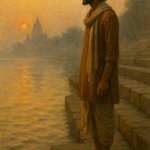
सवेरा अभी पूरी तरह खुला नहीं था। पूर्व दिशा में फीकी सुनहली परत अपना अधूरा संगीत बिखेर रही थी। निकुंज ने घाट की सीढ़ियों पर नंगे पाँव खड़े-खड़े नदी की धीमी लहरें सुनीं — ध्वनि इतनी हल्की कि कान ही नहीं, आत्मा भी ठहर कर सुनती। शहर की हाई-डेसिबल दुनिया से भागकर वह यहाँ आया था, पर भीतर का कोलाहल क्या सच-मुच पीछे छूट पाया था? कौन-सी आवाज़ असली है, और कौन-सी सिर्फ़ आदत? यह प्रश्न क्षितिज पर टँगा सूरज जैसा था — दिखता सदा, छूता कभी नहीं।
कुछ ही दूरी पर प्राचीन शिव-मठ की घंटी बजी। ध्वनि अनुगूँज बनकर पानी पर दौड़ी, फिर लौटकर निकुंज के भीतर उतर गई। उसके मन ने फिर खुद से ही खुद को कहा, “कितनी बार तुझे चेताया कि धीमे चल, मगर तू हर बार तेज़ी से ही भागा। अब क्या खोजने आया है?” वही मन, वही प्रश्न, वही अनिश्चितता। वह मुस्कुराया—inner sarcasm—और शांत बैठ गया।
“उद्धरेदात्मनात्मानं नात्मानमवसादयेत्।
आत्मैव ह्यात्मनो बन्धुरात्मैव रिपुरात्मनः॥”
(व्यक्ति को स्वयं ही स्वयं का उत्थान करना चाहिए; वह स्वयं मित्र भी है और शत्रु भी।).........
storynine145.com/2025/07/07/अनुगूंज/

17
India Demographics
· Population | 1,409,128,296 (2024 est.) | male (725,784,825) | female (683,343,471) |
· Rank | 2nd in total population (India has become the most populous country according to latest numbers) | 2nd in female population | 1st in male population |
· Age structure | 0-14 years: 24.5% (male 181,115,052/female 163,647,028) | 15-64 years: 68.7% (male 500,568,593/female 467,593,781) | 65 years and over: 6.8% (2024 est.) (male 44,101,180/female 52,102,662) |
· Dependency ratios | or total dependency ratio: 45.5 (2024 est.) | youth dependency ratio: 35.6 (2024 est.) | elderly dependency ratio: 9.9 (2024 est.) | potential support ratio: 10.1 (2024 est.) |
· Median age | total: 29.8 years (2024 est.) | male (29.1 years) | female (30.5 years) | comparison ranking (total 142)
(Source: The World Factbook, CIA)
#India #Census #Population
9
India | The Annual Survey of Unincorporated Sector Enterprises (ASUSE)
· For unorganized/unincorporated industries.
· Non-agricultural sectors | manufacturing, trade and other services sectors |
· Estimated number of workers | 2021-22 (9.79 crore) | 2022-23 (10.96 crore) |
Employment in India
· 2023-24 | employment increased to 64.33 crore |
· 2014-15 | 47.15 crore employed |
· Up by | 47.15 crore | during 2014-15 to 2023-24 |
(Source: RBI’s KLEMS Database)
· Data figures on employment generation estimates | across the whole country |
#India #Census #Population
24
India | The estimated Worker Population Ratio (WPR)
Or employment generated
· 2023-24 | 58.2% |
· 2017-18 | 46.8% |
· Unemployment Rate (UR) | 2017-18 (6%) | 2023-24 (3.2%) |
(Source: Annual Periodic Labour Force Survey (PLFS) Reports, Ministry of Labour & Employment, GOI)
· PLFS | done by MoSPI | since 2017-18 | period (July to June every year) |
· PLFS | collects data on employment and unemployment |
· EPFO | with new 7+ crore new subscribers | between September 2017 and September 2024 |
#India #Census #Population
18
India: Dependency Ratio
· What is DR? | number of | 0 to 14 years children + 60 and 60+ aged population | per 100 working age population (15-59 years) |
· What it highlights | the potential dependency burden on the working-age population |
· Higher numbers to support (children + elderly (dependent) | means higher DR | means more burden on unpaid care work | means overall extra burden on the economy |
· India’s DR | projected to come down | 2011 (64.6%) | 2026 projected (54.3%) | 2031 projected (53.7%) | 2036 projected (54%) |
· 0 to 14 population | 2011 | 30.9% | 2026 projection | 23.8% | 2031 projection | 21.9% | 2036 projection | 20.1% |
· 15 to 59 population | 2011 | 60.7% | 2026 projection | 64.8% | 2031 projection | 65.1% | 2036 projection | 64.9% |
· 60 and 60+ population | 2011 | 8.4% | 2026 projection | 11.4% | 2031 projection | 13.1% | 2036 projection | 14.9% |
(Source: MoSPI)
#India #Census #Population
19
India | Demographics
Current numbers
· Total population in millions, 2025: 1,46.39 crore
· Population annual doubling time (2025): 79 years
· Population aged 0-14, 2025: 24.2%
· Population aged 10-19, 2025: 17%
· Population aged 10-24, 2025: 26%
· Population aged 15-64, 2025: 68.7%
· Population aged 65 and older, 2025: 7%
· Total fertility rate, per woman, 2025: 1.9
· Life expectancy at birth, 2025, male: 71 years
· Life expectancy at birth, 2025, female: 74 years
(Source: United Nations Population Fund)
#India #Population #UNFPA
10
India | Working-age Population
· 2011 | 15 to 59 years | 60.73% of India’s population | or 73.54 crore persons |
· 2026 projection | 15 to 59 years | 64.8% of India’s population | or 92.39 crore persons |
· 2031 projection | 15 to 59 years | 65.06% of India’s population | or 96.21 crore persons |
· 2036 projection | 15 to 59 years | 64.93% of India’s population | or 98.85 crore persons |
(Source: MoSPI)
#India #Population #Census
10
India | Demographics
Census 2011
· Population | 121.09 crore
· 2026 projection | 142.59 crore
· 2031 projection | 147.88 crore
· 2036 projection | 152.23 crore
· 0 to 14 population | 2011 | 30.9% | 2026 projection | 23.8% | 2031 projection | 21.9% | 2036 projection | 20.1% |
· 15 to 59 population | 2011 | 60.7% | 2026 projection | 64.8% | 2031 projection | 65.1% | 2036 projection | 64.9% |
In Absolute Numbers
· Population | 1,21,08,54,977 |
· Households | 24,95,01,663 |
· Males | 62,32,70,258 |
· Females | 58,75,84,719 |
· Workers | 48,18,88,868 |
· Non-workers | 72,89,66,109 |
(Source: Census of India, MoSPI)
#India #population #Census
24
प्रसल: मौन के पार का सूर्योदय
storynine145.com/2025/07/06/प्रसल-मौन-के-पार-का-सूर/
#monologue #selfdevelopment #LifeLessons #lifeisstrange

20


