

Official Twitter account for the National Weather Service Seattle. Details: https://xitter.cf/t.co/yoQbjVwBSK
- Tweets47.3K
- Following428
- Followers258K
- Likes17.9K






ALT Graph showing types of tsunamis that can impact Washington. Anyone who lives near the ocean or large body of water is at risk of a tsunami. Distant tsunamis are tsunamis created by a distant earthquake or landslide that travels across the ocean. Areas of greatest impact for distant tsunamis are Pacific coastal areas. Communities impacted have hours to evacuate. Cascadia subduction zone tsunamis are created by large magnitude 8 or 9 earthquakes off the Pacific Northwest coast and can impact Pacific coastal communities. Communities impacted have tens of minutes to evacuate. Local tsunamis can be created by local earthquakes in large bodies of water near local faults. Local tsunamis can impact communities close to the water. Communities impacted have minutes to tens of minutes to evacuate. Landslide caused tsunamis occur underwater or from slides that land into water. Communities impacted depend on where the landslide occurs and can only have minutes to tens of minutes to evacuate.

ALT Una infografía con los tipos de tsunami que pueden impactar a Washington. Las personas que viven cerca del mar o una masa de agua están en riesgo. Los tsunamis lejanos son causados por terremotos lejanos o deslizamientos que viajan a través del mar. Las áreas más afectadas serán las áreas costeras del Pacifico y tendrán horas para evacuar. Los tsunamis creados por la zona de subducción de Cascadia son creados por terremotos de gran magnitud de 8-9 en la costa Noroeste del Pacifico y pueden afectar a las comunidades costeras. Tendrán decenas de minutos para evacuar. Los tsunamis locales pueden ser creados por terremotos locales en masas de agua que están cercas de fallas locales y pueden afectar a comunidades cercanas. Tendrán unos minutos a decenas de minutos para evacuar. Los tsunamis causados por deslizamientos ocurren debajo del agua o caen al agua. Las comunidades afectadas dependen del lugar donde el deslizamiento ocurre y tendrán minutos a decenas de minutos para evacuar.

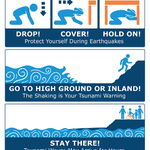
ALT Image depicting actions to take when an earthquake strikes. Drop, cover, hold on. If near a shoreline, the shaking is your warning. Go to high ground or inland. Image depicting a person running to higher ground with an incoming large wave offshore. Tsunami waves may arrive for hours, so make sure to stay inland on higher ground until the threat passes. Image depicts group of people together on high ground with large waves below them.

ALT Una imagen demostrando que hacer cuando ocurre un terremoto. ¡Agáchese, cúbrase, y sujétese! ¡Si está cerca de la costa, el temblor es su aviso natural! Diríjase a terreno elevado o al interior. La imagen contiene una persona corriendo a terreno elevado mientras se acerca una ola grande a la costa. Las olas del tsunami pueden continuar por horas, así que asegúrese de permanecer en terreno elevado o al interior hasta que la amenaza del tsunami termine. La imagen contiene un grupo de personas juntas en terreno elevado con olas grandes debajo de ellos.

ALT Image shows a community consisting of a house, school, store, highrise, playground, and roadways. Where will you be when an earthquake strikes? What will you do? If you are indoors, in a classroom, in a store, or in a highrise: make sure to drop, cover, and hold on. If you are in a wheelchair or walker: lock your wheels, cover your head and neck and hold on. If you are outdoors: move to a clear area if you can do so safely and drop, cover, hold on. If you are driving: pull over, stop, and set the parking brake. Stay inside the vehicle until the shaking stops. If you are near a shoreline: as soon as the shaking stops, head to high ground or inland.

ALT Una infografía de una comunidad de una casa, escuela, tienda, edificio alto, parque infantil, y carreteras. ¿Dónde estará usted cuando un terremoto ocurra? ¿Qué hará usted? Si está adentro, en un salón de clases, tienda o edificio alto: asegúrese de agacharse, cubrirse, y sujetarse. Si está en una silla de ruedas o un andador: ponga el freno de sus llantas, cúbrase la cabeza y el cuello, y sujétese bien. Si está afuera: diríjase a una área despejada si puede hacerlo seguramente y agáchese, cúbrase, y sujétese. Si está manejando, hágase a un lado, pare, y use el freno de emergencia. Quédese dentro del vehículo hasta que pare de temblar. Si está cerca de la costa: en cuanto pare de temblar, rápidamente diríjase a terreno elevado o hacia al interior.

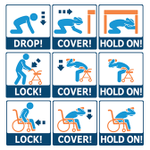
ALT Image depicting actions to take when an earthquake strikes. Drop, cover, hold on. If you use a walker or a wheelchair, lock, cover, and hold on.

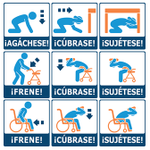
ALT Una imagen demostrando que hacer cuando ocurre un terremoto. Agáchese, cúbrase, y sugétese! Si usa un andador o una silla de ruedas, frene, cúbrase, y sujétese.

ALT Join us at 10:15am for the statewide earthquake and tsunami drill and siren test. Image depicts actions to take when an earthquake strikes: drop, cover, hold on. Image also depicts actions to take after the shaking stops. If you are along the coast, the shaking is your tsunami warning. Go to high ground or inland after the shaking stops.

ALT Are you prepared for a foggy commute? Slow down and allow extra time to reach your destination. Turn on your low-beam headlights and fog lights if you have them. Never use high-beam lights. Leave plenty of distance between you and the vehicle in front of you.

ALT ShakeOut. Don’t freak out. Get ready to shakeout on October 15, 2026. Register at ShakeOut.org.

ALT Una imagen con el texto: ven, muévete, participa y protégete, para el ShakeOut el 15 de octubre, 2026. Regístrate en ShakeOut.org/espanol
