
The Jet Propulsion Laboratory advances science and discovery through NASA robotic missions exploring Earth, the solar system, and the universe.
- Tweets13.5K
- Following129
- Followers3.7M
- Likes18K








ALT An artist's concept of the Voyager spacecraft, with its long antenna pointing down and to the right in the direction of Earth. Earth isn't visible in the image, but Voyager is among the stars. In the background, there is also a long, deep blue ribbon of gas and dust stretching from the bottom of the image to the top.


ALT Poster with a dark background and 1970-style gold lettering that reads: Voyager One Light Day. A stylized golden rendering of the spacecraft swooshes through the scene.

ALT Poster with a dark background and gold lettering that reads: Voyager One Light Day. A stylized golden rendering of the spacecraft fills most of the lower third of the frame, near an orbital map of the solar system showing the spacecraft's trajectory past the planets and out into interstellar space. Text details aspects of the voyager in terms of its distance, time, and speed.

ALT A gold rendering of Voyager 1 against a starry background accompanies the headline “Shine Bright for Voyager’s Light-Day.” After sunset on Tuesday, Nov. 17, 2026, celebrate Voyager 1 reaching one light-day from Earth by signaling its call sign, V-G-R. Open the automated flasher in your phone or tablet’s browser and point your device toward the sky, or use a flashlight to flash the on-off pattern shown online. Find both at go.nasa.gov/shinebright.


ALT JPL, Caltech, and California Science Center leaders stand along a railing near Space Shuttle Endeavour at the Samuel Oschin Air and Space Center. The white shuttle is displayed upright beside its orange external tank and a white rocket booster, under the gallery’s tall steel rafters.

ALT Guests gather around touchscreens in the Kent Kresa Space Gallery. Models of a Mars lander and several generations of rovers stand against a rust-colored panorama of the Martian surface, with a model of the Ingenuity helicopter suspended above them.

ALT Dave Gallagher, Jeffrey Rudolph, Kent Kresa, Lynn Booth, and Ray Jayawardhana stand shoulder to shoulder, in that order from left to right. Behind them, the words “Kresa Space Gallery” appear above large yellow letters spelling “SPACE.”


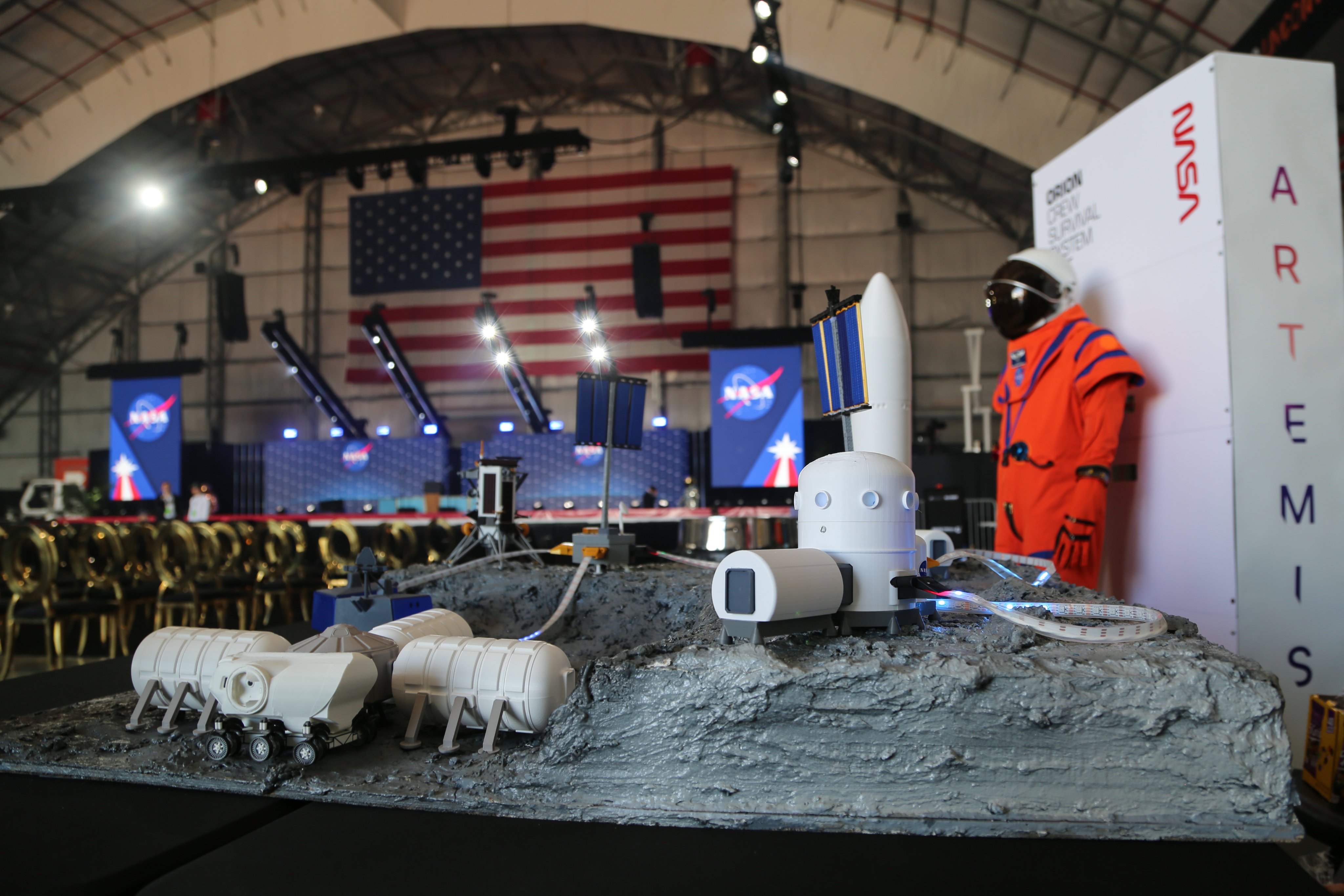
ALT A NASA exhibit at UP.Summit during MAX POWER on Nov. 6, 2026, features a conceptual lunar surface display illustrating the power infrastructure needed to support longer-duration missions on the Moon. In the foreground, miniature habitation modules and other lunar surface assets sit atop a gray, rocky terrain model, demonstrating how infrastructure could support sustained lunar exploration. The display is illustrative and does not represent a finalized Moon Base design. Behind the model stands an orange Orion Crew Survival System suit, with a stage and large American flag visible in the background. Credit: NASA/Briana Zamora

ALT Two strips of inky black solar arrays cross diagonally over the scene. In the background is a stark white clean room. A technician in clean room attire is inspecting the hardware in the foreground. Credit: BAE Systems Space & Mission Systems