

Join us as we explore the worlds of our solar system.
- Tweets9.8K
- Following140
- Followers3M
- Likes11.2K




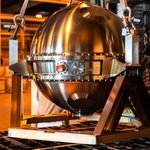


ALT Photo of a Hall thruster identical to those on NASA’s Psyche operating in a vacuum chamber at JPL during tests. A ring of blue light emits a hazy stream of glowing material. The blue light is generated by xenon ions being accelerated through an electromagnetic field, which gives the spacecraft a gentle but steady acceleration. NASA/JPL-Caltech

ALT Screenshot of a web application showing the current position of the Psyche spacecraft with its wings of solar panels, along with more info about the mission.


ALT A graphic with NASA's "meatball" logo, which consists of a blue circle dotted with stars and crossed by a red, V-shaped swoosh. "NASA" is written in large white text on the circle, which is set against a solid black background. Credit: NASA


ALT screenshot of web application representing several antenna ground stations and which are actively communicating with which spacecraft. One antenna is shown downlinking data from MMX.


ALT An artist’s concept of JAXA’s MMX spacecraft at Mars. Credit: JAXA


ALT screenshot of a web application showing a simulated view of the asteroid-like moon Phobos above the surface of Mars


ALT A web of satellite flight paths criss-cross around Earth



ALT A long-exposure photo of Earth taken from aboard the International Space Station. The nighttime view of Earth shows long streaks of city lights and a soft, green airglow outlining the planet. Blurry stars fill the background, and space station hardware appears in the foreground.

ALT A rocket lifts off on a pillar of fire as a bird flies by, the scene reflected in the still waters of a lake.

ALT A rocket lifts off on a pillar of fire


ALT NASA's Cassini spacecraft captured this natural color view of Saturn almost a month after the planet's August 2009 equinox. The shadow cast on the planet by the rings remains narrow. Credit: NASA/JPL/Space Science Institute

ALT Saturn's rings obscure part of Titan's colorful visage in this image from NASA's Cassini spacecraft. The south polar vortex that first appeared in Titan's atmosphere in 2012 is visible at the bottom of this view. Credit: NASA/JPL-Caltech/Space Science Institute

ALT Saturn's largest and second largest moons, Titan and Rhea, appear to be stacked on top of each other in this true-color scene from NASA's Cassini spacecraft. The north polar hood can be seen on Titan appearing as a detached layer at the top of the moon on the top right. This view looks toward the Saturn-facing side of Rhea (949 miles or 1528 kilometers across). North on Rhea is up and rotated 35 degrees to the right. Images taken using red, green and blue spectral filters were combined to create this natural-color view. The images were acquired with the Cassini spacecraft narrow-angle camera on June 16, 2011, at a distance of approximately 1.1 million miles (1.8 million kilometers) from Rhea and 1.5 million miles (2.5 million kilometers) from Titan. Image scale is 7 miles (11 kilometers) per pixel on Rhea and 9 miles (15 kilometers) on Titan. Credit: NASA/JPL-Caltech/Space Science Institute

ALT A blue hue, present in the northern hemisphere of Saturn is seen here by NASA's Cassini spacecraft. The changing blue hue marks winter at Saturn and is likely due to reduction of ultraviolet sunlight and the haze it produces, making the atmosphere clearer and increasing the opportunity for Rayleigh scattering (scattering by molecules and smaller particles) and methane absorption. This view looks toward the unilluminated side of the rings from about 44 degrees below the ring plane. Images taken using red, green and blue spectral filters were combined to create this natural color view. The images were taken with the Cassini spacecraft wide-angle camera on July 29, 2013. Credit: NASA/JPL-Caltech/Space Science Institute

ALT Illustration of the MMX spacecraft, with its landing legs and solar panels, in space above Mars, with the small moon Phobos nearby. Credit: JAXA

ALT A stylized graphic showing the arc of a planet, with various arcs above it symbolizing orbits or trajectories, in shades of neon blue and red against a black background. The text "PLANETARY DEFENDERS" is overlaid in the middle.