

Data center maximalist
At sea
Joined March 2014
- Tweets12.7K
- Following5.6K
- Followers4K
- Likes94.5K


Native_0x retweeted

Have you ever wondered why catching Starship is so much harder than catching Super Heavy, even though they both return to the same launch tower? 🔥
💡 The answer comes down to four major engineering challenges that make Starship’s recovery fundamentally different 👇
⚡ The first problem is shedding an enormous amount of energy
At hot staging, Super Heavy was traveling at roughly 5,800 km/h (3,600 mph). Starship, meanwhile, had to return from orbital speeds of roughly 27,500 km/h (17,100 mph).
That’s nearly five times faster. Because kinetic energy increases with the square of velocity, each kilogram of Starship at orbital speed carries roughly 22 times the kinetic energy of a kilogram of Super Heavy at separation.
That works out to nearly 30 million joules per kilogram.
Almost all of that energy has to be dissipated before Starship can safely reach the tower.
One option would be to use rocket propulsion to cancel out its orbital velocity. However, scrubbing off roughly 7.7 km/s of speed using Raptor engines alone would require a massive amount of propellant.
The rocket equation makes this approach especially punishing. Every extra kilogram of landing propellant has to be hauled into orbit first, dramatically increasing the fuel needed at liftoff.
Instead, SpaceX uses Earth’s atmosphere to bleed off almost all of Starship’s orbital velocity.
That saves an extraordinary amount of propellant, though it introduces another major hurdle.
🔥 Surviving extreme atmospheric heating comes next
As Starship plunges into the atmosphere at hypersonic speeds, powerful shock waves compress and heat the surrounding air to blistering temperatures.
Thousands of ceramic heat-shield tiles protect its stainless-steel structure from the intense heat.
Simply keeping those tiles attached isn’t enough, though. Superheated gas can seep into the gaps between them, risking damage to the underlying structure.
For Flight 15, SpaceX carried forward upgrades from Flight 14, including extra tile-retention hardware in vulnerable areas and redesigned curved tiles that reduce heating between adjacent tiles.
Because Super Heavy never reaches orbital velocity, its return doesn’t expose it to anything close to the same thermal stress.
And there’s another complication.
A heat shield that survives one reentry isn’t necessarily ready to fly again. Starship’s thermal protection system must eventually withstand repeated missions without major repairs or refurbishment.
That’s critical, since rapid reusability is one of the core reasons SpaceX designed Starship to be caught rather than discarded.
Yet surviving reentry still isn’t enough. Starship also has to arrive at the exact right spot.
🎯 Hitting a precise target from orbit raises the stakes even further
About 56 minutes before the catch, a single Raptor engine fired for just 10 seconds to initiate Starship’s return.
That brief deorbit burn wasn’t meant to eliminate orbital velocity. Instead, it nudged the spacecraft’s trajectory so atmospheric drag could take over the much larger job of slowing it down.
Starship then entered the upper atmosphere thousands of kilometers away over the Pacific Ocean.
From there, its four aerodynamic flaps controlled its orientation and fine-tuned the forces acting on the vehicle.
Super Heavy uses grid fins to steer during its return, but Starship’s flaps have to handle a far wider range of flight conditions.
As Starship decelerates from hypersonic through supersonic and down to subsonic speeds, its guidance system continuously adjusts its attitude and flight path.
The challenge is maintaining the right balance of altitude, speed, and trajectory while aerodynamic forces shift dramatically throughout reentry.
For Flight 15, the return corridor crossed sparsely populated parts of northern Mexico and South Texas.
Starship maneuvered around major population centers in the Rio Grande Valley, passed north of South Padre Island, headed offshore over the Gulf of Mexico, and made its final turn toward Pad 2 at Starbase.
Think about the guidance precision required.
A spacecraft returning from orbit must dissipate nearly all of its immense kinetic energy while threading a carefully controlled trajectory straight back to a single launch tower.
It also has to arrive at a low enough speed, in the proper orientation, and with enough propellant remaining to pull off the final maneuver.
That brings us to the most visually spectacular part of the entire recovery.
🚀 Executing the landing flip with pinpoint precision is the final test
Super Heavy approaches the launch tower already vertical, using its grid fins and Raptor engines to guide its final descent.
Starship comes in belly-first.
It has to rapidly swing its massive frame upright, stabilize its attitude, and align itself precisely between the tower’s mechanical arms.
SpaceX’s official Flight 15 timeline allotted just 18 seconds between the start of Starship’s landing burn and the catch.
During those 18 seconds, three sea-level Raptor engines ignite to kick off the maneuver.
The spacecraft rotates upright while its flight computers constantly regulate engine thrust and vehicle attitude.
The engines then step down from three to two, giving the vehicle finer control as it nears the chopsticks.
Finally, it transitions to a single engine for the last moments of descent before shutting down as the tower takes its weight.
Consider the coordination involved.
The guidance system must balance translation, rotation, thrust, and descent rate while positioning a massive spacecraft within a narrow capture envelope.
Unlike a conventional vertical rocket landing, Starship must first transition from an aerodynamically controlled, belly-first glide to an engine-powered vertical approach.
All of this unfolds within seconds, right after the vehicle has completed one of the most punishing atmospheric reentries ever attempted by a reusable spacecraft.
🧠 What makes SpaceX’s approach so ingenious is how seamlessly the entire recovery system works together
Trying to solve every phase of the return with rocket propulsion would carry a crushing propellant penalty.
Instead, SpaceX delegates the toughest parts of the recovery to systems purpose-built to handle them.
The atmosphere dissipates most of the orbital kinetic energy without consuming onboard propellant.
The heat shield protects Starship from the intense thermal loads of that deceleration.
The four aerodynamic flaps provide the control authority needed to manage its attitude, energy, and trajectory throughout atmospheric flight.
And the Raptor engines take over once aerodynamic control alone can no longer deliver the precision needed for the final catch.
That division of labor allows SpaceX to recover an orbital spacecraft without carrying enough fuel for an all-propulsive return.
Yet the engineering trade-off goes deeper than saving propellant.
SpaceX is shifting much of the cost of returning from orbit away from expendable propellant and toward reusable hardware built to endure extreme thermal and mechanical stress.
The potential economic payoff is enormous.
Cutting back on the propellant reserved for recovery frees up more of Starship’s mass capacity for useful payload. However, that advantage only becomes truly meaningful if the heat shield, flaps, engines, and other systems can survive repeated flights without extensive refurbishment.
That’s why catching Ship 42 is such a landmark milestone.
SpaceX has proven that its thermal protection, aerodynamic controls, propulsion, and guidance systems can work in concert to recover an orbital upper stage right at the launch site.
The next engineering hurdle is proving that the same spacecraft can do it repeatedly.
If SpaceX can bring Starship home, inspect it, refuel it, and launch it again without rebuilding major systems, the economics of getting payload to orbit could change dramatically.
That first catch proves the recovery architecture works. Repeated reflights will determine just how much of its economic potential SpaceX can unlock.
Native_0x retweeted

The AI Futures Project have updated their timelines. They say we are five months ahead of AI 2027, and they now believe a Superhuman AI Researcher will arrive sometime in 2027.

Native_0x retweeted

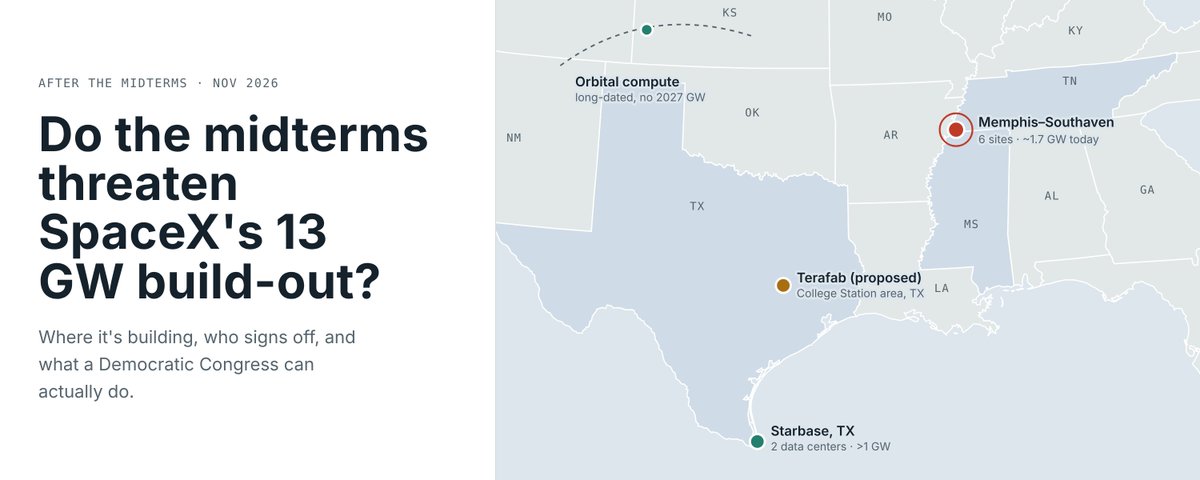
Democrats swept Congress. Does that threaten SpaceX's 13 GW AI compute build-out?
$SPCX
Native_0x retweeted

In 2 Wochen werde ich 27 – und habe bereits 3 Jahre meines Lebens an ME/CFS verloren
Job gekündigt. Studium abgebrochen. Zurück bei meinen Eltern.
Über 650.000 Menschen in Deutschland sind betroffen. Nur mehr Forschung und wirksame Medikamente können uns unser Leben zurückgeben.
Deshalb sammle ich erneut Spenden für die gemeinnützige @MECFSResearch
Jeder Euro und jeder Retweet hilft enorm. Danke 🙏
👉 betterplace.org/de/fundraisi…
#MECFS #MECFSResearch #LongCovid

Native_0x retweeted

If you’re a macro investor, connect the dots for a second. Markets are pricing in a September hike, yields are surging, and the consensus is completely taking the bait.
Druckenmiller who literally trained both Warsh and Bessent publicly takes a swing at Bessent’s bond market interventions. Bessent plays along, firing right back. Meanwhile, Warsh and Druck wrote this piece calling on the Fed to hold off on hikes in 18.
It’s a masterclass in narrative control imo. Warsh gets styled as the uncompromised hawk to buy the central bank maximum market credibility even though everyone knows the core mandate from Trump is to cut rates.
Trump throws up a bone, gets a deal with Iran. Crude gets crushed-> yields come down, energy drops, and inflation cools. Warsh gets his cover to aggressively cut, equities rip to fresh all time highs, and the Admin claims its "Golden Age."
I mean come on it’s too obvious!!!


Native_0x retweeted

I want to send 20 brands into low Earth orbit aboard a Falcon 9.
An actual billboard on a satellite payload orbiting planet Earth.
17 fixed spots, 3 up for auction starting at $100. Target is $1m to liftoff.
orbitadspace.com

Native_0x retweeted

Guys, the world is so compute constrained. I honestly don’t understand how anyone can think otherwise.
Almost nobody is seriously using AI today, and we’re already hitting capacity. Everything is a bottleneck: land for data centers, permits, electricity, grid connections, chips, construction, cooling.
Demand is growing far faster than supply, and expanding supply is insanely expensive.
In this game, the best-positioned companies are the ones with massive net income from non-AI products. They can fund hundreds of billions in CapEx while everyone else has to raise money just to stay in the race… and remember if you are not at the frontier you have no pricing power so you won’t be able to fund your compute need.

Kimi K3 has received far more love than we expected, and our GPUs are feeling it.
Over the past 48 hours, demand has pushed close to the limits of our current capacity. To protect the experience of existing subscribers, we're temporarily pausing new subscriptions and prioritizing compute for current members. Existing subscribed users are not affected.
We're adding capacity as fast as we can and will reopen new subscription spots in batches.
Going forward, we'll also split membership into two more focused plans: Kimi Membership for Kimi Web, App, and Work; and Kimi Code Membership for coding workflows. This will help us match compute more precisely and keep the experience stable.
Thank you for your patience and understanding!


Native_0x retweeted

In London this week.
Every time I’m here, I’m struck by how beautiful many parts of the city are.

Native_0x retweeted

What locking in at @dupeapp looks like in 2026.
More people are discovering Dupe, and the vast majority of that growth, roughly 70–75%, is organic.
At the same time, we've brought a number of upgrades to our matching algo, improving our ability to understand what shoppers are actually looking for and are likely to purchase.
As Dupe grows, the platform becomes increasingly effective at connecting shoppers with products they're likely to love. Better recommendations lead to greater confidence, which in turn drives higher engagement, stronger conversion, and more purchasing activity across the platform.
The data reflects that while our audience is growing quickly, shopper engagement and purchase activity are growing even faster.
We're actively investing in our partnerships in fashion, accessories & beauty. If you're an affiliate manager in this space in a top 100 brand we'd love to show you how Dupe can help you grow your sales FAST. Reach out and i'll get you in touch with our partnerships team.
Finally, we've doubled our team size this quarter and are bringing on more critical hires by end of June, starting with a Staff Designer ($10k bounty included) 👉🏼 lnkd.in/esKu8uCP

Native_0x retweeted

By the way, Lilly's is not the only one-and-done cholesterol-lowering therapy in development
To name a few others:
1. CRISPR Therapeutics (ANGPTL3 CRISPR)
2. YolTech (PCSK9 base editing)
3. Scribe (PCSK9 epigenetic silencing)
4. Editas (LDLR CRISPR upregulation)
5. Epigenic (PCSK9 epigenetic silencing)


Native_0x retweeted

Memory shortage lasting WELL past 2026 everyone..
Again, just wait until you see how much memory (and storage) is required for inference/agentic AI.
Native_0x retweeted

why are they like this?
@jessepollak man enough with shilling memes and get involved with the real projects surely?
Native_0x retweeted

Hey! We officially launched on YC, we are building a programmable drug to cure all cancers with a simple kill switch triggered by a DNA match
We appreciate any likes, comments, and repost!!! Thank you guys!
Linkedin:
linkedin.com/posts/finaldose…
X:
nitter.gq/i/status/2054230123730…


FinalDose is building the first programmable drug platform - a single smart drug molecule that finds diseased cells by their DNA and destroys them. They're starting with all cancers.
Congrats on the launch, @Jeffliu6068Liu, @sklin_lite, and @liyaohuang2!
ycombinator.com/launches/QKj…
Native_0x retweeted

You dont want a yacht. You dont want a big house. You dont want a super car, a $40,000 watch, or shoes you worry about getting dirty. You want free will.
You want to wake up naturally on a Tuesday and you want to go to bed when you’re done having fun. You want to say yes to everything that excites you without having to request time off. You want to go to the the gym at noon, in absolutely no hurry. You want to spend 18 hours a day doing what you love. You want to be exactly where you desire being, always. You want to spend as much time with the people you care about as possible.
You’re saying you wanna be rich? In what?
Native_0x retweeted

To the DMs and TGs asking if we still believe in $dupe. We’re redesigning who’s in our holder base. As we mentioned in Q4’25, we want our core holders to be institutions and our own co. Over $1M of institutional capital has come into solana:fRfKGCriduzDwSudCwpL7ySCEiboNuryhZDVJtr1a1C since March. $2M since Oct last year.

+77% AOV growth so far this year compared to this time last year (and growing).
We’re mindful of not just buying growth with marketing. The goal is building a durable business by relentlessly improving the product.
Our AOV trend tells the story better than anything else: users are getting dramatically more confident spending higher cart values with Dupe at their side and its because the product got better not because we cranked ad spend.
The secret is we disrupt ourselves constantly. Every other month or two we’re willing to rethink core assumptions, ship risky changes, and rebuild things from scratch if needed. Most experiments don't move the needle, but the learnings compound until one changes the trajectory of the company.
The unlocks so far have been:
→ AI that understands shopping intent more accurately than leading foundation models and shopping startups alike
→ Superior product matching algorithms that understand shoppers' preferences
→ Deep investment in making our partners more money with each click
→ 1B+ products processed across 1M+ stores
→ Major UX upgrades across the experience
→ Major investments in growing the team
Dupe is the only consumer AI shopping platform purpose-built to compound buyer conviction over time.
We're hiring in NYC (or tri-state) btw. We need:
- iOS Eng
- API Eng
- SRE
- Head of Creator
- AI Systems Eng
- Product Designer
- Executive Assistant
- Growth Marketer
- Lifecycle Marketer
solana:fRfKGCriduzDwSudCwpL7ySCEiboNuryhZDVJtr1a1C

Native_0x retweeted

On the topic of $MSTR selling $BTC:
- First, it's nothing new, they have been signaling for months now that selling BTC to fund dividends was an option. It was already the case on the last earnings call
- It's true though that they looked even more open to this idea on yesterday's earnings call. What's also new is that they explained for the first time that the theoretical threshold to choose selling BTC over MSTR to fund dividends was not 1x mNAV but 1.22x. That's a pretty big statement because it sort of forces them to stick to their word and sell BTC below that level (instead of selling MSTR shares).
- I think they want to get rid of the "If they sell a single BTC, it's over for them" narrative. They will sell some BTC, everyone will realize that nothing happens, and all the people who were parroting this stupid statement will be proven wrong once again.
- Maybe the most important thing to realize is that they "only" have to pay $125M in dividends per month. Selling $125 M worth of BTC per month has basically zero impact on the price. And even you think that "it's about the narrative impact", then let me remind you that they are *already* selling $125 M a month of a close derivative of BTC, which is the MSTR common stock.
- What they were also signaling yesterday, is that they want to see mNAV go up again. To be honest, this reminds me of the time when they said they wouldn't sell MSTR shares below 2.5x mNAV, these were the guidelines that they never respected, so take all of their plans with a grain of salt.
- Stating that they are likely to sell BTC increases optionality for Strategy, and that's imo a good thing. Another positive consequence is that for the first time, we are seeing a path where the BTC stack of MSTR doesn't only go up. For the people who are scared about Saylor holding too much BTC for the asset to remain "decentralized", this should be viewed positively.
Native_0x retweeted

What if you could test a drug on a human organ and simultaneously know what would have happened without it?
That's what we built.
Proud to share our work in @NatureBiotech: digital twins of human lungs 🫁🔥 (paper: nature.com/articles/s41587-0…)
We created digital twins of ex vivo human lungs: multimodal AI models trained on 951 human lungs from the world's largest EVLP dataset at @UHN. Physics-informed ML across physiology, biochemistry, transcriptomics, proteomics, metabolomics, and imaging, all forecasting together.
The key insight: the physical lung receives the treatment. The twin is the untreated control. Paired causal inference on the same organ. No separate cohort. No intersubject noise.
Result: we detected drug efficacy with 6 lungs. Traditional methods would need 18.
This is what precision preclinical evaluation looks like.
From Virtual Cells → Virtual Organs → Virtual Patients.
One step toward virtual organs replacing animal testing.
Huge congratulations to Elly Zhou (a phd student I co-supervise) for leading this work with exceptional rigor, and to Andrew Sage and @SKeshavjee for building the foundation that made it possible.

Native_0x retweeted

kalshi ($22b valuation, CFTC-regulated, backed by coatue) just launched perpetual futures on hyperliquid infrastructure. $100b annualized volume trajectory running through $HYPE's order book. a regulated US exchange with ICE and FIS partnerships chose hyperliquid over building in-house. polymarket launched perps 2 hours later on acquired brahmaFi tech. the prediction market perps war is now a proxy war for settlement layer dominance and hyperliquid is the arms dealer to both sides of tradfi