

Decoding Global Markets 🌍 | Charts Tell the Truth | Macro • Crypto • Equities | Tweets are not financial advice |
Joined April 2010
- Tweets23K
- Following901
- Followers8.2K
- Likes5.8K






Understand it, and review your Crypto account.
Also try to use different Email and Password for small and new exchanges..

4 data leaks reported today:
1. Coinbase's vendor Amplitude exposed some users’ contact data (funds unaffected).
2. Bithumb (Korea) had user data leaks.
In TradFi, two securities firms in Korea leaked data:
3. Mirae Asset
4. Daishin Securities
You can't prevent a leak, but you can protect yourself.
Leaked exchange data (names, emails, phone numbers, addresses, ID documents, transaction history) is mostly used for phishing, SIM swapping, and social engineering.
Reduce info you share
- Use a unique email alias for each exchange (SimpleLogin, Apple Hide My Email, etc). A leak then can't be linked to your other accounts, and you can spot which service leaked.
- Share only what's required. Don't add optional profile details.
- Use a dedicated phone number (a VoIP or secondary SIM) for exchange accounts if you can, since leaked numbers are the main route to SIM swaps.
Lock down the account
- Use a unique, long password from a password manager.
- Turn on hardware security keys (YubiKey) or passkeys, or at least an authenticator app.
- Avoid SMS 2FA.
- Enable withdrawal address whitelisting and a withdrawal time lock if the exchange offers them.
- Set up an anti-phishing code, which puts a code you choose in every legitimate email from the exchange.
- Review active sessions and API keys regularly. Delete any API keys you don't use.
- Restrict API keys to withdraw-disabled and IP-whitelisted.
Defend against
- SIM swapping: Ask your carrier to add a port-out PIN or number lock.
- Phishing and impersonation: Assume anyone who contacts you about your account, "security issues," or "refund recovery" is a scammer, even if they know your name, balance, or recent trades.
- Exchange support staff don't ask for your password, 2FA codes, or seed phrase.
- Never click links in emails or texts. Go to the site yourself.
- "Wrench attacks": Leaked addresses plus holdings data have led to real-world extortion and robberies. Don't publicize your holdings, and keep large balances out of anything tied to your home address if you can.
If a breach is announced
1. Change the exchange password and any other account that reused it.
2. Check haveibeenpwned.com for your email address.
3. Revoke API keys and active sessions.
4. Review recent withdrawals and security settings.
5. Watch for phishing emails and texts that reference the breach, because scammers move fast after one.
Stay SAFU! 🙏

$BTC: Bitcoin broke out of the symmetric triangle on the 4h chart.
Price pushed above the descending resistance and is now holding near $81k. The breakout is confirmed. R1 sits around $82k and R2 near $84.5k.
Momentum is improving. The MACD is turning up from the lows. A follow-through above $82k would strengthen the move. Failure to hold the breakout zone would put the structure back into question.
FOMC is today, FED going to pause but how Kevin Warsh can be dovish with OIL above $100


Semiconductor index #SOX rose 3.44% today.
$NVDA +2.61%
$MU +4%
$SNDK +2.36%
$INTC +5.65%
$WDC +5.30%
$CRWV +4%
After the recent weakness, this is a clear bounce in the group. The question now is whether this turns into a short-term rally or just a one-day relief move.
Watch if the strength holds over the next few sessions. Semis often lead when risk appetite returns.
Rest. #DYOR Follow @NeelMacro


Understand what happen with Brazil's stock market.
Brazil’s Bovespa dropped nearly 14% in one session after the election result.
Markets had been pumped hard on the expectation of a right-wing win. After the first round, investors positioned for Flávio Bolsonaro and the fiscal tightening they hoped would come with him. Stocks and the currency rallied on that bet.
Then Lula won the runoff. The left-wing candidate defeated the right-wing candidate, and the market erased most of those recent gains in a single day. Brazil ETFs in Asia fell as much as 15-16% before local markets even opened.
This was not a full crash. The index is still up roughly 9% for the year and 50% up since Jan 2025. It only gave back the election-driven rally.
If you only read X influencers, it looks like the end of Brazil’s market. The truth is simpler. Market makers played their role. Buy the rumor, sell the news.
This is not limited to crypto alts. It happens in any market that runs hard in a short period on an expected outcome, then reverses when the actual result arrives.
Rest. #DYOR Follow @NeelMacro

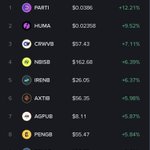
8 of the top 10 gainers are stocks. Just give ideas on where liquidity moves first.
$CRWV $NBIS $IREN up despite of Musk concern
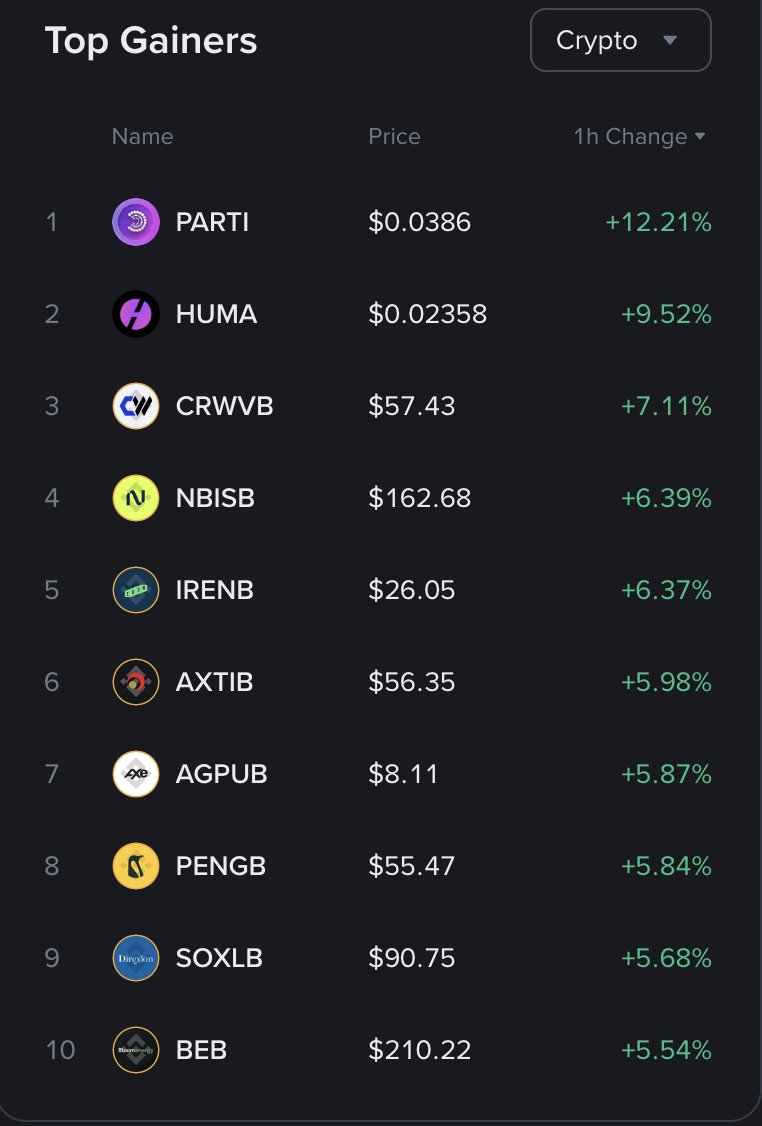


#Bitcoin has continued dropping over the last 5 days and has lost the daily MA 50.
Weekly Stoch RSI is showing losing momentum.
Five big events are coming in a short window:
1. Israel Election – Oct 27
2. FOMC – Oct 28
3. $GOOGL + $META Earnings – Oct 28
4. $AMZN + $AAPL Earnings – Oct 29
5. US Midterm Election – Nov 3
These will drive volatility.
Bitcoin stays in a bull structure as long as it holds above the weekly MA 50 near $75,800.

No One Tell You This
S&P 500 has been positive in every single November-to-June period after midterms since 1942.
21 out of 21. Average gain: +16.6%.
US midterms are on November 3. History says the six months after tend to be constructive for stocks.
Rest. #DYOR Follow @NeelMacro


HISTORY SAYS THE NEXT 12 MONTHS COULD BE VERY BULLISH FOR S&P500
Since 1950, the S&P 500 has gone up in the 12 months after every single US midterm election.
A separate dataset going back to 1942 finds the same thing in the November to June window after a midterm: 21 for 21, also positive every time.
Year 3 of the presidential cycle, the year right after the midterm, has also historically been the strongest year of the entire 4-year cycle.
Fidelity's 1961-2024 data puts the average at 18.7%.
Here's why this keeps happening.
Before an election, markets have to price every possible outcome at once: who controls Congress, which taxes get cut or raised, which regulations pass or die.
Nobody can commit real money when 5 different futures are still live.
That's why midterm years are historically the weakest part of the 4-year cycle, averaging just 3.8% from 1945 to 2025, compared to 10.9% in the other three years, with an 18% average drawdown along the way.
Once the result is locked in, that entire range of outcomes collapses into one.
Markets don't need the winner to be market friendly. They just need the unknown removed, and removing the unknown alone lowers the risk premium investors demand to hold stocks.
This pattern has survived completely different crises, for completely different reasons, every single cycle:
After the 2010 midterms, the US was still digging out of the financial crisis.
The Fed launched $600 billion of QE2, buying long term Treasuries to push yields down and force money into riskier assets.
It worked, until 2011, when the US debt ceiling standoff led to the first-ever downgrade of US credit, and Europe's sovereign debt crisis exploded at the same time.
The S&P fell almost 19% at its worst point that year. It still finished the year positive.
After the 2014 midterms, the US economy and labor market looked fine, but oil prices collapsed and the dollar spiked, gutting earnings across the entire energy sector.
Then in 2015, China devalued its currency and its economy slowed sharply, triggering a global risk off panic, right as the Fed prepared its first rate hike since 2006.
The S&P barely survived, finishing up just 3%, the weakest year in the entire 76 year record.
But It still didn't break the streak.
After the 2018 midterms, the Fed had hiked rates 4 times that year and was still shrinking its balance sheet.
Trade war fears with China pushed the S&P to the edge of a bear market by Christmas Eve.
Then Fed Chair Powell reversed course in early 2019, signaled patience, stopped hiking, and eventually cut rates 3 times.
Big tech earnings stayed strong and the US and China moved toward a trade truce. The S&P went on to gain nearly 29% that calendar year.
After the 2022 midterms, inflation had just peaked at 9.1%, the Fed was still raising rates, and most of Wall Street was calling for a recession.
A cooler than expected inflation report landed right after Election Day, convincing investors the Fed was close to done hiking.
Stocks can explode while a central bank is still raising rates, because markets price where policy is heading, not where it sits today.
Through 2023, the expected recession never came, the Fed slowed down then paused, and a generative AI boom sent Nvidia and the rest of mega cap tech into one of the biggest rallies in years.
Four different decades.
Four completely different crises, a debt downgrade, an oil crash, a trade war, and the fastest rate-hiking cycle in 40 years.
The S&P 500 closed positive after every single one.


US President Donald Trump has said he may launch another military campaign against Iran.
Speaking during a rally in Florida, Trump said, “We may do another little epic fury,” using the codename of the US-Israeli war against Iran that started on February 28.
He went on to urge Iranian officials to agree to US demands to end the conflict.
Source: ALJAZEERA
#Bitcoin is holding up better than most assets in October.
While #Nasdaq is down roughly 8%, #Gold is off about 15%, and oil is up near 19% and back above $100, $BTC has only dropped around 7% and is still defending its support zone.
The crypto market is fighting at strong support despite high inflation and broader weakness elsewhere.
Four big events are coming in a short window:
1. Israel Election – Oct 27
2. FOMC – Oct 28
3. $Googl + $META Earnings – Oct 28
4. $AMZN + $AAPL Earnings – Oct 29
5. US Midterm Election – Nov 3
These will drive volatility. Bitcoin already lost its MA 50. A break below $80k would open the door to $76k, which also lines up with the weekly MA 50.
Avoid high leverage for the next 10 days. One headline can flip the direction either way.
If you are in spot, pick your #alts and stay ready to add on any panic dip. This does not mean sell here. It means keep cash ready for a deeper pullback.
Bitcoin stays in a bull structure as long as it holds above the weekly MA 50 near $76,100. A 20-30% correction in alts from here would be a better buying zone than chasing strength.
Rest. #DYOR Follow @NeelMacro

Something unusual in crypto.
Bitcoin and other #alts show an upside move with oil at $100.
At the same time, #gold dropped below $4,000 and bounced back.
It seems someone knows something and is taking positions in the market before the news breaks.
Or it is a trap. Soon we will all know.
$BTC $ETH $SOL
