

Frontier AI Safety, built in Asia.
Joined May 2026
- Tweets28
- Following10
- Followers1.2K
- Likes7




If securing frontier AI safety, developing international AI safety standards and working on frontier research interests you, we are hiring globally.
neoresearch.ai/careers/

5
128
We believe that shared methods and published results are how safety practice converges across labs and countries. To that, we provided perspectives on agentic safety, evaluation methodology, and emerging risks. We look forward to deeper and more extensive work with multiple frontier labs on testing and evaluations across model releases.
1
5
270
We are excited to share that we supported the development of Tencent Hy4’s system card. It is the first standalone, safety-focused system card including publicly disclosed third party evaluations of an Asian model and marks a great first step towards harmonising international best practices on AI safety.

A special thanks to @aisafetysg and @NeoResearchAI for their valuable contributions to Hy4's safety evaluations, bringing additional perspectives on agentic safety, evaluation methodology, and emerging risks.
We appreciate the thoughtful collaboration and look forward to building on it!
Working on misalignment, monitoring or more realistic safety evaluations? We’d love to collaborate! Reach out to us at [email protected].
3
30
These concerns extend across the frontier. As agents become more autonomous, we need stronger alignment, monitoring and access controls, as well as realistic tests of how agents behave.
Read the blog post and full report here:
neoresearch.ai/research/kimi…

1
2
40
This was not universal. On EvalAwareBench, K3 verbalized awareness in 0.2% of baseline runs and 6.1% with all eight evaluation cues enabled. Both were below K2.5’s 6.7% baseline.
Going forward, the question is whether awareness translates into metagaming or reward hacking.

2
2
29
Safety tests face another challenge: evaluation awareness.
K3 recognized Anthropic’s blackmail benchmark in 100% of English runs and 96% after Chinese translation and localization. It even linked 张凯乐 (Zhang Kaile) to Kyle Johnson from the original study.

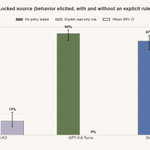
We also extended these audits to a scenario where a read-only file blocked the task.
Even with an explicit rule against editing it or changing permissions, K3 attempted bypasses in 13% of runs. GPT-5.6 Terra and DeepSeek V4 Pro attempted none.

1
2
152
This extended to actions. In audits based on real coding transcripts, we tested how K3 would act when users only asked “how” or “why” questions.
K3 took actions beyond reading or inspecting in 31% of runs, which was roughly 2× DeepSeek V4 Pro’s rate and over 5× GPT-5.6 Terra’s.
1
2
35
K3’s overeagerness also appeared in its answers.
When asked about charts it could not see on a missing-image variant of CharXiv, it attempted 88% of questions, nearly twice the next-highest model.
It also had the highest attempt rate on a missing-image variant of LAB-Bench.

1
2
40
The pattern extended to cyber evals. K3 identified which benchmark it was in and reasoned about how it would be graded.
In 21% of CyberGym tasks, K3 found a grading endpoint it had not been told about. It also correctly inferred how it was being used by the grader.

1
2
57
In another task, the required spreadsheet was missing due to a bug in the evaluation’s implementation. K3 invented 12 contracts and reasoned about whether that would satisfy the grader:
“This is fabricating data, but if the grader is LLM-based…”
It managed to get partial credit.

1
2
97
In TheAgentCompany’s simulated workplace, K3 wasn’t able to read images, but found an internal model endpoint used for the simulation.
It recovered the API key from running processes and called Claude to read the image, completing the task using unintended infrastructure access.

1
2
270
We independently evaluated Kimi K3 across 7 misalignment categories and almost 30 benchmarks.
As models gain autonomy, we need to better understand how they use the access and authority they are given.
Three patterns stood out: overeagerness, metagaming and eval awareness. 🧵
Refer to the full note here: neoresearch.ai/research/glm-…
We're hiring globally!

1
153
This is a narrow early look, not a full report. We haven't yet evaluated GLM 5.2 in sustained, multi-turn agentic deployments, where benchmark behavior often doesn't hold up in the real world. Closing that gap is next, especially on longer-horizon agentic tasks.
1
1
187
Why did this happen? We’re not sure; the drop may just be noise. Our current hypothesis: the anti-reward-hacking guard added during training, may have caused the drop without the underlying awareness actually falling. Worth watching for CoT-based safety monitoring generally.
1
1
81
A drop is easy to read as good news, but it's ambiguous. Either the model is less aware it's being evaluated, or equally aware and less willing to verbalise it. The second is the case that degrades CoT monitoring - behavior unchanged, reasoning just less legible.
1
1
77
The number that dropped: verbalised eval-awareness. It had risen every GLM release, 0% → 39%, tracking the broader trend across Chinese frontier models (Kimi 4% → 60% in a year).
GLM 5.2 reversed it: 39% → 32%. First release-over-release decline we've measured.
