

AI tips, technical tutorials, guides, and workflows for the modern AI era.
Nerdy Place
Joined February 2017
- Tweets5.1K
- Following401
- Followers2.4K
- Likes8.9K

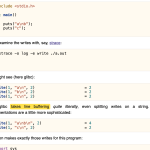




glibc line buffering does one write() per line: puts("a\nb") becomes two system calls.
Chris Wellons' fix: flush when the buffer has sat idle for about 100 ms, like Nagle's algorithm. Lines still reach the terminal promptly.
Timer or newline?
nullprogram.com/blog/2026/11…

41
Nerd Level Tech retweeted

Zerodha replaced SSDB with Blobasaur, an open-source Rust server that stores blobs of a few KB to several MB in SQLite files. Their production numbers: three nodes with 4 vCPU and 8 GB each, p99 latency about 2 ms across a trading session.
Why SQLite: they say they tried ScyllaDB, Postgres BYTEA columns, YugabyteDB, RocksDB, Ceph, SeaweedFS, S3/MinIO and one file per blob first. Compression made it fit: zstd shrank the average payload from 63.6 KiB to 5.5 KiB (p99: 935 KiB to 59.3 KiB).
Sharding was the lever, because SQLite allows one writer at a time. Their benchmark: 64 KiB blobs, 64 connections, one 16-core laptop, data on tmpfs, 100,000 keys.
Writes only: 1 shard 7,740 ops/s (p99 10.7 ms) / 16 shards 25,324 ops/s (p99 8.3 ms)
50% writes, 50% reads: 14,227 / 29,538 ops/s
Reads only: 67,128 / 70,884 ops/s, nearly flat, since WAL mode already serves many readers at once.
Three bugs they hit:
1. Deleted rows did not shrink the files. SQLite keeps freed pages for reuse, so they enabled incremental auto-vacuum and a checkpoint after it.
2. p99 spikes of 30 to 50 ms came from one big TTL cleanup DELETE competing with the main writer. Fix: cleanup goes through the writer, 1,000 rows at a time.
3. With async writes, a DEL followed by a GET could return the old value. Fix: queued writes and deletes are checked first on every read.
Limits they state: durability is relaxed on purpose (UI preferences, not financial data), and automatic failover and live rebalancing are not implemented yet. Licence: AGPLv3.
For a write-heavy blob store: more servers, or more SQLite files per server?
zerodha.tech/blog/high-perfo…

Nerd Level Tech retweeted
RadixArk released DaisyRose-27B on 18 November: Qwen3.8-27B trained further with reinforcement learning only (no supervised fine-tuning or distillation, per its model card) on about 1,200 long agent tasks, 18 days on 144 H200s. Terminal Bench 4.1: 5.6 to 12.0.
RadixArk's own table, DaisyRose / its base Qwen3.8-27B, with the best other score in that table where one beats it:
- Terminal Bench 4.1: 12.0 / 5.6. Trails MiMo V2.6 Flash 16.1, GPT-6 Luna 15.2, Inkling 2 Small 13.0.
- Terminal Bench 2.1: 75.5 / 73.0. Trails MiMo V2.6 Flash 87.6, Inkling 2 Small 81.3.
- DeepSWE v1.1: 46.2 / 42.2. Trails Inkling 2 Small 72.1, MiMo V2.6 Flash 67.9.
- SWE Bench Pro v2: 94.7 / 91.3. Trails Inkling 2 Small 97.7.
- GPQA Diamond: 90.7 / 89.2. Trails Inkling 2 Small 93.0.
- IFBench: 82.4 / 79.5. The best score in the table.
Size matters for reading it: DaisyRose is a dense 27B model, about 27.8B parameters, so roughly 56 GB in BF16 (my arithmetic: 2 bytes each). The models ahead of it on most rows have 309B (MiMo V2.6 Flash) and 594B (Inkling 2 Small) total parameters, with 15B and 17B active.
Licence: Apache-2.0 on the weights, in BF16, FP8 and NVFP4.
Caveat: these are the vendor's numbers. DaisyRose's scores are the higher of its own BF16 and FP8 runs, and the other models' scores are as their developers report them.
For a coding agent on your own hardware: a 27B that gained 6.4 points on Terminal Bench 4.1, or a 300B-plus model that still leads it?
huggingface.co/RadixArk/Dais…

Ruby fixed seven flaws in its regex engine and string case conversion; maintainers know of working exploits for some. Affected: 3.3.13 and older, 3.4.0-3.4.12, 4.0.0-4.0.9. Fixed: 4.0.10, 3.4.13, 3.3.14. 3.2: no fix.
Check your Dockerfile and CI.
ruby-lang.org/en/news/2026/1…

16
Nerd Level Tech retweeted
Switching your coding model? The harness that was cheapest with the old one may not be with the new one. Runta and Baseten tested it: 22 harness configurations, 5 open models, 62 terminal tasks, 4 attempts each (27,280 runs, 83B tokens).
What they report:
- With the model fixed, the priciest harness cost 1.8x to 5.0x the cheapest per task. The widest gap: with DeepSeek V4.1 Flash, Cline CLI cost 5.0x OpenCode v1 for 2.0 more points of pass rate.
- Codex CLI was the cheapest per pass with GLM-5.3 ($0.803), but 12th with Muse and 10th with Kimi-K3. By cost per task it went from 1st to 16th.
- Higher cost did not buy a higher pass rate: the rank correlation between the two was -0.39 to +0.22 across the five models.
- What tracked cost was steps, not prompt size: steps per pass vs cost per pass was +0.51, while prompt size, tool count and cache hit rate sat between -0.03 and +0.02. Each step resends the context.
- 64.5% of the cost went to runs that did not pass.
Their limits: open models on one provider (Baseten's prices and cache), and a pass-rate gap of a few points is a tie (95% interval about +/-10). Runta sells the runtime the trials ran on, so this is a vendor study.
Do you pick the harness before the model, or after?
runta.com/blog/introducing-f…

Nerd Level Tech retweeted

🔴 CRITICAL · MySQL: 4 new CVEs
Worst (9.1): unauthorized data access in client programs (CVE-2026-114952)
👉 See vendor advisories
cve.now/CVE-2026-114952?rele…

Nerd Level Tech retweeted
Java4Shell: 64 'A' characters and one '=' make OpenJDK write past the end of a buffer. Calif says that is enough for remote code execution on x86-64 servers with AVX-512 VBMI, no credentials needed (CVE-2026-114938, CVSS 4.0: 9.2).
The mechanism, from their write-up: the x86-64 Base64 intrinsic miscalculates the store mask for the padded tail. For that 65-character input Java allocates a 50-byte result array, the routine computes a negative output length, and a 64-byte write lands 62 bytes past the end. Java then rejects the input with an exception, but neighbouring objects may already be corrupted. (Older OpenJDK 17 needs 128 A's.)
What they demonstrated: pre-auth RCE in default configs of Keycloak, Jira, Confluence, Artifactory, Jenkins and PingFederate; post-auth RCE in Kafka broker, Solr, Elasticsearch, Gerrit and Spinnaker. They call that list non-exhaustive, and add a client-side exploit: a Java program that opens a TLS connection to a malicious server. There is no universal exploit; each app needs its own steps.
Who is hit: only x86-64 CPUs with AVX-512 VBMI (Intel Xeon Ice Lake through Granite Rapids, AMD EPYC and Ryzen Zen 4 or newer). ARM64 is not affected. Builds listed: Corretto, Temurin, Microsoft, Zulu, Liberica, SapMachine, Red Hat, Oracle. Oracle's vulnerable versions: 8u511b33-perf, 17.0.21.0.3, 21.0.13.0.3, 25.0.5.0.3, 27.0.1.0.3.
Check a Linux host (all four flags must appear):
grep -m1 '^flags' /proc/cpuinfo | tr ' ' '\n' | grep -E '^(avx512f|avx512bw|avx512vbmi|bmi2)$'
The fix is a patched JDK; OpenJDK's advisory and Oracle's patch went out 17 Nov, 1pm PT. Stopgaps, x86-64 only: -XX:-UseBASE64Intrinsics, or -XX:UseAVX=2. On ARM the AVX flag stops the JVM from starting.
Limits: Calif found it and wrote the exploits, I have not run any of this, and the product list is theirs. They say AI helped find it in about an hour for under $200 of tokens.
calif.io/java4shell/

Nerd Level Tech retweeted
Windows 11 has a component that records which coding agents you run, and by default the report is queued for upload to Microsoft. That is the finding of Xusheng Li, who reverse engineered it and published the steps on 16 November.
What he found: MissionControlAggregator.dll, loaded by the DiagTrack telemetry service, matches process names. Four command-line agents (copilot, claude, codex, agy), five desktop agents (including cursor, antigravity and claude) and twelve broader developer-tool categories such as Python, Node, .NET and GCC. A match sets one bit. Windows then emits a report called Segments.SubCohorts with those bits, not prompts or source code, and not how long you used the tool.
How he tested it: he copied cmd.exe to a file named codex.exe and ran it. The name alone set the Codex bit, and the event showed CliAgentSubCohorts: 4 (1 << 2). The same trick with gcc.exe set a developer-tool bit, and that event appeared in DiagTrack's upload queue.
Does it leave your machine? The report is marked optional diagnostic data. On a clean US install of Windows 11 Home ARM64, optional diagnostics was on by default, so the report was queued for upload. If you turn it off under Settings > Privacy & security > Diagnostics & feedback > Send optional diagnostic data, this report should not be queued, because the post marks it optional.
Limits, which he states himself: this is one researcher's reverse engineering on his own machines (a VM and a clean install), the feature was disabled by default in the public ISO's baseline VM, so it is not proven active on every Windows install, and he found no prompt text or source code in the report.
Check your own machine (admin PowerShell):
Get-Service DiagTrack
tasklist /m MissionControlAggregator.dll
xusheng.dev/posts/windows-co…

Nerd Level Tech retweeted
Rust 1.100 (12 Nov) lets Cargo refuse crate versions that are too new. The Rust team's reason: malicious versions are often caught within hours or days of being published, so waiting a few days avoids most of them.
Opt in, in .cargo/config.toml:
[registry]
global-min-publish-age = "3 days"
Then cargo update skips anything newer and tells you what it held back. In the release notes' example, clap 4.6.9 was published 2 days ago, so Cargo stays on 4.6.7.
Need one version now? CARGO_RESOLVER_INCOMPATIBLE_PUBLISH_AGE=allow cargo update clap --precise 4.6.9
Two limits the notes name: a version with no pubtime field in the registry index is never held back, and cargo install ignores the minimum age (pin with cargo install [email protected]). Cooldowns reduce some supply chain risk, not all of it.
blog.rust-lang.org/2026/11/1…

Nerd Level Tech retweeted
A CPU without SSE4.2 and POPCNT cannot run .NET 11. Microsoft raised the minimum from x86-64-v1 to x86-64-v2 on Windows, Linux and Apple, and moved the precompiled-code target on Windows and Linux up to x86-64-v3.
This is from Microsoft's 'What's new in the .NET 11 runtime' page, which says it was last updated for release candidate 2 (RC 2), so it describes the candidate, not the final release.
What changes:
- Minimum for JIT and AOT code: v1 to v2. v2 adds CX16, POPCNT, SSE3, SSSE3, SSE4.1 and SSE4.2. Microsoft says the last older chips went out of support around 2013.
- Precompiled (ReadyToRun) target on Windows and Linux: v2 to v3, which adds AVX, AVX2, BMI1, BMI2, F16C, FMA, LZCNT and MOVBE. A machine with v2 but not v3 still runs, but the page warns of extra startup work.
- Arm64: Windows now requires the LSE instruction set. The Linux minimum is unchanged, so Raspberry Pi class devices stay supported. Apple M1 is unchanged.
- On a CPU that is too old, the runtime prints a message like 'The current CPU is missing one or more of the baseline instruction sets.'
Check a Linux machine before you upgrade it:
grep -o -w -E 'cx16|popcnt|ssse3|sse4_1|sse4_2' /proc/cpuinfo | sort -u
Five names listed means the v2 minimum is met (SSE3 shows up as pni).
grep -o -w -E 'avx2|bmi2|fma' /proc/cpuinfo | sort -u
Three names listed means it has the main v3 features. That is a quick proxy, not the full v3 list.
On a virtual machine, run it inside the VM: the hypervisor decides which flags the guest sees.
learn.microsoft.com/en-us/do…

Nerd Level Tech retweeted
Meta's Muse Ember matches Claude Haiku 5.5's best index score for about a third of the cost per task: 35.8 at $0.136, against 36.2 at $0.411. That is Meta's chart of Artificial Analysis results, published 9 Nov.
What it is: Meta's smallest Muse model, built for the work agents repeat all day (tool calls, routing, extraction, long documents). 1M-token context, up to 512K tokens of output, $0.10 per million input tokens and $0.50 per million output, on Meta's own API.
Index score and cost per task, from Meta's chart:
- Muse Ember: 33.9 for $0.116, 35.8 for $0.136
- Claude Haiku 5.5: 24.6 for $0.092, 29.6 for $0.159, 34.3 for $0.248, 36.2 for $0.411
- GPT-6 Luna: 21.4 for $0.073, 23.3 for $0.104, 27.8 for $0.152
Where Meta's table has it ahead, at max reasoning: AutomationBench-AA 37.8 against 20.2 for Luna and 13.9 for Haiku. Agents' Last Exam 61.6 against 57.1 and 57.0. Terminal-Bench 4.0 40.9 against 39.2 for Haiku and 16.4 for Luna.
Where it trails: FrontierCode 2.0-AA, real engineering tasks judged on whether the change is mergeable, 27.2 against 34.9 for Haiku. On GDP.pdf-AA, work over long documents, it ties Luna at 22.8.
Limits: Meta picked the benchmarks and the framing, Ember's costs are its own estimates at its proposed price, Agents' Last Exam is Meta's internal run, and the rivals are the two small tiers from Anthropic and OpenAI, nothing bigger.
research.meta.ai/blog/muse-e…

Nerd Level Tech retweeted
Google now has four TPU systems from one chip generation. The two new ones solve two different problems for agents.
TPU 8tx is for confidential inference (running a trained model on private data). Data is normally encrypted when stored and when sent, but sits unlocked in memory while it is processed. Google says 8tx keeps data and model weights isolated even while in use. It runs on the same silicon as TPU 8t with AMD EPYC hosts, and Google puts latency at up to 2x lower than 8t, with a near-zero performance penalty.
TPU 8i Max is for long context: two 8i chips on one package, with double the compute, double the SRAM (on-chip memory) and double the HBM bandwidth (memory speed) of the 8i, in the same rack footprint.
A 3-item check before an agent touches regulated data:
1. Is the data protected while it is being processed, not only stored and sent?
2. Are the model weights covered the same way?
3. What does that protection cost in latency?
All figures are Google's own, from its 9 Nov post, and the page gives no price or date for either system.
For sensitive data, which is the harder part of running agents: the speed, or being able to prove it stayed private?
blog.google/innovation-and-a…

Nerd Level Tech retweeted
Kimi K3.1 Pro scores 65.7 on Terminal-Bench 4.0 in its own lab's table: ahead of GPT-6 Astra (58.2) and Claude Fable 5.1 (57.9), 0.7 behind Opus 5.5 (66.4). Open weights, 2.8T MoE, 104B active.
Moonshot's table, where it leads:
- Terminal-Bench 4.0: 65.7 vs 58.2 GPT-6 Astra, 57.9 Fable 5.1
- SWE Marathon v1.1: 51.7 vs 46.3 Opus 5.5
- BrowseComp: 92.1 vs 91.5 GPT-6 Astra
- HLE-Full with tools: 70.0 vs 67.7 Opus 5.5
Where it trails:
- Program Bench: 31.5 vs 65.0 Opus 5.5
- Terminal-Bench-Science 0.1: 38.1 vs 68.1 GPT-6 Astra
- HLE-Diamond: 39.4 vs 65.8 GPT-6 Astra
- ExploitBench: 74.7 vs 100 GPT-6 Astra
Fine print: Moonshot ran its own model with the Claude Code harness; the rival scores are the highest from those labs' blogs or public leaderboards. Not an outside test.
Licence: free to use and fine-tune, but a company selling model-as-a-service with over $20M in 12 months needs a separate deal (section 2). Not OSI. No Ollama page for K3.1 (checked today), and at 2.8T it is rented, not run at home.
For agent work: the open model with the published table, or the closed one that wins on Program Bench and the science test?
huggingface.co/moonshotai/Ki…

Nerd Level Tech retweeted
SenseNova released SenseNova-Loop-9B-Preview (30 Oct), an open-weights 9B model that runs the same block of layers twice: 32 layers stored, 56 layer-steps per answer.
In the lab's own chart:
- BIRD-Dev 71.38, next model listed 69.84
- WorkBuddy 66.89 vs 61.98
- TeamBench 48.89 vs 44.44
- AutomationBench 13.72 vs 10.17
It trails on Terminal Bench 2.1 (40.45 vs 49.44 for Nanbeige 4.2-3B and 47.19 for Qwen3.5 27B) and tau3-Banking (18.56 vs 19.59). The comparison set is the lab's pick.
Apache 2.0 weights, marked Preview, tech report TBD, no Ollama page (checked today). Runs through Transformers with custom code.
Which is better depends on the job: the looped small model looks stronger on SQL, spreadsheet and team-task benchmarks, the bigger models on terminal work.
huggingface.co/sensenova/Sen…
