Physicist interested in Astrophysics & Particle Physics| Research in Math & Science Edu| Math & Science Writer| Teacher & Teacher Trainer| WomenInSTEM

Italy
Joined June 2007
1/2 26 Oct. 1868: at the session of the Académie des Sciences in Paris, two independent reports are read — one from Pierre J. C. Janssen and one from J. N. Lockyer. Both describe a spectroscopic method for observing solar prominences in broad daylight, without waiting for an eclipse. The actual observations had taken place earlier. On 18 August 1868, during the total eclipse in India, Janssen examined the spectrum of the prominences and saw a bright yellow line that did not match sodium. On 20 October Lockyer, in England, independently observed the same prominences in daylight and found the identical line. In the reports read on 26 October the main result that stood out was the new method itself. The yellow line was noted, but neither report yet presented it as clear evidence of a new element. The Academy later awarded a medal to both for the method of observing solar prominences. In the following weeks, Lockyer (working with Edward Frankland) became convinced the yellow line (later called D₃) belonged to an element unknown on Earth. He named it helium (from the Greek helios = Sun). The element was isolated on Earth only in 1895 by William Ramsay. In short: - observations of the yellow line → 18 Aug (Janssen) and 20 Oct (Lockyer) 1868 - official reading of the method → 26 Oct 1868 - recognition as a new element → later A clear case of independent discovery of the same method, and the start of the helium story.
4
15
3
32
1,208
Nereide retweeted
This magnificent, color-enhanced image was captured by Juno spacecraft as it performed its 8th flyby of Jupiter, on Sep. 1, 2017. You can see, closer to the planet, the Galilean moon of Io; in the distance (to the left), another Galilean moon, Europa. ➡️go.nasa.gov/3koUmI2
3
32
1
77
Nereide retweeted
This fascinating Viking 1 image features Noctis Labyrinthus at sunrise, when the canyons of this region on Mars appear filled with water ice fog (possibly) from frost sublimated by the early morning sun. Noctis Labyrinthus (the labyrinth of the night) is located near the Martian equator in the heart of Tharsis upland, at the western end of the Valles Marineris (take a look at the image in the 2nd post). The region is characterized by a disordered morphology and the presence of large fractures and canyons, which develop in different directions around enormous conglomerates of older terrain. Notice the vivid clouds of water ice in and around the inpouring canyons of the region. Scientists hypothesize they possibly form when water, condensed during the previous afternoon in shaded areas, is early vaporized as the sun rises at the subsequent morning. The color composite image, made over by JPL's Image Processing Laboratory using different filters, shows the distribution of clouds against the rust colored background of the Martian terrain.   The image was taken during the Viking Orbiter 1's 40th orbit, in the seventies of the twentieth century. Image source and description➡️photojournal.jpl.nasa.gov/ca… Image Credit: NASA/JPL/USGS Further reading ➡️en.wikipedia.org/wiki/Noctis… ➡️nssdc.gsfc.nasa.gov/nmc/spac…
7
49
3
113
5,306
2/2 In the first post: animation of a standard helium atom (2 green protons, 2 white neutrons, 2 blue electrons). Credit: NASA/Dana Berry Primary source (Comptes Rendus, séance du 26 octobre 1868): archive.org/details/comptes-… AAS article: aas.org/posts/news/2022/10/m…
5
11
94
Nereide retweeted
Physicist and nobelist Claude Cohen-Tannoudji passed away on 22 October. A lot of the early groundwork in quantum optics and cold atoms came from Cohen-Tannoudji. As a researcher, he always combined theory and experiment. He was an exceptional teacher as well. In his Nobel lecture he quoted E. Rostand: "It is at night that it is beautiful to believe in the light", a phrase that reflects his humanism. Born in Constantine in 1933, he spent his entire career at the Laboratoire Kastler Brossel. With Serge Haroche he developed the dressed-atom approach, treating the atom and the surrounding light field as a single quantum system. In the 1980s his group (with Aspect, Dalibard and Salomon) demonstrated Sisyphus cooling and showed that atoms could be cooled below the single-photon recoil limit—results that, together with the work of Chu and Phillips, earned the 1997 Nobel Prize. His lectures at the Collège de France and the textbook written with Diu and Laloë shaped generations of physicists. RIP lkb.fr/en/laboratoire/presen… Photo: Laboratoire Kastler Brossel
3
23
6
52
2,835
Nereide retweeted
1/2 JWST never ceases to amaze! An international research team, using JWST, has just discovered the first population of 64 candidate brown dwarfs (cBDs) outside the Milky Way (MW) in the young star cluster NGC 602, located in the Wing of the Small Magellanic Cloud (SMC). SMC, an irregularly shaped dwarf galaxy at a distance of about 200,000 light-years, is one of the closest companions of the Milky Way. It contains a few hundred million stars. NGC 602 is very young, with an age of 2–3 million years, and is the most significant site of star formation in the Wing of SMC. It is a conglomerate of at least 3 stellar clusters: NGC 602a, NGC 602b, and NGC 602c. The BD candidates have masses ranging from 0.05 to 0.08 solar masses (or 50 to 84 Jupiter masses), in accordance with evolutionary models of brown dwarfs (BDs). Although further detailed studies are needed to confirm the true nature of the cBDs, this is a particularly important milestone because brown dwarfs represent a category of objects located between gas giant planets and true stars. The discovery was made possible thanks to the sensitivity and spatial resolution of the James Webb, features which allow it to observe in detail even objects at large distances and through dense fields of gas and dust. This discovery not only expands our understanding of star and planet formation, but also offers a glimpse into the conditions of the early Universe, as NGC 602 is an environment rich in ionized gas and dust, similar to those in which the first stars and planets in the Universe formed. Image Credit: ESA/Webb, NASA & CSA, P. Zeidler, E. Sabbi, A. Nota, M. Zamani (ESA/Webb) This image includes data from Webb’s NIRCam (Near-InfraRed Camera) and MIRI (Mid-InfraRed Instrument). #JWST
6
51
4
176
4,746
Nereide retweeted
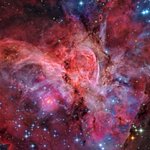
The Great Carina Nebula, also known as NGC 3372, is one of the largest H II regions in the heart of Southern #MilkyWay, in the Carina constellation. Visible to the unaided eye under the right conditions, it is at a distance of ~ 7,500 ly. NGC 3372 spans over 300 ly, surrounds several open clusters, and one of the most massive stars known: the variable η Carinae. According to the most accredited theories, this star is expected to end as a great supernova in the near future. This close-up (~20 ly across) is a composite of #Hubble, ESO and amateur data, processed by Robert Gendler & Roberto Colombari. It reveals the intricate filaments of gas and dust in the nebula’s core, including the bipolar Homunculus structure formed by material ejected in the 19th century. science.nasa.gov/image-artic…
5
24
3
58
1,218
Nereide retweeted
1/3 Sep.1,1859: The Carrington Event As English astronomer Richard Carrington watches the Sun through his telescope, he notices a sudden brightening on the Sun's surface like he'd never seen before. 17 hours later, the northern lights are visible as far south as Cuba. #Space
7
56
3
106
Nereide retweeted
1/2 At the South Pole a research team from 30 institutions has recently put together one of the sharpest maps of how matter is distributed in the universe. It’s not a photo of galaxies: it’s made using the oldest light that exists, the light that’s been traveling for over 13 billion years. That light is called the cosmic microwave background, or CMB. It’s the glow left over from the Big Bang. As it travels toward us, every time it passes near large amounts of matter it gets slightly bent by gravity. By carefully measuring these small bends you can figure out how much matter is along the path, including the matter that doesn’t emit light. The telescope at the South Pole has the advantage of a very clear sky. Using data from the 2019 and 2020 seasons, over an area of about 1500 square degrees, the scientists got the most sensitive map of this kind made so far. It’s like a photograph with very little background noise: you can see the details of how the matter is distributed more clearly. This map mainly shows how “clumpy” the universe was at certain times, when stars and galaxies were forming. It lets us check if structures grew over time the way the standard model says they should. Put together with other observations, it also gives some clues about the total mass of neutrinos—those elusive particles that zip through pretty much everything and almost never interact. It’s not a perfect map. The authors themselves explain that some residual “noise” remains, caused by distant galaxies, hot gas, and small imperfections in the instrument. They corrected it as much as possible, but it doesn’t disappear completely, especially in the smaller parts of the map. Some choices about which scales to look at and how to model certain effects still influence the result a bit. When you try to go beyond the standard model there are still uncertainties—more hints than solid evidence. It’s still a useful step: it lets us test better how the universe grew and sets the stage for more ambitious measurements in the coming years. The data used are from only two seasons; they’re already analyzing more. #cosmology
4
19
3
37
1,204
Physicist and nobelist Claude Cohen-Tannoudji passed away on 22 October. A lot of the early groundwork in quantum optics and cold atoms came from Cohen-Tannoudji. As a researcher, he always combined theory and experiment. He was an exceptional teacher as well. In his Nobel lecture he quoted E. Rostand: "It is at night that it is beautiful to believe in the light", a phrase that reflects his humanism. Born in Constantine in 1933, he spent his entire career at the Laboratoire Kastler Brossel. With Serge Haroche he developed the dressed-atom approach, treating the atom and the surrounding light field as a single quantum system. In the 1980s his group (with Aspect, Dalibard and Salomon) demonstrated Sisyphus cooling and showed that atoms could be cooled below the single-photon recoil limit—results that, together with the work of Chu and Phillips, earned the 1997 Nobel Prize. His lectures at the Collège de France and the textbook written with Diu and Laloë shaped generations of physicists. RIP lkb.fr/en/laboratoire/presen… Photo: Laboratoire Kastler Brossel
3
23
6
52
2,835
Nereide retweeted
1/2 A British-built magnetometer headed for a distant orbit could extend the usable warning time for the most severe solar storms. Operational space-weather forecasts currently rely on spacecraft at the Sun–Earth L1 point, about 1.5 million km from Earth. The fastest coronal mass ejections leave little more than 15 minutes before the magnetised plasma arrives—an interval too brief for many protective actions on power grids, satellites and communications systems. ESA’s HENON mission, a 12U CubeSat set to launch in early 2027 as a secondary payload with the PLATO telescope, will test a different vantage. The spacecraft will enter a Distant Retrograde Orbit (DRO) of the Sun–Earth system, a co-orbital yet more elliptical path first proposed by Michel Hénon in 1969 and never previously flown. On the sunward portion of this trajectory HENON will sit roughly 15 million km upstream of Earth—10 times farther than L1—sampling the solar wind and interplanetary magnetic field earlier. MAGIC is a miniaturised magnetoresistive magnetometer developed at Imperial College London. It is supported by the UK Space Agency through ESA’s General Support Technology Programme and will measure the magnetic field carried by the solar wind. Together with a Czech plasma analyser and a Finnish energetic-particle monitor, it will supply the data needed to check whether upstream measurements improve estimates of storm intensity. The orientation of the magnetic field inside a CME is still the hardest element to forecast and largely determines geomagnetic impact. If the results hold, the lead time for the strongest storms could grow from about fifteen minutes to two or three hours. HENON is a technology-demonstration mission, not an operational service. Its role is to qualify CubeSat systems for deep space and to test sub-L1 monitoring; continuous coverage would require a later constellation such as the one outlined in ESA’s SHIELD concept. The project is led by Argotec; Jonathan Eastwood of Imperial College presented the work at the Royal Astronomical Society’s National Astronomy Meeting 2026. Severe space weather already appears on the UK National Risk Register for its potential effects on critical infrastructure. HENON will not close the forecasting gap by itself, yet it offers a concrete step toward longer observational lead times and the technologies needed for more effective future alerts.
5
19
1
34
1,147
Nereide retweeted
NASA’s #Perseverance rover has broken the off-world driving record. On 11 Oct. 2026, it reached 45.22 km on #Mars, surpassing Opportunity’s 45.16 km. It hit the mark in five and a half years, compared with nearly 15 for its predecessor, on the 2,006th Martian day (sol) of the mission. Much of the credit goes to AutoNav: Perseverance maps the terrain in 3D while moving and picks its own route between points chosen by Earth. Over 90% of its total distance has been driven this way, processing 600,000 points per look versus Sojourner’s 20. It can cover up to 412 meters in a single sol. The record fell as the rover headed toward Idubi in the Lac de Charmes region on the edge of Jezero Crater, exploring some of the oldest terrain in the solar system in search of possible hydrothermal systems. The original plan called for no more than 20 km; systems remain fully operational and it will keep adding distance. Video Credit: NASA/JPL-Caltech More: jpl.nasa.gov/news/nasas-pers…
10
20
4
42
1,319
Nereide retweeted
1/4 This is a heavily saturated false color image of Stickney, the largest crater on Phobos (the larger of Mars' two moons). It's a detail of the first of two images, acquired by @HiRISE on 23 March 2008. Credit: NASA/JPL-Caltech/UArizona #scritturebrevi #VentagliDiParole
6
53
4
104
9,917
Nereide retweeted
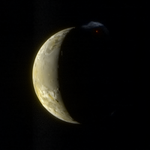
1/3 In this nice pic by Cristian Fattinnanzi, you see lined up left to right beyond the dark lunar limb: Callisto, Ganymede, Jupiter, Io, Europa. The sunlit crescent is overexposed with the Moon's night side faintly illuminated by Earthshine. #scritturebrevi #ventaglidiparole
8
59
4
212
39,175
The Great Carina Nebula, also known as NGC 3372, is one of the largest H II regions in the heart of Southern #MilkyWay, in the Carina constellation. Visible to the unaided eye under the right conditions, it is at a distance of ~ 7,500 ly. NGC 3372 spans over 300 ly, surrounds several open clusters, and one of the most massive stars known: the variable η Carinae. According to the most accredited theories, this star is expected to end as a great supernova in the near future. This close-up (~20 ly across) is a composite of #Hubble, ESO and amateur data, processed by Robert Gendler & Roberto Colombari. It reveals the intricate filaments of gas and dust in the nebula’s core, including the bipolar Homunculus structure formed by material ejected in the 19th century. science.nasa.gov/image-artic…
5
24
3
58
1,218
Nereide retweeted
Amazingly beautiful lenticular cloud over Mount Etna, taken during the sunset, on February 2020. Source➡️bit.ly/3o3M88a 📷©️Marisa Liotta More on #lenticularcloud➡️bit.ly/2INd7or #Sicily #Etna #volcano
13
43
1
117
Nereide retweeted
Area of cycloid = 3 x Area of rolling circle. Source➡️bit.ly/346sf8q Let's remember, in #geometry, a #cycloid is the curve traced by a point on a #circle as it rolls along a straight line without slipping. #iteachmath #mtbos #mtmschat
7
51
5
103
Nereide retweeted
Drawings by Leonardo for 'Divina proportione' by L. Pacioli At the end of the 15th century Leonardo met Pacioli at the court of Ludovico il Moro. Pacioli commissioned Leonardo to produce sixty illustrations of regular solids, realised starting from the #goldenratio. #iteachmath
6
69
4
158
Nereide retweeted
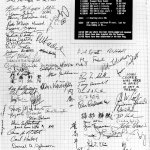
In the early hours of October 13, 1985, in the CDF control room at Fermilab, the screens suddenly lit up. After weeks of only beam-gas collisions, the first proton-antiproton collision events at the Tevatron (1.6 TeV) appeared. At 2:52 a.m. the detector recorded a new world energy record. CDF (Collider Detector at Fermilab) was the large particle detector installed at the interaction point called B0 of the Tevatron. It was there that, that night, the researchers saw the first true collision events and began celebrating with sparkling wine (the internal message said "look for free bubbly at B0"). The image shows the CDF logbook page from that night: the signatures of the "CDF Crew," the notes, and a computer printout of the status message confirming the event and inviting people to celebrate at B0. Subsequent events confirmed that it was not beam-gas. That night the Tevatron Collider physics program truly began. Ten years later the two main experiments, CDF and DØ (the other large detector installed at a second interaction point), would discover the top quark. Photo: Fermilab History and Archives history.fnal.gov/historical/… Source: FermiNews Special Edition, October 23, 1985 history.fnal.gov/historical/… #physics #ScienceHistory
3
10
3
28
1,154