

Neuralink news and updates.
Phoenix, Arizona ☀️🌵
Joined July 2020
- Tweets2.4K
- Following253
- Followers13.6K
- Likes9.2K




Pinned Tweet
Neuralink patient Zach is now able to control his robot vacuum cleaner (@maticrobots).
Neuralink is building a brain-*machine* interface, and any digital device can be that *machine* part.
Patients have demonstrated control of:
- Computer mouses
- Computer keyboards
- Robotic arms
- A remote-controlled airplane
- Wheelchairs
- and now a robotic vacuum cleaner
Who will be the first to control a Tesla vehicle or a Tesla Optimus?

My wife and I first video edit ever lol
@maticrobots breaking vacuum history being the first robot vacuum in the world to be controlled, purely with thoughts!
I am so stoked and honored they allowed me the chance to try this out!
December 2021:
"I think we have a chance with Neuralink of being able to restore full body functionality to someone who has a spinal cord injury.
Meaning I think we have a chance- I emphasize, a chance, of being able to allow someone who cannot walk or use their arms to be able to walk again."
- Elon Musk via @WSJ
Neura Pod – Neuralink retweeted

I am connected to mine from the second I wake up to the second I go to sleep. It's become an extension of my body and a lifeline that has made me feel more human.
Neuralink has given me some of the independence back that ALS has stolen from me.

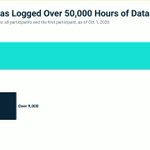
Neuralink has logged over 50,000 hours of brain recording data.
The very first patient (@ModdedQuad) accounts for nearly 10,000 of them.
Imagine what happens as this brain data scales to billions of hours of detailed brain data. Neuralink will have a data pipeline that no other company will have.

Interesting, in many ways:

NEURALINK: It appears Neuralink through X Holdings via DV Property Venture LLC has acquired more land for the Neuralink campus in Del Valle, Texas.
DV Property Venture LLC is listed at 2110 Ranch Road 620 S, Lakeway, TX. It is the same address used for the 2022 SEC filings for the Twitter acquisition.
Not only that but the same fencing, same private property signs, and same mobile security camera systems are being used at both plots of land.
The DV plot is 100 acres just northeast of the main campus' 111 acres. The land separating the two is a privately owned tree farm.

One of Neuralink's longer term goals is to help with detecting strokes, and perhaps even stroke recovery. The need for this continues to grow.
105 million people were living after a stroke in 2023, nearly double the 54.5 million in 1990, mostly because more people survive strokes and live longer. Elon named strokes in his 2020 list of conditions a Neuralink could one day help.
Which would matter more to you after a stroke, getting movement back, or getting speech back?

There are many people around the world living with this horrible disease.
Neuralink is not able to cure ALS, but they can dramatically improve the quality of life for these patients.

I've enjoyed these more and more each year.
More people need to hear about the tremendous good Neuralink is doing!

Really an honor to interview @PairedWith_P7 with @RyanTanaka about life with Neuralink
Interesting perspective from Dr. Huberman on the tech giants and their interest in the brain.
Neuralink paired directly with Grok and Optimus is an inevitable future outcome.
If they don't already, each tech giant should have an interest in building a neural foundation model. Imo, Neuralink is in the lead and will continue to be in the lead in this regard.

Andrew Huberman on why Meta, OpenAI, and Anthropic are all going to become biotech companies.
"Dario came up through neuroscience. Sam, I've spoken to, is extremely smart about the neuroscience, as is Zuck.
The technologists who used to just engineer stuff, they're becoming neuroscientists...and I think most people don't realize that.
They will all tell you, 'Okay, here's the goal. The goal is to be able to read and write from your brain non-invasively.'
Even just for things like drive and motivation, a non-invasive device where you could literally crank up your level of motivation by stimulating the nucleus accumbens and related pathways while engaging in a particular learning task or in hard work, and then turning it off so that you can capture more energy.
That's coming, and those companies are all about that. That's what the real arms race of AI is about."
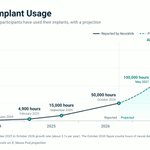
Neuralink recently announced their clinical trial participants have used their implants for a combined total over 50,000 hours.
At ~27 patients, this means each patient has used their device for nearly 2,000 hours.
Assuming 16 hours of use per day, 7 days per week, that's an average of ~4 months of nonstop usage per patient.
One of Neuralink's main advantages is *scale.* Assuming this growth continues, they'll have more detailed brain data than any company in the world.
Actually, I'm sure they already have more of this data than any company in the world!
1. Imagine what will happen when they have 10s and 100s of millions of brain implants all pattern matching when people are developing dementia or about to have a stroke or depressed.
2. Imagine their ability to train an AI model just like ChatGPT, but instead of using words to train a large language model (LLM), they can use brain data to train a neural foundation model.
3. Imagine using the brain data from the fleet to create a fully digital recreation of the human brain that is optimized for learning and skill development- just like Tesla's FSD is an artificial driver trained on the data of millions of real drivers.
3.1. With that brain, could you directly plug it into Optimus and create a superhuman? Did someone say SpaceXxTeslaxNeuralinkxBoring?
The possibilities are limitless.

This is the main concept for Neuralink I've been so excited about for the past 5 years- using their *fleet* of brain implants to learn much more about the brain and ultimately recreate an artificial brain.
Neuralink's access to detailed brain data will far exceed any other company or academic lab.
This means the ability to pattern match when people are developing early signs of dementia or have particular aptitude for something will be easy to spot.
This will enable earlier diagnosis and treatment. This will enable better, more optimized skill training.
The possibilities are quite literally limitless.

Our clinical trial participants have now used their Neuralink implants for over 50,000 hours, building one of the largest datasets of intracortical neural activity ever.
We used it to pretrain a foundation model for BCI: self-supervised neural encoders that turn noisy, drifting spikes into stable representations.
Some initial results:
• Decoders that keep working for weeks instead of days. For some users, calibration dropped from 10 min/day to 10 min/week
• Teleporting cursors that jump straight to the intended target
• A new cursor-control record of 11.32 bits per second (exceeding the performance of most able-bodied people)
We’re just getting started. Future directions include pooling data across participants, one-shot (or zero-shot) calibration, and an API for the motor cortex.
Read more:
neuralink.com/updates/pretra…

Neuralink has enabled participants to exceed prior bitrate records.
This is the best overall metric for measuring brain-computer interface capability. Although it doesn't tell the full story in one number, it's a quantifiable metric that indicates a lot.
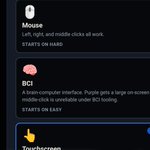
This screen capture is a participant playing Webgrid (very importantly faster than the vast majority of non-Neuralinked people could play).
My high score is around 10 bit per second.
Our clinical trial participants have now used their Neuralink implants for over 50,000 hours, building one of the largest datasets of intracortical neural activity ever.
We used it to pretrain a foundation model for BCI: self-supervised neural encoders that turn noisy, drifting spikes into stable representations.
Some initial results:
• Decoders that keep working for weeks instead of days. For some users, calibration dropped from 10 min/day to 10 min/week
• Teleporting cursors that jump straight to the intended target
• A new cursor-control record of 11.32 bits per second (exceeding the performance of most able-bodied people)
We’re just getting started. Future directions include pooling data across participants, one-shot (or zero-shot) calibration, and an API for the motor cortex.
Read more:
neuralink.com/updates/pretra…
You have the power to positively change someone's life by getting them to join the Neuralink team-
Share this with any of your talented + intelligent student friends living in the Bay Area:

@neuralink is hosting an event in SF. october 16, afternoon. open to students at local universities and to interns working in-person in the bay area. invites are limited, apply below.
app3.greenhouse.io/e/arnmvw
Excellent message from Neuralink patient Jon Noble:

Just wrapped the most incredible week working with the @neuralink engineering team and I’m still buzzing.
Thank you to every engineer, researcher, and Neuralnaut pushing this forward. Restoring communication and independence at this pace isn’t just impressive. It’s beautiful.
The future is arriving faster than most people realize. 🦾🧠🇬🇧