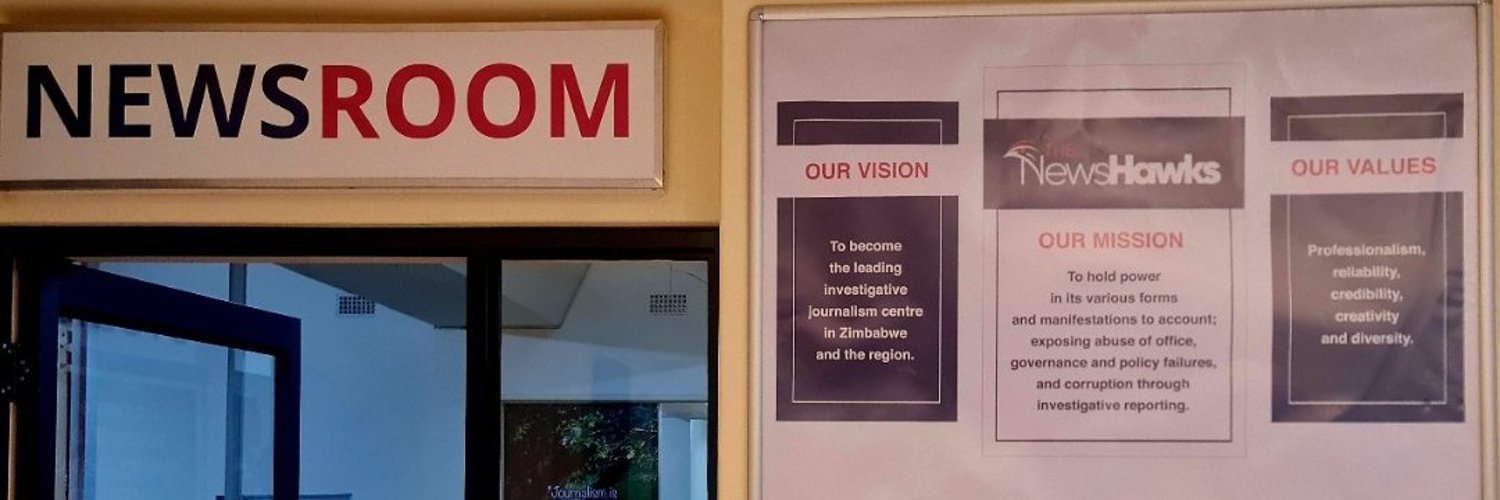

Zimbabwe's leading digital investigative reporting, breaking news & analysis platform. Independent. Factual. Impartial. Fearless. https://xitter.cf/t.co/fl36ibjgGe
Joined September 2020
- Tweets31.1K
- Following2.5K
- Followers139K
- Likes666





A TALE OF TWO PRESIDENTS AND THEIR RELATIONSHIPS WITH THE MEDIA INSIDE ONE WEEK
IN a striking contrast of democratic perspectives, political leadership styles and shifting dynamics of the world press freedom index, this week put the foundational tenets of global media discourse on full display on both sides of the Atlantic.
In Washington D.C., United States President Donald Trump on Tuesday repeatedly clashed with and insulted members of the White House press corps during a tense Oval Office briefing. Meanwhile, on the other side of the Atlantic at the foot of the African continent, South African President Cyril Ramaphosa marked "Black Wednesday" (National Press Freedom Day) by robustly defending the independent press, with a particular emphasis on protecting female journalists from harassment.
Black Wednesday (National Press Freedom Day) is commemorated every October 19 to remember the historic 1977 apartheid crackdown on independent media and civil society.
The apartheid regime shut down major independent, black-oriented publications, including The World and Weekend World.
Editors and journalists — most notably The World editor Percy Qoboza — were arrested and detained without trial (Qoboza was held for five months in Modderbee Prison).
The simultaneous events in Washington D.C and Johannesburg presented two starkly divergent democratic perspectives and leadership styles, illustrating how the relationship between political authority and public accountability is shifting globally.
During tne event announcing a federal whistleblower programme, Trump lost his temper with reporters, lambasting and insulting them.
Singling out Andrew Feinberg from The Independent, Trump grew visibly irritated, pointing a finger and saying, "I don't know who the hell you are, but you better be careful."
When Feinberg attempted a follow-up question regarding Trump's golf courses, the President interrupted him, shouting, "Quiet. Quiet! What’s wrong with you? Are you a sick person? I actually think there’s something wrong with you."
Just 24 hours earlier, on Monday, October 19, an entirely different narrative unfolded in Johannesburg, South Africa. Ramaphosa addressed senior media practitioners at a luncheon hosted by the ANC to commemorate Black Wednesday— the 49th anniversary of the apartheid regime's brutal 1977 crackdown on independent media and black-oriented newspapers like The World.
Instead of demanding compliance, Ramaphosa asserted that political leaders must expect discomfort. "You must have the freedom to question government and press those in government to feel accountable. We must be prepared to accept criticism as leaders," Ramaphosa said. Crucially, Ramaphosa used the platform to single out and condemn the rising tide of online abuse, intimidation, and gender-based harassment targeted at female reporters, declaring that political leaders have an absolute duty to stop such threats.
The juxtaposition of these two events highlights fundamentally opposing views on the role of journalism in a constitutional democracy.
Trump’s actions fit into a historical strategy of delegitimising the press as an adversarial corporate actor rather than a civic institution.
By calling journalists "sick" or demanding they be "careful," the executive branch attempts to dictate which questions are valid, often threatening the press access of mainstream outlets. This strategy seeks to weaken public trust in democractic institutions, leaving the executive as the sole trusted arbiter of reality.
Conversely, South Africa’s relationship with the press is deeply intertwined with apartheid and its liberation history.
Under apartheid, censorship was a key weapon of state oppression. Consequently, post-apartheid leaders have historically recognised that a free press is a core pillar of survival for the state. Ramaphosa pointed out South Africa currently ranks 21st out of 180 countries on the World Press Freedom Index — the highest in Africa.
🔴South African President Cyril Ramaphosa addressing the National Press Freedom Day on Monday.
Ramaphosa strongly condemned the harassment and intimidation of journalists, particularly women journalists, during a Black Wednesday commemoration event in Johannesburg.
Ramaphosa defended the constitutional right of the media to question the government and hold political leaders accountable.
Kenyan President William Ruto arrived in Harare, Zimbabwe, yesterday to attend the 25th Comesa Heads of State and Government Summit today under the late local tycoon Wicknell Chivayo’s lingering shadow.
Chivayo’s shadow is hanging over Ruto, highlighting the public and political scrutiny surrounding the close, controversial ties between the Kenyan president and the late flamboyant Zimbabwean businessman, who tragically died in a helicopter crash on September 30.
As the outgoing chairperson of Comesa, Ruto travelled to Zimbabwe primarily to hand over the leadership bloc to his host, Zimbabwean President Emmerson Mnangagwa.
The high-level summit will be held at the New Parliament Building focuses on regional economic integration, industrialiaation, and trade agreements.
The trip marks Ruto’s first visit to Zimbabwe since the sudden death of Chivayo — whom he described as a friend.
Before his death, Chivayo enjoyed extraordinary and unprecedented access to the Kenyan presidency. He frequented State House in Nairobi, attended an intimate family engagement for Ruto's daughter Charlene, and famously recorded a viral video of President Ruto personally driving him.
Their tight relationship sparked massive political debate in Kenya where he had a diplomatic passport regarding state hospitality and Chivayo's corporate interests — including reports linking his companies to multi-billion dollar Kenyan airport expansions.
With Ruto landing in Chivayo's home country, social media and political commentators have heavily fixated on the unaddressed questions surrounding their financial and personal partnerships.
This is how the biggest passenger plane in the world - Airbus A380 -
is built.
The full-length, double-deck superjumbo measures 72.7 metres long, has a wingspan of 79.8 metres.
Lovingly nicknamed "Superjumbo", this massive double-decker aircraft stands as a marvel of modern engineering, though its production officially wrapped up in 2021.
The A380 dominates almost every size metric in passenger aviation.
It is the only aircraft certified for more than 500 seats.
It carries around 525 passengers in a typical multi-class setup, but can hold up to 853 passengers in an all-economy configuration.
ZANU PF’S SUCCESSION BATTLE: WHO HOLDS THE CARDS, AND WHAT HAPPENS NEXT?
Follow-up analysis | 20 October 2026
By Washington Katema
I my earlier article, “ZANU PF’s Succession Battle: Three Scenarios to Watch,” I argued that the struggle unfolding within ZANU PF was about more than who succeeds President Emmerson Mnangagwa.
It concerned the rules governing succession, the balance of power within the party, the growing influence of wealthy political actors and the future of the establishment that emerged from the events of November 2017.
The resolutions adopted at the party’s 23rd National People’s Conference in Chinhoyi have sharpened that argument.
The party endorsed Mnangagwa to remain as state President until 2030, resolved to retain him as party leader until 2029 and moved its 2027 elective congress to 2029.
In 2029, he will seek re-election as party leader and possibly have someone else as presidential election candidate for 2030 elections.
These decisions have given institutional expression to the political project associated with the constitutional changes.
But the conference also exposed the faultlines beneath the appearance of unity. Vice-President Constantino Chiwenga’s speech, with its emphasis on accountability, internal democracy, collective leadership and the need for change to emerge from the party’s structures, deserves particular attention.
Although he did not explicitly reject the resolutions, his insistence that the party belongs to its members rather than individual leaders raised questions about how decisions are made and whose interests they serve.
The central question is therefore no longer simply who succeeds Mnangagwa.
Is the President preparing to hand over power, or are the succession arrangements being shaped to ensure that he remains in office for as long as possible?
The Tagwirei question
Kudakwashe Tagwirei’s rapid ascent through business, government and ZANU PF’s senior structures has placed him at the centre of the succession debate. His entry into the Politburo and growing political prominence have strengthened perceptions that he is being positioned for a more consequential role in the ruling establishment.
Yet it would be premature to conclude that Mnangagwa intends Tagwirei to succeed him.
Political alignment is not the same as a succession agreement.
A powerful businessman can be an important political ally without being the designated heir.
An incumbent may also find it useful to cultivate several centres of influence, provided none becomes powerful enough to challenge his own authority.
Tagwirei’s growing prominence could therefore mean several things.
He may be positioning himself for eventual succession; he may be helping consolidate Mnangagwa’s political and economic networks; or he may be serving as a counterweight to established party and security elites.
These possibilities are not mutually exclusive.
The more important question is whether his growing influence translates into demonstrable support within the institutions that will determine the eventual outcome.
Access to the President, wealth and senior appointments can open doors, but they do not automatically confer the authority required to lead ZANU PF.
There is also a wider development that deserves closer scrutiny: the growing role of money in political competition.
Money has always mattered in Zimbabwean politics. What may be changing is the extent to which financial resources translate directly into political influence, access to party structures and the ability to shape internal decisions.
Allegations circulated around the Chinhoyi conference that money had been given to provincial structures to boo Chiwenga. These allegations remain unverified, and there is no established evidence that such payments took place.
They should not be presented as fact.
Nevertheless, the allegation itself points to an important analytical question.

That common military experience makes Sibanda’s potential role worth examining, although their political trajectories and positions in the current contest are not identical.
Sibanda spent more than two decades at the highest levels of military command, including as Commander of the Zimbabwe National Army and subsequently the Zimbabwe Defence Forces. Following his retirement, his appointment to ZANU PF’s Politburo brought him formally into the party’s senior political structures.
He also shares the Shumba totem with Mnangagwa, a connection that has attracted attention in discussions about the President’s political networks and possible succession calculations.
None of these factors establishes that Sibanda is being prepared for the presidency.
But his military background, entry into the Politburo and potential acceptability to sections of the establishment make him a legitimate subject of scenario analysis.
His candidacy could become relevant if the incumbent concludes that Tagwirei lacks the political experience or institutional support required to lead the party, or if Chiwenga’s elevation proves unacceptable to influential constituencies.
A figure with military credentials who is not as deeply identified with the current factional contest could, under certain circumstances, offer a compromise between competing interests.
There are, however, important constraints.
Military seniority does not automatically translate into political authority, and Sibanda would need to demonstrate support within the party’s structures.
His historical military position and shared totem with Mnangagwa are relevant contextual factors, not evidence of an agreed succession arrangement.
The regional experience of Mozambique offers a useful comparison.
In 2024, FRELIMO’s selection of Daniel Chapo demonstrated that the candidate widely expected to emerge does not always prevail. President Filipe Nyusi’s preferred candidate, Roque Silva, failed to secure sufficient support within the party’s Central Committee, and Chapo emerged as the successful candidate following an internal contest.
The comparison has limits. FRELIMO and ZANU PF have different internal dynamics, and Mozambique’s experience cannot predict Zimbabwe’s outcome.
But it illustrates an important principle: the incumbent’s preferred candidate, the most visible contender and the eventual successor need not be the same person.
A dark horse becomes plausible when leading candidates cannot secure an acceptable settlement, when the incumbent needs a compromise or when influential actors decide that an alternative offers a better guarantee of political stability.
For Zimbabwe, the question is whether the current arrangements leave room for such an outcome or whether the Chinhoyi resolutions have narrowed the field so substantially that an alternative would require a major political realignment.
Three scenarios, one overriding uncertainty
The three scenarios outlined in my earlier article remain relevant, but the conference has changed the context in which they should be assessed.
The first scenario is that Mnangagwa consolidates his position and keeps his options open.
The conference resolutions strengthen his immediate position, Tagwirei continues to rise, and Chiwenga’s room for manoeuvre narrows.
The incumbent retains control over the timing and terms of any eventual transition.
In this scenario, Tagwirei’s growing influence does not necessarily mean that he is the chosen successor.
He may remain an important ally without ever becoming the principal beneficiary of the succession process.
The second scenario is a negotiated succession.
If Mnangagwa eventually decides to leave office, or circumstances compel him to do so, competing factions may negotiate around a candidate acceptable to the incumbent and influential party, economic and security constituencies.
That candidate could be Tagwirei, Sibanda or another figure who emerges as a compromise.

Chiwenga’s prospects would depend on his ability to retain leverage and negotiate an acceptable outcome.
The third scenario is that the contest becomes a struggle over the incumbent himself.
If Mnangagwa’s continued tenure becomes the principal point of contention, the succession debate could develop into a wider confrontation over the rules, institutions and interests governing the ruling establishment.
Such a confrontation could produce a compromise, further consolidation of the incumbent’s position or a prolonged internal struggle.
These scenarios are not mutually exclusive.
The first could lead to either of the others, depending on how competing factions respond and whether the incumbent’s calculations change.
Chiwenga’s conference speech is relevant to all three.
It could be interpreted as an attempt to preserve his position within an increasingly centralised system, a signal of discomfort with the concentration of power or the articulation of principles that could become more consequential if the succession contest intensifies.
Similarly, the allegations about payments to provincial structures, if substantiated, would indicate that money is playing a more direct role in managing factional competition.
At present, however, the allegations remain unverified and cannot be used as proof of a particular faction’s strength or intentions.
The analytical task is to distinguish between what has been established, what can reasonably be inferred and what remains a scenario.
The possibility that Mnangagwa wants to succeed himself
The Chinhoyi resolutions give Mnangagwa’s continued leadership a formal political basis within ZANU PF.
The national constitutional changes have also shifted the framework within which the next President would be chosen.
Against this background, the assumption that Mnangagwa is preparing to hand over power should not be treated as a given.
It is possible that his immediate objective is to remain in office, consolidate his political position and postpone the moment when he must choose between competing successors.
The succession debate may be useful precisely because it keeps potential contenders focused on their own ambitions while leaving the incumbent at the centre of the political system.
This interpretation would help explain why Tagwirei’s elevation does not necessarily settle the succession question, why Chiwenga’s position remains contested and why a figure such as Sibanda could become relevant without being an obvious front-runner.
The most important distinction is between identifying a preferred successor and identifying the incumbent’s preferred political outcome.
They are not necessarily the same thing.
My assessment is that Mnangagwa’s continued hold on power remains the central scenario against which all others must be tested.
Tagwirei may be a beneficiary of the current political realignment, Chiwenga may remain a consequential player, and Sibanda or another dark horse may yet emerge.
But none of these possibilities should distract from the prospect that the incumbent’s own tenure is the real issue at stake.
The question is no longer simply who succeeds Mnangagwa.
It is whether the succession arrangements now taking shape are intended to produce a successor at all, or to preserve the conditions under which Mnangagwa can continue to rule.
Until that becomes clearer, declaring any individual the inevitable heir would be premature.
The decisive contest is over who controls the rules, the institutions and the timing of political transition.
The outcome will depend on how those centres of power interact, not merely on which faction appears strongest today.

ANALYSIS: In Zimbabwe, Power Is About Keeping the Winning Coalition Loyal : Not Persuading the Public
By Gideon Nkomo
IN democracies, politicians obsess over swing voters. In authoritarian regimes like Zimbabwe, the calculation is different: the public is not the main audience.
Survival depends on managing a much smaller “winning coalition” of elites — security chiefs, party barons, patronage networks and business allies — whose loyalty must be constantly bought, balanced and, when necessary, coerced.
That is the central lesson of Zimbabwe’s recent political history. Robert Mugabe did not fall because he lost an election.
He fell because the coalition that had sustained him — the securocrats and patronage kingpins — concluded he could no longer protect their interests.
When that elite support withdrew in 2017, his long rule ended within days.
Emmerson Mnangagwa’s political strategy since then has been shaped by that lesson.
His priority is not winning over the broader electorate in any genuine sense.
It is preventing a repeat of 2017 by keeping his own coalition tethered to him, neutralizing rivals and disabling independent centres of power.
This is not the crude “our people will do what we say” model of politics.
It is more calculating. Authoritarian leaders know that the greatest threat often comes from within.
Succession uncertainty is the nightmare: once subordinates believe a leader’s exit is near, factions form, loyalties shift and patronage flows begin to dry up. Mugabe learned this late. Mnangagwa appears determined not to.
His method has been what analysts describe as “quiet institutional capture.”
Rather than relying solely on revolutionary charisma or open violence, Mnangagwa has systematically weakened the institutions that could constrain him.
The judiciary, parliament and electoral commission have been reconfigured or pressured into serving the ruling party’s interests. The army and intelligence services remain the “steel frame” of authority, but the system is dressed up as constitutional rule. It is a hybrid order: repressive in substance, legalistic in form.
Alongside this comes patronage. State resources, empowerment funds and public appointments are distributed to loyalists, deepening factional fights over who controls the money. Potential rivals are sometimes co-opted with prestigious but powerless positions, or even offered cabinet posts to opposition figures.
This is not power-sharing. It is a calculated buy-off designed to entrench dependence and prevent a unified opposition from forming.
Coercion remains in the background.
The public is managed through a combination of electoral manipulation, repression of dissent and the threat of violence. Elections are held, but they function more as a façade than as a genuine mechanism for changing power.
The goal is not to persuade the masses; it is to demobilize them, divide the opposition and keep the elite coalition intact.
The contrast with Mugabe is instructive.
Mugabe relied on charisma, revolutionary legitimacy and “divide and rule” factionalism. He tolerated a surprising degree of internal party contestation and, at times, genuine electoral competition — which shocked him when he lost a constitutional referendum in 2000 and faced a serious opposition challenge. Mnangagwa’s style is more institutional and more calculating. He understands that charismatic authority is fragile.
His answer is to capture the machinery of the state so thoroughly that rival centres of power cannot coordinate.
His current push to extend his rule to 2030 fits this logic.
The move is not simply about staying in office.
It is about disrupting his rivals’ succession planning, keeping patronage networks tethered to him and ensuring that no alternative power centre can form around a scheduled transition.
So what do authoritarian politicians think? Not simply: “These are our people; they will do what we say.”
They think: “Who in my inner circle is becoming a threat?

What patronage must I distribute to keep them loyal?
How do I neutralize the opposition before it can coordinate with my rivals?
And how do I avoid blame when things go wrong?”
In Zimbabwe, the “our people” who matter are not the masses. They are the elite coalition whose loyalty keeps the regime alive.
The rest of the population is managed through a mixture of spectacle, repression and selective reward.
That is the real logic of authoritarian politics — not command, but constant, anxious calculation.

ZIMBABWEAN GOVERNMENT CAUGHT UP IN A UK CONTRACT KILLLERS, EXTREMISTS AND FAKE RALLY SCANDAL
An Al Jazeera’s Investigative Unit documentary film titled Contract Killers and the Far Right exposes links between the British far-right student movement Turning Point UK (TPUK) and an armed loyalist paramilitary member, while detailing a fake political rally organised on behalf of the Zimbabwean government.
The investigation revealed that TPUK's chief executive Jack Ross was acting on behalf of the Zimbabwean government and paid thousands of pounds to Allan Nesbitt — a convicted violent criminal linked to the Ulster Volunteer Force (UVF), a proscribed terrorist organisation — to stage a fraudulent political rally.
The purpose of this rally was to manufacture public support in the UK for lifting international sanctions against Zimbabwe.
Uebert Angel, a Zimbabwean businessman, self-styled prophet, and President Emmerson Mnangagwa's Special Presidential Envoy and Ambassador-at-Large to Europe and the Americas, is referenced in the story.
While Angel is a prominent figure frequently tied to Zimbabwean state lobbying, sanction-busting campaigns, and was famously the central target of Al Jazeera's 2023 Gold Mafia exposé regarding illicit state financial flows, this specific film focuses directly on the operational link between TPUK leadership, British far-right networks, and loyalist paramilitaries acting as paid conduits for the Zimbabwean state.
Beyond the fake rally for Zimbabwe, undercover cameras captured Ross introducing an undercover reporter to Nesbitt, revealing that Nesbitt could arrange violent physical attacks or execution-style contract killings through his paramilitary connections.
Ross has completely denied the findings, claiming his secretly recorded remarks were "not meant seriously".
🔴Bard Santner Microfinance Bank, which has ambitions of becoming the first diaspora-focused financial institution of its kind in the country to tap into the deep multi-billion-dollar remittance market, has unveiled a multidisciplinary board of directors, who have held senior roles at some of the world’s best known banks, audit firms and financial regulators.
Former HSBC, KPMG and PwC executives join Bard Santner Bank board
AFTER its launch last week amid a blaze of publicity, Bard Santner Microfinance Bank, which has ambitions of becoming the first diaspora-focused financial institution of its kind in the country to tap into the deep multi-billion-dollar remittance market, has unveiled a multidisciplinary
board of directors, who have held senior roles at some of the world’s best known banks, audit firms and financial regulators.
The board aims to provide robust corporate governance oversight and secure depositors' funds in a market where people have lost hundreds of millions of dollars due to mismanagement, corporate governance failures and devastating cycles of economic meltdown and hyperinflation.
Strong corporate governance and strict protection of depositors' funds are vital in the Zimbabwean financial market against a backdrop of a checkered history of systemic banking crises, owner-manager abuses, and a fragile macroeconomic environment affecting different institutions, big, medium or small.
Size and scale of the institution no longer matter the most.
Agility, utility, and profitability are the true north stars of modern fintech — shifting the focus entirely away from traditional banking's reliance on sheer size and scale.
While legacy banks historically won by having the largest balance sheets and the most physical branches, the digital era has levelled the playing field.
Survival and dominance now belong to the nimble, not behemoths.
The 13-member board, which includes executive, non-executive and independent directors, is drawn from five different countries in the region and overseas, Zimbabwe, South Africa, Mauritius, India and the United Kingdom.
It includes Vinod Bussawah (chairman) and independent directors: Roger Bennett, Scott Trimble, Brad Shorkend, Peter Wood, Dr Roshan Boodhoo, Niazi Hoolash, and Monika Bhatt.
Its non-executive directors are Senziwani Sikhosana, Tatenda Hungwe, Lucia Chingwaru, whilw executive directors entail Ngonidzashe Chikowore (Managing Director) and Givemore Gomo (Finance Director).
The board has financial heavyweights on it, experienced directors and regulators with great track records.
Bussawah, a Fellow of the Association of Chartered Certified Accountants with more than 30 years in finance and governance, chairs the board.
He already presides over audit committees of two listed companies.
There is Boodhoo, former chief executive of the Financial Services Commission of Mauritius and former deputy CEO of SBM Group, one of the largest banking groups on the Island nation.
He sits on the board of a NASDAQ-listed company.
Scott Trimble, 30 years in senior and board-level roles at HSBC, HBOS, Grant Thornton, Moore Global and the Isle of Man financial regulator, brings a wealth of experience and leadership.
He was named UK Anti-Money Laundering Advisor of the Year in 2022 and 2023.
Forty years in banking and trust services, including Lloyds Bank, Canada Trust and CIBC, and founder of Fortress Management Services in the Isle of Man, Roger Bennett is is also a top-notch professional.
Former Associate Director at KPMG and Senior Manager at PwC Niazi Hoolash has led central bank mandated restructurings of commercial banks and is a key member.
Brad Shorkend is an adjunct faculty member at the Gordon Institute of Business Science and Duke Corporate Education, and adviser to leadership teams across Europe, the United States, Asia, the Middle East and Africa, Monika Bhatt is Company Secretary in practice, specialising in corporate law and governance.
These world-class directors sit alongside Zimbabwean bankers with decades of experience in the local market, including Peter Wood, former Chairman of BancABC Zimbabwe.
Bard Santner Inc. pioneers Sikhosana, Hungwe and Chingwaru, who are non-executive directors, will steer the ship as custodians of the vision and strategy, while Chikowore and Gomo provide management skills and ensure profitability.

Sikhosana, who has long experience in the local banking and financial services sector, is the captain of the ship as chief executive of the group.
Recently, he was honoured as the 2026 Director of the Year by the Institute of Directors Zimbabwe.
Bussawah said: “Our job as a board is simple: to protect depositors’ money and to make sure the bank is run to international standards.”
Chikowore noted: “Zimbabweans deserve a new fintech institution they can trust. That is why we brought together experts with great track records, locally, regionally and internationally, alongside people who know this market well, to build a new diaspora-focused institution from sracth.
We want to lay a strong foundation, ensure corporate governance and protect depositors' funds from the word go."
Sikhosana said trust and confidence in banking are the bedrock; everything.
"Banks are founded on trust.
Trust in banking is gradually earned through customer-centred, efficient and consistent service, security, and transparency.
Trust and the interplay of confidence and accountability become the nerve-centre of banking.
This entails a deep responsibility to protect both depositors' funds, confidentiality and data.
When customers choose a bank, they are not just choosing a name or brand; they are entering a confidential relationship built on the legitimate expectation of safety of their funds, confidentiality of their information and ethical behaviour."
The appointment of this multi-disciplinary board comes at a critical evolutionary junction for the banking sector, which is changing irrevocably due to the digital revolution.
Historically, microfinance and remittance-driven digital platforms have been viewed as informal alternatives to traditional commercial banks, often suffering from weaker governance frameworks.
By constructing a board strong on local and international regulatory compliance, corporate governance and legal structure, as well as professional and technical expertise, Bard Santner is positioning itself to shift this perception entirely.
This structure directly addresses the complexities of cross-border financial connection.
Because the bank aims to operate as a digital-first conduit linking the Zimbabwean and wider African diaspora, primarily in markets like South Africa, the United Kingdom, and the United States, with local small-to-medium enterprises and investment funds, its exposure to compliance risk is high.
The presence of an independent, internationally certified governance specialists at the helm ensures that anti-money laundering controls and know-your-customer frameworks match standard international banking requirements.
This baseline of compliance is crucial for maintaining relationships with foreign correspondent banks.
Furthermore, the board's emphasis on separating executive functions from independent oversight addresses a historic weakness in emerging fintech startups, where rapid scaling often bypasses internal auditing.
By staffing its board with recognised champions of corporate integrity and international asset law, the bank has laid down a solid framework of trust.
As the institution begins mobilising parts of the continent's multi-billion-dollar remittance pool into structured investment vehicles, its corporate governance model will serve as a digital-era vital blueprint.
It demonstrates that for a financial intermidiary to truly succeed, it must be built on a foundation of capital, customer care, and compliance.

🔵Proceedings of the Southern African Development Community (SADC) Heads of State and Government extraordinary summit held earlier today chaired by the regional grouping's chairman President Cyril Ramaphosa of South Africa from Cape Town.
The meeting was held to deal with the following issues:
🟢Filling the position of the Deputy Executive Secretary for Regional Integration.
🟢Security & Politics: Electing the incoming Chairperson of the SADC Organ on Politics, Defence and Security Cooperation.
🟢Ministerial Lead-in: Preceded by a meeting of the Sadc Council of Ministers chaired by South Africa's Minister of International Relations and Cooperation, Ronald Lamola.
Zimbabwe and other member states had representatives in the meeting.
🟡Click on the video below to follow the proceedings for details.
The Southern African Development Community (Sadc) convened a Virtual Extraordinary Summit of Heads of State and Government earlier today opened by South African President Cyril Ramaphosa from Cape Town to address institutional appointments and the leadership of the Sadc Organ on Politics, Defence and Security Cooperation.
The meeting follows South Africa’s hosting of the 46th Ordinary Sadc Summit of Heads of State and Government at the Inkosi Albert Luthuli International Convention Centre in Durban, KwaZulu-Natal, on August 18.
It focused on key institutional appointments and regional security leadership matters.
Ramaphosa opened and chaired the virtual meeting, accompanied by Minister of International Relations and Cooperation Ronald Lamola.
The summit reviewed reports and recommendations for the appointment of the Deputy Executive Secretary for Regional Integration.
Member states addressed election of the incoming Chairperson of the Sadc Organ on Politics, Defence and Security Cooperation.
The meeting included high-level delegations from Sadc member states, including representatives from Mauritius, Mozambique, Namibia, Tanzania, Zambia, Zimbabwe, and the Sadc Secretariat.
