

IRL: Line Manager Control Tower Web3: - Builder @ActionModelAI - Contributor @QMSNetwork Prev: Team @haha_app
ID
Joined February 2025
- Tweets3.2K
- Following197
- Followers220
- Likes2K






Pinned Tweet
Ghaha!
Friendly Reminder!
There has been an increase in scammers attempting to impersonate @haha_app on Telegram. Once again, please note that HaHa Wallet does not have any Telegram channels, groups, moderators, or support on Telegram.
Website, Social Updates, and Community Updates are only available on the following platforms:
X: @haha_app
Official Discord Server: discord.gg/hahawallet
Official Website: haha.me
Official Blog: blog.haha.me
Please remain cautious and stay alert. As we are currently in the mainnet phase and farming karma using real assets, this situation allows scammers to take advantage of the moment.
Stay aware, stay safe.

bad shift scheduling can mean overtime at one site while other shifts are still understaffed. its a real world optimization problem where every assignment affects the rest, and QMS is designed to help search through those combinations. #QMS1102

21

🔐 Update on the Upcoming Verification Process
We know many of you are looking forward to verification - and we’re stepping closer to that moment.
This process is designed to be structured, transparent, and fair, ensuring every qualified Human Node moves forward with clarity. Here’s how the flow will work:
Phase 1: Matching
You begin by tapping “Match Curator.”
An anonymous list will appear, and you can choose a curator to match with.
After selecting, you enter the matching state and wait to be successfully picked. Once picked, your application advances to the submission stage.
Phase 2: Submission
When it’s your turn, a strict 24-hour countdown will start.
You must complete and submit your documents within this time. Missing the deadline may move you to a later pool, delaying your progress.
There are 3 submission levels. After completing all required steps, you press Submit, and your status changes to In Review.
Phase 3: Verification Process
This is the last stage - your application will be reviewed carefully.
This process is more than a technical update - it’s a defining milestone before full verification rollout.
Prepare early. Understand each phase.
Be ready when your turn comes!
#InterLink #ITLG #ITL

17
Big things ahead for @QMSNetwork I'd build something that makes getting started in DeFi easier for everyone. #QMSBuilders
15

0xSynツ retweeted
The hard part of a post-quantum migration is coordination, not cryptography, and that cost grows with the size of the chain.
The algorithms are standardized. What takes years is getting every wallet, custodian and bridge to move, each on its own schedule.
QMS has one advantage here: it's early.
There's a question bigger chains are already wrestling with: What happens to wallets that never upgrade?
Some owners have lost their keys, others have simply walked away. And if those accounts become vulnerable to quantum attacks, what should happen to the funds?
Ethereum's own post-quantum team says this is still an open governance question. It estimates that long-abandoned funds account for around 0.1% of ETH's supply, compared with roughly 5% of Bitcoin's.
QMS is planning for this from the start.
The proposal is to freeze accounts that haven't migrated once post-quantum signatures are widely supported. Owners with the original seed could then recover access using a post-quantum-secure zero-knowledge proof.
It's much easier to plan for this while a network is young, before years of wallets, applications and infrastructure have built up around it.
That's an advantage QMS has today, and one worth making use of.
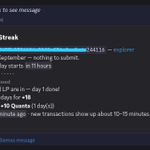
.@QMSNetwork Testnet Trials is back, now as a streak. Make one swap and one LP on @QWAP_xyz every day. Show up 6 of 7 days to earn the streak bonus.
Miss a day? One is forgiven, any 6 of the 7 days earn the streak bonus.

The QMS Testnet Streak kicks off today.
Thanks to your feedback, we've made improvements to swaps and liquidity provision, so now it's time to try them out.
Join our 7-day challenge to earn Quanta, our Discord community reward points that count toward the October leaderboard.
Here's how:
→ New participant or switching wallets? Submit your wallet in Discord first.
→ Make 1 test-token swap + add liquidity daily on @QWAP_xyz
→ Earn 8 Quanta points per day (10 for Pioneers & Qwabbits)
→ Complete any 6 of 7 days for a bonus
→ Earn up to 70 Quanta points (88 for Pioneers & Qwabbits)
Head to our Discord announcements for full details.

2
41
Ethereum is tackling quantum resistance while upgrading an already massive ecosystem. QMS takes a different approach, building post-quantum security into its architecture from day one.
The smartest migration is the one you plan for before it becomes a problem.
#QMS1002

1
42
Useful work is definitely an interesting part of QMS, but Im leaning toward transaction finality.
At some point, its not just about getting a transaction included in a block. Its about knowing when you can actually trust it as settled.
Note on transaction finality: A transfer may appear in a block before it’s final.
Finality means the record can no longer be rewritten, so apps can treat the payment as settled.
We’re building this layer for a future release.
1
25
0xSynツ retweeted
Every proof-of-useful-work chain has to answer one attack: post a problem you already solved, then mine with the answer.
QMS removes the payoff in three ways (white paper §4.4):
- The solver has to be randomized.
- Its seed comes from the parent block hash.
- Blocks go to a lottery over valid outputs, blind to quality.
Solving problems well is what clients will pay for in the marketplace, planned for a future release.

0xSynツ retweeted
On 7 October, Europol and Ethereum researcher Justin Drake gave crypto holders the same advice for 2 different threats: move funds to a fresh address that has never shown its public key.
Europol's worry is a future quantum computer, and Drake's is AI finding a mathematical shortcut, though no attack was named.
Either attack would start from a public key the chain can already see, so you can doubt the AI claim and the advice still holds. A fresh address only hides the key until you spend, and the lasting fix, a new kind of signature, takes years.
0xSynツ retweeted
On a proof-of-stake chain, 3 things get signed with elliptic-curve keys: user transactions, validator votes, bridge messages.
A large enough quantum computer could forge all of them.
Which should go post-quantum first?
25%User transactions
10%Validator votes
9%Bridge messages
55%All at once
285 votes • Final results 0xSynツ retweeted
In less than 2 weeks, the QMS Testnet has passed 1 million addresses.
The explorer shows:
• 5.6M+ transactions
• 1M+ addresses
• 78.8K+ blocks
• 12.1s average block time
Thanks to everyone who has helped with testing. What other stats should we track?

0xSynツ retweeted

Some points on how we are addressing the quantum and AI threat to cryptography at @QMSNetwork :
Currently deployed on testnet:
1. Proof-of-useful-work consensus layer, the security of which relies on hashes like other proof-of-work schemes, which is believed to be immune to both quantum and AI attacks.
In the works for testnet 2:
2. Hybrid signatures on the finalization layer, requiring both ECDSA and a PQ signature. If one is broken, finalization is still secured by the other, and it buys us some time to upgrade the broken one.
On the roadmap:
3. Account abstraction on the execution layer to use post-AI and post-PQ signature schemes.
4. Freezing broken schemes and upgrade paths for accounts.

There has been a lot posted about AI breaking crypto these past days. Let me attempt to sort the good from the bad.
It started with OpenAI solving a whole bunch of math problems: nitter.gq/OpenAI/status/21075967…
Maybe if we had poured the same amount of money into university math departments, humans would have solved all this a long time ago. But nonetheless, really impressive, solid work.
So, if AI can do all that, maybe it can break the crypto systems we are using now. That is a reasonable question, and every serious cryptographer is thinking it.
What is not reasonable is Justin Drake’s post about it, where he suggests that ECDSA might be vulnerable to AI and we should consider going into “bunker mode” by moving funds to accounts where the public key hasn’t been revealed: nitter.gq/drakefjustin/status/21…
Of all the different cryptographic schemes he could have picked on for such a post, why choose ECDSA? There is no evidence that AI is making any progress towards breaking elliptic curve cryptography (on which ECDSA is built). There are so many other more fragile cryptographic schemes that would have made for a more reasonable post.
But let’s get a little paranoid for a minute, and assume that AI is about to break elliptic curves. Then going into bunker mode on a chain like Ethereum is bizarre at best, because the whole consensus is built on elliptic curves. If AI can break elliptic curves, there is no more consensus, and therefore no more Ethereum. The consensus layer needs to be upgraded before AI breaks elliptic curves; otherwise the bunker is pointless. Drake’s post might have been semi-reasonable coming from a paranoid Bitcoin maxi, because Bitcoin’s proof-of-work will most likely not be broken by AI (or quantum computers; that is why @QMSNetwork is also building on proof-of-(useful-)work. Sorry for the self-promotion. Back to the topic.) So if we take Drake’s reasoning to the end, we should all leave Ethereum and go to Bitcoin to hide our tokens there. But he is an Ethereum researcher; he can’t be advising people to migrate to Bitcoin. He really gives the impression of not having thought this through.
So, back to the claim that AI could soon break ECDSA. I recommend reading the series of posts from Yehuda Lindell, who explains really well why this isn’t reasonable: nitter.gq/LindellYehuda/status/2…
Some other reactions are funny, like Jacob Creech from Solana talking about future upgrade paths, which is beside the point: nitter.gq/jacobvcreech/status/21…
The point of bunker mode is to hide your funds while waiting for chains to deploy upgrade paths. Since Solana doesn’t have an upgrade path ready yet, that is an argument for going into bunker mode, not against. Not sure how he arrived at the opposite conclusion from where the argument was taking him.
So back to the AI threat. It seems unlikely that AI breaks elliptic curves before quantum computers do. But whichever comes first, the real discussion is about what post-quantum schemes we should use, and which of them are also post-AI. And this is what Vitalik’s post is about: nitter.gq/vitalikbuterin/status/…
It is fairly reasonable, but it is a promotion of Ethereum's chosen PQ path forward. If Vitalik had posted this out of the blue, it might have raised a few eyebrows, because the AI threat to PQ schemes like ML-DSA is unsubstantiated as far as I know (though more plausible than for ECDSA). But straight after Drake’s post, Vitalik’s sounds so much more reasonable.
0xSynツ retweeted
If you already have an Ethereum contract, deploy it on QMS Testnet and see how it runs.
Use Foundry or Hardhat. Standard EVM contracts need no code changes. Pay gas in test QMS using a throwaway wallet.
Test tokens have no monetary value.
0xSynツ retweeted
Fresh addresses buy time. As Justin points out, getting out of bunker mode still requires a cryptographic migration.
How much of a chain needs public-key cryptography at all?
On QMS, block production needs none. It's secured by computational work, with no miner signing keys to expose. Finality is designed around post-quantum signatures. The execution layer starts with standard EVM accounts using ECDSA, with a path to post-quantum accounts.
Whatever odds you put on an early Q-Day or a classical break, design the migration path before the threat sets the timetable.

Today I call upon the blockchain industry to calmly begin planning for "bunker mode". My personal recommendation is to set in motion a controlled mass migration of assets to fresh addresses, i.e. addresses whose pubkeys remain hidden behind a hash.
Holders, starting with large and sophisticated ones, should consider moving the bulk of their funds to addresses that have never signed a transaction. And when they do sign one, they should also move remaining funds to a new address (possibly generated from the same seed phrase).
Don't rush. While I believe there is cause for action a rushed migration would do more harm than good. Don't panic either. Moving assets to protected addresses is a simple, preventative step which does not require new cryptography or new wallets.
IMO it is now reasonable to brace for the possibility that ECDSA breaks before qday, in the worst case in months not years. By "break" I mean fast private key recovery (e.g. in one week) on available hardware (e.g. a large GPU cluster).
Recent days have been humbling for human mathematical intuition. Long-held, unquestioned hypotheses have fallen. This includes the n log(n) bound for integer multiplication and the 3SUM conjecture. In hindsight, May's unexpected disproof of the Erdős unit distance conjecture was our warning shot.
Yesterday's OpenAI drop made it clear that mathematical superintelligence is upon us. They say there are weeks where decades happen. We are about to live through weeks where centuries of mathematical progress happen. Could our magic 64-byte ECDSA signatures be too good to be true? Was it just security through obscurity all this time?
Elliptic curves feel especially vulnerable to superintelligence. Curves carry rich structure, with room for fancy tricks like Schoof, Frobenius, pairings. (By contrast, hashes are designed to minimise algebraic structure.)
Separately, as Ewin Tang can attest, an efficient quantum algorithm sometimes foreshadows an efficient classical one. We should be open to the possibility of a classical counterpart to Shor that breaks elliptic curves and RSA at once.
Also noteworthy is the striking under-representation of cryptographic breakthroughs among the 722 mathematical results OpenAI published. I've witnessed first-hand the US government censoring academic quantum cryptanalysis results. Backroom interventionism is my base case.
I urge large, sophisticated actors to lead by example. Project11's "risq list" (bitcoin-risq-list.projecteleven[.]com) is a great tracker of exposed BTC pubkeys. Binance, Bitbank, Robinhood, Bitfinex, and Tether have an opportunity to harden their cold storage. Next month I'll address institutions in London in a live Q&A (forum.ethereuminstitutional[.]org/london-2026).
Again, please do not rush. Wallets holding under 50 BTC enjoy partial cover from "Satoshi's shield", i.e. his 20K exposed addresses that hold 50 BTC each. Load-bearing signers like oracles and L2 security councils should consider rotating ECDSA pubkeys with every signed message and/or multi-signing with a hash-based schemes like SPHINCS.
Exiting bunker mode safely will require post-AI cryptography. My inclination is to go all-in on hash-based cryptography and avoid structured mathematical assumptions entirely, whether from curves, lattices, or isogenies. A single battle-tested hash (e.g. from the SHA or BLAKE families) yields plausible post-AI security.
The Ethereum roadmap on strawmap[.]org fully embraces hash-based cryptography with end-to-end formal verification as a response to the quantum threat. Those timelines must now be revisited and accelerated in light of mathematical superintelligence. I'll be pushing for maximum defensive acceleration.
0xSynツ retweeted
Bots gave QMS Testnet its first public stress test. They swamped the faucet on day one, and anti-bot protection went in immediately.
Now it’s your turn:
→ Make a swap or provide liquidity on @QWAP_xyz
→ Deploy a contract and see how it runs
→ Open a block in the explorer and see what problem it solved
→ Find something unusual? Drop it in Discord
That’s what testnet is for: finding the edges before they reach mainnet.
0xSynツ retweeted
Most people ask how to survive quantum computers.
QMS asks: what if they could work for the blockchain network?
In our first AMA, CTO @Christopher_QMS unpacked the vision, what the testnet proves today, and what comes next.
Full recap: qms.finance/news/qms-ama-rec…

0xSynツ retweeted
We launched our @QMSNetwork Testnet Beta without doing any load testing. Our code worked. We opened the testnet to the public. Happy to see that we hit 75% utlization this morning, with some blocks full to near 100%. All is working smoothly. 🔥🚀🚀


0xSynツ retweeted

Trying QWAP for the first time?
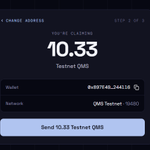
Here's how to add QMS Testnet to your wallet, claim free test tokens, make your first swap and open an LP position.
(Testnet tokens have no value. Don't send real funds to the testnet. Only use official links.)
1. Add QMS Testnet to your wallet
Any EVM wallet that supports custom networks works. Open its network settings, add a custom network and enter:
Network name: QMS Testnet
Chain ID: 19480
RPC URL: rpc.testnet.qms.finance
Currency symbol: QMS
Block explorer: testnet.qmsscan.io
2. Claim free test tokens
Copy your wallet address and paste it at faucet.testnet.qms.finance
10 test QMS per request, up to 4 requests every 24 hours. Use it for gas and swaps.
3. Make your first swap
Open testnet.qwap.xyz, connect your wallet, and switch to QMS Testnet if prompted.
Swap > sell QMS for USDC or any other token with a pool. Start small, approve if your wallet asks, then confirm.
Keep some QMS for gas.
4. Open an LP position
Swap for both tokens in a pair first, e.g. WQMS and USDC.
Explore > Pools > pick the pair > New position. Enter an amount, approve, confirm. Your position shows up in Portfolio.
Heads up: a planned testnet reset will clear balances and positions.
Swap or pool issues? discord.gg/qwapofficial
Full guide: qms.finance/news/welcome-to-…

