The official feed of the Nobel Prize @NobelPrize #NobelPrize
Stockholm, Sweden
Joined September 2008
- Tweets20.2K
- Following492
- Followers1.3M
- Likes2K
The original publication on graphene was published #OTD in 2004.
The discovery of the material – incredibly thin yet strong and able to conduct heat and electricity – led to a Nobel Prize for authors Andre Geim and Konstantin Novoselov.
Learn more: bit.ly/3xxH2Wj
“Whatever you're meant to do, do it now. The conditions are always impossible.”
Novelist Doris Lessing was awarded the 2007 literature prize when she was 88 years old. She was and still is the oldest person to receive the award.
"It is important to believe in yourself. You should not automatically believe what others tell you, and certainly not what a chatbot says, but believe in yourself. That is the key. You've got to have some humility of course, but you have to believe in your ability to learn."
- 2006 medicine laureate Craig Mello sharing advice to young aspiring researchers
Watch our full event that took place in South Korea: youtube.com/watch?v=vSfL5fi-…
How much do you know about the will and testament of Alfred Nobel?
On the 193rd anniversary of Nobel's birth, watch as Gustav Källstrand tells us about the man and the document that led to the establishment of the Nobel Prize.
Learn more about Nobel and his legacy: nobelprize.org/alfred-nobel
Want to know more about the groundbreaking discoveries regarding mirrored molecules that was awarded the 2026 Nobel Prize in Chemistry? This year’s chemistry laureates Henri B. Kagan and Kenso Soai solved chemistry’s asymmetric mystery.
Chemists call life homochiral, from the Greek words for “same” and “hand”. This is because just like our hands, all amino acids exist as two mirrored variants, but only one of them is found in the proteins in your cells. The other is rarely found in nature. This is also true of the sugar molecules that are part of our DNA; there are two different mirror images of these molecules, but life only uses one. Chemists have long wondered how homochirality can emerge.
It was Louis Pasteur who, in the nineteenth century, was the first to observe the remarkable mirror-image forms found in crystallised tartaric acid. When he placed the crystals under his microscope, he discovered that they occurred in two distinct forms. Later he was able to show that the two versions rotated light in opposite directions.
In the mid-1980s, Henri Kagan discovered a new way of manipulating chemical reactions. This made it possible to create a much greater excess of one mirror-image form than had previously been thought possible. This discovery has been revolutionary for chemists who develop reactions for the manufacture of pharmaceuticals, flavours, scents and new materials.
The importance for the pharmaceutical industry, has to do with the fact that the two mirror-image forms can have very different effects. In some cases, one may be therapeutic while the other is harmful. Today, it is already being applied in the manufacture of asthma medicines and antiviral compounds.
Around ten years later, Kenso Soai took the next step by designing the first chemical reaction with the potential to become homochiral, meaning that only one of the two possible mirror-image forms is produced. Other than life itself, no one had ever achieved this feat. The Soai reaction is one of the most spectacular chemical experiments ever conducted.
Learn more: nobelprize.org/prizes/chemis…
Today on World CRISPR Day, we would like to highlight our two chemistry laureates Jennifer Doudna and Emmanuelle Charpentier.
In 2012, they developed a method for high-precision gene editing, which has transformed the field of biotechnology and medicine. The genetic scissors became known as CRISPR/Cas9. In 2020 their breakthrough was awarded with the Nobel Prize in Chemistry.
Watch this interview of Doudna explaining how CRISPR has evolved since then: bit.ly/3U5DTNQ
"I didn't count on winning the Nobel Prize until it happened, and it might never have happened."
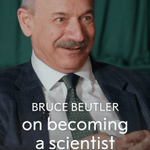
Medicine laureate Bruce Beutler reflects on the reasons for becoming a scientist.
Beutler shared the 2011 medicine prize for discoveries concerning the activation of innate immunity.
Anne Carson's poetic work ‘Nox’ is a book object created from the grief of her estranged brother's death. An epitaph to Michael, who died after living abroad for many years, it is also a translation of Roman poet Catullus’ elegy ‘Poem 101’ – written in honour of his own brother who died on foreign soil.
The book is contained within a box whose pages emerge accordion-folded on one continuous sheet of paper that includes family photographs, collages, sketches and letters dedicated to Michael.
Find more book recommendations from the 2026 literature laureate: nobelprize.org/what-to-read-…
Have you read literature laureate Elfriede Jelinek’s famous work, ‘Lust’? The darkly satirical critique of society aroused a scandal when it was published in 1989.
Learn more about her work: nobelprize.org/prizes/litera…
#NobelPrize
"Creativity is combining facts no one else has connected before."
Christiane Nüsslein-Volhard was awarded the 1995 Nobel Prize in Physiology or Medicine for her studies on fruit flies.
Discover more about her life and work: bit.ly/2WYTSda
Many great discoveries come from unexpected results. John Gurdon encourages his students not to move on too quickly when they don't get the results they were expecting.
Gurdon was awarded the 2012 medicine prize jointly with Shinya Yamanaka for the discovery that mature cells can be reprogrammed to become pluripotent.
Learn more: bit.ly/3VdIESt
"To be the first person to know something - it's really pretty cool if you are a dork like I am."
Medicine laureate Fred Ramsdell shares what he loves about science.
Ramsdell was awarded the 2025 medicine prize for discoveries concerning peripheral immune tolerance.
Watch our full interview with Ramsdell: nobelprize.org/prizes/medici…
This year’s peace laureate Navi Pillay, dedicated her prize to "all the survivors of international crime."
Pillay’s career has been defined by an unwavering commitment to universal legal principles and a strong moral compass. She has played a pivotal role in efforts to prosecute war crimes, crimes against humanity and genocide. Throughout her career, Pillay has held states and political leaders accountable while offering hope to victims of violence and conflict.
Born into a family of Indian Tamil heritage, Pillay grew up under apartheid in South Africa. As a lawyer, she confronted deep structural discrimination, segregation and exclusion. In 1967, Pillay was one of only three women admitted as an attorney and became the first non-white woman to establish her own legal practice in Natal. As she later recalled, she had little choice: “No law firm would employ me because they said they could not have white employees taking instructions from a coloured person.” As a non-white lawyer under apartheid, she was also barred from entering a judge's chambers. A clear thread runs through her life’s work, from her early defence of Nelson Mandela and other anti-apartheid activists to her later service as a judge in some of the key international court cases of our time.
Pillay has served as a judge of the High Court of South Africa, the International Criminal Tribunal for Rwanda, and the International Criminal Court (ICC). When the International Criminal Tribunal for Rwanda established that rape and sexual violence could constitute a crime against humanity – as well as genocide – her influence was a significant factor. She was the United Nations High Commissioner for Human Rights and, until recently, she chaired the UN Independent International Commission of Inquiry on the Occupied Palestinian Territory. Today Pillay is a judge on the International Court of Justice in the case where Myanmar stands accused of genocide.
With this year’s prize the Norwegian Nobel Committee seeks to underline that the rule of law forms the foundation of the international system for maintaining peace and resolving conflicts without violence. History has shown that a world without respect for the rule of law becomes unjust and inhumane. Judges, who safeguard the fragile line between order and chaos, deserves recognition for their vital work. Yet today these judges are increasingly under attack, and the institutions they serve face sanctions. For that reason, people like Navi Pillay are needed now more than ever.
Read more: nobelprize.org/prizes/peace/
#OnThisDay in 1900, Max Planck presented his law of black body emission, Planck’s law. Planck's law (coloured curves) accurately describe black body radiation and resolved the ultraviolet catastrophe (black curve) a prediction of late 19th/early 20th century classical physics.
Craig Mello was awarded the Nobel Prize after discovering a process called RNA interference, which can regulate gene expression by silencing selected genes, or rendering them inactive. This plays an important regulatory role within a genome.
Read more: bit.ly/3eM8UBh
Francis Halzen was awarded this year's physics prize for his contributions to the IceCube Neutrino Observatory and the discovery of high-energy neutrinos of astrophysical origin.
But Halzen admits he's never actually been to the observatory built, as he envisaged, in the South Pole. It would not have been possible without the adventurous technicians from University of Wisconsin, on location in Antartica.
The IceCube team endures a 10,000 mile journey just to get to the South Pole, with many segments and layovers lasting hours to days, depending on the weather. It's very cold and the work is hard, but they seem to have some fun as well.
Check out their blog to learn more: icecube.wisc.edu/category/ga…

ALT A group of people wearing red parkas is seated inside a vehicle, possibly in a cold region, based on their attire. The ceiling and walls have various stickers and signs, including one stating "United States Antarctic Program." They are sitting on benches and some holding items, with windows on both sides providing natural light.
"Science needs us to work on the things that everyone else doesn't work on. When doing new things, you've got to be prepared to fail fast. If something is hard, you might need the support of a mentor to decide if you should carry on with your work or if you should let it go."
- Brian Schmidt to high school students in South Korea
If you missed our event in Seoul, South Korea, watch the full event here: nobelprize.org/events/nobel-…
The 2026 Nobel Prize in Literature was awarded to Anne Carson. Since the mid-1980s she has published a wide range of literature: poetry, essays, translations and collaborative artwork.
When reading Carson one thing strikes you as a reader: she sounds like nobody else. With playful intellectual precision, she addresses painful subjects without sentimentality. Her literary voice is charged with an intensity that makes her books impossible to put down. Since Carson’s books offer multiple and ambiguous meanings they can be re-read in different situations in life.
A good place to start as a reader is 'The Beauty of the Husband: A Fictional Essay in 29 Tangos' (2001). It’s a relatable portrait of jealousy and an autofictional account of a break-up. Structured as a series of tangos, the chapters oscillate between desire and anger. The verse captures the swirling movement and passion of the dance itself.
Carson’s first book, 'Eros the Bittersweet: an essay' (1986) is a reworking of her doctoral thesis, exploring the classical Greek concept of eros. In the book, Carson shows how desire is fundamentally bound up with absence. The tension generated by absence is a recurring theme and a defining feature of her writing.
'Nox' is one of many collaborations that Carson has made with her husband, the artist Robert Currie. Nox is a folded text presented in a box. Part elegy, part tribute, it reflects on the disappearance of Carson’s brother in the form of a collage of memories and images.
As Anne Carson said, when being asked where readers should start if they want to get to know her work: start in the middle! So pick up a book and step into the universe of our newest literature laureate.
Did you know that 1965 physics laureate Richard Feynman was an enthusiastic correspondent?
One of the most beautiful letters he wrote was to his first love and late wife Arline Greenbaum. The letter was written on this day 80 years ago. Greenbaum was Feynman's high school sweetheart who sadly passed away at the age of 25 from lymphatic tuberculosis. Feynman wrote her a love letter around two years after her death.
A segment of the letter read:
“When you were sick you worried because you could not give me something that you wanted to and thought I needed. You needn’t have worried. Just as I told you then there was no real need because I loved you in so many ways so much. And now it is clearly even more true — you can give me nothing now yet I love you so that you stand in my way of loving anyone else — but I want you to stand there. You, dead, are so much better than anyone else alive.
I know you will assure me that I am foolish and that you want me to have full happiness and don't want to be in my way. I'll bet that you are surprised that I don't even have a girlfriend (except you, sweetheart) after two years. But you can't help it darling, nor can I—I don't understand it, for I have met many girls and very nice ones and I don't want to remain alone—but in two or three meetings they all seem ashes. You only are left to me. You are real.
My darling wife, I do adore you. I love my wife. My wife is dead.
Rich
P.S. Please excuse my not mailing this—but I don't know your new address."
This love letter is featured in Feynman's book of letters, 'Perfectly Reasonable Deviations from the Beaten Track', where more of his correspondence can be read.
Photo from the Nobel Foundation archive.
Did you know literature laureate Grazia Deledda’s writing career began when an Italian fashion magazine published the 13-year-old’s story called ‘Sangue sardo’ (Sardinian Blood)?
Learn more: nobelprize.org/prizes/litera…