








Hong Kong is moving fast on cross-border tokenised deposits. 🇭🇰
HKMA, Swift, HSBC, Standard Chartered & Bank of China are working towards 24/7 international payments without relying on stablecoins.
Here's what caught my attention: ethereum:0x4a220e6096b25eadb88358cb44068a3248254675 has already outlined how Overledger could connect Hong Kong's digital money ecosystem: tokenised deposits, wholesale CBDC and different DLT networks.
The infrastructure is evolving & interoperability will be key.
ethereum:0x4a220e6096b25eadb88358cb44068a3248254675


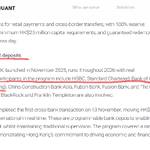
NEW: Hong Kong’s central bank and @Swiftcommunity partner with @HSBC, @StanChart and Bank of China to test cross-border tokenized deposit payments, as banks seek 24/7 international payment rails without relying on stablecoins.

ALT The image displays the logos of Hong Kong Monetary Authority, Swift, HSBC, Standard Chartered, and Bank of China, each in yellow against a black background.
🇪🇺 **The Digital Euro. Nexi. Quant.**
ECB just selected Nexi Group to help build the connectivity layer for the Digital Euro, with a pilot planned for 2027 and potential rollout from 2029.
Here's what's interesting: Nexi inherited SIA, which partnered with Quant back in 2019 to integrate Overledger into its SIAchain infrastructure.
A historical connection. A new strategic opportunity.
If that relationship evolves into the Digital Euro ecosystem, Quant could have a role in connecting traditional financial infrastructure with tokenised money and multiple DLT networks.
The pieces are getting interesting. 👀
$QNT Interoperability is the bigger picture.

🇺🇸 AMERICA WAS JUST THE BEGINNING.
The Clearing House selected $Qnt to power interoperability for its On-Chain Money Initiative, backed by some of America’s largest banks. 🇺🇸
Now imagine what happens when this scales globally. Trillions in financial assets could become interoperable, enabling faster settlement, 24/7 markets, and an entirely new financial infrastructure powered by $QNT.
🇯🇵 Japan. The Yen. Programmable money.
Quant already has a strategic partnership with Dentsu Soken to advance tokenised deposits and programmable settlement in Japan.
Could JPY be the next major chapter?
The world is waking up. And we're still early...

This post was made when $QNT was at $60.
I wasn’t wrong. I said $QNT would be the biggest surprise in crypto, and look at where we are now. 👀
Big accounts, small accounts… everyone is talking about Quant.
And this is only the beginning.
You’re not prepared for what’s coming

I genuinely believe $QNT is going to be the biggest surprise in crypto and most people still aren’t positioned for what’s coming. 🚀
The difference between a narrative and a vision is execution.
Today, $QNT put Fusion Rollup live on mainnet.
74 networks connected.
Multi-ledger assets.
Unified liquidity.
Institutional-grade governance.
After years of development, patents, standards work and partnerships, the infrastructure is now live.
The next chapter begins.

The #FusionRollup is live on mainnet.
The world's first multi-ledger rollup - connected to 74 networks from day one, purpose-built for institutions operating across multiple blockchains at once.
Learn more about the launch here: quant.network/news/a-new-cat…
#QuantFusion #EnterpriseBlockchain #MultiLedger
There's a new version of this post
Global finance just aligned on a 3-layer future:
• Wholesale CBDCs (central banks)
• Tokenised deposits (commercial banks)
• Public blockchains (markets)
But the real key is the horizontal layer connecting it all.
This is the shift from isolated systems to a true network of networks for money.
$Qnt
This quoted post is unavailable.
This is one of those moments people will understand later.
Murex sits at the heart of global capital markets. 65 of the top 100 banks rely on it to run trading, risk, and settlement.
Banks don’t replace it, they build on top of it.
And now $QNT is embedding tokenisation directly into MX.3.
The shift from traditional finance to programmable finance just got very real.
I’m delighted to announce that @quantnetwork and Murex are partnering to bring tokenised deposits and digital bond settlement into MX.3.
Institutions have been asking the same question. How do we move forward with tokenisation without disrupting the trading, risk and post-trade operations we depend on?
The answer is now inside the platform they already use.
Tokenised RWAs just crossed $100 billion. DTCC has SEC approval to tokenise real-world assets from mid-2026 and major UK banks are already working with Quant through the Great Britain Tokenised Deposit initiative - all of which signals that the market is moving.
Users in banks, asset managers, insurance companies, pension funds, hedge funds, corporations and energy utilities in over 65 countries now have a production-ready path into tokenisation through the systems they already run.
The future of capital markets infrastructure is programmable: quant.network/press-releases…
#Tokenisation #DigitalAssets #CapitalMarkets #Programmability
$QNT just plugged tokenised finance directly into Murex MX.3 which is one of the most widely used capital markets platforms globally.
No new systems & no disruption...
Banks can issue, settle, and manage tokenised deposits and digital bonds inside the infrastructure they already trust.
This is how adoption actually happens. Quietly, then all at once. 🚀
Murex built the systems capital markets trust. Quant is making those same systems programmable.
Today, we’re announcing a strategic partnership that brings institutional-grade digital asset capabilities directly into MX.3, one of the most widely deployed capital markets platforms in the world.
Banks and capital markets firms can now issue, settle and manage tokenised deposits and digital bonds within the systems already operational across their trading, risk and post-trade workflows. No rip and replace, no parallel infrastructure. The same platforms made ready for the next era of settlement, automation and liquidity.
This partnership comes as tokenised infrastructure moves from pilot to production across the world’s largest markets. Tokenised real-world assets have crossed $100 billion. DTCC has SEC approval to tokenise US Treasuries from mid-2026. Major UK banks are already working with Quant through the Great Britain Tokenised Deposit initiative.
The infrastructure moment is here, and now it runs on MX.3.
Read the full announcement: quant.network/press-releases…
#Tokenisation #DigitalAssets #CapitalMarkets #Programmability

This is what long term vision looks like.
From proposing the first blockchain interoperability standard in 2016…
to publishing an official ISO standard in 2026.
The same multi-gateway architecture that shaped the standard is the foundation of Overledger.
$QNT has been working on the infrastructure layer of finance long before most of the market even understood the problem.
The rails are being written into global standards
A decade in the making, we have published an ISO standard for blockchain interoperability.
This is a milestone I've been working towards since 2015, Remitt was founded with the conviction that blockchains could transform financial services but only if the industry solved interoperability and harmonised around global standards. Without that, blockchain would remain fragmented, siloed, and locked out of mainstream institutional adoption.
In April 2016, we published what was the world's first proposal for a blockchain standard (remitt.com/blog/2016/04/28/w…) a bold move at a time when the industry was still largely focused on proofs of concept and competing protocol narratives, not standardisation.
The idea was simple but ambitious: if blockchains were going to serve global markets, they needed a common framework that transcended any single protocol or vendor.
Central to this thinking from the very beginning was the concept of a multi-gateway architecture, leveraging the know-how of 20 years of experience in cybersecurity to frame the principle that interoperability shouldn't depend on a single bridge or point-to-point connection, but on a layered gateway model that could abstract away the differences between underlying DLTs and connect them through a common interface. This was the architectural foundation of what would become Overledger, and it was also the design philosophy we brought to the standards process.
The belief was that a viable international standard for blockchain interoperability had to be protocol-agnostic and gateway-driven, enabling any DLT to communicate with any other DLT (any-to-any) and with existing networks, without requiring those ledgers to change how they operate. The standard and the technology were born from the same insight.
That same year, I worked closely with the team from @standardsaus (Standards Australia), who had the foresight in 2015 to champion the initiative at the international level. Together, we pushed for ISO to establish a dedicated Technical Committee for blockchain and not to be absorbed into an existing committee, but to stand on its own as a recognition that this technology warranted its own global standards programme. The industry demand was there, the use cases were multiplying, and the fragmentation was becoming a real barrier.
In September 2016, the New Work Item Proposal (NWIP) received global approval, and ISO formally gave the green light to establish a new Technical Committee (remitt.com/blog/2016/09/19/g…). TC 307 — Blockchain and Electronic Distributed Ledger Technologies — was born (remitt.com/wp-content/upload…). The inaugural meeting was held in Sydney in April 2017, and from that moment the real work began.
As the standards work progressed internationally, the mission at Remitt was evolving too. What started as an effort to use blockchains for financial services and solve interoperability grew into something far larger, a full enterprise infrastructure platform for connecting any blockchain to any network. Remitt became Quant, and we built Overledger, the world's first blockchain operating system to deliver on that original vision. The multi-gateway architecture that informed the standards thinking became the core of Overledger's design: a technology layer that sits above all blockchains, providing institutions with a single integration point to access any DLT, any network, and any existing system. The interoperability challenge that drove the standards work was the same challenge we set out to solve commercially and the two efforts reinforced each other throughout.
For close to a decade since TC 307's formation, subject matter experts across the world have contributed their time and expertise to Working Group 7 — Interoperability is the committee I chair.
International standards are not built quickly they are built through consensus, technical debate, and relentless refinement. The same methodology and rigour that created the Internet, through publishing standards. The result is a published international standard for blockchain interoperability.
🔗 iso.org/standard/82098.html
A huge thank you to @isostandards as the international standards developing organisation, to the team at @standardsaus who started the initiative in 2015 and worked tirelessly to get TC 307 approved and established globally, and to every subject matter expert who contributed to Working Group 7 over the years. This would not exist without that collective effort.
From a blog post proposing the world's first blockchain standard in 2016, to a published ISO standard in 2026 and from Remitt to Quant, from an architectural concept of multi-gateway interoperability to Overledger and a global standard, this has been a decade-long journey of building both the standards and the technology to make blockchain interoperability a reality for institutions worldwide.
There is still much more work ahead. More standards to develop, more to evolve, and more to build. But today, we mark a significant milestone.
#Blockchain #ISO #Interoperability #Standards #TC307 #DLT #Quant #Overledger
🚨 Bank of Japan exploring blockchain for 24/7 instant settlement between financial institutions is a serious infrastructure move.
Atomic settlement, reduced gridlock risk, interoperable rails… that’s the exact category $QNT is positioned in.
No name drop. But the direction of travel is clear.

Everyone’s focused on AI models.
Oracle just reminded the market that the real power sits in private enterprise data.
If AI starts reasoning over bank balance sheets, loan books, treasury positions and settlement flows in real time, then the next step is execution.
And execution in finance means secure, interoperable, atomic movement of value across institutions.
That’s where infrastructure like $QNT becomes interesting.
AI can analyze the system.
But someone still has to connect it, synchronise it, and settle it safely across banks, ledgers and jurisdictions.
Private AI + tokenised deposits + CBDCs + real-time rails is not a sci-fi stack anymore. It’s being built layer by layer.
Most people are watching the model wars.
The real leverage might sit in the rails underneath.


Oracle just told every AI company on earth the same thing.
Your models are worthless.
Not the technology, talent or the billions spent training them.
But the data they were trained on.
Larry Ellison, the man who built Oracle into the backbone of global enterprise just dropped a bombshell.
He said ChatGPT, Gemini, Grok, and Llama, all of them are training on the exact same data.
The entire public internet, every Wikipedia page, Reddit thread and every news article.
That means they're all converging essentially becoming the same product with different logos.
Ellison's word for it is commodities.
But here's where it gets dangerous.
He says the real gold isn't public data, It's private data.
The medical records in hospital systems, the financial data in bank vaults.
The supply chain secrets of every Fortune 500 and guess where most of that data already lives.
Not Google, Amazon or Microsoft but inside Oracle.
Oracle databases hold most of the world's high value private enterprise data.
So Oracle just launched something called AI Database 26ai.
It lets the top AI models, ChatGPT, Gemini, Grok, Llama reason directly over a company's private data, without that data ever leaving the vault.
They're using a technique called RAG, Retrieval Augmented Generation.
The AI doesn't train on your data, it searches it in real time.
Think about what that means.
A bank could ask AI to analyze every loan it's ever made without exposing a single customer record.
A hospital could have AI diagnose patients using its full medical history without violating HIPAA.
A defense contractor could let AI reason across classified operations without data leaving a secure environment.
Ellison is betting this is bigger than the training market. Bigger than the GPU boom.
Bigger than the data center buildout.
He called it the largest and fastest growing market in history.
The numbers back the ambition.
Oracle's remaining performance obligations just hit $523 billion.
That's contracted revenue not yet delivered and $300 billion of it comes from OpenAI alone.
Cloud revenue hit $8 billion in a single quarter, OCI grew 66 percent and GPU revenue surged 177 percent.
But here's the part nobody's talking about.
If private data becomes the real AI moat, then whoever controls the database controls the future of AI.
And that's a level of power that should make everyone uncomfortable.
I genuinely believe $QNT is going to be the biggest surprise in crypto and most people still aren’t positioned for what’s coming. 🚀
This is big. And not in a hype way, but in a quiet infrastructure way
$Qnt being selected for the Bank of England’s Synchronisation Lab tells me something important: this isn’t about theory anymore. It’s about solving real treasury problems for real corporates, inside the UK’s core payment system
👉Atomic multi-bank settlement
👉Deterministic finality
👉No partial payment risk
What gives me confidence is this that $Qnt isn’t trying to replace the system. It’s working within RTGS, within CHAPS, within existing structures, making them programmable and synchronised.
That’s how lasting change happens.
While timelines and price move however they want, the direction feels clearer than ever. We’re watching the next layer of money being engineered and we’re early enough to understand it. 🧠
Delighted to share that @quantnetwork has been selected for the @bankofengland’s Synchronisation Lab as part of the RTGS Future Roadmap.
Our use case: atomic, multi-bank treasury operations powered by Quant Flow and PayScript®. All payment legs settle together or not at all, eliminating partial settlement risk across multiple banks in a single action.
This is programmable finance that works within existing market structures, not around them.
quant.network/press-releases…
#RTGS #TreasuryManagement #PaymentsInnovation #FinancialInfrastructure #SynchronisationLab #ProgrammableMoney
People are acting like SWIFT + Chainlink means someone else is “winning” I don’t see it that way.
I see banks experimenting, layering tech, trying to solve real-world settlement problems.
The more complex it gets, the more interoperability becomes unavoidable and that’s exactly why I’ve been paying attention to $QNT
This space is maturing right in front of us.


CZ mentioning a potential 2026 “supercycle” should make one thing clear: institutions are coming in waves.
And when they do, $QNT, the backbone of regulated blockchain integration will rerate violently.
Don’t be shocked when it prints 4 digits. ⚡️

In the last 24h we’ve seen massive $QNT movements.
Over 5% of total supply shifting hands. That doesn’t happen by accident. It’s a signal: Fusion is close, institutions are in position, and the narrative is aligning perfectly.
A new financial order is unfolding right in front of us and we’re early enough to witness it, understand it, and build with it.
Pioneers always feel it first. 🚀💛
🚨 700,000 $QNT moving into a few strategic wallets!
You don’t see this level of coordination unless something big is lining up behind the scenes.
Supply evaporating.
Whales consolidating.
Institutions preparing.
When the reason for these moves becomes public, retail will understand why you accumulate before the headlines drop.
Stay ready, this is how major cycles begin. 🚀🔥

🧿💥 $QNT This is SOME HUGE movement of QNT.
We have seen many wallets redistribute from large private wallets > CB hotwallet > 3 LARGE wallets.
That's 700,000 QNT so far ($63M).
This is certainly strategic. We wait for the news while the BIG play is underway 👌

🇬🇧 The UK just changed the game.
With the new Property Bill officially recognising digital assets as personal property, the UK has positioned itself to lead the global shift to on-chain finance.
Tokenised money, digital assets, cross-border settlement, all need secure, compliant interoperability.
That’s exactly where $QNT, Overledger and Quant’s ISO-aligned infrastructure step in.
As assets, payments and finance go fully on-chain, the rails that connect them become the most valuable layer.
The UK is laying the legal foundation.
$Qnt is building the technical one.
Mass adoption isn’t a theory anymore, it’s policy. 🚀
The UK has just taken a significant leap forward with the Property (#DigitalAssets etc) Bill receiving royal assent.
This new law formally recognises #cryptocurrencies, #stablecoins, and other digital assets as personal property under UK law.
This sets the UK up for digital assets and #tokenisedmoney globally. As finance moves on-chain with all our assets being tokenised, this legislation sets the UK apart and creates the certainty for economies to trade in the UK.
With approximately 12% of UK adults now owning cryptocurrency, this legal framework positions the country as a leader in digital asset regulation, offering the clarity and consumer protection needed to unlock institutional adoption and cross-border digital commerce.
The future of finance is being built on-chain, and the UK is laying the legal foundation to lead it.
Read the full legislation here: legislation.gov.uk/ukpga/202…
#Tokenisation #Blockchain #CryptoRegulation
Citi is now pushing real-time cross-border payments, digital-wallet rails, and tokenized settlement, all in one move.
The problem they’re trying to solve? A fragmented global payments system that can’t talk to itself.
That’s literally the problem $Qnt was built for.
When the biggest banks shift to hybrid digital + fiat rails, the infrastructure that enables true interoperability becomes priceless.
$QNT is positioned exactly where the world is moving.

$QNT is back at the top - again.
📈 #1 gainer on CMC in the last 24h
⬆️ Jumped 8 positions in a single day
💛 Strength across BTC pair + USD pair
With Fusion, enterprise volumes, and real-world integrations accelerating…
Quant is only just getting warmed up.
The quiet phase is ending. 🚀🔥

$QNT is leading the entire market today.
It's the #1 gainer on CoinMarketCap over the last 24 hours.
When real utility meets real demand, the chart eventually speaks for itself.
Strap in! Quant is waking up. 🚀
