

Building @esquisse_camera. Prev: https://nitter.gq/t.co/dH5RWGv2iq & https://nitter.gq/t.co/LFI3YSMpUw (acquired).
Joined February 2011
- Tweets9.4K
- Following494
- Followers2.1K
- Likes39.7K






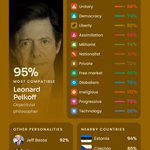



Here’s my take: there’s an M-shaped future for the US stock market:
- Short term: bullish. Sure, it crashed today, but (1) it comes after a record streak of strong performance, (2) you’d have to be a fool to bet against US tech, and (3) P/E ratios are not absurd.
- Medium term: bearish. At some point, I think the US will be held back by its underfunded, poorly maintained infrastructure and societal divisions. This is when we’ll stop treating China as an outsider and more like the new imperium it is.
- Long term: super bullish. The US is the only developed nation that keeps making babies, and I think the philosophical roots of American society are much, much stronger than most people believe.
Things I still have no clue about: when the breaking points will happen, whether the US and China can coexist (I think they can), and whether robots can substitute for humans.

The timing of today's market crash is noteworthy.
As selling pressure spreads, the Nasdaq 100 is now down nearly -5% on the day.
Meanwhile, the market-implied odds of a Democrat "sweep" in the Midterms next week has surged from 65% to 72% today, a record high.
That's +7 percentage points in 2 days amid this market downturn.
We have yet to receive a comment from the Trump Administration regarding the current situation in the market.
However, what is clear is that the timing of today's market crash will be consequential.
And, even as technology stocks drop sharply, US Treasury Yields are barely seeing any relief.
This leaves us with high rates, a falling stock market, $100+ oil prices, and rising CPI, PPI, and PCE inflation.
Next week is going to be interesting, to say the least.
I’ve been wanting to upgrade to the Oled MacBook Pro for the past 2 years and now it’s there I’m not sure I want it anymore.
I’m currently on a 12hr flight to sf and haven’t touched my MacBook once. I connected it to WiFi when we took off, launched Claude and have been interacting with it through my phone.
I like the comfort of having an actual keyboard and screen but do I really need a $3k mbp for that…?
This is a perfect example of how distribution is everything and the rest doesn’t matter much.

So I recently badgered my cinematographer @steveyedlin into making my ideal iPhone still camera app. It shoots RAW, bypasses the iPhone's look processing and instead uses the same image processing we use on our movies. apps.apple.com/app/apple-sto…

There are two ways out of this:
1) break up the eurozone
2) let inflation slip
I don’t bet on #1

The AfD can end it if they want, but it would mean that Italy and Spain won't be buying as much German stuff anymore. Absent a sudden surge of extra-EU competitiveness, German factories would take the hit. These claims built up because Germany entered the euro at too low a level vis the deutschmark, and screwed down on labour costs with the Hartz labour market reforms. At the same time, the Latin countries suddenly had access to much cheaper capital (debt). So, Spain, Italy, et al started consuming much more than they saved (they bought more stuff from Germany than Germany bought from them) and Germany saved more than it spent (they loaned money/sent capital to those countries to fund the purchase of German stuff).
This, in fact, is the core problem of the eurozone: it is unbalanced. Unwinding it would be painful on both sides: Italians and Spaniards would have to accept much lower standards of living, and Germans would have to accept industrial job losses. This is made worse by the present geopolitical circumstances and the fact the euro does not allow the simple revaluing of various free-floating currencies to restore balance. Instead, the Italians and Spanish would have to grind down on wages to force deflation, which would make their debt metrics worse (because the Germans absolutely refuse to engage in inflationary policies) -- all against a nasty and inflationary geopolitical backdrop. It's a problem.
It’s true, but I can be a founder with a 0.01% chance of a successful exit while making serious money along the way, whereas there’s a 0.00% chance I can be an anthropic employee.
But, yes, if you’re smart, please let us monkeys build companies cause we don’t know what else to do.

if you had 2 cofounders, raised from top teir vc, exited for a few billion dollars, you still wouldnt make as much as employee #400 at Anthropic will from the IPO.
Just let that sink in for a moment
My cofounder and I started @esquisse_camera mostly thanks to AI. It's essentially an AI-led company at this stage. It started out of necessity because the camera market is small and we had to be super capital-efficient.
One of the perks I hadn't seen coming, but that seems obvious in hindsight, is that part of our progress comes directly from advances in the models we use.
For instance, we've done more since Opus 5.5 came out than we did in the rest of 2026 combined. It's like having a whole team of engineers with IQs of 160.
And when things go wrong, it's mostly because we left something out of the specs or didn't think of something when writing our prompts.
This makes me very optimistic!
As a result, what I wrote a year or so ago aged poorly: nitter.gq/compose/articles/edit/…
What matters:
- Network & access (getting your hands on the right parts is hard)
- Community & distribution
- Data


Côme retweeted

please listen to dessa.
i have never heard anything artificial that sounded so… human.
if you ever doubted that human-ai-relationships were going to be a thing. well. this snippet will convince you otherwise.

We believe voice is the most natural way to interact with intelligence, so we created Dessa, the most authentic full-duplex speech model ever built. Talking with it feels like talking with a person…full of emotion, nuance, pauses, and a natural cadence.
block.xyz/dessa

I think one of the reasons for this is the total lack of investors who can back entrepreneurs building rapidly profitable businesses. They’d need to simultaneously a) provide a large investment amount and b) hold it for a few years until some liquidity (OBO, LBO, or dividends) is provided.
For instance, I know I’ll need to raise at some point with @esquisse_camera. Let’s say $2–3m. I won’t really need funding after that (or it’ll come through debt). But it’s probably going to be 5–7 years before I can do an OBO or pay dividends. As a result, that doesn’t work for VCs, and it’s going to be a long, tedious process to assemble a business angel syndicate.
Same story with CitizenPlane.com. We raised a $1.3m seed round (yeah, you know the 2010s were different lol) with a VC and never ever touched it. Except we have no pre-agreed way to return that money, although the company makes a couple millions EBITDA every year.
So I think this calls for a vastly different kind of structure that is compatible with the seedstrap model. It’s probably more akin to PE btw. I hope we’ll get there soon. Founders need it.


This 💯

iPhone Duo is the end of smartphones.
Hear me out: every computing cycle has approx a decade (or two max) of innovation before people move on to the next thing.
The original iPhone launched in 2007. For the next decade, smartphones and their apps gave us:
- Cameras (Snapchat, Instagram)
- Payments (Apple Pay, Venmo, Cash App, WeChat)
- Navigation (Google Maps, Apple Maps)
- Communication (WhatApp, iMessage)
- Entertainment (TikTok, YouTube)
Entire industries were built around smartphones. Somewhere around 2020, innovation started slowing (I left smartphone biz towards the end of 2021 partly due to the boredom of nothing new happening lol).
Now folding phones is a last ditch and somewhat desperate attempt to make the category exciting again.
Impressive engineering but solving new problems? Going by the lack of adoption of Android folding phones and lukewarm reception to the Duo, that's a no.
What's happening is we are stretching an existing form factor because we’ve run out of ideas.
We’re witnessing the final stages of its dominant innovation cycle as the next computing platform isn't here yet. Smartphones aren't dead but they're dying (slowly).
My bet is the next thing will be centered on AI; a device that increasingly understands what we want and acts on our behalf. Something will come along that makes the previous generation feel unnecessarily complicated.
Probably won't even have a screen..
I've been using Gigi for the past few days and it's amazing. It's just so great to be able to ask Claude to search my network and my friends network for relevant contacts.
Use my link to signup and add me if you're on it: app.gigi.co/invite/come-cour…


Your AI agent can find anyone on the internet. It has no idea who can actually get you to them.
Until now.
Meet Gigi: the trusted network that gives agents access to people.
That investor you've been dying to meet. The engineer you'd hire tomorrow. The dream customer you can't get in front of. Chances are, someone in your extended network knows them. Gigi finds out who.
Your agent can now search your network, ask the agents of people you trust to search theirs, and find real warm paths to the people you want to reach.
All without exposing anyone's contacts. And without reading a single email or message.
Your network is no longer who you know. It's who your agent can get you to.
Think of one person you wish you knew. Ask Gigi to find your way in. Link in the comments👇
I did that a few times, I highly recommend checking out @WayoWork if you're in nyc


I watched it, and this iPhone does look nice. But the whole time I couldn't help thinking it's a faster horse.
I don't want a phone anymore. I just want my AI assistant with an easy way to fix its inevitable screwups.


This should be printed and handed out (alongside the Norwegian experiment) to every citizen in the world. Especially in France.

this California wealth tax thing is just incredible.
so in October 2025, a California healthcare union proposed a "one time" 5% tax on any billionaire's wealth. the ballot measure will be voted on next month. In early December 2025, California announced that it would be a retroactive tax if passed, applying to anyone with CA residency as of Jan 1, 2026. The objective is to pay for Medi-Cal, California's incredibly dysfunctional healthcare system. (which also functions as a glorified welfare apparatus, but that's a discussion for another time).
polls reveal that the CA electorate is split around 50/50 on the tax, but prediction markets only give Prop 40 a ~23% chance of passing (there are competing measures on the ballet that would nullify it).
there are 200 billionaires in CA, worth collectively somewhere between $2.3 and $2.6 trillion. 5% of that is around $100b, accounting for a small amount of attrition. proponents of the tax forecasted a significant windfall, assuming only a 10% departure rate.
supporters thought they were being clever with the retroactive concept. no billionares would leave CA in the few short months between the tax being proposed and the residency cutoff date, without the tax even having passed yet, right?
well as it turns out, they did.
a new paper [1] from two academics at Stanford called "The Net Present Value of the California Billionaire Tax Act", argues that not only did more billionaires leave due to the proposed tax than its proponents expected, but that the value of the tax, if it does pass, is actually negative.
proponents of the tax only assumed 10% avoidance, that is, only 10% of the taxable base of targeted billionaires would leave CA within the very short Oct-Dec 2025 window. Jaros and Rauh, the Stanford academics, find that a lower bound of 28.6% of the taxable base managed to leave.
just based on known departures, those departures total $577b in net worth, or $28.8b in potential tax lost. this of course does not capture everyone (many left without announcing their departure), so the authors normalize to departure rates estimated from other wealth tax events, and apply other discounts for litigation, arriving arrive at a figure of only $28-$36b in forecasted tax revenues.
but this isn't all! all of the income taxes paid by the departed billionaires are also forsaken. the authors estimate that CA billionaires pay $3.3- 5.8b in annual income taxes. they assume a midpoint of $2b lost in annual collections from departed billionaires. the net present value of that lost income stream is -$68.9 billion.
so when you add it all up you get:
+ $30b one-time tax windfall (estimated)
- $69b in present value of lost future income taxes
= - 38.9b overall net present value of the tax
of course, this analysis is highly estimate driven. the authors simulate the parameters 100k times and find a negative NPV of the implemented tax 85 percent of the time.
and if the tax doesn't pass, which it's not looking like it will, California still ended up losing at least $577b in departed net worth, and they have permanently poisoned the well with entrepreneurs who will now worry about future wealth taxes.
[1]: nber.org/system/files/workin…


