
Washington, DC
Joined July 2024
- Tweets8K
- Following264
- Followers128
- Likes7.9K





OGSilverback retweeted

One of the clearest photographs of the surface of comet 67P/Churyumov–Gerasimenko
Taken by the Rosetta spacecraft


OGSilverback retweeted
The Cat’s Paw Nebula: A Stellar Nursery in Chaos
In this multiwavelength view of the Cat’s Paw Nebula (NGC 6334), about 4,000 light-years away in Scorpius, infrared light from the James Webb Space Telescope is combined with X-rays from the Chandra X-ray Observatory (shown in pinkish purple). A mottled patch of pink at the center reveals young, million-year-old stars tucked behind thick, overlapping rings of dark orange cosmic dust.
Webb’s infrared vision unveils a turbulent scene still unfolding: massive young stars are carving cavities into the surrounding gas and dust with powerful radiation and stellar winds, while their intense light bathes the region in a bright nebulous glow rendered in blue. These energetic newborns are both shaping and ultimately limiting the local star-forming process.
Image credit: X-ray: NASA/SAO/CXC; Infrared: NASA/ESA/CSA/STScI; Image Processing: NASA/CXC/SAO/J. Major

OGSilverback retweeted
A volcano has appeared on the moon Io, and we didn't even notice it happening.
In 1997, this area of Jupiter's moon Io looked completely quiet. But nearly three decades later, JunoCam’s optics detected fresh lava, sulfur, and a massive new volcanic region spanning approximately 180 km.
Comparing images from *Galileo* and *Juno* revealed an even more striking picture: two lava flows about 100 km long and nine active volcanic plumes had appeared—where none had existed before.

OGSilverback retweeted

Today October 11th was the day of the Meditrinalia. It was a celebration of the tasting of the first new wine of the autumn vintage. The wine was offered to the gods as a libation. The Romans were more than happy to raise a glass to the benefits of wine

OGSilverback retweeted
The Cosmic Cliffs: Where Stars Carve the Universe
Called the Cosmic Cliffs, this region is the dramatic, jagged edge of a gigantic gaseous cavity inside the nebula NGC 3324, roughly 7,600 light-years away.
The vast cavern was hollowed out by the intense ultraviolet radiation and powerful stellar winds from extremely massive, hot, young stars blazing at the bubble’s center—above the area shown in the image. Their high-energy light continues to sculpt the nebula’s walls, slowly eroding them away and shaping the towering, cliff-like formations that give this view its name.
Credit:
JWST: Image: NASA, ESA, CSA, STScI
Hubble: NASA, ESA, and The Hubble Heritage Team (STScI/AURA)
Acknowledgment: N. Smith (University of California, Berkeley)

OGSilverback retweeted

Incredible close up footage of a fast flowing river of lava rushing from Hawaii's Kilauea volcano.
📽: Epic Lava Tours
OGSilverback retweeted
Earth's beautiful and fragile atmosphere viewed from the International Space Station.
📸: Alexander Gerst

OGSilverback retweeted

The "sound" of a black hole, based on observations from NASA's Chandra X-ray Observatory of pressure waves rippling through the hot gas around the supermassive black hole in galaxy NGC 1275, raised in pitch about 57 octaves so we can hear them. 📽️: NASA/CXC/SAO nitter.gq/wonderofscience/status…

OGSilverback retweeted
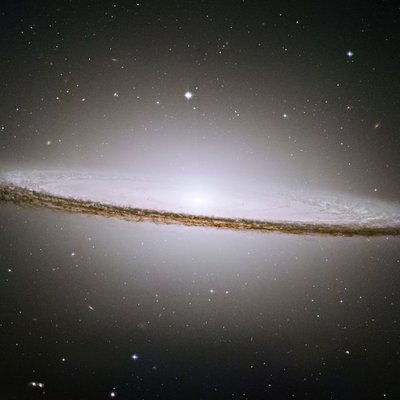
A striking face-on glimpse of NGC 3596, a spiral galaxy 90 million light-years off in Leo.
Its star-filled arms show clusters of gas and dust, outlining the galaxy’s radiant spiral design.
(Credit: ESA/Hubble & NASA, D. Thilker)

OGSilverback retweeted

I'm not sure folks have realized just how crazy the second half of 2026 and 2027 will be for global temperatures – on the back of a record-smashing El Niño event. Here is my latest estimate of where both years will end up compared to global temperatures since 1850.

OGSilverback retweeted

A breathtaking glimpse of "Mystic Mountain," a region within the Carina Nebula.
(Credit: NASA, ESA and M. Livio and the Hubble 20th Anniversary Team/STScI)

OGSilverback retweeted
A section of the Martian surface near the southern polar cap. The "foam" here is a layer of frozen carbon dioxide, pitted with shallow depressions that reveal the planet's underlying soil. Visible at the bottom right is a depression or impact crater, with dry ice also visible on its floor.
The image was captured by the HiRISE camera aboard the Mars Reconnaissance Orbiter.
🌙


OGSilverback retweeted
A hawk seems to spread its wings across the stars in this breathtaking view of RCW 36.
Inside this stellar nursery, new-born massive stars light up glowing blue gas while hidden brown dwarfs wait in the shadows
(Credit: ESO/A. R. G. do Brito do Vale et al.)

OGSilverback retweeted
Humanity faces a massive climate catastrophe: scientists anticipate a new El Niño cycle—a phenomenon that, 150 years ago, claimed the lives of tens of millions of people.
This natural phenomenon involves the warming of the Pacific Ocean, disrupting weather patterns across the globe: some regions are inundated by floods, while others are scorched by drought and wildfires. These conditions lead to famine, rising prices, and mass migration.
Current forecasts are even more alarming: in 2026, ocean temperatures could rise to 3°C above normal, threatening crop losses and global food supply disruptions.
The last such cycle, in 1877, claimed the lives of up to 60 million people.


OGSilverback retweeted

Today marks the 50th consecutive day of record-breaking global ocean temperatures.
Sea surface temperatures in the key El Niño monitoring zone have risen faster since New Year's Day than in any year on record.
We are on pace for the strongest El Niño on record (reliable records began in 1850).
2026 will more than likely be the second-warmest year on record globally, with 2027 virtually guaranteed to be the warmest year on record.