

Director Pandemic and Epidemic Intelligence Systems @WHO #WHOPandmicHub #globalhealth #surveillance #riskassessment #healthemergencies #outbreaks
Berlin, Germany
Joined January 2018
- Tweets1.8K
- Following214
- Followers3.6K
- Likes1.3K




By 2030, we want every new health threat identified and understood within 24 hours of emerging, anywhere in the world.
We've already done it many times. We can't yet do it reliably, everywhere.
I spoke with @Devex about how we get there: youtube.com/watch?v=pxoouVSb…
Structure outlasts sequence. That's reshaping how we study viral evolution.
With AlphaFold, 4.4M viral protein structures now span 8 databases, and 60%+ of their folds match nothing known in cellular life.
A new lens for surveillance.
Full digest: aipublichealth.substack.com/…

Pregnant women, new mothers and children are left out of most drug research. So how much do we actually know about the medicines they're given?
A new study mapped the gap across 38 million PubMed abstracts. The answer is sobering. 🧵
3/ The scale of the gap:
22-66% of drugs given to pregnant or postpartum women lacked pharmacokinetic or epidemiology/trial evidence.
8-40% of drugs used in children did too.
Missing pharmacokinetic data was the most common gap of all.
4/ AI used well: not to replace the evidence, but to show us exactly where it's missing.
The results are now the MPRINT-KP Silver knowledge portal, with a call for more pharmacokinetic studies in these groups.
Full digest: aipublichealth.substack.com/…
#APHIDigest
We test medical AI for accuracy. That misses the real problem.
Sex and gender bias doesn't show as wrong answers. It hides in tone, word choice and clinical detail, and it runs both ways, not just against women.
Full digest: aipublichealth.substack.com/…

Can a routine blood count help triage dengue where lab confirmation is slow?
Tree-based ML on 1,523 patients hit 0.709 AUROC, 91% sensitivity, 46% specificity.
Useful for triage in endemic settings, not a replacement for testing.
Full digest: aipublichealth.substack.com/…

79%.
That's the share of predictive AI models for pharmacovigilance in the Asia-Pacific with no external validation, across 64 studies from 14 countries.
A model never tested outside its own data is a prototype, not a safety tool.
Full digest: aipublichealth.substack.com/…

This week's AI + public health journal digest is out.
9 papers: pharmacovigilance, dengue diagnostics, gender bias in clinical AI, maternal drug-evidence gaps, viral evolution and more.
Full digest: aipublichealth.substack.com/…
#APHIDigest

31,917 patient surveys. 31 physicians. One question: do ambient AI scribes change how patients rate their care?
The answer: no measurable difference, up or down.
Sometimes the useful finding is that nothing broke. Reassuring before these tools scale further.

If an AI study landed on your ethics committee tomorrow, could it review the algorithm?
In Tanzania, researchers asked 10 committees. The governance was solid. The AI-specific capacity was not: judging algorithms, vetting big datasets, monitoring after approval.

"Just pilot it, train staff, embed it, move on." That is how we roll out most health innovations.
A new analysis argues AI breaks that model. It can be opaque, and it drifts as data and vendors change. Adoption is not the finish line. It is the start of oversight.

In 2024, more than 60% of US local health departments reported no dedicated informatics staff.
You cannot fix a data pipeline no one on staff can change. The workforce is a layer of AI readiness, not an afterthought.
aipublichealth.substack.com/…

~250,000 adverse safety events hit US healthcare every year. More than 95% go undetected.
A new tool in PLOS Digital Health goes after that gap, without handing the final call to a black box. 🧵
Tested on 300 paediatric cardiac arrest charts for adrenaline dosing errors:
97.9% accuracy on overdoses
91.6% on dangerous delays
under 1 minute per chart
It beat LLM-only baselines, and most misses came from data extraction, not the logic.
The catch: one drug, one setting, and a hand-built rule set for each new use case.
But pairing model-based extraction with rule-based decisions is a workable answer to trust in clinical AI.
Full digest: aipublichealth.substack.com/…
#APHIDigest
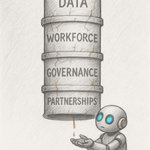
1/ Most public health agencies are not ready for AI. Readiness isn't a model you buy. It's four layers of infrastructure, built in order. A short thread.
5/ Layer 4, partnerships. Where does capability sit when the contract ends? A vendor can leave, and the gap it filled comes straight back.
6/ The layers compound. Each dataset, standard, and skilled hire makes the next one worth more. Skip them, and every project starts from scratch.
Full article: aipublichealth.substack.com/…
#APHIArticle