

Hardware that changed everything, then got put in a drawer.
Joined October 2026
- Tweets251
- Following27
- Followers64
- Likes77




The GIF was invented by an online service that charged by the hour.
CompuServe, based in Columbus, Ohio, was one of the first online services you could dial into from a home computer. It opened to home users in 1979, charged $5 to $6 an hour in the early 1980s, and by 1987 had 380,000 subscribers, the most of any online service.
Members loved swapping pictures, but every minute online cost money, and big images crawled over slow dial-up modems. Steve Wilhite, a CompuServe engineer, spent about a month leading the work on a color format that squeezed images small enough to download quickly. CompuServe released it on June 15, 1987, as the Graphics Interchange Format, or GIF, and Wilhite always said it should be pronounced "jif," like the peanut butter. CompuServe shut down its original service in 2009, but the format it built to save members time on the phone line is still everywhere.

A 16-month-old web browser company was worth $2.9 billion after one day on the stock market.
Netscape Navigator 1.0 was released on December 15, 1994, by Netscape Communications of Mountain View, California. It was free to download for students, schools, nonprofits and anyone trying it out, and businesses paid $39 for a single-user license.
In early 1994, Jim Clark, the founder of Silicon Graphics, emailed Marc Andreessen, 22, who had helped write the Mosaic browser as a student at the University of Illinois. They met for breakfast at Cafe Verona in Palo Alto, then flew to Illinois, where Andreessen's friends from the Mosaic team signed on in one night. Netscape went public on August 9, 1995, at $28 a share, and demand was so heavy that trading couldn't start for almost two hours. It opened at $71 and closed at $58.25, and Clark's stake was suddenly worth about $566 million.

IBM's headquarters told the team building the first hard drive to drop it.
The IBM 350 disk storage unit first shipped in June 1956 to Zellerbach Paper in San Francisco, as part of IBM's 305 RAMAC computer system. It stacked fifty 24-inch disks spinning at 1,200 rpm and held 5 million characters, about 3.75 megabytes. With its air compressor it weighed over a ton, and it leased for $750 a month.
The drive came from a small IBM lab in San Jose, California, opened in 1952 by Reynold Johnson, a former high school science teacher from Ironwood, Michigan. In April 1953, Johnson decided the lab would drop every competing technology and bet on spinning disks, an idea many engineers considered a mechanical nightmare. When managers on the East Coast heard about it, they sent stern warnings to drop the project over budget problems, but headquarters was about 12 hours away by plane and the team kept going. In February 1954 they moved data from punched cards to a disk and back, and that November the project won official approval.

In 1973, a television set won an Emmy.
The Sony Trinitron KV-1310 went on sale in Japan in October 1968 with a 13-inch screen. Its picture tube used one electron gun firing three beams through a grille of fine vertical slits, and it was about twice as bright as ordinary color TVs. The US model arrived in 1969 for $319.95.
Sony's earlier color sets, called Chromatron, cost so much to build that engineer Susumu Yoshida said the business threatened to sink the company. Yoshida's fix was to put three cathodes in a line inside a single gun, and Sony cofounder Masaru Ibuka personally supervised the team. At an April 15, 1968 press conference, Sony promised full production in under six months, even though the engineers had hand-built only ten prototypes. Five years later, the Trinitron became the first TV set ever to win an Emmy, and Ibuka accepted it on a broadcast seen across the US.

The camera that made 35mm film the standard for photography was designed by a man with asthma.
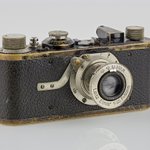
The Leica I was made by Ernst Leitz, a microscope maker in Wetzlar, Germany, and shown at the Leipzig Spring Fair in March 1925. It weighed about 470 grams, took 36 pictures on a roll of 35mm movie film, and cost 290 Reichsmarks.
Its designer, Leitz engineer Oskar Barnack, was an amateur photographer, but his asthma made the big, heavy cameras of the time too much to carry. Around 1913, he built a small prototype that used movie film turned sideways. In 1924, with many Leitz managers still doubting it would sell, Ernst Leitz II ended the debate: "I hereby decide: we will take the risk." Its film size became the world standard, and in 2022 Barnack's own early Leica sold at auction for 14.4 million euros.

More than 20 companies, including IBM, Kodak and General Electric, turned down the invention behind the office photocopier.
The Xerox 914 was unveiled on September 16, 1959, by Haloid Xerox of Rochester, New York. It was the first successful copier to use plain paper, making about seven copies a minute. It weighed about 650 pounds and cost $27,500, so most offices rented it and paid per copy.
The process came from Chester Carlson, a New York patent attorney who found copying documents by hand tedious. He and physicist Otto Kornei made the first copy using his process in 1938 in a rented room above a bar in Queens, but company after company turned him down. Haloid's president, Joseph C. Wilson, bet the company on it, spending $12.5 million, more than Haloid earned from 1950 through 1959. Predictions were for about 5,000 machines in three years, and 10,000 had shipped by the end of 1962.

TV remotes got the nickname "clicker" from tiny hammers hitting metal rods.
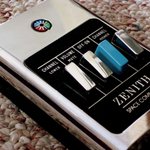
The Zenith Space Command went on sale in the fall of 1956. It had four buttons and no batteries. Each button struck an aluminum rod that rang at a pitch too high for people to hear. TV sets with it cost from $259.95 to $550, about 30 percent more than without it.
Zenith's founder, Eugene F. McDonald Jr., hated commercials and wanted viewers to be able to mute them without getting up. In 1955, engineer Eugene Polley built the Flash-Matic, a remote that aimed a beam of light at sensors on the TV, but sunlight could set them off too. Zenith engineer Robert Adler switched from light to sound. Every press of a Space Command button made a small click, which gave remotes their nickname.

The first smartphone went on sale for $899 and was named after a kids' game.
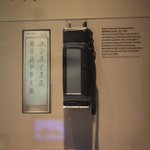
The IBM Simon Personal Communicator was a touchscreen cellular phone and PDA sold by BellSouth starting in August 1994. With a two-year BellSouth contract it cost $899; without a contract it was $1,099. It could place calls, send faxes and email, and run apps like a calendar, address book and sketch pad on its LCD with a stylus.
IBM engineer Frank Canova originated the idea and led the architecture. He demonstrated a prototype code-named Sweetspot at COMDEX in Las Vegas in November 1992, and the next day USA Today ran a front-page Money section photo of him holding it. BellSouth sold roughly 50,000 Simons before the product was discontinued in early 1995. The name came from the Milton Bradley memory game Simon, and the device is widely cited as the first smartphone.

The first consumer digital camera with a screen was born when a prototype got too hot to use.
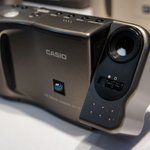
Casio released the QV-10 in Japan in March 1995 for 65,000 yen. It was widely recognized as the first consumer digital camera with a built-in color LCD for framing and instant playback. It stored up to 96 images in 2 MB of flash memory at 320 by 240 pixels and could send them to a PC over a serial cable.
Lead developer Hiroyuki Suetake had earlier watched Casio's 1987 electronic still camera fail. In 1991 his team built a bulky prototype nicknamed Atsuko and Omoko, Japanese for hot and heavy, because it ran near 90 degrees Celsius and weighed about 2.75 kilograms. They ripped out the viewfinder, stuck on a cooling fan, and used a Casio LCD pocket TV as a makeshift screen. Seeing the shot right away was so useful that Suetake built the display into the QV-10, and digital cameras with screens soon became the norm.

Myst, one of the best-selling PC games of the 1990s, started as free Macintosh software.
HyperCard was a hypermedia tool for Apple Macintosh computers, created by Bill Atkinson and released by Apple on August 11, 1987. New Macs got it free; existing owners paid about $49. It let people build stacks of interactive cards with buttons, graphics and a plain-English scripting language called HyperTalk.
Atkinson had insisted Apple give HyperCard away, calling it a software erector set for non-programmers. Rand and Robyn Miller of Cyan used it to build Myst as a HyperCard stack before the game became a CD-ROM hit. Ward Cunningham later traced the idea of the wiki back to a HyperCard stack he wrote in the late 1980s. Atkinson later said that if he had aimed HyperCard at networks instead of local disks, it might have become the first Web browser.

Most terminal apps on modern computers still imitate a screen from 1978.
The VT100 was a video terminal made by Digital Equipment Corporation and introduced in August 1978. By 1980 it was advertised for about $1,550. It was a keyboard and screen that connected to a larger computer, and it followed new ANSI standard codes for moving the cursor, clearing the screen and changing text style.
It became the industry's best-selling terminal, so much software was written to use its codes. In 1984 at MIT, Jim Gettys had his student Mark Vandevoorde write a terminal program, which became xterm for the new X Window System. Early versions of it imitated DEC's VT102, a close relative of the VT100. Later terminal apps kept that compatibility, so the codes DEC designed for one 1978 screen still run inside today's terminal windows.

The computer used to invent the World Wide Web was a black magnesium cube.
The NeXT Computer was introduced by Steve Jobs in October 1988 at Davies Symphony Hall in San Francisco, priced at $6,500. Jobs had founded NeXT after being forced out of Apple in 1985, and the machine's NeXTSTEP software made it unusually fast to build programs with windows and buttons.
In 1989, Tim Berners-Lee, a scientist at CERN in Switzerland, wrote a proposal for linking documents across computers. His boss, Mike Sendall, wrote "Vague but exciting" on it and let him buy a NeXT. On that machine, Berners-Lee wrote the first web browser and ran the first web server, with a label warning people not to turn it off. Apple bought NeXT in 1996, and its software became the basis of Mac OS X.

IBM's most successful typewriter replaced swinging metal arms with a spinning ball.
The IBM Selectric was introduced on July 31, 1961, starting at $395. Instead of separate typebars for each letter, it had a single ball covered in characters that turned and tilted to strike the paper. Swapping the ball changed the font in seconds.
The machine's look came from Eliot Noyes, an architect and designer hired by IBM president Thomas J. Watson Jr. in 1956. Watson had admired the stylish typewriters of the Italian company Olivetti and felt IBM's products looked dull by comparison. Noyes gave the Selectric a smooth, rounded body inspired in part by Olivetti's designs. The ball also meant there were no typebars to jam, and the Selectric became a fixture of offices for decades.

In 2004, Motorola sold a flip phone less than 14 millimeters thick.
The Motorola Razr V3 was unveiled in Chicago in July 2004 and went on sale in the US that November through Cingular for $499.99. It had an aluminum body and a keypad cut from a single sheet of metal. Motorola sold about 130 million Razr phones.
The phone came from a small team in Libertyville, Illinois, led by engineer Roger Jellicoe, who had also worked on Motorola's StarTAC. In 2003 he was told to build the thinnest phone ever, within about a year, so celebrities could carry it at the Academy Awards. Designer Chris Arnholt shaped its look, and the team kept trimming parts to save fractions of a millimeter. They missed the Oscars, but the Razr was the best-selling phone in the US in 2005, 2006 and 2007.

Sony's first portable CD player started as a block of wood the size of four CD cases.
The Sony D-50, sold in North America as the D-5, came out in November 1984 for 49,800 yen, about $350 at the time. That was roughly half the price of Sony's first home CD player, the CDP-101, released two years earlier.
At the time, few people owned CD players and only about 1,000 albums had been released on CD. Kozo Ohsone, who ran Sony's audio division, wanted a small, cheap player to change that. He showed his engineers a wooden block about 13 cm square and 4 cm thick and told them the player had to be that size. Many parts had to be shrunk to fit, but they made it, and the D-50 helped turn the CD into something people could take with them.

One of the first phones with a built-in camera took pictures of about 0.1 megapixels.
The Sharp J-SH04 went on sale in Japan in November 2000 through the carrier J-Phone. Its camera captured 110,000 pixels, and you could email the photo straight from the phone, a service J-Phone called Sha-Mail, from shashin, the Japanese word for photograph.
Three years earlier, in 1997, software entrepreneur Philippe Kahn was at a California hospital while his wife was in labor. He wired a digital camera, a laptop and his cellphone together and sent a photo of his newborn daughter, Sophie, to friends and family. The J-SH04 put that whole contraption into a single phone. Today nearly every phone has a camera, and phones are how most photos get taken.

The first computer to sell a million units was advertised by William Shatner.
The Commodore VIC-20 went on sale in the US in 1981 for $299.95, when many computers cost well over $1,000. It had a full keyboard, color graphics and 5 KB of memory, and it plugged into an ordinary TV.
Commodore founder Jack Tramiel wanted computers for the masses, not the classes, and he sold the VIC-20 in department and discount stores instead of just computer shops. Shatner, known as Captain Kirk on Star Trek, appeared in its TV ads, pitching it as a computer that did far more than a video game console. In January 1983, the VIC-20 became the first computer to pass one million units sold. It reached about 2.5 million before the Commodore 64 took over.

IBM built a laptop whose keyboard was wider than the laptop itself.
The ThinkPad 701C, released in 1995, had a 10.4-inch screen in a case about 9.7 inches wide, too narrow for a full-size keyboard. So its keyboard came in two interlocking pieces. When you opened the lid, they slid out and locked together into a keyboard about 11.5 inches wide.
The design, nicknamed the butterfly keyboard, was led by IBM engineer John Karidis. Small laptops usually meant cramped keys, and the 701C let people type normally on a machine small enough for a briefcase. It became the best-selling laptop of 1995. Larger screens soon made the trick unnecessary, but the Museum of Modern Art in New York added the 701C to its permanent collection.

The compact disc is the size it is partly because of Beethoven.
The first CD player, the Sony CDP-101, went on sale in Japan on October 1, 1982, for 168,000 yen. It read music from a 12-centimeter disc with a laser, so there was no needle, no hiss and no wear from repeated plays. Sony developed the CD format with Philips.
Disc size was one of the last questions the two companies had to settle. According to an account Sony has told for decades, executive Norio Ohga wanted a single disc to hold all of Beethoven's Ninth Symphony, which can run more than 70 minutes. The final standard held about 74 minutes, on a disc 12 centimeters across. Every CD player, CD case and car stereo slot that followed was built around that number.

In Japan, a Buddhist temple has held funerals for robot dogs.
The dogs were Aibo, made by Sony. The first model went on sale in 1999 for 250,000 yen in Japan and $2,500 in the US, and the 3,000 units offered in Japan sold out online in about 20 minutes. Aibo could walk, respond to its owner and develop its own behavior over time.
Sony stopped making Aibo in 2006 and ended official repairs in 2014. A repair company called A-Fun, which employed former Sony engineers, kept many running with parts taken from Aibos that couldn't be fixed. Owners felt those donor dogs deserved a proper goodbye, so starting in 2015, Kofukuji temple in Isumi, Chiba, held funeral services for them before they were taken apart. Sony brought Aibo back in 2018.
