

Just a neanderthal. Destination: The Restaurant at the End of the Universe.
Milky Way
Joined February 2021
- Tweets12.5K
- Following757
- Followers467
- Likes36.9K
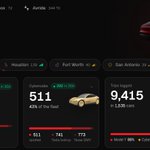





FSD 14.x Lite is a VERY BIG DEAL many do not understand !
HUGE !
The Lite version is NOT a mercy release for HW3 owners. It is a lesson in AI learning optimization that will be used in EVERY future AI product Tesla releases, CyberCabs, Optimus, Grok with AI4, AI6, ETC.
I have a HW3 car and AI4 car, seeing the old 10 year old hardware approaching the capabilities of AI4 is eye opening & mind blowing giving me a new found appreciation for Tesla AI expertise...
( Translation: $TSLA is severely undervalued )
VERY FEW UNDERSTAND THIS !!!

Compounding retweeted

Xiaomi has launched World Model 2.0, an AI that generates driving video, and its demo looks so much like Tesla's Reality View that Chinese bloggers held it up against FSD v15 almost immediately 🔥
Some posts claimed Xiaomi copied Tesla in a week. But that's not true 🙂
The paper behind it was public before FSD v15 started rolling out, and the clip comes from the simulator Xiaomi uses to train and test its driving AI.
World Model 2.0 generates realistic driving video from up to seven cameras at once, so Xiaomi's driving software can practice inside it.
So what did Xiaomi actually build, and how does it work❓
🎥 Xiaomi's demo comes from a simulator that has already produced 200,000 training clips
Xiaomi announced World Model 2.0 on November 27, and its article shows two demo clips.
Each clip stacks three views of the same street: the car's existing on-screen display of what its sensors detect on top, an AI-generated view from above and behind the car in the middle, and the real front camera at the bottom.
Xiaomi says the middle view was generated from data a test car collected. Nowhere does it call the clip real-time or say that view is coming to owners' screens.
A world model is an AI that learns how the world behaves, so it can predict what happens around a car when the car changes course.
Xiaomi lists two jobs for this one. It has delivered more than 200,000 synthetic clips to train its cars' perception AI, aimed at better recognition in dangerous situations, and it runs a closed-loop simulator where engineers can replay real accidents and work on targeted fixes.
The dates back that up. Xiaomi published version 1.0 in May, the 2.0 report was public by November 3, and Tesla started rolling out FSD v15 on November 21.
🧠 Xiaomi took an open video AI and trained it on 12.6 million clips to draw seven cameras at once
Xiaomi didn't start from scratch. World Model 2.0 is built on Wan2.2-5B, an open video-generation model, and keeps its architecture, weights, and video compressor.
The training diet was huge: 12.6 million clips, including 5.4 million of driving, 3.6 million of robots at work, 3.6 million of general video, and a small set showing physical cause and effect. A separate AI wrote a text description for every clip.
Training happened in three rounds. First the model learned general motion from single-camera video. Then it learned to handle one to seven cameras at once and to follow controls like camera position and road layout.
The last round made it fast. Video models like this start from noise and clean it up step by step, and the final version needs just two cleanup steps for each chunk of video.
Seven cameras bring a tricky problem, because they all look at the same world. A car seen by the left camera has to show up in the right spot when it moves into the front camera's view.
Xiaomi's answer is an attention design that handles the links between cameras and the flow of time separately. For long videos, a technique called Gated Linear Attention squeezes older frames into a compact running memory, which cuts the compute and memory a long rollout needs.
🧱 A 3D copy of the street keeps the AI from losing track of the road
Video AIs tend to drift on long clips. Road layouts warp, objects wander, and different cameras stop agreeing about where things are.
Xiaomi's fix is WorldRec 2.0. In a single pass, it turns footage from several cameras over time, plus depth, into a 3D copy of the street made of Gaussians, small translucent 3D blobs that together recreate the scene.
Parked things and moving things get separate sets of blobs, so cars can drive around while the road stays put. It works a lot like a set builder making a scale model of the street before the camera crew starts filming.
That 3D copy can be rendered from camera angles the test car never had. Those renders feed straight into the video generator as a guide, along with a layout of the cars, lanes, traffic lights, and signs the car detected.
Xiaomi hasn't spelled out the exact recipe for the demo's outside view, but these are the pieces its report describes: a 3D copy of the street, a layout of what the car detected, and a camera position the model can be steered to.
🚦 Xiaomi's simulator-trained driver crashed a third as often in 1,000 test scenes
Hooked up to driving software, the world model becomes a driving school.
Xiaomi gives it an HD map, the car's position, the obstacles around it, and the opening frames of a scene. The driving software picks a move, the world model generates what happens next, and the software gets scored on progress, staying on the road, keeping a safe gap, avoiding crashes, and ride comfort.
Learning by trying, getting scored, and trying again is called reinforcement learning.
Across 1,000 test scenes, software trained this way crashed in 0.4% of them, compared with 1.2% for the comparison software, and it finished 96.3% of its scenes.
In one simulated intersection, it finished adjusting its speed 4 seconds before a merging car reached the crossing point, while the comparison software braked late and crashed.
Xiaomi also checked the simulator against reality. It ran six versions of its driving software inside it, and their ranking on risky lane changes and late braking matched what real-vehicle tests found.
In other words, the simulator sorted good builds from bad ones the same way real roads did.
⏱️ At under 5 frames a second per view, it's still a lab tool but looks promising
Xiaomi deserves credit for publishing its speed numbers too.
In the report's speed test, the model generated seven camera views at once on a single Nvidia H20, a data-center GPU, taking 1.742 seconds for each chunk of video.
Wan2.2's compressor packs four video frames into each compressed frame, so the reported 1.148 compressed frames per second works out to roughly 4.6 video frames per second for each view, for the core network alone.
The report's idea of real-time belongs to a simulator, too. A step counts as real-time when it finishes within the time budget of the simulated step.
Xiaomi gives no in-car timing for the demo's outside view. The world model that actually ships in Xiaomi cars works behind the scenes: its latest driver-assistance update adds a causal chain that remembers the past 20 seconds of traffic and an in-car world model that predicts the next 6, with nothing said about a screen.
The paper also shows no failure cases from Xiaomi's own model, and a short demo clip can't show how it handles the rare, messy scenes that trip AI up.
The clip that got called a one-week copy is really a window into where Xiaomi's driving AI goes to practice. The next test is whether Xiaomi can shrink a model like this enough to run inside the car.
Compounding retweeted

사이버캡 VIN 번호 5,000대 넘겼다!!!!!
텍사스에 등록된 VIN 번호 기준 5,000 넘겼습다!!!! 등록률도 급증하면서 20% 돌파했습니다!!!
타임라인
2026.02.18 · 사이버캡 1호 생산
2026.04.27 · 사이버캡 대량 양산 시작
2026.08.31 · VIN 2,000/등록 45대
2026.09.18 · VIN 3,000/등록 58대
2026.10.21 · VIN 4,000/등록 351대
2026.11.26 · VIN 5,000/ 등록 1,107대

Every single time tech improves
Fear mongers scream to scare population
Every single time we see standard of living improve
Who is spreading the FUD?
Gov has the most to gain by spreading FUD which helps to control/regulate/tax,
not by the innovation itself.

David Friedberg: Why the AI Job Loss Narrative is Bullsh*t
“The job loss narrative is bullsh*t. It's also why ‘Everyone is going to end up on welfare,’ is bullsh*t. (And) ‘We need the government to step in and provide UBI,’ is bullsh*t.
Because with any other kind of frontier moment in human history, it's the new jobs, the new industries get created before the old ones are irrelevant.
I think the biggest opportunity for AI is on the frontier. That is where basically businesses and people can do things that humans and businesses have never been able to do before.
And that means crafting solutions to really difficult engineering problems, to really difficult scientific problems, to previously intractable problems.
And that's where I think that the frontier gets expanded by 100x or 1,000x versus AI being some iteration on existing business processes to save money and make things more efficient, which is where people natively go because most people don't work on the frontier, and they're not pushing the envelope on what's possible.
So their mind is always about, ‘Well, how does this change my job?’ And then you immediately get fearful about your job getting recast.
And the truth is, that's not the typical use case. The typical use case where we spend time and spend tokens is doing things that we've never done before, figuring out how to solve those really tough problems, how to do it quickly, how to do it efficiently, and that means humans generally can expand our frontiers, our horizons.”
8
Compounding retweeted

After experiencing @Tesla's Cybercab in Dallas, some riders don't want to use any other robotaxi because of how much they love it, despite competing services offering discounts.

No sunset for AI3 anytime soon.
Why?
The human brain uses 20W of power with minimal difference between rest and full on thinking, similar for 50 IQ vs 150 IQ.
Difference is neural efficiency.
AI3 for Tesla is an neural efficiency test bed.
All lessons will be applied to AI4 and beyond.
Before FSD 14 lite, everyone was saying that was it for AI3, then FSD 14 lite came out and it drives almost as well as FSD 14 (I have both cars).
Difference is neural efficiency.
Considering that AI is still in its infancy all past experience points to much more room for improvement.
65
With all that's going on in the market,
anyone paying attention to Tesla RoboTaxi
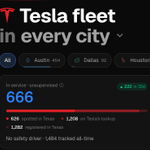
Yesterday unsupervised was ~700 now 1187 👀

16


Everything Tesla does is a "first" essentially an experiment, then they adjust to market needs.
2
90
Compounding retweeted

Most investors don't understand present value... youtu.be/XuPrR1SgQQE?si=IQjt…

This is the definition of an INVASION of a nation‼️

Islamists invade Poland from Belarus.
Readers added context they thought people might want to know
This video is from spring of 2024.
facebook.com/reel/924250389…
Since then the fence has been reinforced and it's not so easy to breach.
rmf24.pl/regiony/bialys…
235
Compounding retweeted

Babies are the best. My babies are older now and I was just arguing with my daughter bc she doesn’t think she will always be my baby. Lol


I never understood what it means to have a baby until I had one of my own !
It's God's greatest gift ❤️
1
1
11