

VLX — Edge-native multimodal AI for real-time perception, reasoning, and action. GitHub: https://nitter.gq/t.co/ZUYXqCMHAR Discrod: https://nitter.gq/t.co/NJjOYSxO03
Joined October 2024
- Tweets211
- Following126
- Followers584
- Likes250




A whole new OmAI experience is here! 🚀
🔥A sleeker interface.
A redesigned homepage, smoother navigation, and a cleaner layout that puts everything you need right at your fingertips.
🧠Meet VLX-Flow 1.6
Always-on perception. Precise, proactive responses. Flow 1.6 continuously understands incoming video and responds when it matters.
🎯Introducing the Task Center
Complete tasks, earn free credits, and unlock more ways to experiment with our models. Your next Physical AI experiment starts here!
More to discover. More to experiment with. More reasons to jump in.

Seeing an object is one thing. Knowing exactly where it is — even in a cluttered real-world scene — is what makes vision useful for Physical AI.
VLX-Seek 1.5 brings fine-grained visual grounding to the edge, with open weights ready for developers to explore.
Built to find. Ready to build.

If you need a VLM that finds things in messy real scenes, look at VLX-Seek.
It is a fine grained perception model for edge and embodied vision.
Not just what is in the image. Where it is. Which instance. And when it is missing.
Instead of making the model spit raw box coordinates, it turns candidates into region tokens and lets the LM select and refer.
Open source inference plus VLX-Seek 1.5 10B weights.
Runs on CUDA, Ascend 910B, and Apple Silicon.
Repo: github.com/om-ai-lab/VLX-See…

Something BIG is coming to OmAI. 👀
We've been working on something exciting behind the scenes, and we're almost ready to share it.
A sneak peek at what's coming:
⚡ Upgraded VLX models — New versions with improved capabilities, bringing us closer to faster, more responsive real-time multimodal AI.
✨ A fresh new look — We're giving the entire platform a makeover, with a cleaner interface, smoother interactions, and a better way to explore what our models can do.
And this is just the beginning.
Better models. Better experience. More possibilities for Physical AI.
Stay tuned. The next chapter of OmAI is almost here.

Busy roads. Multiple lanes. A clearer view of traffic. 🚗
VLX Seek identifies cars across urban road scenes, providing a foundation for vehicle counting, traffic-flow monitoring, and congestion analysis.
Turn everyday camera footage into useful traffic data.
730ms changes what you can build with a 3B vision model.
VLX-Seek 3B now reaches ~730ms end-to-end latency in our current test setup:
NVIDIA T5000 / MAXN
1920×1080 image
27-token output
But the interesting part isn’t the benchmark number itself.
It’s what happens when natural-language visual grounding starts responding at sub-second speed.
You can ask:
“Find the worker standing next to the machine.”
“Locate the damaged package on the conveyor.”
“Find the red vehicle near the entrance.”
And get the target region back fast enough to plug into a larger workflow.
That opens up more practical use cases across:
• Robotics
• Industrial inspection
• Visual agents
• Surveillance analysis
• Edge vision systems
For visual AI, accuracy tells you whether the model can find the target.
Latency determines how usable that ability actually feels.

What if machine vision could find ANYTHING you describe?
We put VLX-Seek through 3 quick tests:
🔩 Count the screws
🔍 Separate bent fasteners from straight ones
⚙️ Find the yellow gear
No fixed class list. No retraining for every new object.
Just tell VLX-Seek what to look for.
From object counting to fine-grained visual grounding, all through natural language.
One optimization won’t get a vision model to sub-second latency. The full stack matters.
For VLX-Seek 3B, we tested each optimization independently against the same vLLM baseline (~1.54s).
Only one optimization was enabled at a time. All other components remained on the baseline vLLM setup.
Here's how each performed:
Vision Engine (TensorRT): ~1.14s
LM W4A4: ~1.28s
FlashInfer GDN Prefill: ~1.51s
LM Head W4A16 only: ~1.46s
Each optimization targets a different bottleneck, but none alone breaks the 1-second barrier.
Now enable them all together: ~1.54s → ~730ms.
The full stack optimizes every major stage of inference:
Vision Processing → Prefill → LM Linear Layers → LM Head
No single magic trick. Just removing bottlenecks, stage by stage. Faster visual grounding starts with optimizing the entire pipeline.

What if a sorting line could understand exactly which package to pick? 📦🤖
With VLX-Seek, a robotic arm can locate packages directly from natural-language instructions:
“Find the damaged parcel.”
“Pick the box with the red label.”
“Locate the package on the left conveyor.”
VLX-Seek identifies and localizes the target in the scene, then passes the position to the robotic arm for sorting.
From visual grounding → robotic picking → automated sorting, one instruction can drive the whole workflow.
No fixed class list.
No manually defined target categories.
#Robotics #ComputerVision #VLM #Automation #VLX
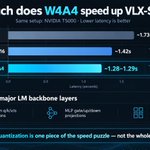
How much does W4A4 actually speed up VLX-Seek 3B? ⚡
We tested multiple LM backbone quantization setups on the same NVIDIA T5000:
⏱️ Inference Latency:
- Baseline PyTorch: ~1.73s
- LM backbone W4A16: ~1.42s
- LM backbone W4A4: ~1.28–1.29s
The W4A4 setup covers major LM backbone linear layers, including:
• Attention q/k/v/o projections
• MLP gate/up/down projections
• Linear Attention projections
The goal isn't just fewer bits.
It's reducing the computational cost of operations repeated throughout inference.
🚀 Combined with vision-side and prefill optimizations, latency drops even further.
Quantization is one piece of the speed puzzle — not the whole stack.

👷 Can AI instantly spot who's wearing a helmet on a busy construction site?
With VLX-Seek, just give a simple instruction: "Find all workers wearing a helmet"
⚡️ Seconds-level response
🎯 Accurate visual grounding
🏗️ Built for real-world construction site monitoring
No fixed categories. Just natural language → precise detection.
Smarter visual monitoring starts with VLX-Seek.
Can a vision model keep up with a fast-moving production line?⚡️
VLX-Seek can detect and locate bottled water in real time, even in dense industrial scenes.
Just describe what you’re looking for, and it finds the right bottles fast and accurately — built for practical visual inspection on the edge.
Where does the latency of a vision model actually come from? Not just the language model.
For VLX-Seek 3B, we moved the main and auxiliary vision towers to a TensorRT-based vision engine.
Same test setup:
NVIDIA T5000 / MAXN
1920×1080 input
27-token output
Latency dropped from: ~1.73s → ~1.14s
That’s already a major reduction before combining the rest of the optimization stack.
A visual grounding model has to process the image before it can reason about what and where to find. So if the vision pipeline is slow, optimizing the LM alone won’t get you to low latency.
For VLX-Seek, faster grounding starts with making the model see faster first.

730ms. On a 1080p image. ⚡
VLX-Seek 3B just got 2.36× faster.
Tested on an NVIDIA T5000 with a 1920×1080 image and 27-token output:
• PyTorch baseline → ~1.73s
• vLLM → ~1.54s
• Fully optimized → ~730ms
That’s roughly 58% lower end-to-end latency.
What changed?
• TensorRT vision engine
• FlashInfer GDN prefill
• W4A4 quantization for LM linear layers
• W4A16 LM head optimization
The result:
VLX-Seek 3B now reaches sub-second visual grounding on 1080p input.
That matters when the model isn’t just answering a benchmark — it’s sitting inside a robot, an inspection pipeline, a visual agent, or an edge vision system waiting to find the next target.
From 1.73s to 730ms. And it isn’t the end...

On a fast-moving production line, every second counts. ⚡
Built for edge devices, VLX-Seek combines language-guided localization, counting, and fine-grained identification—reducing reliance on cloud transfers and unstable networks.
From a simple instruction to locating the targets that matter—in seconds.👇
Thanks to @ThePirateFace for adding VLX-Seek to their model collection! 🏴☠️
VLX-Seek brings fine-grained visual perception to embodied AI—locating targets described in natural language, distinguishing specific instances, and recognizing when a target is absent.

Explore the official project and build with us 👇 github.com/om-ai-lab/VLX-See…