

X has basically become the place where I keep notes as I think through storytelling, film and meaning (while I drink coffee)
South Pasadena, CA
Joined February 2016
- Tweets4.3K
- Following1
- Followers1.1K
- Likes6.3K


Pinned Tweet
New to JustinsMorningCoffee?
Film student?
Just curious?
I’d say start with the 7 Basic Plots Lectures
It’s like a free film course where you can think along with me as I attempt to go upstream & understand the story archetypes
The Seven Basic Plots
youtube.com/playlist?list=PL…

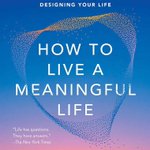
Wonder
Coherency
Flow
Community
- the four key components of meaning-making
I’m excited for this book (which I’ll be reading in any spare moments I find over the next couple of months)

3
367
Sometimes I wonder if so many of the problems in our lives can be boiled down to just simple impatience.
Here’s the quote that floored me the other day.
“Your job is to be wrong quickly and right slowly.”
Cut your losses quick if you find you’ve gotten off the path, or when you realize your thesis has been wrong, and spend a lot of time (more time than you think you should) researching the right way to go.
You have time; that’s what I’ve learned recently, you always have time. So you can take your time when making big decisions knowing that these things are not supposed to be rushed.
P.s. I THINK this was from Warren Buffet, but I can’t verify that.
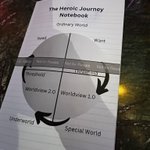
I’m plugging away on the Heroic Journey Notebook - my little movie watching notebook.
I keep self-publishing it, having a copy delivered to my house: using it to map some movies, and seeing how it works, updating it, filling in the gaps, re-publishing and having another author copy delivered, and repeat.
It’s a lot of what I got from the Story Grid system, with some modifications by yours truly, but tailored for movies rather than novels.
I’m close to the point where I’ll start giving it out to the screenwriting folks I know to road test it.


2
5
387
If anyone has seen House of Dynamite, I NEED to know how that movie made you feel.
I have a theory about it: I think it illustrates a very, very important lesson in storycraft.
1
237
So my little movie watching notebook will look something like this.
The idea is: you have it in front of you while you watch the movie, and you fill in the core scenes.


1
2
245
It’s going to have be paired with some YouTube lectures so that people can understand how to map the movie. I’ve been doing it myself with a hard copy of the notebook.
The most difficult part is distinguishing between the CORE scenes and either setup (pre) or metabolizing (post) scenes.
In other words, each core scene will have one or several pre-scenes (setups), and usually one or several post-scenes (metabolizing/processing).
So when you first start doing this you well need to do it in pencil and get a good eraser because you’ll find that you are going to have to develop your intuition.
——————————
THEN, after you have mapped, let’s say, 10 of your favorite movies, your skillset at recognizing core events should be sufficiently developed, such that you can just flip the page and start filling it out for one your own movie ideas.
The notebook will, ideally, become a repository of outlines which you can use for your future screenplays.
Additionally, when you get stuck writing, you’ll have a resource/quick guide, where you can go back and look at how your favorite movies have navigated any specific part of the terrain you are now navigating with your story.
Say for example, you get stuck at the “Epiphany” moment.
Simply flip back through your notebook and look at the epiphany scene in every movie that you have mapped (I recommend putting in the timestamps too so you can quickly watch the scenes if you want to).
(I am deeply indebted to Story Grid (Shawn Coyne and Tim Grahl and all the wonderful novelists over there) for these insights)
It’s still an experiment but I feel like I’ve made so much progress.

1
164
In the Black Mirror and Alien Earth, as well as that kind of cheesy one “Upload” - the presupposition is that if you take a human consciousness, replicate it as an AI and upload it into a synthetic body - while it may not “technically” be that person’s consciousness, it IS conscious.
And the dramatic question becomes: what about the *rights* of that consciousness?
Are the synthetic entities with AI brains going to be turned into slaves, in other words? (We are meant to feel empathy for them)
To my thinking, this isn’t the way to go.
Why should we assume consciousness can be transferred?
No, instead, we should assume that the person died when the upload happened. The “transhuman” seems like a conscious entity from the outside, but it is in fact, only a machine with an LLM brain who looks and sounds like the original person.
Here’s the story:
The politician encourages everyone to upload into synthetic bodies so they can live forever. But secretly he’s got a patch of code he’ll run right before the election which will allow him to influence the vote.
A ragtag underground group of “organics” have not upgraded, because - well some of them are ideologues, sort of like the Amish, who willfully go for the harder, shorter lives out of principle, some simply can’t afford it, and some are just old fashioned crazy conspiracy theorists.
Well when the code patch is run, and this band of misfits finds themselves the last of the real humans, what will they do?
1
222
Some of the best artists in the world learned their craft by copying the masterworks.
I’m currently working on a notebook which you can use to plot out the core scenes in your favorite movies as you watch.
The theory is this:
The more practice you get pulling out the core scenes of your favorite films, eventually you will be able to fill out a sheet with all the core scenes for one of *your* ideas.
Now, I’m still tweaking the notebook, (getting a lot of help from my courses with Story Grid) but it’s close to being done.


1
2
195

A “Herald Scene” - it’s basically a “here’s where we are right now” scene
The distance from the object of desire, the emotional state of that location, & the place in the landscape of the story
That’s the purpose of the scene, & you can put some exposition or setup in as well
1
181
Paul Schrader says he can’t write a screenplay without knowing the title (which, for him, needs to have a hard consonant in it), and how the story ends.
Hitchcock needed to know what the MacGuffin was.
3
180
Thinking about different types of antagonism in stories:
1. External antagonist (desires to eat/exploit you)
2. Internal antagonist (the part of you that shirks or sabotages potential)
3. Luminary Opponent (the opponent that loves you)
In The Hobbit:
External: The Danger
Internal: Fear/laziness
Luminary Opponent: Gandalf
Pride and Prejudice:
External: Pride (Mr. Darcy)
Internal: Prejudice
Luminary Opponent: The Mother pushing her to marry
The Matrix:
External: Agent Smith
Internal: Self doubt/ complacency (personified by Cypher)
Luminary Opponents: Morpheus/Trinity
Back To The Future
External: Biff
Internal: Cowardly fear (personified by George)
Luminary Opponent: Doc
1
166
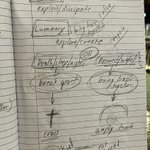
Here’s how I’m mapping out movies these days (using the Heroic Journey 2.0 model from Story Grid). I’m just going from core scene to core scene (eliminating exposition, sub plots, foreshadowing, and metabolizing scenes which will be **in-between** the core scenes):
Here’s the first three movements in Back to the Future:
Act 1
A1 Sc -1 CO: “Ordinary World”
Marty is in a family of slackers (not fulfilling their potential).
A1 Sc 1 Inciting: “Security Breach”
Doc Wants Marty to help him with something
A1 Sc 2 Comp: “Getting the Message”
Doc invented a Time Machine
A1 Sc 3 Crisis: “Close Call”
Doc gets shot by the Libyans.
Best bad Choice:
1 - Stay with Doc and get shot too
2 - Escape in the Delorean
A1 Sc 4 Climax: “Enlistment”
Marty chooses the Delorean and sees if they can do 90
A1 Sc 5 Resolution: “Leaving Home”
Marty crashes into a barn in 1955
————————————
Act 2 “Special World”
- Procedural knowledge
————————————
A2 Sc 1 Inciting: “Unexpected Outcome”
The locals are hostile.
A2 Sc 2 Comp: “Grappling with Trust”
Marty convinces Doc he’s from the future.
A2 Sc 3 Crisis: “Crossroads Challenge”
There’s no plutonium in 1955, and 1.21 gigawatts will be needed, which can only be achieved with a bolt of lightening.
Best Bad Choice:
1 - Stay in 1955
2 - Try the risky lightening harnessing
A2 Sc 4 Climax: “Epiphany”
Marty will be erased from existence unless he gets his parents back together.
A2 Sc 4 Resolution: “No Going Back”
Marty has a week to introduce them.
————————————-
Act 3 “Chaos” Perspectival Knowledge”
————————————
A3 Sc 1 Inciting: “System Crash”
Marty’s mother is infatuated with *him* not George McFly
A3 Sc 2 Comp: “Gut Check”
Marty is going to have to play the bad guy to help George impress Lourraine. (Shadow agency)
A3 Sc 3 Crisis: “Abyss”
Doc refuses to let Marty warn him about his 1985 death.
Best Bad Choice:
1 - Go against 1955 Doc’s wishes and warn him.
2 - Stay silent and lose 1985 Doc.
(There’s also a Crisis in the George subplot worth mentioning)
Best Bad Choice:
1. Stand up to Biff
2. Walk away and abandon Lourraine
A 3 Sc 4 Climax: “Defection”
Marty writes a letter to Doc, telling him about the attack.
George stands up to Biff
(Note: both actions utilize shadow agency)
A4 Sc 5 Resolution: “Coming Back”
Marty un-disappears when his parents kiss.
——————————
That brings us to act 4: Participatory Knowledge, the climactic movement.
(More on this later).
All in all, I’m making progress, grinding away at this stuff little by little.
1
155
Storytelling is all about portals between worlds.
John York’s - Into the Woods
“If one accepts the notion of entering a new world… then the story archetype and its ingredients all slip neatly into focus.”
“The ‘surprises’…are more commonly referred to as ‘subversions of expectation’ - a sudden twist both surprising yet plausible which throws the story in a new direction. Tending to occur toward the end of every act…”
“It’s easy to dismiss such fireworks as gimmicks, yet these subversion of expectations are nothing of the sort - they’re profoundly important structural devices that underlie all storytelling, for they are the PORTAL that invites a protagonist into their new world.”
4
194
I’m extracting the core scenes from my list of movies, anecdotally crowd sourced as films that you can’t help but watch multiple times.
——————————
Today I pulled out the Act 1 core scenes from:
Office Space
The Devil Wears Prada
Truman Show
(I’m compiling them in a google drive folder so I can embed them into a slide show for once I’m ready to finally put out a public lecture on the past 9 months of work).
1
176
The Devil Wears Prada was a particularly thorny one, because it’s like studying a dance, which has all this stuff integrated into the whole so well, it’s tough to see where one ingredient begins and another ends. It’s a beautiful, cohesive whole.
But if you are going to reverse engineer how to write something like that yourself, you have to work at cracking it open.
1
118
But after a few hours of work, the core scenes became quite obvious to me, and I was able to distinguish between setup, event, and metabolism scenes.
Usually if I can clearly get what the crisis choice of the act is, in this case between quitting vs. staying in her stressful job, then I can go back and find all the rest.
In the Devil Wears Prada, it’s an irreconcilable goods crisis choice, between:
The Job (a good thing)
Peace (a good thing)
Each choice has a blessing and a curse:
Stay -
Blessing: Influence/power/money
Curse: Toxic 24/7 impossible demands
Quit -
Blessing: Harmony with the boyfriend and family
Curse: Losing money/giving up on ambition
Remember, the CRISIS scene is the one in which the choice is clearly laid out, and we understand that it is unavoidable. They MUST choose. (They can’t have both)
The CLIMAX is when they make the choice.
The RESOLUTION is them getting the blessing/curse that results from the choice.
Andy chooses fashion, the blessing is that she impresses her co-workers and her boss. The curse is that it drives a wedge between her and her boyfriend/family/friends.


108