

AI for chemistry and material science @AIatMeta. Previously known as Open Catalyst Project.
Joined June 2021
- Tweets212
- Following19
- Followers2.8K
- Likes69




FAIR Chemistry retweeted

The Open Molecules 2025 dataset is out! With >100M gold-standard ωB97M-V/def2-TZVPD calcs of biomolecules, electrolytes, metal complexes, and small molecules, OMol is by far the largest, most diverse, and highest quality molecular DFT dataset for training MLIPs ever made 1/N

Introducing the newest members to the family - OMol25 and UMA. Check them out below!

Excited to share our latest releases to the FAIR Chemistry’s family of open datasets and models: OMol25 and UMA! @AIatMeta @OpenCatalyst
OMol25: huggingface.co/facebook/OMol…
UMA: huggingface.co/facebook/UMA
Blog: ai.meta.com/blog/meta-fair-s…
Demo: huggingface.co/spaces/facebo…
FAIR Chemistry retweeted

For existing MLIPs, lower test errors do not always translate to better performance in downstream tasks. We bridge this gap by proposing eSEN -- SOTA performance on compliant Matbench-Discovery (F1 0.831, κSRME 0.321) and phonon prediction.
arxiv.org/abs/2502.12147
1/6

Today we're excited to introduce OCx24 - an experimental catalyst dataset aimed to help bridge the gap between computational and experimental results. Read more below!
Paper: arxiv.org/abs/2411.11783
Dataset: github.com/FAIR-Chem/fairche…
Blogpost: ai.meta.com/blog/open-cataly…


Excited to unveil OCx24, a two-year effort with @UofT and @VSParticle! We've synthesized and tested in the lab hundreds of metal alloys for catalysis. With 685 million AI-accelerated simulations, we analyzed 20,000 materials to try and bridge simulation and reality.
Paper: arxiv.org/abs/2411.11783
Dataset: fair-chem.github.io/core/dat…
Blogpost: ai.meta.com/blog/open-cataly…
FAIR Chemistry retweeted

Our team at FAIR is looking for research interns in 2025. We work on a range of AI for chemistry topics from applied projects to machine learning potentials and generative models.
If you are interested please apply and don’t hesitate to reach out!
metacareers.com/jobs/1243659…
and of course huge thanks to @jrib_ for their help and effort with the matbench-discovery.materials…
Work by @lbluque, @mshuaibii, @xiangfu_ml, @bwood_m, @csmisko, Meng Gao, @ammarhrizvi, C. Lawrence Zitnick, @zackulissi
Get in touch to share your experience and feedback!
This work builds upon open research, notably Alexandria and the Materials Project, and wouldn’t have been possible without those efforts!
Alexandria:
alexandria.icams.rub.de/
Materials Project:
next-gen.materialsproject.or…
6/x
When training EquiformerV2 (31M) on only MPtrj we found that adding an auxiliary denoising objective (see DeNS arxiv.org/abs/2403.09549) substantially improved performance due to effective data augmentation and by preventing overfitting on a smaller dataset.
5/x

Our EquiformerV2 (86M) model pre-trained on OMat and fine-tuned on MPtraj and a subset of Alexandria, is state-of-the-art on Matbench discovery across all metrics with an F1 score > 0.9 and an accuracy of 20 meV/atom.
4/x

Data diversity was achieved by sampling relaxed structures from Alexandria followed by one of three different processes:
- Rattled Boltzmann Sampling
- Ab-Initio Molecular Dynamics
- Rattled Relaxation
3/x
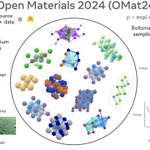
OMat24 contains over 100 million Density Functional Theory calculations focused on structural and compositional diversity. The force and stress distributions are substantially more broad than other open datasets for training ML potentials.
2/x

Introducing Meta’s Open Materials 2024 (OMat24) Dataset and Models! All under permissive open licenses for commercial and non-commercial use!
Paper: arxiv.org/abs/2410.12771
Dataset: huggingface.co/datasets/fair…
Models: huggingface.co/fairchem/OMAT…
🧵1/x

Come work with us on the FAIR Chemistry team!
Roles:
- Postdoc: metacareers.com/jobs/1194146…
- Research interns: metacareers.com/jobs/1243659…
Reach out if you have any questions and help spread the word!
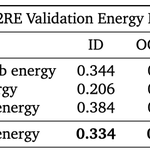
Before using an adsorption energy model, one should be aware of surface reconstructions that can impact results.
Alternatively, total energy models are more robust models to surface reconstructions that still work on par with existing adsorption energy models

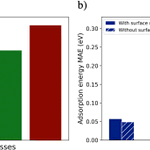
Perhaps the most notable impact on errors are surface reconstructions. This can pose an ill-defined adsorption energy, making it difficult for models to train and evaluate.

Interestingly, they also show that the performance of models trained on data with the tighter DFT settings is comparable to those trained with the original OC20 settings.

While tighter convergence settings have a considerable impact on DFT total energy; when they look at energy differences like the adsorption energy, they see significantly smaller convergence errors due to a cancellation of errors.
Results shown for the OC20-200k dataset.

