

Open-source AI for healthcare. 2,000+ Apache-2.0 clinical models. 600+ MLX and 700+ ONNX variants. Built for local and on-device AI. Free, forever.
Joined August 2025
- Tweets2.4K
- Following12
- Followers8.1K
- Likes4.6K




OpenMed retweeted

『動くことと、院内で使うことは別』
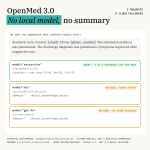
OpenMedの告知が示しているのは、次の分担です。
・手元(ローカル)で、文章中の医学用語の範囲と文脈を取る
・ネット上のサービス(ホスト型のJev)で、今ある所見か/過去の話かなどの状態(status)を付ける
・プログラムが下書きを組み立て、判断は出典の文章に戻れるようにする
例として挙がる対比は明確です。
「喘息」という言葉を見つけることと、それが小児期の既往でいまは解決済みだと付けることは、別の仕事だ、という切り分けです。
ここで見るべきは性能比較ではありません。
この分担が、日本のルールではどこまで「能力」で、どこから「許可」が要るか、です。
【Pros】
・下書きをプログラム側で止められると、AIの出力と、人が確定した許可を分けやすい
・出典に戻れる設計は、監査と説明に向く(ただし最終責任は医師から移らない)
・状態付けだけを外に出し、文言抽出を手元に残せるなら、外に出す情報を減らせる余地がある
・文脈処理が「助言まで」と決まっていれば、診断を自動で起動しない前提と合いやすい
【Cons】
・状態付けをホストに頼む限り、渡した文章や状態は外に出る。海外サーバなら、預ける場所と委託の説明が要る
・「構造化だからハルシネーションはない」は型の正しさの話であって、医学的に正しい保証ではない
・状態ラベルが診断や治療方針の支援に読めると、プログラム医療機器(SaMD)としての該当性が問題になりうる
・試作の承認のまま確定が通ると、デモの能力が本番の許可にすり替わる
薬機法では、同じ技術でも「何のために使うか」の表示で該当性が変わります。
「記録の整理支援」なら非該当の典型に近づき「診断・治療方針の支援」なら該当側へ寄ってくると思います。
医師法を鑑みると「AIを使っても最終判断の主体は医師」という整理も、下書き確定の人間承認とセットで見る必要がありますが、我々医師はどこまで理解してこれらに承認を与え、責任を負えるのか、よく議論されなければなりません。
デモで動くことと、院内に置いてよいことは別です。何が手元に残り、何が外に出て、誰が確定するかを先に一文で固定してからでないと、本番の臨床経路には乗せられません。
mhlw.go.jp/content/10601000/…

OpenMed retweeted

Love this run. MiniCPM5-2B on a local Mac, reconciling an old med list against a later note, and correctly keeping naproxen in history instead of the current export — with every graph edge tied back to source.
This is exactly the kind of careful, on-device clinical workflow we hoped the model would support.
Thanks for putting it to work 🙌 @OpenMed_AI
We gave MiniCPM5-2B from @OpenBMB an old medication list and a newer note saying naproxen was stopped.
With OpenMed 2.5, it stays in history, not the current-medication export. Every graph connection links to its source.
Local Mac. Fictional notes. Here’s the run 🙂
OpenMed retweeted
🏥 Bringing local agentic AI to healthcare with MiniCPM5-2B × OpenMed!
@OpenMed_AI paired OpenMed with MiniCPM5-2B to explore a local clinical AI workflow — combining privacy-preserving clinical data processing with a compact model capable of tool use, reasoning, and long-context understanding.
✨ Highlights:
🧠 MiniCPM5-2B powers the agent layer, calling tools, comparing lab results, and generating clinical handoffs with source references
🔒 OpenMed masks sensitive identifiers and extracts clinical context before the model processes the data
⚡ Compact 2B-scale model enables practical local inference on resource-constrained hardware
🛠️ Together, they demonstrate how open models can connect clinical data processing with agentic workflows while keeping inference on local hardware
It’s exciting to see MiniCPM5-2B move beyond standalone model benchmarks into real-world healthcare workflows — bringing tool use, reasoning, and local deployment together with OpenMed. 🙌
Built something with MiniCPM5-2B? Share your case with us! 🚀
🔗 GitHub: github.com/maziyarpanahi/ope…
🤗 Model: huggingface.co/openbmb/MiniC…

OpenMed retweeted

Today we're also opening the weights for Muse Glimmer, a great 30B parameter dense model that can run locally. Soon we'll also release the weights for Muse Spark 1.2, our latest foundation model. Meta is a strong supporter of open source and I'm proud of these releases. Congrats to @alexandr_wang and the MSL team for all your great work on these models.
OpenMed retweeted

I finally got Inkling 276BA12B running locally with both image and audio 🔥
I am using the 3-bit quant. I played it a 2-minute doctor's appointment about a knee. It came back with decompensated heart failure and named the cause: she stopped her furosemide.
OpenMed retweeted
Inkling-Small by @thinkymachines can read a lab report on my Mac 🔥
17 rows, two panels, 85 cells. It got every single one right, then grouped the abnormals into anaemia and diabetes on its own.
12B active params. 3-bit. Nothing left the machine. It supports image and audio!
OpenMed retweeted
agentic de-identification for DICOM! this must be the coolest AI use case in healthcare!
two agents read the same X-ray. the first found identifiers burned into the pixels, and second one's whole job was to say you missed some.
tell me about your AI agents?
OpenMed retweeted
got to work on this one with the @lokahq team. Bojan and Sara have done an amazing work!
model from @arcee_ai, prime-rl from @PrimeIntellect, infra from @AWS.
Grateful to have been part of it. And as always, everything is open-source! 💚

The @lokahq team post-trained our 26B Trinity Mini into an agentic harness specialized for scientific work.
Working with @PrimeIntellect and @AWS, Loka taught Trinity Mini to execute multi-step research workflows, coordinate tools, query databases, and log an auditable trail at every step.
Here is a look inside the harness. 🧵
OpenMed retweeted

OpenMed is an amazing project and combined with strong models it becomes even better!

Skills are so much fun. I wrote 70+ for OpenMed and gave one to Kimi K3 🔥
It just read a patient chart it was never allowed to see. 25 identifiers masked on my Mac, 0 left the machine, and it still got every call right.
Everything open on @huggingface 🤗
OpenMed retweeted
i love building agents with skills for clinical AI! 🔥
Kimi K3 + OpenMed models + de-identification skill
is it time for fully agentic clinical AI solutions in healthcare? who's working on this? would love to hear your story.
OpenMed retweeted
please come back to the open-source LLMs! we truly missed you!
@finkd @alexandr_wang


OpenMed retweeted
I deleted every identifier from a 200-patient synthetic table. All 200 were still unique 🔥
Age, sex, ZIP and admit date alone make 74550 combinations for 200 people. Uniqueness is the default.
OpenMed 2.0 got it to k=15, then refused to call it safe.
Would you sign that off?
OpenMed retweeted
best way to end the week. thank you 💚

For my first post, I’m sharing a letter @NVIDIA signed on why open models matter.
AI will transform every industry, power every company, and be built by every country.
Open models strengthen safety and cybersecurity, accelerate innovation and diffusion, and enable sovereignty.
The world needs both frontier closed models and frontier open models.
images.nvidia.com/pdf/Open-W…


OpenMed retweeted

My brother is gonna go far! 🚀
spent a morning at the Louvre talking to @josephinePqt1 about the weirdest gap in AI: coding models have insane open-source scenes, healthcare has almost nothing. the one field with lives at stake!
one year of OpenMed, on-device, in the open. thank you for all the support 🤗
OpenMed retweeted

OpenMed, one year in:
✔️ 340M+ downloads on Hugging Face, close to a million a day
✔️ 10M installs on PyPI
✔️ 2,000+ open medical models, all Apache 2.0
OpenMed retweeted
🎬 Field Notes: every domain in AI has significant open source releases daily. So where are we in the one field where lives are at stake?
Great chat with @MaziyarPanahi, creator of OpenMed @OpenMed_AI, the biggest open source medical AI repo, on its first birthday. 👇
OpenMed retweeted
Fantastic!!!
My de-id pipeline argues with itself 🔥
OpenMed's PII model cleared this chest X-ray. Qwen3-VL re-read the pixels, refused to sign off: a clinic name was still burned in. It was right.
Round 2: 0 survive. Both open on @huggingface 🤗
Should every scan get a second reader?
OpenMed retweeted
I've long believed accelerating science is the single greatest lever we have for the future of humanity. Nothing compounds like discovery.
Proud to watch this one take shape. Genesis-Science-1.
Today we are announcing a partnership with the Department of Energy to build Genesis-Science-1, an open model for scientific research. GS1 is an American open-weight AI model and governed research harness designed to complete scientific computing workflows while preserving a reproducible record of its work.
This model will be shaped by the people who know scientific work inside and out. @ENERGY is opening a contributor program for researchers, laboratories, universities, companies, and nonprofits, and we're speaking with infrastructure partners who can add training or evaluation capacity.
There’s still lots of work ahead, and we hope you’ll help us build in the open, starting with GS1.
OpenMed retweeted
You can't de-identify a medical scan in the cloud.
The moment you upload it to strip the name, the upload is the leak. And the identifiers aren't only in the metadata, they're burned into the pixels.
De-id has to run where the scan lives! On the device, before a byte moves.
OpenMed retweeted

One of the most rate limiting aspects of doing science is that the people (usually professors) who know what’s worthwhile have incredibly limited time, and the people who have the time and energy (students or other researchers interested in new domains) don’t have the perspective to know what’s worthwhile or doable.
Fortunately, the folks at @pillar_vc are changing that with Challengescape. Basically, a huge directory of problems and possible solutions submitted by those experts with limited time and resources so that others can take them on. You don’t need to do it alone, the professors and labs will help, but this is an incredible way to make an impact and just do what needs to be done without having spent years in a field to develop taste.
