

Sovereignty maxi. Reformed roundtripper.
cold storage
Joined October 2014
- Tweets1.8K
- Following7.5K
- Followers523
- Likes21K






You buy the stablecoin. The stablecoin buys the gilts.
The gilts fund the system that watches how you spend the stablecoin.
They call this innovation.
I call it a direct debit for your own surveillance.


The Technical-Industrial Complex needs programmable money.
The Financial-Industrial Complex provides it through government debt markets and sovereign-issued gilts.
One finances the system.
The other builds the infrastructure.
Programmable money, digital identity, AI surveillance, predictive policing, and real-time financial monitoring all become far more powerful when integrated into a single architecture.
That’s why I see CBDCs, tokenised government debt, digital identity systems, and surveillance technologies as converging rather than developing independently.
The debt funds the infrastructure.
The infrastructure enables the control.
The control secures the debt.
In that sense, the police and surveillance state is not merely a political project.
It’s a financial one.
The Technical-Industrial Complex supplies the technology.
The Financial-Industrial Complex supplies the capital.
Together they build the architecture for programmable society.
4
322
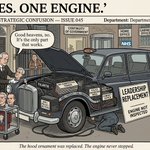
Six prime ministers. Same engine.
At what point do we stop blaming the driver and start looking under the bonnet?

3
70
The state built the ladder, funded the rocket, wrote the tax code, switched off the rival, then called it private genius.

Not to take anything away from Elon Musk’s financial achievement, but understanding the difference between sovereign wealth and subordinated wealth is useful when saying that he has become the world’s first trillionaire.
People see Forbes rankings and think that’s where the real money is.
The House of Saud, Abu Dhabi’s Al Nahyan family, Qatar’s Al Thani family, the Rothschilds, the Rockefellers, sovereign wealth families, and the broader financial-industrial complex have spent generations building influence over capital, banking, energy, debt markets, institutions, and the rules of settlement itself.
Most billionaire wealth is marked-to-market. It is a quoted value based on public company shares, liquidity, credit conditions, lenders, institutional shareholders, asset managers, and collateral rules.
Direct control of wealth is different.
Much of the world’s wealth is not publicly visible.
Private companies, trusts, foundations, sovereign entities, and offshore structures rarely appear on rich lists.
Privacy, control, and asset protection are features of wealth preservation, not bugs.
You’re a trillionaire when you can send a trillion dollars of Bitcoin in a single transaction (and nobody in the world can do that yet), or load a trillion dollars of gold onto a ship in your name and move it without permission.
Everything else is subordinate to someone else’s balance sheet, rules, and approval.
Visible wealth and actual financial power are not the same thing.
I encourage sovereign wealth over subordinated wealth.
Only sovereign wealth is true freedom.
Follow the money.

5
84
They called it the world’s game.
Then the border asked for papers.
Haiti’s history gets censored on a shirt.
African players get searched like suspects.
A Somali referee gets locked out.
Fans get taxed twice on the resale platform.
The trophy is still gold. Look underneath it.


FIFA world cup 2026 opening ceremony.
Readers added context they thought people might want to know
This video depicts an AI-generated fake, not the real FIFA World Cup 2026 opening ceremony. fifa.com/en/tournaments… cbsnews.com/news/2026-fifa…
5
79
A crisis is never just a crisis.
It is a negotiation over who gets to write the recovery plan.
North Korea found a buyer.
Nigeria got a prescription.
One side exported weapons and rebuilt.
The other swallowed structural adjustment and watched industry disappear.
The bomb is the opt-out clause.


Exclusive: North Korea’s uranium-enrichment capacity could soon expand by 75% once a new facility reaches full production, according to new research on.wsj.com/4ogtr0m

2
34


The Pope asked for the common good. Silicon Valley offered a free trial.


NOW - Pope XIV says the church and Anthropic, will work together to "find the way for humanity, in this time of artificial intelligence."
Readers added context they thought people might want to know
The Pope says that he accepts the invitation to "walk together," not "work together."
vatican.va/content/leo-xi…
1
41


I’m Nigerian, I’ve been in crypto since 2020, and I’ve seen enough behind the scenes to know that a lot of people in this industry are not who they pretend to be.
That reality has disappointed me many times.
What hurts here is that I truly believed Sam was different.
This is not coming from a place of being a random outsider throwing stones.
I knew Sam personally.
We got close in Dubai in early 2025 through overlapping circles from Nigeria and mutual connections. I brought him into conferences hosted by my former workplace, a Dubai government institution, at no cost, because I respected what he was building and wanted to support him.
Around that time I wanted to invest in Templar.
He even offered me tokens for free when I was going through a hard period, though I initially wanted to pay. Later, when I had financial problems after losing my job, he helped me again.
So yes, I will always acknowledge that.
That is exactly why this betrayal cuts deeper.
I invested not just in Templar, but later in Grail and Basilica too, because I believed in him, his vision, and his character.
In an industry full of extractive people, I thought I had finally met someone genuine.
That is what makes this so hard to process.
What also pains me is the wider damage.
As a Nigerian, when something like this happens publicly, it reinforces the worst stereotypes people already have about us. I’ve already seen people make those comments.
That part really broke my heart, because one person’s actions end up staining the image of many innocent people.
When everything happened, I did not come to him with insults.
I did not attack him.
I reached out privately because I genuinely wanted to understand what happened. Even after my own position was damaged, I still wanted to hear him out as someone I knew personally.
His explanation to me was basically that others wanted to cheat him, so he changed it on them.
I asked the simplest questions:
What happens to Templar?
What about the tokens?
What is the plan from here?
Is anything changing?
These were not aggressive questions. They were normal questions from someone who trusted him, invested in him, and still wanted clarity.
Instead of answering, he blocked me everywhere.
That was the moment it really sank in for me.
Not even the financial loss.
The silence.
The avoidance.
The inability to face people who believed in you.
If your intentions are clean, you do not run from honest questions from people who stood by you.
I can be grateful for the help someone once gave me and still tell the truth about how deeply they betrayed that trust.
I will not erase the good he once did for me, but I will also not pretend this was honorable, transparent, or fair.
Crypto is already full of performance, manipulation, and carefully managed personas.
Too many people know how to sound visionary in public and become someone else entirely in private.
That is one of the hardest lessons this space keeps teaching people over and over again.
My view is simple:
When people trust you with capital, belief, reputation, and loyalty, you owe them honesty.
Maybe not perfection.
Maybe not endless success.
But honesty, accountability, and a clean exit at the very least.
Anything less destroys more than money.
I’m saying this as someone who defended, believed, invested, and reached out in good faith even after the damage was done.
So this is not bitterness.
It is heartbreak, and disappointment.
I genuinely thought he was different.
He wasn’t.


@SimonDixonTwitt are you re ording your weekly and informative hard talk analysis this week?
3

For Every African Sovereign That Falls. Their Replacement Always Have The Same Resume. open.substack.com/pub/ope1/p…
10


