

AI, semiconductors & global markets | Tracking primary sources, industry shifts and key data | Filtering noise, sharing what truly matters
Hong Kong
Joined April 2017
- Tweets4.5K
- Following865
- Followers2.7K
- Likes16


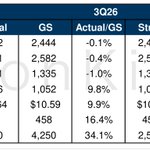


Renesas Electronics guides for its data center digital power production capacity run rate to increase by 2 to 2.5x YoY in 2027 as its Saijo factory begins contributing in 1Q27. Digital power management ICs account for roughly half of data center sales, where revenue grew by a mid-20% level QoQ in 3Q and management guides for a mid-teens % QoQ increase in 4Q alongside memory interface chips. Operating margins in digital power vary significantly across customer platforms: while favorable project deliveries helped 3Q operating profit reach ¥150.5bn, management assumes a mix deterioration in 4Q as shipments tilt more toward ASICs rather than GPUs. Just over half of the anticipated QoQ operating margin decline in 4Q is driven by this product mix headwind, with the remainder caused by foreign exchange movements, elevated production costs, and seasonal year-end expenses.
Renesas shares fell 4.6% following the briefing as management refrained from raising near-term guidance, yet analysts view the 4Q margin compression as temporary and estimate FY2026 operating profit at ¥560.1bn on ¥1,669.8bn in sales. Sell-side models project sales and margin momentum to re-accelerate from 1Q27 as Saijo capacity comes online. This resilient server exposure contrasts with broader semiconductor cross-currents: while peers like UMC anticipate 10%+ price hikes in 1Q27 backed by peripheral AI demand, PC-focused suppliers like Intel guide for soft $15.5bn revenues and 38% gross margins. For Renesas, key risks to watch include the timing of Saijo volume ramp, GPU-versus-ASIC server adoption ratios, and persistent sluggishness in broader automotive production.
#Earnings #Stocks
Report date: 2026-10-29
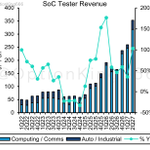
Advantest expanded second-quarter system-on-chip tester revenue by 103.4% YoY to ¥353.3bn, driving a 14.3% upward revision in full-year operating profit guidance to ¥967.0bn. The quarterly surge pushed total second-quarter revenue up 81.7% YoY to ¥477.7bn, exceeding consensus expectations of ¥430.0bn by 11.1%. Operating profit climbed 146.0% YoY to ¥266.8bn, delivering a 55.9% operating margin that topped consensus projections of 50.8% by 5.0 percentage points. Backed by an automated test equipment market compounding at over 50%, management raised its full-year revenue outlook by 8.7% to ¥1,863.0bn, up from ¥1,714.0bn previously, while projecting full-year net income of ¥741.5bn.
To meet this demand, Advantest has already achieved its manufacturing capacity target of 5,000 units and is pulling forward its 10,000-unit milestone well ahead of the previously guided schedule of fiscal year 2029. Management also indicated a subsequent milestone of doubling capacity to 20,000 units without committing to a fixed date, while accelerating memory tester assembly lines in parallel. Company guidance projects the 2026 total addressable market near the upper end of its forecast range at $11.5bn. Sell-side models project fiscal year 2027 net income of ¥741.5bn, while analysts estimate a price target of ¥45,800, with test equipment delivery schedules and memory tester ramp execution serving as primary variables to monitor.
#Advantest #SemiEquipment
Report date: 2026-10-28


Taiwan Union Technology is projected by analysts to raise copper clad laminate prices across the board by 10-20% starting in 4Q26F, as raw material cost inflation strengthens its pricing power. In 3Q26, the company reported gross margin of 36.9%, up 7.2 percentage points QoQ and ahead of consensus estimates of 31.8%, as pricing adjustments on lower-tier laminates successfully passed on rising E-glass costs. With high-end CCL (M7/M8 and above) vendors working toward semi-annual price renegotiations, sell-side models project blended ASP to rise 10-15% each quarter, lifting 4Q26F revenue by 18% QoQ and 2027F revenue by 86% YoY to TWD118,164mn. Analysts estimate gross margin will reach 38.4% in 2027F and 39.3% in 2028F, highlighting high earnings elasticity for smaller-scale AI laminate producers.
This pricing discipline mirrors broader sector dynamics across peer suppliers. Industry estimates on Elite Material Co. (EMC) similarly project 4Q26F price adjustments of 10-20% and gross margins reaching 39.3%, reflecting synchronized semi-annual price renegotiations for high-end AI CCL alongside lower-tier raw material pass-through. However, sustained margin gains remain contingent on raw material quote trajectories: extended E-glass inflation through 1H27F and low-end copper foil supply crunches introduce formula variables that could pressure lower-tier profitability if downstream fabricators resist subsequent price adjustments.
#PCB #Investing
Report date: 2026-10-29

Dassault Systèmes lowered its constant-currency cost base growth to 2.8% YoY in 3Q26, establishing a structural operational ceiling over future expense growth rather than accelerating investment. Management previously intended to re-accelerate spending as top-line revenue growth rebounded, but it has now committed to holding cost expansion near current rates. This operational shift, paired with productivity efficiencies emerging from internal AI deployments, delivered 3Q26 non-IFRS EBIT of €490m, topping sell-side projections of €464m and consensus targets of €470m. The revised strategy positions the group to generate greater operating leverage than the +40 to +60 basis points per year originally envisioned.
Across the broader enterprise software and cloud landscape, vendors are balancing differing investment profiles: while hyperscalers such as Microsoft expanded capital expenditures by 30% YoY to $45.2bn in their first fiscal quarter of 2027 to build infrastructure, Dassault Systèmes is prioritizing internal cost control to protect margins. Sell-side models project group non-IFRS EBIT will expand from €2,087.0m in 2026 to €2,246.4m in 2027, lifting the operating margin from 32.5% to 32.7%. The primary observable for investors is the upcoming capital markets day in mid-November, where management must confirm whether this restrained expense policy will remain firm as revenue growth accelerates.
#Software #Investing
Report date: 2026-10-29

Fortinet saw sequential revenue growth slow to 1.5% in Q3 2026, the company's slowest Q3 expansion since going public, as year-over-year topline growth decelerated to 20.5% from 25.6% in the prior quarter. This top-line downshift was accompanied by acute gross margin compression in hardware, where Non-GAAP product gross margin fell to 64.5% compared to consensus expectations of 67.0% due to persistent component price inflation. Although services gross margin beat expectations by 100 basis points, it failed to offset component cost pressures. Tight operating expense control across R&D, sales, and administration cushioned the bottom line, allowing Non-GAAP operating margin to reach 33.9%, a 200 basis point beat against consensus.
This moderation in perimeter hardware security contrasts with accelerating public cloud infrastructure spending, such as Microsoft delivering 48% constant-currency Azure growth in Q1 FY27. Fortinet management indicated that underlying demand remained steady excluding pricing, but large enterprise customers increasingly staged procurement milestones across prolonged delivery schedules. Because the industry has progressed past 50% of the current firewall refresh cycle and is lapping prior price hikes, sell-side models project diminishing revenue tailwinds. Consequently, analysts reduced Q4 revenue estimates by $90mn, noting that the observable risk to monitor is whether component input costs stabilize before pricing benefits dissipate further in 2027.
#Software #Investing
Report date: 2026-10-29

Palo Alto Networks increased target performance share awards for fiscal 2026 to $54,000,000 for chief executive Nikesh Arora, up from $44,000,000 in fiscal 2025, to counter talent competition from AI-native firms. Target awards for chief product officer Lee Klarich also doubled from $5,000,000 to $10,000,000, while grants for other named executives rose from $13,000,000 to $15,000,000. All long-term equity remains 100% performance-linked through performance share units tied to next-generation security ARR and non-GAAP EPS. To balance execution against rapid cyber disruption, the board altered its benchmark to include acquisitions representing 4% or less of market capitalization at closing, reversing an earlier policy that excluded all inorganic revenue.
That 4% threshold proved critical: it allowed Chronosphere's >$500m in exiting ARR to count toward fiscal 2026 targets while excluding CyberArk, enabling management to beat its internal ARR target by $0.49bn and attain a 213% long-term award payout. Without Chronosphere, the company would have missed its internal benchmark. For fiscal 2027, the board is tightening guardrails by lowering maximum PSU payouts from 400% to 300% of target and requiring at least $450m in ARR outperformance (versus $400m previously). Peer reports show broader cyber headwinds as Fortinet's third-quarter 2026 revenue growth slowed to 20.5% YoY with product gross margins falling to 64.5% versus 67% consensus, reinforcing why scale above $10bn relies on active portfolio tuck-ins.
#Software #Investing
Report date: 2026-10-28

Equinix expanded cabinet billing net adds by 128% year-over-year to 5,700 in the third quarter of 2026, driven by accelerating enterprise demand for hybrid AI colocation. Annualized gross bookings reached a record $533 million, climbing 35% year-over-year from $394 million and outpacing consensus estimates of $458 million. New contract pricing rose 12% year-over-year as tight retail colocation availability preserved strong pricing power. Enterprise clients, led by financial institutions deploying hybrid AI architectures, drove the bulk of new volume, while specialized neoclouds accounted for less than 2% of monthly recurring revenue.
Contract visibility remains exceptionally strong into 2027, with 60% of targeted fourth-quarter 2026 bookings already secured and over 20% of the 13,450 cabinets scheduled for delivery in the fourth quarter already pre-sold. Customers have also committed to approximately 15% of 2027 retail capacity. Across the broader AI hardware supply chain, peers like Vertiv reported 55% organic revenue growth on surging cooling and power demand, reinforcing that data center infrastructure expansion is broad-based. Analysts project recurring revenue will maintain steady double-digit growth, though unexpected customer churn or colocation price discounting could soften renewal spreads.
#DataCenters #Investing
Report date: 2026-10-28

Samsung Electronics & SK hynix Daily Buybacks — 2026-10-30
#SKhynix #SamsungElectronics


eBay increased third-quarter US gross merchandise volume by 27.1% YoY to $12.55bn, driven by consumer-to-consumer demand and platform loyalists. Consolidated gross merchandise volume reached $23.17bn, expanding 16% YoY on a foreign-exchange-neutral basis and 13% organically to top consensus estimates of $22.34bn by 3.7%. Growth is highly concentrated in enthusiast power laws: an engaged core of 16 million platform loyalists visiting daily now generates over 70% of total marketplace volume, while consumer-to-consumer volume climbed 20% YoY to represent 72% of total transactions. Focus Categories expanded the growth spread over non-focus categories to 19 percentage points, led by collectibles and trading cards alongside refurbished items.
This enthusiast-led expansion contrasts with international volume, which increased 3.8% YoY to $10.62bn, showing that current marketplace momentum remains heavily concentrated in domestic enthusiast niches rather than broad global e-commerce recovery. The integration of apparel marketplace Depop doubled its US volume, helping expand addressable demand across younger cohorts and mitigating European competition. For the fourth quarter, management guides consolidated organic foreign-exchange-neutral volume growth to 8%–10%, or 12%–14% including Depop, reflecting typical seasonal conservatism. Sustaining this pace into 2027 depends on whether trading cards and collectibles retain liquidity after extraordinary 2026 participation, as sell-side models project organic volume growth to normalize toward 8%.
#Internet #Investing
Report date: 2026-10-29

Intel ($INTC) guided fourth-quarter 2026 revenue to contract 6.1% sequentially to a midpoint of $15,500 mn, driven by sharp weakness across personal computer client demand. The projected pullback represents a steep reversal from sell-side models anticipating 5.4% quarter-over-quarter expansion, leaving guided revenue 8.9% below consensus of $17,018 mn. Alongside the top-line contraction, management guided non-GAAP gross margin down to 38.0%, trailing consensus of 42.5% by 445 bps and analyst projections of 43.6% by 563 bps. Non-GAAP EPS guidance of $0.25 similarly dropped 42.1% below the consensus estimate of $0.43, as client PC volume headwinds undermined factory fixed-cost absorption.
The cautious fourth-quarter trajectory contrasts with prior sell-side expectations that robust enterprise server CPU demand and advanced packaging traction could fully counterbalance client computing slumps. While external trackers highlighted double-digit shipment declines across PC hardware, fourth-quarter profitability shows that client volume erosion directly depresses corporate gross margins. Analysts maintain a Neutral rating with a 12-month target price of $150 based on 30x normalized EPS of $5.00, noting that future recovery hinges on execution across advanced packaging and Intel Foundry nodes, while further server CPU share losses present downside risk.
#Intel #PCs
Report date: 2026-10-29

argues for replacing reinforcement learning with world models and planning, detailing a new initiative to build AI for the physical world beyond language models. — Yann LeCun, Founder & Chair, AMI Labs; Professor of Computer Science, NYU; 2018 ACM Turing Award Winner
youtube.com/watch?v=7Yr62DCt…
AppLovin ($APP) faces a growth reset as analysts lower fourth-quarter 2026 revenue growth estimates to 35.6% YoY from 44.0%, alongside moderating full-year 2027 top-line expansion to 25.0% YoY from 32.0%. Sell-side projections also cut fourth-quarter Adjusted EBITDA to $1,894mn (from $2,048mn) and FY27 Adjusted EBITDA to $8,500mn (from $9,060mn). The revision reflects category saturation across mobile gaming, where high existing penetration limits further step-function share gains, while expansion into the broader Consumer merchant TAM requires a longer ramp to build advertiser density.
Broader digital advertising peers demonstrate solid underlying demand, with related sell-side reviews noting Amazon generated third-quarter revenue of $201.94bn (+12.1% YoY) as ad services exceeded expectations, while Alphabet Search decelerated against tough comparisons despite 103% YoY cloud growth. For AppLovin, merchant penetration remains below 1%, leaving substantial runway as larger models deploy with increased GPU inference. However, competitive pressure is mounting as Meta ($META) aggressively scales its audience network, and higher sales and marketing expenses to build a direct Consumer sales force will likely constrain near-term margin expansion.
#Internet #Tech
Report date: 2026-10-28
