

Pres. for Option Pit 15 Year Floor Trader on the CBOE and PCX. Group One/HCM Trading options since 1989.
Maine
Joined October 2011
- Tweets7.1K
- Following732
- Followers5.1K
- Likes4.2K






Andrew Giovinazzi retweeted

Yes:
"glaciers are not a permanent fixture of our environment and we need to quit pretending that they are. Glaciers will always be growing or receding; they are not supposed to stay static over time. Pretending so is a fool’s errand."

Long story short, this is BS.
Landslides / avalanches in Nepal have happened for tens of millions of years. In fact, floods associated with landslides are how the V-shaped valleys in the region were carved out millions of years ago at pre-industrial atmospheric carbon dioxide (CO₂) concentrations.
The Himalaya is an exceptionally steep and tectonically active mountain range where earthquakes trigger landslides, avalanches, and glacier collapses fairly regularly. The Google Earth satellite image I pulled up shows this well.
Although an earthquake likely did not trigger the devastating landslide the other day, moderate earthquakes occur often due to plate tectonic movement lifting the Himalaya upward driving India into the Asian continent, and it is likely earthquakes in recent years and months helped set the stage for this.
Frequent seismic shaking in alpine areas can fracture glaciers by creating crevasses, unstable blocks of ice called “seracs,” and hanging ice.
🔗 nhess.copernicus.org/article…
The north face of the Himalaya in the Langtang Valley is characterized by steep slopes that are conducive for “hanging glaciers” (a type of glacier that starts high on a steep mountain wall and stops abruptly, usually at a cliff edge). These hanging glaciers are far more susceptible to destabilization and often produce avalanches when ice is knocked loose. Jim Steele (@JimSteeleSkepti) wrote a nice post about the geology behind this; I recommend giving it a read.
Although warming and surface melt can affect glacier stability, basal conditions are largely controlled by geothermal heat flux, friction, pressure, and bedrock geography.
And while there aren’t any paleoclimate temperature reconstructions in the exact area the recent disaster unfolded, there is evidence that both the Himalaya and Tibetan Plateau were warmer throughout much of the early-to-mid Holocene than they are today (e.g., Chen et al, 2020; Feng et al., 2022), which suggests that glaciers in the region may have also been smaller.
🔗 link.springer.com/article/10…
🔗 agupubs.onlinelibrary.wiley.…
Climate change is real, yes. It always has changed and always will, and I don’t deny that at least some modern warming is due to carbon dioxide (CO₂) emissions.
But glaciers are not a permanent fixture of our environment and we need to quit pretending that they are. Glaciers will always be growing or receding; they are not supposed to stay static over time.
Pretending so is a fool’s errand.


Andrew Giovinazzi retweeted

We’re digging into unusual $DNN call activity, the uranium trade, $NVDA earnings, $VIX options, $BTC, $MSTR and more with @optionvol on "The Option Block 1494: Radioactive HYPE...and Yurts!"
Plus, @MikeTosaw explores options-based alternatives to fixed income.
Listen to this episode on your favorite podcast platform including YouTube: youtu.be/gcypZZfXVwU
And subscribe to the full Options Insider Radio Network on your favorite podcast platform:
🍎Apple: dms0xc.s.gy/mC77lX
🎧Spotify: dms0xc.s.gy/eBVJH2

Andrew Giovinazzi retweeted

Remember this?! 🤣
During the UN Climate Conference last November, the Brazilian government had to charter two cruise ships, the Costa Diadema and the MSC Seaview, to house over 10,000 attendees after many of them complained about the lack of hotel accommodations and A/C.
The cruise ships are powered by marine-grade diesel.

Andrew Giovinazzi retweeted
I bet you didn't hear about this.
The Concordia Research Station in Antarctica dipped to -84.1°C (-119.3°F) on July 18th.
That's the lowest temperature recorded anywhere on Earth since 2012, and it was within half a degree of Concordia's all-time record.


Andrew Giovinazzi retweeted
The AI trade is wobbling, semis are under pressure, and volatility is waking up.
Join @RussellRhoads, @OptionPit and special guests Matt & Mike Thompson (Thompson Capital Management) as we break down $VIX, AI spending, volatility term structure, unusual options activity, and the return of the volatility "mullet."
Listen to this episode on your favorite podcast platform including YouTube: youtu.be/PBS2Q4439Pw
And subscribe to the full Options Insider Radio Network on your favorite podcast platform:
🍎Apple: dms0xc.s.gy/mC77lX
🎧Spotify: dms0xc.s.gy/eBVJH2
🤖 Made with AI

Andrew Giovinazzi retweeted

Just heard someone on TV saying DC is going to be 110 today. This is what happens when Heat Indexes, which are dependent to some degree on a person's ability to handle heat, take the place of actual temperatures; the media focuses on them, further distorting the event's extremity and weakening historical perspective. So people now, because they are acclimated to air conditioning, which we did not have then, will go outside and feel hotter than the same person who was acclimated to it. Plus, you tell them the heat index and then say, "Look, you are a victim of this," and it compounds the impact. The fact is, this country today is likely not tough enough to meet the challenges we faced in the 1930s, climate-wise and otherwise. We are a victim of our own comfort, disregarding the foundation that made us tough enough to get where we are now
Andrew Giovinazzi retweeted
On today's date in 1901, over half of the U.S. was at or above 90°F and nearly 9% of the land area was at least 100°F. The same weather occurring this week occurred exactly 125 years ago, but according to most climate alarmists, it was just weather in 1901, but this week's three-day event is undeniable proof that we are facing a climate catastrophe.

Andrew Giovinazzi retweeted

The weakness in equities during the month of June predominantly came from funding stress. I saw a lot of commentary centered around macro factors, which was a bit of a head scratcher because if you were on the institutional side, the color on the Street was crystal clear regarding where the main footprint in equity weakness came from.
There were three main factors that ended up putting pressure on equities. The funding issues were strictly on the equity side because, although revcons and box rates were elevated, the repo market remained quite normal.
1) CCAR reports: Bank stress test reports are typically released at the end of June. The numbers are generally reflective of December holdings, but regulators and internal risk teams will often conduct an update during June to ensure balance sheets still look relatively in line before the reports are finalized. It is similar to how an auditor performs one final review of a firm’s balance sheet before issuing the audit. This is standard practice, but there is a natural inclination for banks to keep their balance sheets much cleaner during this time of year, which means certain forms of equity lending begin to tighten, especially when new broad sector leaders are trading at elevated realized vol. This can contribute to the weak seasonal effects we sometimes see in June, and it can become even more pronounced when markets turn volatile.
2) IPO new issuance: One massive IPO came to market, and much of the private wealth community worked with the deal runners to ensure it went smoothly. Many private wealth advisors encouraged their clients not to sell existing equity holdings, but instead to borrow cash to participate in the IPO through the secondary market. In other words, investors were trying to avoid selling current positions while simultaneously using other forms of financing to buy into the IPO. The funding market quickly recognized this dynamic and repriced equity financing accordingly.
3) Leveraged ETF holdings: This one is fairly straightforward. Some leveraged ETFs now hold single stocks that are experiencing very high realized volatility, and the Street wants to be compensated for accepting those names as collateral when lending against them. Put simply, the collateral itself has become more volatile.
The result was a perfect storm in which there was meaningful demand for equity financing from several different sources at the same time. The increase in equity financing rates made it much more difficult for balance sheets to outright buy stocks and continue driving the market higher, as we had seen over the previous few months. June has now passed, and those financing rates have come down considerably.


Andrew Giovinazzi retweeted

👇👍

There's so much to say about this chart. it shows to very related measures: the ratio of the single stock VIX (VIXEQ) to the $VIX versus SPX 1m implied correlation.
The higher the ratio the lower the implied correl and you can see we are an absolute extreme.
You might say the market is "complacent" by way of the record low IC. Agree the sense that there is a disregard for the potential for a macro shock that hits all assets at once. Said shock would move the current level down and to the right in the chart.
But what's really driving the ratio up and IC down is the level of single stock implied volatility. The number of stocks enveloped in a "spot up, vol up" dynamic is significant. Thus, the VIXEQ is higher now than at the peak of the market shock in late March!
When a stock surges, investors who want to stay long but are worried the rug may be pulled out start looking at call options. They allow you to walk away if things reverse. That demand forces implied vol higher. From the option seller's standpoint, stocks are exhibiting huge one-day "up shocks" that are both difficult and costly to hedge. That gets priced in.
I am reposting my Tweet here on "SK Hijinks" because it' may be the strongest example of the feedback loop between price, implied vol and the overlay of short gamma products.
I think we are getting closer to a tipping point and there's a sharp, tradable reversal forthcoming.
xitter.cf/Alpha_Ex_LLC/status/20…

RT @Options: Is this The Option Block 1470: The Swimsuit Issue of the Options Market?
Indices are flashing red, but the heat is ON! We ar…
Andrew Giovinazzi retweeted
Another wild close in the options market as $NVDA and $TSLA traders were sweating it right into the bell.
From massive call volume to late-day reversals, today’s tape had everything options traders love.
Get more premium options data and analytics from @QuikOptions at TheHotOptionsReport.com.
🎧 Listen to the full episode of "The Hot Options Report: 05-15-2026. Sweating the Close: NVDA & TSLA" on all major podcast platforms including YouTube:
youtu.be/UiKgBgdMezQ
Andrew Giovinazzi retweeted

Activist: "Your cows are putting carbon into the atmosphere."
Farmer: "Where did they get it?"
Activist: "What?"
Farmer: "The carbon. Where did the cow get it before it put it anywhere."
Activist: "From... eating?"
Farmer: "From eating grass. And where did the grass get it."
Activist: "The soil?"
Farmer: "The air. The grass pulled it out of the air last spring. The cow ate the grass. The cow breathed some of it back out. It went back into the air it came from."
Activist: "But it's still going into the atmosphere."
Farmer: "It's going back. There's a difference between a thing going somewhere and a thing going back. You've described a circle and you're frightened of it."
Activist: "Then just don't have the cow."
Farmer: "The grass still dies in autumn. It rots where it falls. The carbon goes back into the air either way, just without anyone getting fed in the middle."
Activist: "It's not that simple."
Farmer: "It's grass, cow, breath, grass. Or it's grass, rot, air, grass. Same circle, fewer dinners. If that's complicated for you I'd stay away from the water cycle. That one's got clouds in it."

Andrew Giovinazzi retweeted

Wait, what the hell is going on here?
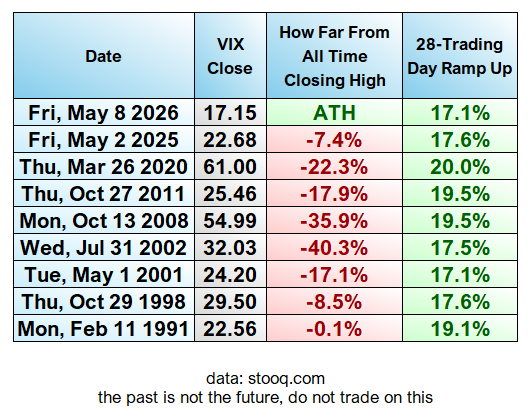
The S&P500 (SPX) was up +17.1% in 28 trading days as of Friday's close. Absolutely absurd.
But what if I told you it was also the first time a ramp up that hard (+17.1%), that fast (<=28 trading days) had happened since the beginning of computerized trading (1982) where EITHER:
- VIX was under 22 (it closed Friday at 17.15)
OR
- SPX closed at a new all time high close (it got close in 1991)
Freak out all you want about analogs to 1999, this has never happened before in most of our lifetimes.
Should you buy puts? Calls? A gun? Pack of hyenas?
What do I care?
GOD, I missed me.
Andrew Giovinazzi retweeted
The discussion around breadth has been relevant for the last few years, but I think many people completely miss the broader point. I constantly hear breadth deterioration being used as evidence that the market is unstable or fundamentally broken, when in reality this market has been driven by a concentrated group of names for quite some time now.
That is not some hidden flaw in the system. It is the structure of the current regime. Reflexively, part of this is also being amplified by the growing amount of dispersion exposure concentrated among several major players in the derivatives ecosystem. The structure itself naturally reinforces leadership concentration.
At some point, people have to stop analyzing today’s market through the lens of decades-old frameworks. Arguing that weak breadth automatically signals impending instability is no different than the old-school portfolio manager complaining that stock and bond correlations are not behaving like they did in the 1980s.
Markets evolve. Flows evolve. Correlations evolve. Structural dynamics evolve. If you don't evolve your process, data and infrastructure accordingly, you'll quickly get left behind.


Andrew Giovinazzi retweeted
The Southern Studio is now closed. Thanks to @OptionsConf for a great week. Stay tuned to the network for great interviews, panels and more coming soon.

Andrew Giovinazzi retweeted
Just absolutely insane. If you are a derivatives TRADER, this continues to just be an unbelievable environment. Gamma is paying the most naive player in huge ways.
You are seeing 6M stuff with low teen vol on names moving 1-2% a day.
Don’t let your own preconceived views distort you from what the actual market is showing you.
Andrew Giovinazzi retweeted

This is how an economy actually works

Elon Musk avait dit un truc qui m'avait marqué sur l'allocation de ressources. En substance : passé un certain niveau de richesse, l'argent n'est plus de la consommation, c'est de l'allocation de capital.
Cette phrase change tout.
L'économie, dans le fond, c'est juste un problème d'allocation. Tu as des ressources finies et des usages infinis. Qui décide où va quoi ?
Imagine une cour de récré. 100 enfants, des paquets de cartes Pokémon distribués au hasard. Tu laisses faire. Très vite, un ordre émerge. Les bons joueurs accumulent les cartes rares, les collectionneurs trient, les négociateurs trouvent des deals. Personne n'a planifié. Et pourtant chaque carte finit dans les mains de celui qui en tire le plus de valeur. Le système maximise le bonheur total de la cour. C'est ça, la main invisible.
Maintenant fais entrer la maîtresse. Elle trouve ça injuste. Léo a 50 cartes, Tom en a 3. Elle confisque, redistribue, impose l'égalité. Trois effets immédiats. Les bons joueurs arrêtent de jouer, à quoi bon. Les mauvais n'ont plus de raison de progresser, ils auront leur part. Les échanges s'effondrent. La cour est égale, et morte. Elle a maximisé l'égalité, elle a détruit le bonheur.
Le problème de la maîtresse, c'est qu'elle ne peut pas avoir l'information que la cour avait collectivement. C'est le problème du calcul économique de Mises, formulé en 1920. L'URSS a essayé de le résoudre pendant 70 ans avec le Gosplan. Résultat : pénuries, queues, effondrement. Pas parce que les Soviétiques étaient bêtes, parce que le problème est mathématiquement insoluble en mode centralisé.
Quand Musk a 200 milliards, il ne les consomme pas, il les alloue. SpaceX, Starlink, Neuralink, xAI. Chaque dollar est un pari sur le futur. Et lui a un track record. PayPal, Tesla, SpaceX. Il a démontré qu'il sait identifier des problèmes immenses et y allouer des ressources avec un rendement spectaculaire.
L'État aussi a un track record. Hôpitaux qui s'effondrent, éducation qui décline, dette qui explose, services publics qui se dégradent malgré des budgets en hausse constante. Le marché identifie les bons allocateurs, la politique identifie les bons communicants.
Le profit n'est pas une finalité, c'est un signal. Il dit : tu as alloué des ressources rares vers un usage que les gens valorisent suffisamment pour payer. Plus le profit est gros, plus la création de valeur est grande. Quand Starlink est rentable, ça veut dire que des millions de gens dans des zones rurales ont enfin internet. Quand un ministère est en déficit, ça veut dire qu'il consomme plus qu'il ne produit. L'un crée, l'autre détruit, et on appelle ça redistribution.
Dans nos sociétés il y a deux catégories d'acteurs. Les entrepreneurs et les bureaucrates. L'entrepreneur prend un risque personnel pour identifier un problème, mobiliser des ressources, créer une solution. S'il se trompe il perd. S'il a raison, ses clients gagnent, ses employés gagnent, ses fournisseurs gagnent, l'État collecte des impôts. Il est la cellule de base du progrès humain.
Le bureaucrate ne prend aucun risque personnel. Son salaire est garanti. Au mieux il maintient une rente existante. Au pire il la détruit par excès de réglementation, mauvaise allocation forcée, incitations perverses qui découragent ceux qui produisent. Mais dans aucun cas il ne crée.
Regarde les 50 dernières années. iPhone, internet civil, SpaceX, Tesla, Google, Amazon, Stripe, mRNA, ChatGPT. Toutes des inventions privées, portées par des entrepreneurs, financées par du capital risque. Pas un seul ministère n'a inventé quoi que ce soit qui ait changé ta vie au quotidien.
La France est devenue le laboratoire mondial de la dérive bureaucratique. 57% du PIB en dépenses publiques, record absolu. Une administration tentaculaire, une fiscalité qui pénalise la création de richesse. Résultat : décrochage face aux États-Unis, à l'Allemagne, à la Suisse. Fuite des cerveaux. Désindustrialisation. Dette qui explose.
Et le pire c'est que la mauvaise allocation s'auto-renforce. Plus l'État prélève, moins les entrepreneurs créent. Moins ils créent, moins il y a de base fiscale. Plus l'État s'endette et taxe. Boucle de rétroaction négative parfaite. La maîtresse pense qu'elle aide, et chaque année la cour produit moins.
Dans nos sociétés, ce sont les entrepreneurs, toujours, qui font avancer la civilisation. Les bureaucrates au mieux maintiennent une rente, au pire la détruisent. Aucune société n'a jamais progressé en taxant ses créateurs pour subventionner ses gestionnaires.
La question n'est jamais qui a combien. C'est qui alloue le mieux la prochaine unité de ressource pour maximiser le futur de l'humanité. La réponse depuis 200 ans n'a jamais changé. Ce ne sont pas les fonctionnaires.