

Social Health Protection | Health Financing for UHC. Cross-sector catalyst, knowledge broker and change agent for social impact. https://xitter.cf/t.co/ZPd9LFQSjo
Geneva, Switzerland
Joined January 2016
- Tweets7.8K
- Following307
- Followers2.3K
- Likes5.2K



Pinned Tweet
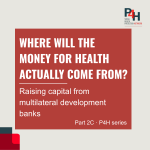
(1/5) Where will the money for health actually come from?
DAC funding fell >23% in 2025 - health funding potentially down 40%+.
Governments are now scoping blended funds, debt swaps, and development bank balance sheets to reimagine health financing.

(5/5)
These instruments have proven themselves in climate finance. The opportunity now is to put them to work for health.
Read Part 2C → p4h.world/en/from-billions-t…
#BillionsToBalanceSheets #HealthFinancing #UHC

(4/5)
Risk Control’s analysis for the @RockefellerFdn puts the headroom at $162 billion of additional World Bank lending over a decade, from capital that already exists.

(3/5)
The @AfDB_Group first public hybrid bond drew eight times the demand on offer.
The IMF has approved channelling unused Special Drawing Rights into bank capital.
🇳🇿 New Zealand became the first country to convert part of its existing pledge into capital the rating agencies will count.

(2/5)
In this new blog @kchalkidou and Rahul Singhal set out how multilateral development banks can expand their lending using capital they already hold.

(1/5)
Three routes are open to development banks that want to lend more for health: hybrid capital, unused Special Drawing Rights, and better use of capital shareholders have already committed.
Part 2C concludes Part 2 of our series on financing health systems in the age of the aid retreat. 🧵

7/7
Next: Part 2C, on how MDBs can raise genuinely new equity capital — not just free up existing room.
#BillionsToBalanceSheets #HealthFinancing #UHC #BlendedFinance

6/7
The blog works through how each mechanism functions, why health has been left out, and what it would take to change that.
📖 Read it: p4h.world/en/from-billions-t…
📚 Glossary: p4h.world/app/uploads/2026/0…

5/7
How:
→ Insurance on existing loans
→ Loan-swapping between regional banks
→ Guarantees from donor governments
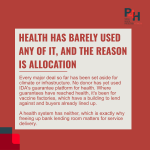
Billions unlocked this way — mostly for climate and infrastructure.

4/7
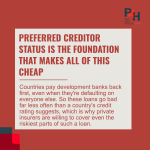
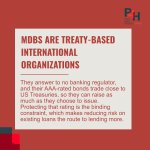
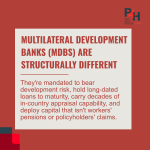
MDBs raise money easily. Their AAA credit rating is the asset worth protecting, and it shapes how much they can lend.
So instead of raising new funds, they free up room to lend by shedding risk on loans already on their books.

3/7
@kchalkidou & Rahul Singhal propose multilateral development banks (MDBs) are the only actors with balance sheets deep enough, between them, to close a health financing gap this size.

2/7
Our last blog explored why most institutional capital - pension funds, insurance, central bank reserves, is hard to mobilise for health.
This instalment takes it forward: if that capital can't move at scale, who can?

1/7
Development banks have freed up billions in new lending capacity in recent years.
Almost none of it has gone to health.
Part 2B of the P4H series on financing health systems in the age of the aid retreat.
🧵

(5/5)
Which brings us to development banks — next up in the series. Watch this space.
📖 Read the blog: p4h.world/en/from-billions-t…
📚 Glossary of terms: p4h.world/app/uploads/2026/0…
Stay tuned for the next in the series!
#BillionsToBalanceSheets #HealthFinancing #UHC

(4/5)
The obstacles aren't legal — they're practical: whose money it is, how fast it must be available, what it protects against, who has the expertise to judge the risk.
Remittances add ~$56bn/year to sub-Saharan Africa — but that's household transfers, not an investable instrument.

(3/5)
The most-cited fix: raise statutory ceilings on where pension funds can invest.
In the largest markets, those ceilings are already generous and sit largely unused.
Ghana permits up to 25% of pension assets in alternatives. Actual allocation: 0.58%.

(2/5)
In this instalment, Kalipso Chalkidou & Rahul Singhal work through Africa's capital pools.
Central bank reserves: held abroad.
Most sovereign wealth funds: invested overseas.
Set aside South Africa and the wealthier North African economies — roughly $250bn remains.


(7/7) Blended finance has a mixed record on scale, targeting and additionality, which is why transparency and alignment with equitable UHC principles matter.
Read the full piece 🔗 p4h.world/en/designing-blend…
Follow along for more in this series.
#BillionsToBalanceSheets

(6/7) Step 5: Deal with risk from the start.
Credit risk for start-up manufacturing in developing markets is genuinely hard to assess. Guarantees, first-loss facilities and transparent governance separate a fund that closes from a concept note that circulates for years.

