
We are a research team @EdinburghUni to share scientific studies daily about parenting and teens’ wellbeing. Parents and teens are welcome to join in our study.
Scotland, United Kingdom
Joined June 2022
- Tweets307
- Following533
- Followers304
- Likes275




Pinned Tweet
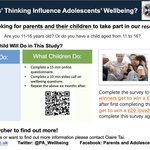
🙌A research opportunity for parents, headteachers, and educators to understand how parents’ thoughts can make differences to child’s #resilience, #copingmechanism, and #wellbeing! Parents’ Survey: edinburgh.eu.qualtrics.com/j… Child's Survey: edinburgh.eu.qualtrics.com/j…

View our Parent Webinar on Youtube: Supporting pre-teens and teens with parenting tips from evidence-based research: youtu.be/e9y8peUimA8. Welcome parents and teens to take part in our ongoing project on parents’ thinking and adolescents’ wellbeing mentioned in the talk!
@InformEpic is holding an online parent workshop on June 27th at 7pm. The topic is about understanding and supporting children with #ADHD, #Dyspraxia, and #autistic who are awaiting assessment. For more info see epic-information.com/2023/06…… or email: [email protected]

Really looking forward to hosting this small group online workshop for parents next week focused on thinking skills (#executivefunctions). Suitable in relation to children with and without a developmental diagnosis, age focus 4-12 #ADHD #Autism #Dyspraxia #DCD
Calling parents to an online parent workshop for understanding and supporting #neurodivergent children including those not diagnosed, see booking link below. Only limited spaces are available to ensure parents’ chances to ask questions.

We are holding an online workshop for parents focused on understanding and supporting neurodivergent children on June 27th 7pm. The booking link is here: epay.ed.ac.uk/conferences-an…. #ADHD #DCD #autism 1 / 3
We are grateful for parent’s’ participation in our webinar and our parenting studies. It is parents’ participation makes our studies become “evidence-based”. Please take part in our research and help us to understand how parenting makes positive differences in teens’ wellbeing!
You’re unable to view this post because this account owner limits who can view their posts. Learn more
Calling for parents to take part in this parenting research to understand how parents’ thinking can make positive differences in teens’ #resilience, #copingmechanism, and #wellbeing! Parents’ Survey: edinburgh.eu.qualtrics.com/j…… Child's Survey: edinburgh.eu.qualtrics.com/j……

Please feel free to contact us if you wish to have the resources mentioned in this parent webinar video: youtu.be/e9y8peUimA8.


Our Parent Webinar on supporting pre-teens and teens with evidence-based research is FREE to watch on @YouTube: youtu.be/e9y8peUimA8. Please click and share this video if you are interested in #parentingtips linked to evidence-based parenting research!
Our Parent Webinar on supporting pre-teens and teens with evidence-based research is FREE to watch on @YouTube: youtu.be/e9y8peUimA8. Please click and share this video if you are interested in #parentingtips linked to evidence-based parenting research!
This video includes three topics: supporting parents in managing teens' noncompliant behaviour, parents' thinking and teens' wellbeing, and using psychoeducational intervention activities to support learning in children with additional support (#autistic, #ADHD, #dyspraxia).

1
1
61
We are delighted to welcome parents to our Parent Webinar on the 22nd of March at 7 pm! For those who can’t join us, our research on parenting and teenagers’ well-being may be of interest to you. See the advertisement for details.

Would you mind quoting/retweeting the above tweet?@SineadRhodes @InformEPIC @StellaWYChan
@ScotParents @children1st @cisweb @Y2K_Project @YouthScotland
@ParentingProje1 @MindsParental @ParentingNI @theLUNAproject @CBYouthVoice @hallgreenfam @includem2000 @NpfsWest
1
1
137
We are hosting a FREE online webinar for parents about supporting pre-teens and teens on Wednesday, the 22nd of March, at 7-8 pm. Please share with anyone who may be interested in parenting tips linked to evidence-based parenting research.
To register:
ParentingWebinarEdinbugh.eve…
Can you quote this tweet and share the webinar information with your followers, please? @SineadRhodes @InformEPIC @StellaWYChan
@ScotParents @children1st @cisweb @Y2K_Project @YouthScotland
@ParentingProje1 @MindsParental @ParentingNI @theLUNAproject @CBYouthVoice @hallgreenfam

A recent research study showed that music education brought benefits to adolescents in developing thinking skills and in improving wellbeing. (1/3)
frontiersin.org/articles/10.…

Teenagers who take part in arts and cultural activities, such as dance, drama, reading and going to concerts, are less likely to engage in antisocial and criminalised behaviour up to two years later, according to a new study by @ucl and @UF. (1/5) researchgate.net/publication…

Teenagers who reported feeling optimism, happiness, self-esteem, a sense of belongingness and loved were more likely to reach their 20s and 30s with good health (such as lower risks of heart diseases and type 2 diabetes) (1/4)
ahajournals.org/doi/10.1161/…
A fascinating study about how to improve thinking skills, such as planning, organizing, and memorizing in children with DCD with practical skills for teachers and parents to use. Check the link below👇
New blog post from us today about using EPIC activities with children with DCD/who are dyspraxic, see epic-information.com/2023/01…
A study found adults with better mental health are more likely to report childhood experiences of playing in rivers, lakes, and in the sea. This suggests that taking children to these ‘blue spaces’ may support their future mental health. (1/5) sciencedirect.com/science/ar…

A study of nearly 2,000 children (aged 9 and 10 years old) found that those who reported playing video games at least 3 hours per day showed better memory and attention, compared to children who never played video games.jamanetwork.com/journals/jam…

A new study published by @UniofBath suggested that taking musical instrument training could be beneficial for people with mental health difficulties such as depression and anxiety (Che et al., 2022). (1/5)nature.com/articles/s41598-0…

Teenagers with additional support needs may experience low parental expectations. However, a new study found high parental expectations about teenagers’ academic performance can increase school functioning in this population. (1/3)
A study by @UZH_en showed that helping children to learn how to manage their attention and impulses in primary school has a positive long-term effect on later educational success. A cost-effective and time-saving, training programme was designed (1/4): sciencedaily.com/releases/20…

Transition to middle school can be stressful time for adolescents. A recent study by @UofIllinois looks at how emotional aspects of parenting can help young people better cope with peer stressors during this transitional period (1/3). sciencedaily.com/releases/20…
Adolescents with ADHD may experience more difficulties with physical and emotional changes that occur in puberty. This novel study identified 5 common practices within interventions that support adolescents with ADHD (1/6). link.springer.com/article/10…