

We partner with organizations to hire the right people for the right role, increase employee retention rates and much more. Click the link below for more info.
USA
Joined March 2023
- Tweets128
- Following5
- Followers2
- Likes19




Same leader, two different modes.
Most leaders lean on one mode out of habit. PI frames the difference clearly: management "is more fast-paced, tactical, incorporates real-time feedback, and holds employees accountable for deadlines and metrics." Coaching plays a longer game and looks at the bigger picture.
The sharpest line between them is ownership. In PI's words: "In coaching conversations, the coach doesn't set the goals; the employee does." From there, the coach asks clarifying questions and helps the person map a path around whatever gets in the way.
A quick test before your next one-on-one: notice whose goal is on the table. A team target calls for managing. Their own growth calls for coaching.
PI's bottom line: most leaders already carry both skill sets, and "The best leaders know how and when to use them." Powerhouse Advisory Group helps leaders build both skills and switch between them on purpose.
When a direct report brings you a problem, which mode do you reach for first?
#Coaching #ManagerDevelopment #TalentOptimization #Leadership #PeopleDevelopment
Link in bio.

6
Pick your two.
PI's guide to manager growth lists 11 areas worth working on, from delegation and feedback to trust and adaptability. Its most practical advice: "The point isn't to improve at everything simultaneously."
Four ways to figure out which one or two deserve your attention right now:
1. Repeat friction. If the same conversation or the same kind of project keeps going sideways, PI calls that "a signal, not a coincidence."
2. Ask directly. Skip "how am I doing?" and try PI's version: "What's one thing I do that makes your job harder?"
3. Team data. Engagement, retention, and output quality say something about how you manage, too.
4. Your wiring. Knowing how you're naturally built around pace, risk, and structure shows where your instincts help and where they get in the way.
Choose your two, work on them, and let the gains stack up. Powerhouse Advisory Group helps managers pinpoint the habits that will move their team the most.
Which area would your team pick for you?
#ManagerDevelopment #TalentOptimization #LeadershipGrowth #PeopleLeadership #LeadershipDevelopment
Link in bio.

13
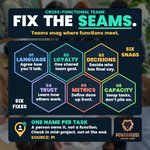
Cross-functional teams rarely break because people stop caring. They snag at the seams, where one function's habits run into another's.
PI's Chief People Officer Jackie Dube lays out six snag points, and each one has a fix:
1. Language: "Ready to launch" means something different to engineering than it does to marketing. Agree early on how the team will talk.
2. Loyalty: people answer to two bosses, and the home department usually wins. Give the team one goal of its own.
3. Decisions: without a formal hierarchy, calls stall or go to whoever is loudest. Settle who gets the final say.
4. Trust: most teammates start out as strangers. Walk through each function's deadlines, constraints, and working style.
5. Metrics: with no shared definition of done, every phase ends in friction. Agree on success criteria first.
6. Capacity: this work usually lands on top of the day job. Take something off the plate instead of piling on.
One more from PI: "Give ownership to a person, not a function." A deliverable owned by a whole department tends to slip through the cracks.
Which of the six shows up first on your cross-functional projects?
Powerhouse Advisory Group helps leaders set these teams up right at kickoff, built around real behavioral data on how each person communicates and makes decisions.
#TeamDynamics #CrossFunctionalTeams #TalentOptimization #LeadershipDevelopment #Collaboration
Link in bio.

18
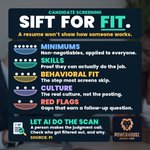
Sift for fit.
PI's guide to screening candidates makes a point most hiring teams already feel: a resume alone "won't tell you how someone actually operates day to day."
Five things worth screening for, in order:
1. Minimums. The hard requirements, checked the same way for every applicant.
2. Skills. Real evidence they can do the work, beyond the titles on a page.
3. Behavioral fit. How they're wired to work, and whether that matches what the role and team need. PI calls it "the piece most screening processes skip over."
4. Culture. The environment you actually offer, not the one in the job ad.
5. Red flags. Unexplained gaps or patterns that deserve one more question.
AI can take the first pass. In PI's words, it's "built for the scan, not the judgment call," so a person still has to look at who got filtered out and why.
At Powerhouse Advisory Group, we help hiring managers bring behavioral data into every screen, so the people you move forward fit the role as well as they fit the paper.
Which of these five does your hiring process skip most often?
#HiringStrategy #TalentOptimization #CandidateScreening #TalentAcquisition #LeadershipDevelopment
Link in bio.

18
Spell it out.
PI makes a sharp point about how teams really operate: when expectations stay unwritten, "unspoken norms default to whoever talks loudest or holds the most authority in the room."
PI sorts the norms worth building into four types, with plain examples a team can actually follow:
1. Communication: if you're blocked, say so within 24 hours.
2. Meetings: if it's not written down, it didn't happen.
3. Accountability: put a date on it, because "soon" isn't a deadline.
4. Conflict and feedback: critique the work, never the person.
Writing them is the easy half. PI suggests a short list of five to eight, a quarterly gut check on whether they still work, and a manager who honors them first, since norms tend to die the moment someone at the top stops following them.
Powerhouse Advisory Group gives leaders a clear read on the working style of every teammate, so the norms you agree on fit the team you actually have.
Which of these four would change the most on your team this quarter?
#TeamNorms #TalentOptimization #TeamDynamics #LeadershipDevelopment #ManagerDevelopment
Link in bio.

13
Check the mirror.
PI's look at leadership blind spots makes a point worth sitting with: most of them "start as genuine strengths that never got adjusted as your role or team changed."
Three that show up often:
1. A decisive leader stops leaving room for other opinions, and the team goes quiet.
2. A consensus-driven leader runs every choice past the group, and the calls that need speed stall.
3. A hands-on leader who was a strong individual contributor calls it diligence. The team reads it as distrust.
None of those strengths went away. They simply kept running with nobody checking them.
The fix starts with honest input. PI recommends 360 feedback, done formally, because anonymous input surfaces patterns that casual one-on-one chats tend to miss.
At Powerhouse Advisory Group, we show leaders how their natural style actually lands with their people, so they can adjust before a strength starts costing them trust.
Which of your strengths has quietly started working against you?
#LeadershipDevelopment #TalentOptimization #SelfAwareness #ManagerDevelopment #LeadershipSkills
Link in bio.

9
Score the hire, not the clock.
Time-to-fill only tells you how quickly a seat got filled. It says nothing about whether the person in that seat was the right call.
PI lays out a simple way to find out, using a worked example of one new hire a few months in:
Retention: still on the team at six months, so it scores 90.
Manager rating: 85 out of 100.
Goals: hitting 80% of them, so it scores 80.
Average the three: (90 + 85 + 80) / 3 = a quality-of-hire score of 85.
Three habits make the number useful:
1. Track three to five signals you can collect the same way every time.
2. Turn each signal into a score out of 100 before you average.
3. Read the results in groups, by source, role, or quarter, because that is where the patterns appear.
Powerhouse Advisory Group helps leaders link what they knew before the offer to how each hire actually performs after day one, so every search gets sharper than the last.
Which hiring channel would win if you scored your last ten hires this way?
#TalentOptimization #QualityOfHire #HiringStrategy #LeadershipDevelopment #TalentAcquisition
Link in bio.

13
If you are rolling out AI, your people are asking for something more useful than a promise.
PI put the question to 1,000 U.S. professionals in its 2025 AI at Work research, and 68% said they want more training opportunities as their company adopts AI. That came ahead of clear communication from leadership (61%) and job reassurance (58%). PI's read on it: employees would rather be equipped than reassured.
Three moves for leaders guiding a team through new tools:
1. Train before launch. Build skill time into the rollout plan, not after it.
2. Fit the training to the person. Some people want to experiment early; others need clear steps and time to adjust.
3. Close the loop. When people share ideas, tell them what you did with that input.
Powerhouse Advisory Group shows managers how to read PI behavioral data so they can coach, grow, and hold on to their people while the work changes around them.
What is the first skill your team needs before your next big rollout?
#TalentOptimization #LeadershipDevelopment #ChangeManagement #FutureOfWork #EmployeeDevelopment
Link in bio.

13
When a senior leader walks out the door, the people around them start eyeing the exit too.
For its 2022 talent optimization research, PI asked 326 executives whether they had quit or changed companies in the past 12 months, and 16% said yes. The executives who left reported an average total attrition rate of 36% at their companies. The ones who stayed reported 17%, less than half.
The same survey asked the executives who stayed what kept them there. The top answer was good job fit. Those who quit pointed to inflexible work options, a lack of trust among the senior team, and too few chances to develop.
Three ways to hold on to the leaders your teams depend on:
1. Recheck fit. Roles change as the business grows, so revisit whether each leader's natural drives still match the job.
2. Build trust. Give the senior team real time to align, disagree openly, and commit together.
3. Grow leaders. Development plans shouldn't stop once someone reaches the executive floor.
At Powerhouse Advisory Group, we bring PI behavioral insight to placing, aligning, and developing the leaders who set the tone for everyone else.
Which leader on your team would be hardest to replace, and when did you last ask what keeps them there?
#TalentOptimization #LeadershipRetention #ExecutiveLeadership #EmployeeRetention #LeadershipDevelopment
Link in bio.

15
When a senior leader walks out the door, the people around them start eyeing the exit too.
For its 2022 talent optimization research, PI asked 326 executives whether they had quit or changed companies in the past 12 months, and 16% said yes. The executives who left reported an average total attrition rate of 36% at their companies. The ones who stayed reported 17%, less than half.
The same survey asked the executives who stayed what kept them there. The top answer was good job fit. Those who quit pointed to inflexible work options, a lack of trust among the senior team, and too few chances to develop.
Three ways to hold on to the leaders your teams depend on:
1. Recheck fit. Roles change as the business grows, so revisit whether each leader's natural drives still match the job.
2. Build trust. Give the senior team real time to align, disagree openly, and commit together.
3. Grow leaders. Development plans shouldn't stop once someone reaches the executive floor.
At Powerhouse Advisory Group, we bring PI behavioral insight to placing, aligning, and developing the leaders who set the tone for everyone else.
Which leader on your team would be hardest to replace, and when did you last ask what keeps them there?
#TalentOptimization #LeadershipRetention #ExecutiveLeadership #EmployeeRetention #LeadershipDevelopment
Link in bio.

12
Every business plan is really a people plan. The org chart decides how fast the strategy actually moves.
PI's State of Talent Optimization Report surveyed more than 200 HR professionals, executives, board members, and business owners. 76% said leadership is only occasionally involved in talent decisions, while 75% said HR is a critical part of leadership. That disconnect shows up in every hire, promotion, and team change that happens without the top team in the room.
Talent calls are strategic calls, so treat them like one. Three moves for senior leaders:
1. Invite HR in. Put behavioral data on the table whenever you set goals, budgets, or headcount.
2. Own key hires. Weigh in personally on the roles that will shape the next stage of growth.
3. Show your work. Tell people the reasoning behind big people decisions so the message lands on the ground.
Powerhouse Advisory Group helps executive teams build PI people data into the way they plan, hire, and lead, so talent becomes part of the strategy instead of an afterthought.
How often does your senior team sit down together to talk about people decisions?
#TalentOptimization #TalentStrategy #HRLeadership #LeadershipDevelopment #PeopleStrategy
Link in bio.

1
23
Getting promoted to manager hands someone a title, a team, and a budget. It rarely hands them the people skills the role demands.
When PI surveyed 1,038 workers across 13 industries on how their bosses lead, nearly 30% said their manager lacks team-building skills, and 17.9% said their manager lacks feedback skills. Those are the gaps your people feel every single week.
Strong individual contributors often get moved up because they were great at the work itself, then left to figure out leadership alone. Three skills worth building before anything else:
1. Team building. Get to know what drives each teammate and how they like to collaborate.
2. Real feedback. Coach in short, frequent conversations instead of saving it all for the annual review.
3. Smart handoffs. Delegate work that stretches people, not just the tasks you would rather skip.
Powerhouse Advisory Group pairs PI behavioral data with hands-on manager development, so new leaders close their skill gaps before those gaps cost you good people.
Which people skill took you longest to pick up after you first became a manager?
#ManagerDevelopment #TalentOptimization #Coaching #LeadershipDevelopment #TeamBuilding
Link in bio.

17
One in three employees believes the boss has a favorite. That perception quietly drains trust across the whole team.
In a PI survey of 1,038 employees about their managers, a staggering 33.4% said they think their manager plays favorites. Only 43% said they don't believe their manager does.
Favoritism rarely starts on purpose. It grows out of who you click with, who you talk to most, and who you hand the high-stakes assignments to by default. Three ways to keep the field level:
1. Share the wins. Rotate who gets the high-visibility projects and the chance to present them.
2. One yardstick. Measure every person against the same clear, written goals.
3. Flex the style. Adjust how you coach each person to fit how they work, but hold everyone to the same bar.
With PI behavioral insight, Powerhouse Advisory Group helps managers read what every individual on the team needs, so coaching gets personal while opportunity stays even.
Which assignment on your team tends to land with the same person every time?
#TeamDynamics #TalentOptimization #PeopleManagement #LeadershipDevelopment #EmployeeEngagement
Link in bio.

19
When the leadership team is out of sync, everyone below it feels the grind.
In PI's Annual CEO Benchmarking Report, CEOs who had dealt with team conflict were asked what it most often relates to. The largest share, 36%, said it ties back to interpersonal struggles, ahead of competing goals or different views on how work gets done. And when asked whether their executive team has strong cohesion, only 41% of CEOs strongly agreed.
Strategy rarely breaks down on paper. It breaks down between the people who are supposed to carry it out together. Three ways to get the top team moving as one:
1. Share styles. Show every leader how each colleague prefers to work, communicate, and make decisions.
2. Set norms. Agree up front on how the team will debate options and land on a call.
3. Check in. Set aside time each quarter to review how the group is working together, not just what it delivered.
Powerhouse Advisory Group brings PI behavioral insight into the executive room, so senior leaders understand one another, channel tension into productive debate, and rally around the plan.
Where does your leadership team lose the most time: disagreeing on the goal, or disagreeing with each other?
#TeamDynamics #TalentOptimization #ExecutiveTeams #LeadershipDevelopment #Collaboration
Link in bio.

18
You can't coach someone you haven't really figured out yet.
PI's 2025 survey found that 46% of employees believe their boss only somewhat or rarely understands their contributions. And 44% say they've been passed over for raises, promotions, or key projects because someone misinterpreted their skills or work behaviors.
That's a perception gap, and it quietly costs you effort, ideas, and eventually people. Three ways to narrow it:
1. Map styles. Learn how each person on your team naturally works, communicates, and makes decisions.
2. Be specific. Anchor feedback in behavior you actually observed, not a general read on someone's personality.
3. Look again. Before review season, test your first impressions against what each person has really delivered.
Powerhouse Advisory Group helps leaders use PI behavioral data to give managers an objective view of every team member, so the quiet contributors get noticed and the right people get the next opportunity.
Is there someone on your team whose real strengths you only discovered later than you should have?
#TalentOptimization #EmployeeEngagement #ManagerDevelopment #Feedback #Leadership
Link in bio.

21
Your middle managers carry the strategy down and the reality back up. Plenty of them would happily hand that job back.
PI's 2023 Middle Manager Report found that 70% of middle managers say they'd return to being individual contributors if given the chance. And 58% don't feel properly supported by their superiors.
That's not a talent problem. It's a support problem, and it sits squarely with the leaders above them:
1. Train first. Teach people how to manage before the title lands, not after the first rough quarter.
2. Check in. Give your managers the same regular coaching you expect them to give their teams.
3. Fit the role. Shape each manager's duties around their natural drives, so leading people feels less like swimming upstream.
Powerhouse Advisory Group helps companies use PI behavioral insights to understand what each manager needs, coach them the way they actually take in feedback, and build a bench of leaders who want to stay in the seat.
If your managers could go back to individual work tomorrow at the same pay, how many do you think would take the offer?
#MiddleManagers #TalentOptimization #ManagerDevelopment #LeadershipCoaching #Leadership
Link in bio.

19
Burnout rarely stays in one office. When the person leading the team is running on fumes, the strain rolls straight downhill.
PI's People Management Report surveyed nearly 2,000 employees across 15+ industries. Among people whose manager seemed burned out, 73% agreed that many of their team members seemed burned out too. With a manager who wasn't burned out, that number dropped to 22%.
So protecting your own capacity isn't selfish. It's how you keep the rest of the line upright:
1. Self-check. Watch your own strain the way you'd watch a team metric, and act before it shows up in your tone.
2. Hand it off. Move the tasks that drain you to the people who are naturally wired to enjoy them.
3. Name it. Say out loud when the load is heavy, so your team feels safe raising a hand too.
Powerhouse Advisory Group pairs leaders with PI behavioral insights that reveal what drains them, what energizes each person on their team, and how to spread the load before anyone tips.
What's the first sign that you're nearing burnout as a leader?
#ManagerBurnout #TalentOptimization #PeopleLeadership #TeamHealth #Leadership
Link in bio.

1
29
Your best people rarely announce they're leaving. They drift quietly, and then one day they're gone.
When PI polled 600 company leaders from 20 industries, high performers had turned over at an average rate of 47% in the prior year. At talent-optimized companies, that rate was 17%.
That gap isn't luck. It comes from managers who treat retention as a weekly habit instead of an exit-interview ritual:
1. Ask early. Hold stay conversations while your stars still care enough to tell you what's draining them.
2. Fit the work. Match each role to how the person is naturally wired, so the job fuels them instead of wearing them down.
3. Grow them. Make the next step visible, so ambition has somewhere to go inside your walls.
At Powerhouse Advisory Group, we use PI behavioral data to show managers what drives each person, so the people you can't afford to lose stay.
Which of your top performers would you be most surprised to lose?
#TalentOptimization #EmployeeRetention #TopPerformers #PeopleManagement #Leadership
Link in bio.

37
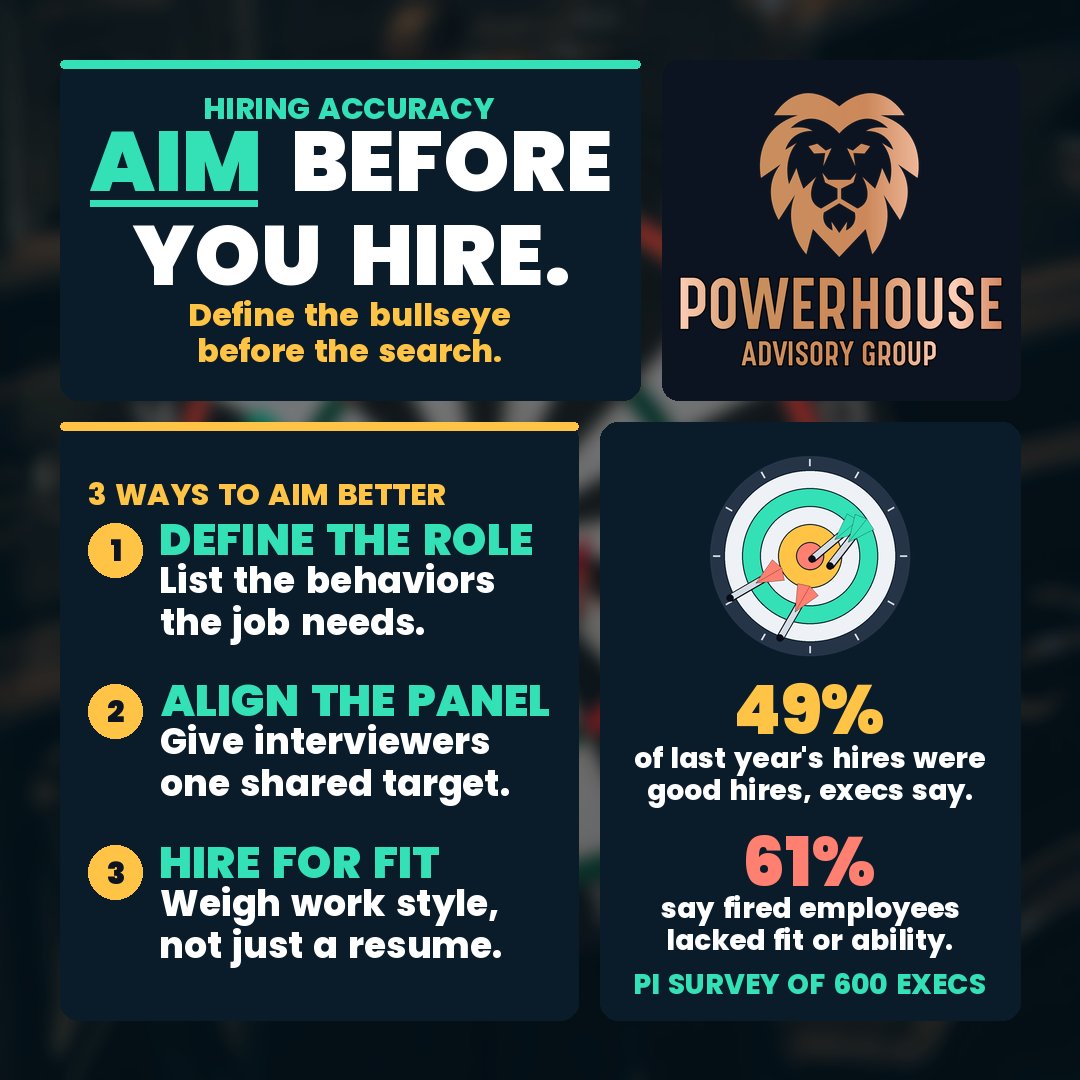
Aim before you hire.
When PI surveyed 600 executives across 20 industries, they estimated that only 49% of the people they hired the previous year turned out to be good hires. That's close to a coin toss on a decision that shapes a team for years.
The misses usually trace back to the target, not the talent pool. In the same PI research, 61% of execs said employees let go for performance reasons were missing the behavioral fit or cognitive ability the job required. In other words, the person was never a match for what the role actually demanded.
Three ways to tighten your aim before the next opening:
Define the role. Before anyone writes a posting, spell out how the work gets done: pace, detail, independence, how much influencing it takes.
Align the panel. If four interviewers carry four different pictures of success, every candidate is being scored against a moving target. Settle on one profile first.
Hire for fit. Experience shows up on paper. How someone will handle this exact job on a rough Tuesday mostly doesn't, so measure it on purpose.
Powerhouse Advisory Group helps leaders set a clear hiring target and find people who fit it.
What's the one trait you wish you'd screened for on your last hire?
#TalentOptimization #Hiring #JobFit #HiringManagers #TalentStrategy
Link in bio.
21
Keep the tank full.
Most people don't start a new job planning to coast. PI's 2026 Motivation at Work survey of 1,000 U.S. employees found 78% started their current role motivated.
The drop-off comes later. Only 16% say their work always feels meaningful, and another 12% rarely or never feel it. For most, meaning shows up in bursts: a project lands, a manager notices, and then the grind takes over again. As PI puts it, occasional meaning produces occasional motivation.
Managers can make the refills routine instead of accidental:
Show the impact. Close the loop on finished work. Tell people who used it, what changed, and why it mattered.
Name the why. Before handing off a task, connect it to a goal the team actually cares about. Busywork without a reason drains people fast.
Know their fuel. What energizes one person can wear out the next. Ask each person what keeps them going, then lead them that way.
Powerhouse Advisory Group helps leaders hire, develop, and keep people who stay engaged long after day one.
What's one thing a manager did that made your work feel like it mattered?
#TalentOptimization #EmployeeEngagement #Motivation #EmployeeRetention #LeadershipDevelopment
Link in bio.

18