

The largest newspaper in China
Beijing, China
Joined May 2011
- Tweets15K
- Following3.8K
- Followers6.4M
- Likes1.1K





Xi sends message to 2026 Global Governance Forum (Xiongan)
Chinese President Xi Jinping sent a message to the 2026 Global Governance Forum (Xiongan) on Friday.
The world is undergoing accelerated transformation unseen in a century, and the deficits in peace, development, security and governance are growing rather than diminishing, Xi said.
"I have put forward the Global Governance Initiative (GGI) to promote the building of a more just and equitable global governance system and a better world," he said.
China stands ready to work with all parties to uphold the vision of global governance featuring extensive consultation, joint contribution and shared benefits, pool strength through confidence-building and tackle challenges through cooperation, Xi said.
He called for efforts to promote the implementation of the GGI to inject more certainty and positive energy into a world of turbulence and transformation, and jointly move toward a community with a shared future for humanity.
The forum opened on the same day in Xiongan New Area, north China's Hebei Province. Hosted by the Chinese People's Institute of Foreign Affairs, it is themed "Rebuilding Confidence and Cooperation: Reforming and Improving Global Governance in a Transforming World."

China on Friday successfully sent the Yaogan-50 03 satellite into its planned orbit via a modified Long March-6 carrier rocket from the Taiyuan Satellite Launch Center in north China's Shanxi Province.

Through the eyes of international friends: What Long March means today
This year marks the 90th anniversary of the victory of the Long March. At an international friends' salon commemorating the 90th anniversary of the victory of the Long March held in Beijing on Sept.3, international friends shared their reflections on the Long March and its enduring spirit. #LongMarch90
What’s in your China haul?
From Chinese tea and silk pajamas to jade jewelry and the latest tech, what are international visitors buying—or hoping to buy—in China? We hit the streets to find out. What would you make room for in your suitcase?
China's domestically built super-large-diameter slurry shield machine rolled off the production line on Thursday in Hangzhou, east China's Zhejiang Province, marking a breakthrough in the development of the country's super-large-diameter slurry shield equipment.
With an excavation diameter of 16.68 meters and a total length of about 125 meters, the machine will soon be deployed to a transportation project in Hefei, east China's Anhui Province.


Frost's Descent, or Shuangjiang in Chinese, is the 18th of the 24 traditional Chinese solar terms, the last term of autumn, arriving this year on Friday, October 23. This period heralds a sharp temperature drop and the season's first frost, signaling autumn's gentle fade into winter.


China has built the world's largest and most complete clean energy industrial chain, with green and low-carbon industries becoming an important engine of economic growth, according to a vice minister of ecology and environment on Wednesday:
- By the first half of 2026, the country's total installed renewable energy capacity reached 2.46 billion kW, accounting for 60.7% of total national power generation capacity. At the end of July, installed solar power capacity surpassed coal power for the first time in history, making it the country's largest single power source.
- The country's combined installed capacity of operational and approved nuclear power units has risen to first place in the world.
- New energy vehicle production and sales have ranked first globally for 11 consecutive years.


At the invitation of Chinese President Xi Jinping, German President Frank-Walter Steinmeier will pay a state visit to China from Oct. 27 to 31, a Chinese foreign ministry spokesperson announced on Friday. (file pic)

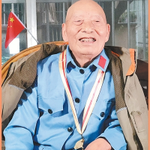
106-year-old Red Army veteran recalls the Long March #LongMarch90
My name is Zhao Maolin. I was born in April 1920 in Daxian county, southwest China's Sichuan Province, now part of Dachuan district in Dazhou. I'm 106 years old.
My parents died when I was young. In 1934, at just 14, I joined the Red Army. The following year, I set out on the Long March.
I served as a medic. Over the years, I have traveled many roads, but nothing compares with the hardships of crossing snow-capped mountains and vast marshlands.
Jiajin Mountain, for example, was notoriously difficult to cross. Beneath the snow lay hidden sheets of ice, making the mountain paths very slippery. Every step took enormous effort, and one wrong move could send a person tumbling down the slope.
I was small and had short legs, so climbing was especially difficult. The higher we went, the thinner the air became, and my body shook uncontrollably from the cold and exhaustion.
The weather in the mountains could change in an instant. Howling winds whipped snow and ice into our faces. When the wind died down, sunlight reflecting off the snow was so intense that it hurt our eyes. Our thin, coarse-cloth uniforms offered little protection against the bitter cold. Snow settled on our clothes and melted, only to freeze again, leaving the fabric stiff as a shell of ice.
Along the way, fallen comrades lay beneath the snow, their outlines still visible. But we could not stop. Anyone who sat down risked never getting back up.
Beyond the mountains lay the marshlands, another deadly obstacle. Beneath the grassy surface were pools of dark, stagnant water. In some places, the water reached our knees. In others, it was deep enough to swallow a person whole. We had to move cautiously, following the footprints of those ahead and stepping only on patches of tangled grass roots.
Many comrades never made it out alive.
Our food supplies soon ran out. When we stopped to camp, we searched for grass roots and wild greens, boiling them into a soup to stave off hunger.
One veteran soldier handed me half a handful of highland barley. As a medic, I could not bring myself to eat the barley. Instead, I boiled it into thin porridge and shared it with wounded and sick comrades, giving each person just a small mouthful.
After surviving the snow-capped mountains and marshlands and coming through so many life-and-death ordeals, the hardships that lay ahead no longer seemed insurmountable.
In 1942, I joined the Communist Party of China (CPC). After the founding of the People's Republic of China in 1949, I transferred to a civilian post in south China's Guangxi Zhuang Autonomous Region and retired in 1981.
Retirement hasn't dulled the resolve the Long March gave me, not for a moment. In idle hours, I often think of the comrades who remain in the snowy mountains and marshlands, and of that journey where survival was never certain.

Sixteen people were killed and 76 others injured after a 7.0-magnitude earthquake struck Baqen County of Nagqu City in southwest China's Xizang Autonomous Region at 10:33 p.m. Thursday, local authorities said on Friday.

Sixteen people were killed and 46 others were injured after a 7.0-magnitude earthquake struck Baqen County of Nagqu City in southwest China's Xizang Autonomous Region on Thursday, according to the city's emergency management bureau.
The damage caused by the quake is being further evaluated, and disaster relief work is underway.
More than 700 personnel have been dispatched for the relief work.


The first "Land Aircraft Carrier" flying car intended for use in the UAE's advanced low-altitude aviation regulatory demonstration zone rolled off the mass-production line in Guangzhou, south China’s Guangdong Province on Tuesday, marking a step forward in China-UAE cooperation on next-generation transportation.


China has allocated 50 million yuan (about $7.5 million) in emergency disaster relief funds and earmarked another 30 million yuan for recovery efforts following a 7.0-magnitude earthquake in southwest China's Xizang Autonomous Region.

Following a 7.0-magnitude earthquake that struck Baqen County in Nagqu City, southwest China's Xizang Autonomous Region, late Thursday, rescue and relief teams were swiftly deployed to affected areas, working through the night to carry out emergency response and relief operations.
The Political Bureau of the Communist Party of China (CPC) Central Committee held a meeting on Friday to review a report on the seventh round of disciplinary inspection launched by the 20th CPC Central Committee.
Xi Jinping, general secretary of the CPC Central Committee, chaired the meeting.

My father Ma Haide: From American doctor to Red Army medic
In 1936, American physician George Hatem went to northern Shaanxi to treat the Red Army, adopting the Chinese name Ma Haide. Hatem marched at night across frozen rivers and saw the Long March reach its end. He dedicated his life to serving China. Watch his son, Zhou Youma, share the story.
Autumn paints the Baiyun Mountain in Luoyang, central China’s Henan Province, in a stunning palette of vibrant colors, creating a breathtaking seasonal wonderland.
China's Long March legacy endures from trek to tech
One of the most visible legacies of the Red Army's Long March, a roughly 12,500-km military odyssey that ended 90 years ago, may well be an active rocket family that bears the same name.
Among the world's busiest launch vehicles, China's Long March rockets have for more than half a century carried satellites, crewed spacecraft and scientific probes into orbit and beyond, helping open the country's path to space.
The journey behind these Chinese rockets echoes that of the Red Army: both were marked by immense hardships, determined perseverance, and the resolve to press ahead against the odds.
Read full: en.people.cn/n3/2026/1022/c9…


Chinese President Xi Jinping has ordered all-out search and rescue efforts for the missing and prompt medical treatment for the injured after a 7.0-magnitude earthquake struck a county in southwest China's Xizang Autonomous Region on Thursday night.
Xi, also general secretary of the Communist Party of China Central Committee and chairman of the Central Military Commission, made the remarks in an important instruction, calling for every effort to minimize casualties.


