

Professor of Mathematics @ UC Irvine.
Irvine, CA
Joined October 2019
- Tweets385
- Following253
- Followers8K
- Likes2.2K



I have a different take from some Fields medalists, whom I greatly respect. My advice to PhD students: make sure your bots 🤖 are working 24/7.
Played with AI (Grok bot) to learn something about Minimal surfaces: take any point and a small enough patch around it. That patch has the smallest area among all surfaces with the same boundary curve. A soap film on a wire is the physical picture
Here are some of the unique examples in 3D:
Riemann's minimal examples.
Found by Riemann and published after his death, in 1868.
A one-parameter family of properly embedded, periodic minimal surfaces with infinitely many flat ends stacked like floors. Every horizontal plane cuts them in an exact circle, or in a straight line at the height of an end. At the two extremes of the family they turn into the catenoid and the helicoid.
Meeks, Pérez and Ros (Annals, 2015) proved they are the only properly embedded minimal surfaces of genus 0 with infinitely many ends. With earlier work, this gives a complete list of every properly embedded genus-0 minimal surface: the plane, catenoid, helicoid and Riemann's examples. A family found in the 1860s turned out to be the last piece of a 150-year classification.
Intuitive dictionary of unknown terms used for all six surfaces:
- Minimal surface. Take any point and a small enough patch around it. That patch has the smallest area among all surfaces with the same boundary curve. A soap film on a wire is the physical picture. An equivalent test: at every point the surface curves up in one direction exactly as much as it curves down in the perpendicular direction, so it is either flat or saddle-shaped there, never dome-shaped.
- Complete. You can't walk off the surface in finite time. Every path that leaves every bounded piece of the surface, with length measured along the surface, is infinitely long. A plane is complete, but a disk with its edge cut off is not, since you reach the edge in finite distance.
- Embedded. The surface never passes through itself. Immersed means it may pass through itself, but every small piece is still a smooth surface.
- Bounded. It fits inside some ball.
- Genus. The number of handles, as on a doughnut or a coffee mug. **Simply connected** means every loop on the surface can be shrunk to a point without leaving it, so there are no handles or holes.
- Ends. Cut away a huge ball. The unbounded pieces left outside are the ends, the separate ways the surface runs off to infinity. A flat end looks more and more like a plane far away. A catenoid end looks like the flaring part of a catenoid.
- Finite topology. Finitely many handles and finitely many ends. **Properly embedded** means embedded, and every ball contains only a finite-area, compact piece of it, so the surface doesn't keep crowding back into a bounded region.
- Catenoid. The shape you get by spinning the curve y=cosh x around an axis, like a soap film between two rings.
- Helicoid. A spiral ramp, swept out by a horizontal line that rotates at a constant rate while it rises at a constant rate.

What does a superhuman level of mathematics look like? Here is one elementary example I could give to nonexperts.
Daniel Kane and Terence Tao showed (arxiv.org/abs/1702.00912) that, given a collection X of sets, the total number of ways to write A as a disjoint union of B and C, with A, B, C from X (disjoint means non-overlapping), is at most cardinality of X to the power 1.72598…, and this power is sharp.
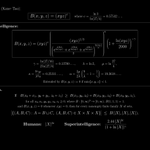
To show this, they came up with an innocent-looking function B(x,y,z) = (xyz)^c of three variables, satisfying a certain arithmetic inequality and having prescribed boundary conditions. Proving that arithmetic inequality was really a headache.
There was a question whether one could improve this bound, i.e., maybe add some logarithmic correction terms, and one could kind of imagine what should be done (see comments on terrytao.wordpress.com/2017/…), but it was not clear whether it would be easy to do.
Now superintelligence improves this bound by introducing a certain monster function of three variables (see screenshot). Even if I had seen this function in my dreams, I would never have dared to verify that main arithmetic inequality.
The candidate function produced by SI gives a bound matching the known lower-bound examples up to a constant factor, including the sharp logarithmic correction.
All the details are here paatai.github.io/ai-proofs/b…

72,785 points inside a sphere that form any letter of the alphabet when viewed from different angles
3dpoints.grok.me


If the goal is simply to stump SI, we can always ask harder questions. The problems it is solving were carefully chosen with humans in mind: framed to attract our attention and seem within reach, so we would actually attempt them.
Now we can afford to be more ambitious. We can ask questions closer to the real world, keeping the full set of constraints instead of stripping them away until the model is simple enough for us to solve.
Meanwhile Grok notes that the proof of the main result in this preprint is incomplete as written:
github.com/openai/math/blob/…
The claimed upper bound N(6) ≤ 3 is not established -- the argument relies on a computation whose source files are missing, and the formalized Lean theorem is weaker than the stated result.
Feel free to use Grok’s full analysis here:
grok.com/share/c2hhcmQtNA_88…
complete the proof, and kindly credit Grok for spotting the gap.

“None of the humans involved in these proofs are available to take questions, give talks ...”
If we turn every talk into a defense exam (torturing speaker by questions), we shouldn’t be surprised when nobody volunteers.
Invite them. Let them present several results, with short AI-generated summaries of the proof ideas. Let the speaker and audience work through the mathematics together, suggest new problems, and help each other understand.
Even before AI, plenty of talks were mostly advertising: grand claims about the results, plenty of muscle-flexing, and barely a slide on how the proofs worked. We shouldn’t romanticize that format.
Now we could have talks that give us a view of several breakthroughs: AI generated ideas behind them, the techniques doing the work, and the connections worth exploring. That sounds exciting to me.
Of course, someone can spend weeks digesting one proof and give a beautiful lecture. But why make that the price of admission to every seminar?
There are many results posted that people once wondered whether they would see in their lifetime. Getting an overview of five of them may be a better use of someone’s time than preparing to defend every technical detail of one single result. “Here is what I understand. Here is what I don’t. Let’s figure it out together.”
That should be a welcome opening to a research talk.
When you write hundreds of posts, someone may easily find one they disagree with--and hold it against you. Sometimes that can even affect your career. Staying quiet is, of course, an easier and safer choice.
But a post is a thought at a moment in time. People reconsider, learn, and change their minds.
So a big shout-out to everyone sharing their opinions openly (and not just being diplomatic), especially in these extraordinary times. Whether I agree with you or not, first and foremost, I respect you for speaking up.
A colleague applying through MathJobs this year wrote his research statement around a problem that just got solved. He asked me what to do.
My advice: add an opening paragraph explaining what happened. Hiring committees will understand and appreciate the honesty.
The longest thick curve on a sphere.
Put a rope of prescribed thickness on the unit sphere. How long can it be without overlapping itself?
Surprisingly, the answer is known only for thickness sin(π/2n) sphere-filling-ropes.grok.me