


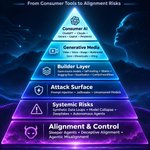



Robots can ace benchmarks and still lose track of objects.
Ai2's RoboTrack adds 307 real manipulation videos and 15M synthetic point tracks. Its point-tracking robot completed 17/20 pipetting trials vs 8/20 using masks.
github.com/allenai/robotrack
#Robotics
1
1
15
I work full-time. And somehow, that’s still not enough work for me. 🚀
A little personal update on what I’ve been building behind the scenes.
Most of you know me for sharing AI news, open-source discoveries, and the latest developments in artificial intelligence.
But I’m not just watching this revolution unfold.
I’m building my own future with it.
My main focus remains my agentic AI project, which some of you already know about.
I’m currently developing with Claude Code while also experimenting with Google’s latest Gemini models through Antigravity.
And I have to say, Gemini has seriously impressed me. The speed at which complex tasks are executed is remarkable.
But there’s something else I’ve never really talked about here.
I’ve been planning a financial application for years.
Not just an idea I came up with last week.
Years of concepts, documented strategies, architecture, feature planning, and countless ideas waiting to become reality.
The ambition is to give everyday retail traders access to tools, market intelligence, and capabilities they’ve never had available to them in this form before.
It’s my side project, but one I’ve been passionate about for a very long time.
And AI is finally making it realistic to bring those ideas to life.
Here’s the part people don’t usually see:
I’m still working a regular full-time job.
Most evenings, weekends, and much of my free time go into building applications, experimenting with models, testing agentic workflows, and figuring out how to turn ambitious ideas into actual products.
My goal isn’t to remain an employee forever.
I want to become independent by building innovative AI products that solve real problems.
And I’m determined to make that happen.
There are still plenty of challenges ahead, and I’m not pretending I’ve figured everything out.
But the progress I’m seeing makes me more excited about the future than ever.
And I have a question for you.
Would you be interested in seeing more of what actually happens behind the scenes?
Not just polished demos, but the real process:
• How I structure and plan complex AI applications
• Which models and coding agents I use
• My strategies for getting better results from AI
• How I approach agent orchestration and development workflows
• The mistakes, breakthroughs, and lessons along the way
• Occasional sneak peeks at the projects I’m building
I’m considering sharing much more of this journey with you.
What would interest you most: my AI development strategies, the agentic system, or a first glimpse of the financial platform?
Because one thing is certain:
I’ve got a lot more planned than what you’ve seen so far.
And this is just the beginning.
#AI #BuildInPublic #CodingAgents
15


🚨 ELON MUSK SAYS WE’VE ALREADY REACHED THE AI SINGULARITY.
If he’s right, the biggest disruption won’t just be smarter AI models.
It could be the collapse of software development costs as we know them.
Here’s why this matters:
Today, AI helps developers write code.
Tomorrow, autonomous agents could design, build, test, deploy, and continuously improve entire products—with minimal human intervention.
Imagine what happens when:
→ One developer can do the work of an entire team.
→ AI agents build and maintain software 24/7.
→ Development cycles shrink from months to days.
→ Anyone can create custom software on demand.
→ AI starts improving the very systems used to build better AI.
This creates a potentially explosive feedback loop:
Better AI → Faster Coding → Better AI Tools → Even Faster Innovation.
And here’s the economic question nobody should ignore:
Why pay $100/month for software that an AI agent could eventually build specifically for you?
Traditional SaaS business models could face enormous pressure.
The next trillion-dollar opportunity might not be another AI chatbot.
It could be the infrastructure that allows autonomous agents to build, operate, and improve software for everyone.
But there’s an important distinction:
Musk’s statement is a prediction about technological acceleration—not scientific proof that a self-improving intelligence explosion has already occurred.
Are we witnessing the beginning of the end of software as we know it?
Source: Elon Musk on X, November 19, 2026
#AISingularity #CodingAgents nitter.gq/elonmusk/status/212329…
🤖 Made with AI


47
AI coding agents can build apps fast. But who checks their work?
This Claude Code harness scaffolds Next.js, Expo and Supabase apps, with hooks that send agents back to fix failed checks.
github.com/cogvera-labs/next…
#CodingAgents

1
43
🚨 THIS IS WHY YOU’RE F*CKED. AND MILLIONS OF PEOPLE ARE NOT READY FOR IT.
For decades, society has sold us a convenient illusion:
Spend years at university. Collect degrees. Add prestigious institutions to your résumé. And somehow, that makes you more intelligent, more competent, and more qualified to lead than someone who actually knows how to get things done.
AI is about to expose just how absurd that hierarchy has become.
Palantir CEO Alex Karp delivered a brutal warning:
“If you’re the kind of person who would’ve gone to Yale, classically high IQ, and you have generalized knowledge but it’s not specific, you’re effed.”
And I believe he’s pointing at something much bigger than the future of education.
We’re witnessing the collapse of credential-based superiority.
For generations, our education system has rewarded the ability to memorize information, reproduce it during exams, and repeat that process until someone hands you a piece of paper declaring you qualified.
We built an entire hierarchy around the ability to store and recall information.
And now we’ve created artificial intelligence capable of accessing and processing more knowledge than any individual human could ever memorize.
We spent decades rewarding memorization, only to outsource much of that intellectual work to machines.
The uncomfortable question is: What happens when the knowledge you spent years memorizing is available to everyone in seconds?
If your greatest professional achievement is remembering information that AI can retrieve instantly, what exactly is your competitive advantage?
A degree is evidence that you completed an academic program. It is NOT proof that you can solve complex problems, make intelligent decisions, manage people, or create economic value.
Yet for decades, companies have promoted people into leadership positions based on academic credentials while overlooking experienced professionals who actually understand the industries they’re supposed to manage.
People who have never repaired a machine, managed a production crisis, built a product, or solved a real operational problem somehow end up supervising those who have spent decades mastering these skills.
Why? Because they had the right piece of paper.
That era deserves to end.
AI is making generalized knowledge increasingly accessible. Information that once required years of academic study can now be retrieved, analyzed, and applied in seconds.
But knowing something theoretically and understanding how it works in reality are two fundamentally different things.
You cannot download decades of practical judgment, accountability, intuition, and experience simply by asking a chatbot.
And here’s the uncomfortable part:
Those who spent years collecting qualifications while avoiding genuine competence may discover that their biggest competitive advantage was never intelligence.
It was an institutional system that rewarded credentials over capability.
I believe practical intelligence, genuine expertise, and demonstrated results will have far greater staying power than academic prestige alone.
This doesn’t mean education is worthless. Doctors, engineers, scientists, and countless other professionals need rigorous academic foundations.
But education should establish competence, not manufacture superiority.
The future shouldn’t belong to whoever spent the longest time in a classroom.
It should belong to whoever can actually deliver.
The real shock won’t be that AI challenges university graduates.
It will be watching people who once considered themselves intellectually superior discover that their degrees no longer automatically place them above the skilled workers they used to look down on.
A diploma is not intelligence.
A title is not leadership.
And academic prestige is not a substitute for competence.
The age of unqualified managers hiding behind impressive degrees needs to end.
🎥 Original interview with Alex Karp:
youtu.be/bqd6dKb8ADI?is=xBti…

Open source is free to use. But who actually pays for it?
OpenClaw just revealed the human cost behind its AI assistant:
• 3,606 contributors
• ~120,000 estimated hours of work
• 83,000 forks
• 279 releases
That’s nearly 58 years of full-time human labor, according to the project’s estimates.
And here’s the bigger question:
If thousands of developers are willing to contribute their expertise to build an AI assistant that anyone can own, what does that mean for the future of subscription-based AI?
OpenClaw runs on users’ own devices, connects to messaging platforms and supports interchangeable AI models.
Its vision goes beyond making AI accessible.
It’s about who controls your AI, your personal context, your memories and your digital identity.
The foundation argues that these shouldn’t become assets locked inside a corporation’s ecosystem.
But there’s another side to this story.
Open-source development still needs funding, maintainers, infrastructure and long-term security support. And running an open-source assistant doesn’t automatically eliminate model API or hosting costs.
The software may be free to obtain. Building and operating it never comes without costs.
**Perhaps the most important competition in AI won’t just be between models.
It will be between ecosystems that own the user relationship and ecosystems that give ownership back to users.**
Source:
openclaw.ai/blog/openclaw-is…
GitHub:
github.com/openclaw/openclaw
#OpenSource #AI

69
✍🏻What if the next AI breakthrough isn’t about building bigger models—but making smaller ones dramatically smarter and more efficient?
Two developments from Hugging Face point toward a potentially important shift in AI engineering.
1. Reinforcement Learning is changing how coding agents operate.
Researchers introduced Harness Adapters: LoRA adapters trained with reinforcement learning to optimize how models interact with coding-agent environments.
Their reported results are striking:
• Terminal-Bench 2.1: 39% → 55% (+16 percentage points)
• Average tokens per task: 2,900 → 1,500 (−48%)
• Tested across Pi, OpenCode and Hermes Agent.
The implication?
Instead of relying exclusively on larger foundation models, developers could train existing models to use tools, navigate environments and execute workflows more efficiently.
2. Inkling 2 Mini explores a different path to AI efficiency.
The new multimodal Mixture-of-Experts model introduces an unusual architecture:
• 26B total parameters
• Only 3B active parameters
• Up to 1M context tokens
• Reuses transformer layers through multiple computational passes
• Supports local deployment through tools including llama.cpp and MLX
Its architecture aims to deliver more useful computation without activating every parameter for every token.
Now connect the dots.
One approach optimizes how an AI model operates inside an agent harness.
The other explores how efficiently the underlying model performs its computations.
Combine these directions, and a compelling possibility emerges:
→ Smaller models specialized for specific agent workflows.
→ Fewer wasted tokens and tool calls.
→ Lower inference costs per successfully completed task.
→ More capable local and self-hosted AI agents.
→ Less dependence on simply scaling model size.
These are early research results, not proof that the combination already delivers those gains. Independent validation and real-world deployment benchmarks are still needed.
But the direction is fascinating.
The next competitive advantage in AI might not be who has the biggest model. It might be who gets the most intelligence out of every token, parameter and watt.
Sources:
huggingface.co/blog/harness-…
huggingface.co/blog/inkling2…
#AI #OpenSource #CodingAgents

75
🚨 GPT-6.2 Sol reportedly catches nearly 2x as many real code-review issues as GPT-6.1 Sol.
Astra also uses fewer tokens for agentic coding tasks. Both are now in GitHub Copilot. Independent validation is still needed.
github.blog/changelog/2026-1…
#CodingAgents

1
1
73
🚨 One repo. Multiple coding agents. Less chaos.
Kagan gives Claude Code, Codex and other terminal agents isolated Git worktrees, separate threads and change review in one desktop app. An early open-source alternative.
github.com/kagan-sh/kagan
#CodingAgents #OpenSource

1
62
🚨 Your coding agent stack can now be configured per team.
GitHub Copilot lets maintainers set default plugins across CLI, VS Code and its app—without forcing everyone to install them manually. Policies still win.
github.blog/changelog/2026-1…
#CodingAgents

27
🚨 Google just made the AI race a lot more uncomfortable for OpenAI and Anthropic.
Gemini 4 Neon is here.
And the most interesting part isn’t that Google launched another frontier AI model.
It’s how much intelligence developers can now access for the price.
Google is positioning Neon between its powerful Carbon model and its faster Hydrogen model.
The goal? Frontier-level reasoning without the cost and latency traditionally associated with flagship models.
Here’s what Google just announced:
⚡ $3 per million input tokens
⚡ $15 per million output tokens
⚡ 1 million-token context window
⚡ $0.15 per million cached input tokens
⚡ Four configurable reasoning levels
But the benchmarks are where things get interesting.
Gemini 4 Neon reportedly achieves:
• 61 on the Artificial Analysis Intelligence Index — #3 overall at xhigh reasoning.
• 70.9% on the Vals Index — #2.
• 65.2% on Terminal-Bench 4.1.
• 46.2% on FrontierCode 2.0.
• 75.8% on Agents’ Last Exam.
• 95.2% on GraphWalks with 256K–1M context.
These are Google’s published comparisons, including results from external benchmark providers. They don’t establish that Neon wins every workload.
In fact, Claude Opus 5.5 remains slightly ahead on Terminal-Bench 4.1 and FrontierCode 2.0.
But here’s where the competition gets interesting.
Google claims Neon delivers a 32% lower cost per task than Carbon at its default high reasoning level.
And that’s a much bigger deal than a few extra benchmark points.
Because for developers building autonomous agents, the important metric isn’t just intelligence.
It’s:
→ How reliably does the agent complete the task?
→ How many tokens does it consume?
→ How much human intervention is required?
→ How much does a successful workflow actually cost?
And Google is attacking all four.
Neon is designed for complex software engineering, multi-file debugging, long-context analysis, scientific research and agentic workflows.
In Google Antigravity, Neon can also orchestrate parallel Hydrogen subagents.
That means a more capable model can supervise complex work while faster models handle execution.
Think about the implications:
One model plans the architecture.
Other agents implement individual components.
Tests run in parallel.
Failures get investigated.
The supervising model coordinates the next steps.
This is where AI development is heading: not just smarter models, but smarter systems of models.
And the economics could become brutal.
If one provider can deliver comparable results with fewer tokens, lower latency and less supervision, competitors will face pressure to improve efficiency or reduce prices.
Of course, benchmarks aren’t production guarantees.
Real-world reliability, long-running agent performance and actual cost per completed task still need independent testing.
But the direction is becoming increasingly clear.
The next AI winner might not be the company with the smartest single model.
It might be the company that makes autonomous intelligence the cheapest to deploy at scale.
Google just made that competition more interesting.
Official source:
blog.google/innovation-and-a…
#Gemini #AIAgents

100
🚨 X’s algorithm is changing. And AI is deciding who gets seen.
Most creators still think reach is about likes, reposts and followers.
But X’s recommendation system uses AI-powered ranking to predict how individual users will interact with content.
Its transformer-based architecture analyzes behavioral signals and estimates engagement probabilities.
The simplified formula:
Score = Σ (wᵢ × P(user actionᵢ))
Each predicted action receives a different weight.
Recent code comparisons suggest:
📈 Likes: +32% weighting
📈 Dwell time: +50%
📉 Video opens: −71%
⚠️ Negative feedback reduces visibility.
These are changes in ranking weights, not guaranteed changes in reach.
Here’s where AI changes everything:
Instead of applying the same rules to everyone, X’s models predict which posts each individual user is most likely to engage with.
Two users can see completely different rankings of the same content.
And as the system learns from behavioral data, optimizing for yesterday’s engagement patterns may become less effective.
The controversial part?
AI doesn’t inherently distinguish valuable information from addictive content.
It optimizes the behavioral objectives defined by its training and ranking system.
That creates a fundamental question:
Are we building an AI-powered information network — or the world’s most sophisticated attention machine?
And for creators, the real challenge may no longer be getting people to click.
It’s creating content that makes them stay, engage and share.
Official source:
github.com/xai-org/x-algorit…
#XAlgorithm #AI

15
🚨 Claude Fable 5.5 could be closer than we think — and its impact could go far beyond benchmarks.
Rumors suggest Anthropic’s next Fable-class model may already be undergoing partner testing.
A mysterious model called Silicon 2 reportedly appeared inside Devin Build, fueling speculation about an upcoming release.
But the bigger story isn’t the rumored launch date.
It’s what the next generation of AI models could mean for software development, 3D creation, and autonomous agents.
Here’s what we know. 🧵
1. The Silicon 2 mystery
Reports suggest Silicon 2 appeared with pricing of $10 per million input tokens and $50 per million output tokens.
Those figures resemble older Fable pricing, leading to speculation that Silicon 2 could be Fable 5.5.
However, Anthropic hasn’t confirmed the model’s identity, pricing, or release date.
2. What improvements are rumored?
Early speculation points toward:
• Stronger 3D modeling and scene generation.
• More precise SVG generation.
• Better web development and UI creation.
These capabilities could allow developers to generate interactive environments, editable graphics, and functional interfaces directly from natural language.
But no independent benchmarks currently verify these improvements.
3. Why this matters for coding agents
Today’s coding agents can already inspect repositories, modify code, execute commands, and run tests.
A stronger model could improve:
→ Architectural decisions.
→ Multi-file refactoring.
→ Debugging and error recovery.
→ Frontend development.
→ Visual validation.
→ Complex development workflows.
Combined with MCP and Claude Code’s experimental Code Mode, improved reasoning could make multi-step workflows more practical.
However, stronger models don’t automatically guarantee autonomous execution.
Tool orchestration, permissions, context management, and testing remain essential.
4. The real productivity opportunity
Imagine delegating an entire feature:
→ Analyze the application.
→ Design the implementation.
→ Generate code and interfaces.
→ Execute tests.
→ Identify and fix failures.
→ Deliver verified results.
Instead of repeatedly supervising individual steps, developers could focus on requirements and outcomes.
The breakthrough wouldn’t just be faster coding. It would be fewer human interventions.
5. Why the AI competition is changing
Frontier AI companies increasingly compete on their ability to complete real work.
The metrics that matter:
• Cost per completed task.
• Reliability across long workflows.
• Execution speed.
• Tool compatibility.
• Context efficiency.
• Required human supervision.
A model scoring higher on benchmarks isn’t necessarily more productive.
A model completing complex tasks with fewer corrections could be.
6. Is Fable 5.5 launching this week?
There’s no confirmed release date.
Silicon 2’s identity remains unverified, and claims about partner testing or major performance gains are still speculative.
The rumored connection to Anthropic’s IPO is also unconfirmed.
My perspective:
If Fable 5.5 delivers meaningful improvements in coding reliability, visual generation, and agent workflows, it could change how developers build applications.
But the real test won’t be another impressive benchmark.
It will be how much work AI agents can reliably complete without constant supervision.
The next breakthrough may not be AI generating more code — but requiring less human attention to deliver finished software.
That’s what I’ll be watching.
Sources:
Anthropic model information:
anthropic.com/claude/fable
Anthropic announcements:
anthropic.com/news/models
Silicon 2 leak analysis:
orcarouter.ai/blog/silicon-2…
#Anthropic #Claude #CodingAgents

162
🚨 Claude Code just introduced something that could fundamentally change how AI agents use MCP.
And the biggest innovation isn’t a new model.
It’s Code Mode.
Anthropic’s experimental feature lets Claude write JavaScript to orchestrate multiple tool calls within a single execution.
This could reshape AI agents, MCP infrastructure, context efficiency, and developer workflows.
Here’s why. 🧵
1. The problem with traditional tool calling
Most AI agents follow repeated cycles:
→ Select a tool.
→ Execute it.
→ Return the result.
→ Interpret the output.
→ Select another tool.
Complex workflows involving repositories, databases, and testing require multiple interactions.
Intermediate results consume valuable context.
2. Code Mode changes execution.
Claude can generate JavaScript to:
• Chain tool calls.
• Execute operations in parallel.
• Pass results between tools.
• Filter large outputs.
• Return relevant information.
Claude doesn’t need to interpret every intermediate result before continuing.
This creates a programmable orchestration layer.
3. What does this mean for MCP?
MCP standardizes connections between AI applications and external tools.
Code Mode doesn’t replace MCP.
It changes how Claude coordinates those tools.
Imagine an agent connected to GitHub, a database, and an issue tracker.
A single workflow could:
→ Retrieve an issue.
→ Identify relevant files.
→ Query related data.
→ Filter results.
→ Return a summary.
Potentially with fewer model interactions.
MCP defines tool connectivity. Code Mode improves orchestration.
4. Why this matters for tokens
Agent workflows consume context through large tool responses and intermediate outputs.
Code Mode processes intermediate data inside its execution environment, returning only relevant results.
This could reduce context overhead.
However, Anthropic hasn’t published general benchmarks proving specific token savings for Claude Code’s Code Mode.
5. Background execution
Supported operations can run in the background for up to two hours while Claude continues responding.
Developers can interact with their agent during builds, tests, or analysis.
6. Limitations and security
Code Mode is experimental, disabled by default, and requires a supported Claude Code version, model, and interactive terminal.
Permissions still apply, but auto mode reviews generated code rather than individually approving every tool call.
Sandboxing and trusted tool access remain essential.
7. The bigger picture
MCP isn’t becoming obsolete.
As agents access more tools, orchestration becomes increasingly important.
Future agent infrastructure could combine:
• MCP connectivity.
• Programmatic orchestration.
• Selective context retrieval.
• Parallel execution.
• Strong security controls.
My prediction:
The competitive advantage will shift from how many tools an agent can access to how efficiently and securely it coordinates them.
Are we moving from agents that reason through individual tool calls to agents that execute entire workflows?
That could fundamentally change agentic software.
Official sources:
code.claude.com/docs/en/code…
anthropic.com/research/advan…
#ClaudeCode #MCP #AIAgents


Check out Code Mode, a new, experimental way for Claude Code to work with tools. Claude writes scripts that chain your tools together in sophisticated ways, and it can answer you while long commands are still running.
Opt in with CLAUDE_CODE_EXPERIMENTAL_CODE_MODE=1 code.claude.com/docs/en/code…
5
1
166
8/ My perspective: This could fundamentally change how I work with Claude Code.
Right now, working with coding agents often means constantly managing the process.
I describe a task, the agent executes several steps, encounters an issue, and comes back for further direction.
But what if I could delegate entire workflows instead of individual operations?
Imagine asking Claude Code to:
→ Analyze my application architecture.
→ Identify bugs and dependencies.
→ Retrieve documentation through MCP.
→ Implement improvements.
→ Run tests and analyze failures.
→ Return with verified results.
All while I continue working on something else.
That’s the direction I find exciting.
Code Mode isn’t full autonomy. It doesn’t eliminate permissions, supervision, or the need to verify results.
But programmatic tool orchestration and background execution could reduce the amount of manual coordination required.
For someone building complex software with AI agents, that matters enormously.
I don’t want to spend my time managing every tool call.
I want to define objectives, review decisions, and evaluate outcomes.
The real productivity breakthrough might not be AI writing code faster.
It might be AI requiring less of my attention to complete a well-defined task.
And that’s the shift I’m most interested in.
#ClaudeCode #AIAgents
19
🚨 Microsoft's agent-framework PyPI releases 1.26.1/1.26.2 contained a credential stealer.
A .pth hook runs on Python startup—even without importing it. Both pulled. Check installs, rotate exposed secrets; pin 1.26.0.
github.com/microsoft/agent-f…
#AISecurity


🚨AI just found 35 security vulnerabilities in Apple devices. And that’s not even the most alarming part.
Researchers working with OpenAI and cybersecurity firm Calif used GPT-6 Cyber to uncover approximately 35 vulnerabilities across Apple’s ecosystem.
We’re not just talking about iPhones and Macs.
The findings reportedly extend to iPads, Apple Watches, Apple TVs, and even Vision Pro.
Here’s why this matters:
1. Some vulnerabilities could enable device takeovers.
According to Forbes, certain flaws could potentially allow attackers to compromise an iPhone or Mac through a malicious website.
That doesn’t mean every vulnerability enables remote takeover, but the potential attack surface is significant.
2. AI helped researchers challenge Apple’s Lockdown Mode.
Researchers reportedly developed an exploit capable of bypassing some protections associated with Lockdown Mode, a security feature designed to protect high-risk users against sophisticated attacks.
Importantly, this does not mean Lockdown Mode is completely compromised or ineffective.
3. The speed of vulnerability discovery is changing.
GPT-6 Cyber isn’t simply identifying suspicious code. Researchers are using it to help develop and validate exploits.
In a separate evaluation involving 65 open-source web applications, researchers at XBOW found GPT-6 Cyber could identify and exploit vulnerabilities roughly twice as fast as GPT-6.1 Sol.
But there was a trade-off: the newer model was substantially more expensive per task.
4. This creates a cybersecurity arms race.
The same AI capabilities that help security researchers discover vulnerabilities can potentially accelerate offensive cyber operations.
Defenders could identify and patch weaknesses faster.
Attackers could also discover exploitable flaws faster.
The critical question is whether automated vulnerability remediation can keep pace with automated vulnerability discovery.
5. Human expertise still matters.
Researchers emphasize that AI-generated findings require validation, technical judgment, and responsible disclosure.
AI is accelerating cybersecurity research, not eliminating the need for experienced security professionals.
The bigger picture:
For decades, finding sophisticated software vulnerabilities required considerable expertise, time, and resources.
Frontier AI is beginning to change that equation.
And if AI can dramatically accelerate the discovery of weaknesses in one of the world’s most tightly controlled consumer technology ecosystems, the implications extend far beyond Apple.
We’re entering an era where the speed of cybersecurity may increasingly depend on the speed of AI.
The question isn’t just how powerful these models become.
It’s whether defenders can deploy them faster than attackers.
Source: Forbes, Thomas Brewster, November 17, 2026
forbes.com/sites/thomasbrews…
#AI #Cybersecurity

2
517