

Full-time open-source tool explorer. Part-time memer.
Joined October 2026
- Tweets61
- Following20
- Followers1
- Likes27






Pinned Tweet
Grepping a giant codebase is officially optional 🤯
Graphify turns a repo into a graph your agent queries:
- 138K stars, +6,662 this week
- Parsed locally, no API key
- Claude Code, Cursor, Codex + 20 more
- My test: Flask mapped in 3s
Which repo would you map first?
🧵 1/3
2
4
321


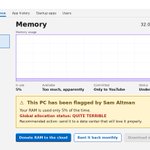
Sam Altman says my RAM is wasted at home, which is why he kindly bought all of it so I don't have to.

19


2/2 Sources:
Mistral announcement: mistral.ai/news/mistral-larg…
Model card (specs): huggingface.co/mistralai/Mis…
Licence: huggingface.co/mistralai/Mis…
TechCrunch: techcrunch.com/2026/10/29/mi…
Follow me for more open-source models.

56
People seriously underestimate tiny-llm.
You don't need a CUDA GPU. You don't need to read vLLM's source. You don't need a paid course.
Build Qwen3 inference from zero: KV cache, batching, paged attention. Which first?
All you need is an M-series Mac and a free repo 🧵 1/2

1
69
2/2 Sources:
Repo (Apache-2.0): github.com/skyzh/tiny-llm
Course book: skyzh.github.io/tiny-llm/
Setup (needs an Apple Silicon Mac): skyzh.github.io/tiny-llm/set…
Found via @techNmak: nitter.gq/techNmak/status/211587…
Follow me for more open-source models.


Someone turned the hardest parts of LLM inference engineering into a course where you have to fix the performance problems yourself.
And you can do it on a Mac.
The project is called tiny-llm, an open-source course for building a miniature vLLM-style inference engine around Qwen3.
It starts with a simple implementation using matrix operations. You build attention, normalization, positional encoding, the Transformer layers, and the loop that generates tokens.
You have a working model.
Now the interesting engineering begins.
During decoding, repeatedly processing the previous tokens wastes computation. So you implement a KV cache and reuse previously computed attention state.
Next, you look at model weights. Keeping everything in dense BF16 consumes memory bandwidth. So you retain packed 4-bit weights and implement specialized matrix operations.
Then you move into Metal kernels, SIMD matrix operations, fused RMSNorm, RoPE, SwiGLU, and tiled prefill attention.
Once the single-request engine works, you tackle a different problem.
What happens when multiple requests arrive, each with different prompt lengths and different amounts of cached state?
You implement continuous batching, chunked prefill, paged KV storage, and attention that reads directly from noncontiguous cache pages.
The four-week curriculum eventually extends into a small coding-agent harness with validated tool calls, checkpoints, context management, and evaluation.
Every stage comes with exercises, reference implementations, tests, and measurements to help you understand the behavior of the system you're building.
The course uses MLX, C++, and Metal on Apple Silicon. You don't need an NVIDIA GPU, and the introductory path supports Qwen3-0.6B on an 8GB Mac.
Some later checkpoints remain under development and review, but there's already a substantial amount of real inference engineering to learn from.
The GitHub repo has crossed 4,800 stars.
GitHub: github.com/skyzh/tiny-llm

41
Binance says about $6.3B was hit by hackers.
How? One employee's work laptop got hacked, and that was enough to get in.
Check your own laptop:
- Saved passwords and login keys
- Extensions and apps you installed but don't trust
- What your AI tools can open on your computer
One hacked laptop can open everything 🧵

1
45
2/2 Sources:
Binance statement: nitter.gq/binance/status/2115993…
Binance announcement: binance.com/en/support/annou…
BBC: bbc.com/news/articles/cwg7xp…
3rd-party script case, Polymarket: bleepingcomputer.com/news/se…

Binance's initial investigation suggests that the security incident may involve a compromised DevOps engineer’s laptop, which allowed an attacker to gain access to a service container and submit unauthorized withdrawal transactions. We have found no evidence of any wallet private key leak. We will share a detailed technical post-mortem once the investigation is complete and the facts are fully verified.
The estimated total impact sits at around $6.3B. We have worked with blockchain partners to freeze affected assets, with ~$3 billion frozen on-chain so far.
Binance will cover all losses from the SAFU fund and the company’s funds. User funds are safe. We will also publish an updated Proof of Reserves once the remediation is complete.
As an immediate precaution, Binance has:
- temporarily suspended deposits and withdrawals while security checks are completed;
- revoked the affected address authorisation;
- engaged law enforcement and blockchain intelligence partners to trace and recover funds.
Our teams are working around the clock to resolve this issue safely and thoroughly. We are working closely with our law enforcement partners to confirm the identity of these criminals and bring them to justice.
Please rely only on official Binance channels for updates. Please feel free to contact Binance Customer Support if you have any further questions.
binance.com/en/support/annou…

31
People seriously underestimate impeccable.
You don't need a designer to critique every screen. You don't need to say "make it pop". You don't need to fix AI-slop layouts by hand.
All you need for polished UI is your coding agent and one design skill.
github.com/pbakaus/impeccabl…

1
47
People seriously underestimate Cloudflare's security-audit-skill.
You don't need a pentest for obvious bugs. You don't need to read every file. You don't need to trust the agent that found it.
All you need is an agent with sub-agents and one free skill.
github.com/cloudflare/securi…

1
54
Stop re-reading your notes. HKU's open-source tutor tests you on them 📚
DeepTutor:
- 48.9K GitHub stars, +2,371 today
- Teaches from your PDFs and slides
- Quizzes you, re-tests what you missed
- Self-hosted, works with Ollama
What subject would you feed it first?
🧵 1/3


1
1
73
2/3 Install in 4 lines (or 1 Docker command): github.com/HKUDS/DeepTutor#-…
Repo: github.com/HKUDS/DeepTutor
Sources: stars api.github.com/repos/HKUDS/D…
+2,371 today: github.com/trending
Misses review: github.com/HKUDS/DeepTutor/b…
Ollama + features: README above

1
1
34
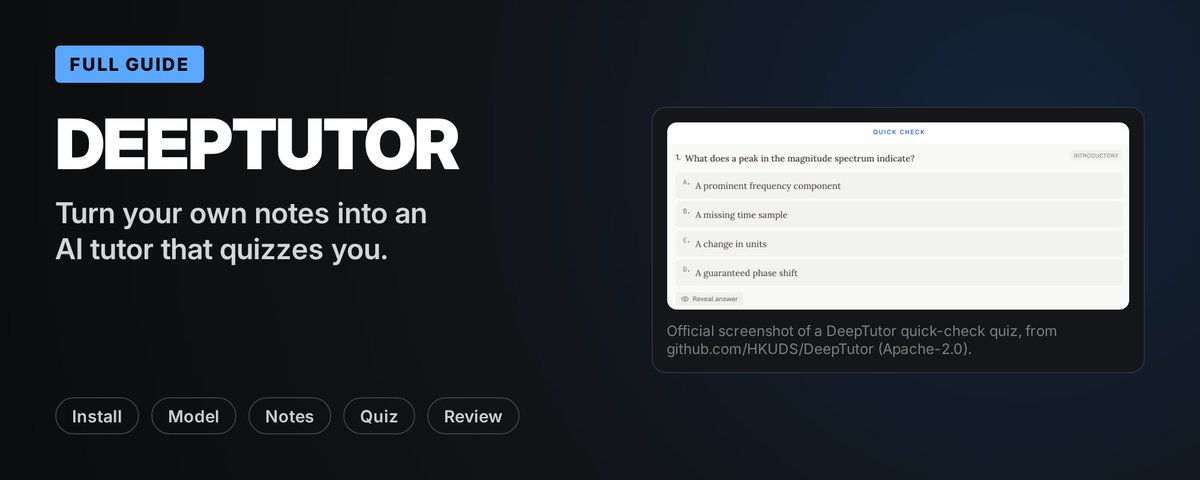
3/3 Full step-by-step guide: install, connect a model (or Ollama), feed it your notes, get quizzed, review your misses, what it can't do 👇
nitter.gq/Parnee0wl/status/21157…
Follow me for more open-source models.

8