
Economist/Strategist - specialized in monetary policy and Capital markets. Works @Allianz. Views are my own. Retweets are not an endorsement!
Vienna
Joined January 2015
- Tweets2.2K
- Following920
- Followers2.4K
- Likes2.2K
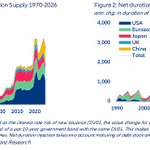


Robert #Pattinson is the new 007, but in #bond markets the real hero is #DV01... Global #duration supply peaked in 2021 and is drying up. #UK, #Japan and #Eurozone add no new duration this year, and only China is expanding. Meanwhile, hedge funds are replacing pension funds and central banks as the main buyers of duration.
The outcome: a desert at the long end of the curve. But beware the duration revival within 2-5 years, once ageing populations and transition spending bring back need for long-dated safe #assets. Check out our analysis: allianz.com/content/dam/onem…

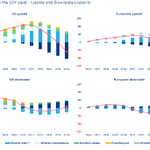
For markets #AI seems is a equity or private debt story, but it will also reshape global interest rates . We see 5 transmission channels: 3 #macro (neutral rate #r*, i#nflation expectations, #fiscal collateral) and 2 micro (AI-driven duration supply and crowding-out). Over next 10 years AI will pull 10y yields down −50bp in the US and Europe, but for different reasons and by different paths. The final result depends on the fiscal. US result need AI productivity materializing to keep its trajectory intact; the eurozone can live without the AI dividend, since its fiscal position doesn't need repairing in the first place.
Read more here: lnkd.in/egBdCcc9

Central Bank independence has in domestic and international dimension.
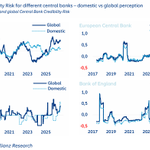
In our newsflow and sentiment analysis of central bank #independence, Americans came out less worried about the #Fed than the rest of the world. That is the reserve #currency at work: the dollar is held globally, so its credibility is judged globally. The #ECB, #BoJ and #BoE face the reverse concern is domestic, and it centres on price stability.
More in our report on how to measure central bank credibility:
lnkd.in/eqVzz4xd

1
4
316
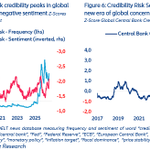
Central bank credibility is becoming a risk rather than a background condition. Against geopolitical tension, polarization, #inflation overshooting and elevated sovereign debt central bank #credibility, long a shock absorber for markets, may start amplifying shocks instead. Our analysis shows the #ECB tops the credibility ranking, the #BoJ carries the highest overall risk, and the #Fed and #BoE each show vulnerabilities. News-based independence concern is at its worst since 2017.
Full report:
lnkd.in/eqVzz4xd

🏳️🌈 Patrick Krizan 🇺🇦 retweeted

Everything you need to know about the global bond market right now:
1. Yields are rising
Long-term yields are elevated across major economies:
🇺🇸 US 30Y: ~5.2%
🇯🇵 Japan 10Y: ~2.9%
🇬🇧 UK 10Y: ~5.0%
🇩🇪 Germany 10Y: ~3.3%
This is happening across markets, not just in the US.
2. Governments need to borrow more
Large fiscal deficits mean more government debt needs to be absorbed by investors.
More supply means governments may have to offer higher yields to attract buyers.
3. Inflation isn't the only issue
Long-term yields reflect three big forces:
- Expected inflation
- Expected future real interest rates
- The term premium
That last one is the extra compensation investors demand for holding long-duration bonds rather than continually rolling over short-term debt.
And it can rise even when markets expect central banks to cut rates.
4. Central banks don't control the whole curve
The Fed, ECB and BoJ control short-term policy rates.
Central banks have the most direct control over short-term rates, while long-term yields are much more heavily influenced by market expectations and investor demand.
That's why long-term yields can rise even when rate-cut expectations increase.
5. This is where it gets important
Higher sovereign yields raise the benchmark cost of capital across the economy.
Mortgages, corporate debt, government interest payments and equity valuations all feel it.
The biggest question now:
How much higher can long-term yields go before they start changing economic behavior?
In our study (with Pierpaolo Fiore) we show that European #sovereign risk premia are sensitive to #political fragility. But what risk to they price? We show that before ECB #QE, redenomination risk (Euro break-up risk) accounted for almost half of the spread sensitivity for Italy and Spain. Today, sensitivity is driven almost entirely by #fiscal risk. Absence of #redenomination suggests the #ECB and EU emergency mechanisms are viewed as credible to prevent exit by market accident. But an intentional exit, whether through a #Eurosceptic populist government or a referendum, remains a tail risk that markets are longer pricing. More: lnkd.in/gVVyEMxZ

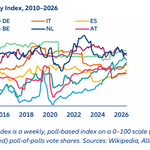
#Political fragility is a key factor for #Europe sovereign bonds but is still assessed a mostly subjective qualitative way. We propose a poll based high-frequency indicator with 4 dimensions: Fragmentation, disaffection, polarization and governability. Europe today is at a peak level of political #fragility and safe havens are eroding. More: The price of political fragility | Allianz

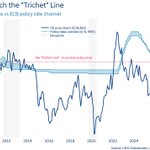
Watch the "Trichet Line" - April 2011 #ECB hiked after an oil price peak when energy prices were already easing turning a supply-driven #inflation shock into #growth policy mistake - starting signal for #Eurocrisis. We face similar pattern today, elevated risk of choking growth, but crisis potential is less since institutional setup is more resilient.

Recent #bond sell-off wasn't only about repricing of expected rates, it was also especially at the long end a repricing of risk (term premium). One forgotten driver of the term premium is the #duration reflux from run-off central bank #QE holdings. since 2022 the #ECB has lifted the 10y term premium by 80bps, the Fed by 35bps. Current #FED purchases are limited to Bills and di not extract duration, the run-off effects persist. For more: lnkd.in/dQKQd2-w

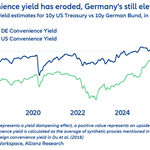
Recent #US #Treasury sell-off was repricing of rate expectations at short end but a term premium (repricing at the long-end. UST becoming more risky. They are still the anchor of global #liquidity but their safety premium is gone. US #convenience yield has eroded while #Germany 's is still substantial, Bunds outperforming recent sell-off. More on transatlantic spread in our report: lnkd.in/dC9vVydZ

1
4
279
10y #US #Treasuries and German #Bund have converged since 2025 by 90bps, the spread between both trades at 140bps only. I expect a reversal when US rate expectations and term premium reprice. There is a 70bps difference explained by neutral rates difference alone. More in our latest report:

4
269
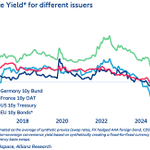
The 10y #transatlantic spread narrowed 90bps since 2025. This narrowing was first due to term premia shock and later mostly a function of converging rate expectations (#Fed with easing bias, #ECB hawkish hold). Are we entering a new regime were #US and #Eurozone yields trade closer-for-longer? We expect a mid-term rewidening as rate expectations and term premia reprice. For more read our latest report: lnkd.in/dQKQd2-w

1
1
220
🏳️🌈 Patrick Krizan 🇺🇦 retweeted

The lesson of the previous energy crisis: Price interventions have to stop ripple effects before they start. This is about buying time for emergency adjustments. European democracies cannot afford another round of falling real wages and war profiteering.
Yours truly @WSJ

Safe asset status of #US #Treasuries is under pressure. USD-Euro Swap spread differential points to #liquidity advantage for #Europe. Widening cross -currency basis (hedging cos for #FX volatility) signals #Eurozone government bonds attracting more demand. Narrowing 10y #BTP –Bund also indicates that Eurozone is emerging as a safe destination for global capital lnkd.in/d4_gbAQ5

Europe has the space to increase #Eurobonds issuance. Global safe assets trade at lower yields due to #convenience yield - a safety and #liquidity premium. But safety and liquidity point in opposite directions: convenience yield dilemma. More debt issuance increases liquidity but decreases safety. There is an optimal spot where max level of issuance meets min level of safety. #US has gone over that point, as have #UK and #Japan - but #Germany and #Eurozone still have a buffer. Eurobonds have a distorted convenience yield, heavily penalized by low liquidity. So, while the US #Treasury has overstretched its liquidity premium, Europe is playing it too safe in terms of Eurobond issuance. lnkd.in/gNR3nTZF

#Eurobonds have been a hot topic in the public debate recently. We have looked into it and clearly see a window of opportunity for more joint issuances. #UST have exhausted their convenience yield while convenience yield of Eurobonds and German #Bunds co-exist as complements, not competitors.

#JGB and Japanese banks are crucial to understand global liquidity and volatility. Japanese banks are major suppliers of #USD through #FX swap market. If constrained in absorption capacity due to increased JGB issuance, this results in export of #volatility to global markets. See the synchrony of negative #JPY ASW and spikes in #VIX! Are we overdue for an #equity volatility shock or is volatility just transferred to other markets (commodities)? lnkd.in/df2e9H8n
