

Ex-banker/ Co-founder of a unicorn fintech. Investor. Advisor
Singapore
Joined June 2013
- Tweets985
- Following240
- Followers216
- Likes1.2K



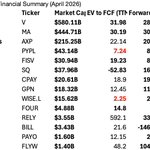
There is plenty being written about FICO: it's down ~27% in one day and almost 70% from its peak. For me, the striking aspect was the huge premium being paid for (you pick the reason): quality of business/ wide moat/ pricing power.
It's easy to show a bull scenario on a spreadsheet, but things can change and paying 70x-100x earnings is sheer madness (at its current price, its still at 17x PE).
It's not that the business was bad, quite the reverse - it was a superb business. But the mistake was assuming that business quality makes valuation irrelevant. It never does.
Price is the moat between a great company and a great investment and never should the two be confused.

Hilarious how the news follows the markets. Till recently, rising yields were an issue with the markets. Now it’s another reason for the markets to go up! Not that I am complaining :)

The 'free mode' on Replit announced with Sam Altman, is nothing but a marketing gimmick.. I tried creating something and my daily limit finished in a few minutes even while it was still working. Next day the limit reset and this time it finished in even lesser time as I had reached my monthly limit! Complete rubbish.
tech.yahoo.com/ai/chatgpt/ar…

The market seems to have largely ignored the large fine imposed on Meta and to an extent, that may be right.
The new $567m penalty brings Meta’s total penalties in the New Mexico case to ~$942m — still only ~0.06% of Meta’s ~$1.5tn market cap.
And that, I think is why the market may be missing the bigger issue because this isn’t a $567m or $942m story. It’s a precedent.
A government has now successfully held Meta financially liable for how its platforms affect minors — and imposed product-level restrictions.
What happens next if other U.S. states, European regulators and governments around the world pursue similar cases?
The risk is a regulatory flood: more lawsuits, more penalties, and eventually restrictions that force Meta to change the engagement machinery underpinning its advertising economics.
The fine is noise, the precedent is the story and that’s one reason why I don’t like Meta as an investment.
I am a Meta critic as is evident from my past tweets. Meta's stock has surged roughly 20% over the past couple of weeks. Much of that excitement appears to be driven by the belief that Meta could become a serious competitor to OpenAI and Anthropic after the release of their Muse Spark 1.1 model.
But I'm not convinced of that logic - simply because if the leaders in frontier AI, who are generating billions in revenue are still losing money by the truckloads, why should Meta fare better—especially if their pricing is at a fraction of competitors' prices?
My current interpretation is different though. I think this might be a relief rally because the investors who were concerned about Meta's AI spend, feel that something will come out of the spend - something more than just promises of advertising productivity.
Think of Meta as spending billions to build roads so customers can come to their malls (ads business). If Meta 'rents' these roads to others, that's simply incremental revenue on an infrastructure that it largely needed to build anyway. I think thats how Meta views it.
Ultimately, though, the success of this investment won't be judged by how much it earns from renting the roads. It will be judged by whether more customers come to the malls—and whether they spend more once they're there. Lets see.
Alex Karp's stirred up a hornet's nest by asking who really benefits when a company's uploads its most valuable data into an AI model.
Enterprises have hitherto moved workloads to the cloud because the trade-off was clear: lower costs, better scalability, and no loss of ownership over their IP.
But with AI, Companies are questioning this approach because even if providers contractually promise not to train on that data, many boards find it difficult to believe them as these providers get more and more into newer domains (accounting/ legal/ customer support and even drug discovery!). Trust is missing, notwithstanding the contractual language.
If that mindset spreads, the implications could be significant. Enterprise AI may increasingly move towards private, sovereign, or dedicated deployments. The value could shift from shared AI services to secure AI infrastructure.
It's difficult to know as of now how far this will impact data center build out, but for sure, the AI providers' business model could severely be stress tested with many moving to open source LLMs on their own hardware. Massively cheaper, even if slightly slower. I don't know if eventually this might lead to slowing down of Capex - one constant complaint of the investors.
But this does highlight how quickly narratives can change in the markets - Palantir stock is itself an example of this. This is one debate worth watching very very closely.
Palantir's Karp bashes OpenAI, Anthropic token model: 'Something has gone completely wrong' cnb.cx/3SVRNAZ

The Buffett era assumed moats were durable by default. We're entering an era where every moat has a political off-switch, a technological bypass, or a cultural expiry date.
SaaS once had a moat. Don't need to explain anything here.
Cola/ FMCG: Ozempic is doing what Pepsi never could — killing the category itself. Same for alcohol companies.
Pharma: This is a patent clock ticking - with Governments questioning the pricing. And AI democratizing drug discovery to a large extent.
Visa/ Mastercard: UPI/RuPay is the clearest proof-of-concept that a government-backed rail can displace them entirely in a large market. Brazil's PIX did the same. The EU has been pushing its own payment initiative. The pattern is clear: every large economy with sufficient political will can build around them.
Airplane engines (Chris Hohn invested in GE aerospace)/ plane manufacturing: wars are now fought with cheap drones more effectively than ever.
Traditional media: never mind :)
Rating companies: their core business is solid. But some other report generation businesses are highly questionable with AI.
Which actually sharpens the real moats list down to two that are genuinely hard to dislodge:
Physical geography lock-in — no government builds a competing port at the mouth of Singapore Harbour
Cultural identity/ luxury — no government mandates an alternative to Hermès
Got to be on our toes out there while investing. Buy-it-forget-it kind of investments are getting super rare.
The way the markets are right now, its like they are saying "if you want me to get restarted, pl. try turning AI off and back on again" 🤣
If you are on the wrong side of the trade for now, the best way is; don't look at it, don't blink and definitely don't make sudden movements.
cnb.cx/4v8lGfW

Google's 2004 IPO is estimated to have created ~900 millionaires.
Facebook's 2012 IPO created ~1,000 millionaires.
If SpaceX (~$1.75T), OpenAI (~$1T) and Anthropic (~$1T) IPOs take place at these valuations, it is estimated that they could collectively create: 10,000–15,000 millionaires. And anything from 35–100 billionaires.
Let that sink in. Companies with $1 billion valuation were called unicorns because they were thought to be rare. Here 3 companies may collectively create 35-100 individual 'unicorns'. Wow.. thats generational wealth and I am so happy for all of them.
The internet had created wealth at scale. The AI era may create it through extraordinarily small teams with extraordinary leverage.
And the story won't end there because at least some (I am assuming reasonably large) part of this wealth will be reharvested back in the investment pool to create more in the AI system.
Last week would have scared a whole bunch. And with the SpaceX IPO this week, followed by the other 2 Trillion dollar ones to follow soon, there is likely trepidation amongst many.
And surely, we have never seen anything to this degree of magnitude, so it is difficult to know what will happen in the immediate future.
The other thing is that winners and losers change over time. But for the right stocks, history suggests that the liquidity-suck effect may be temporary.
Goldman looked at mega-IPOs such as Visa, GM, Alibaba and Meta:
S&P 500: ~(1%) in the month before IPO but ~+5% in the month after the IPOs.
The pattern is often: Cash raising → IPO volatility → capital redeployment.
There will also be pockets of huge wealth creation, that will generate its own trickle effects. Including into investments.
Remember, stock performance eventually mirrors performance of the company behind the stock. Stick to the right ones and don't try to guess how the broader markets will perform. My 2 cents.

A decade ago, detecting early-stage cancer biomarkers required refrigerator-sized lab equipment.
Today, researchers at Westlake University in China claim they've shrunk the technology into a handheld device that can detect lung cancer biomarkers from a single drop of blood with up to 94.9% accuracy. And it will cost $5!
The most important breakthroughs aren't always bigger AI models. I'm far more excited about what AI could enable in #Longevity: wearables that continuously monitor biomarkers and detect disease risk before symptoms appear.
The biggest opportunity may not be treating disease better. It may be preventing it altogether!
That's also why Biotech and Pharma investing feels particularly challenging right now. We're potentially entering a world where AI-driven diagnostics and prevention become just as important as the drugs themselves.
Trust me, there will be huge winners and huge losers. The hard part is that we probably won't know which is which until the future arrives.
sc.mp/n3hsz?utm_source=twitt… via @scmpnews
The reports that Microsoft and Uber have pulled back on Claude Code spending may be more significant than they appear.
Firstly in terms of the so-called concept of token-maxxing, which is probably as important a metric as miles flown for a sales performance or in the older days of the Dot-com bubble: page views.
Secondly, to all those who are implying that Anthropic's revenue may touch USD 1T (trillion with a T) by the next year: keep the champagne on ice for now.
If large customers are already scrutinizing usage and costs, token growth may eventually look less like AWS in the 2010s and more like telecom bandwidth: explosive at first, then increasingly optimized.
What's also interesting is that even at enormous revenue run rates, frontier model companies are not yet demonstrating the kind of operating leverage many investors assume. Read this as saying that they are still not making money at these gargantuan revenues.
So, page views weren't profits and token consumption isn't earnings. For either the makers nor the users.
Not sure yet, but the winners may not be the companies generating the most tokens, but the ones generating the most profit per token. Jury still out there on that.
Investors sitting on the sidelines because they think AI is a bubble, or because IPOs from SpaceX, Anthropic, and OpenAI will cause a liquidity-driven selloff, should remember that market timing is a game very few win.
As the saying goes, there are many who have predicted the last 20 of the past 4 recessions. Ray Dalio/ Michael Burry to name a couple. In fact the so called Doctor Doom (Nouriel Roubini) has strongly rejected the idea of an AI bubble.
Having said that, this does NOT mean buying every AI stock. Plenty are priced for perfection.
But there are a few obvious AI beneficiaries that may not be hugely sexy but are still trading at reasonable valuations. I'd rather own those than wait for a correction that may never arrive.
#MSFT/ #AMZN/ #GOOG/ #NVDA

Subaru (7270.T), a relatively small Japanese car manufacturer (most famous car is Forester) has some amazing financials:
- Revenue of USD 30b
- Operating profit of ~USD 1b
- Cars sold ~900k
- Has a developing defense/ aircraft business
- Dividend yield of 4.7%
- Actively buys back shares
- Cash/ equivalents of USD 6.5b
- Investments of USD 5.7b
It's gone thru a slightly rough 1 year due to the tariffs/ some production issues etc. But solid company.
Now guess what the market in its wisdom values the company: Enterprise Value of just ~USD 1-2b. Thats 1x of its Free Cash Flow (FCF).
And if one employs Buffet's strategy, one could just take a JPY loan at 1% to fund the purchase to negate any FX exposure.
I could buy such companies ALL day.
Brilliant interview. Jeff Bezos is so articulate and non defensive on every question thrown at him. Would love for him to be Presidential candidate at some stage.
Note: Interview with Jeff starts around the 20th minute.

A really important and interesting interview with @JeffBezos and @andrewrsorkin about tax policy, AI, the economy, and space. Unfortunately it is only in audio form.
Bezos argues for eliminating tax on the bottom 50%, making the case that the 3% of tax revenue from this cohort should be made up for by eliminating government waste and fraud. I agree.
He says that instead of vilifying the top 1% who pay 40% of Federal taxes, we should have a real debate about tax policy.
Is making the tax system even more progressive the right answer? Will it generate more revenues or less?
Or should we endeavor to eliminate waste and shrink the size of government in order to eliminate tax on an even greater percentage of Americans?
On AI, he makes a powerful case for more jobs, in fact a labor shortage, due to growth driven by increases in AI-driven productivity.
A must listen.
The interview begins at 18:33.
youtu.be/NSVpd46EfLo?si=2ns1…
Li Lu (who was the only outside fund manager to have handled Charlie Munger's wealth), thru his fund just invested in #TME. Small, 2% position. But super interesting.
Increasing margins/ no debt; high cash on hand/ increasing paid subscribers (~24% vs. ~40% for Spotify, so plenty of room to grow)/ strong China brand on music/ high free cash flow and buys back a ton of own stock. And down ~50% since he bought just a couple of months ago. Wow.


