

Professor of Atmospheric Science. I study climate variability of the tropics, and interactions between the tropics and extratropics. My tweets R my own.
Joined February 2013
- Tweets184K
- Following1.4K
- Followers5.4K
- Likes89.8K





Pinned Tweet
Doubting Einstein's prediction implied doubting his abilities, b/c unless he was flawed, how could he have been wrong?
This does seem to be a moral panic, like the data center nonsense.

A proposed law would criminalize vast swaths of hitherto consensual and legal sexual activity.
This is the fruit of moral panics.
unherd.com/2026/10/a-dangero…

I agree with this.

SpaceX Investor @GerberKawasaki tells me he’s not only “disgusted…from a humanity perspective” by restrictions on Starlink in Ukraine, but also: “…they've given everybody a reason not to use Starlink, that Starlink isn't reliable for national security for anybody but Trump.”


Paul Roundy retweeted

🚨 NEW: For the @WSJ, @Hartz_PhD and I expose the ideological takeover of the American Psychological Association.
The APA is facing the possible loss of its federal accreditation authority following allegations of widespread antisemitism.
But while the APA's antisemitism problem is serious, it's only a symptom of a much deeper ideological rot.
The organization has become so captured by radical left-wing political activism that its commitment to scientific objectivity competence is now in serious doubt.
We examined the program for this year's major APA Division 39 conference, which drew nearly 800 attendees and held 90 panels over four days.
By our count, roughly 70 of the 90 panels were overtly political, and always left-wing. Topics included abolishing the family, queer anarchist psychoanalysis, dismantling gender assessment guidelines, and white supremacy. One session even concluded with a drag show.
There was at least some hope that the threat of losing federal accreditation might prompt some institutional soul-searching. It didn't.
Instead, APA members just elected Candice Hargons as their next president. Her campaign identifies "systemic intersectional oppression" as the profession's "common enemy" and calls for rejecting the traditional scientific notions of objectivity.
Psychologists wield enormous influence over vulnerable patients, and the people seeking treatment deserve the peace of mind knowing that the care they're receiving care is evidence based and not tainted radical politics.
We believe most would agree that federal accreditation should actually mean something. If the APA cannot distinguish its scientific mission from its political activism, the Education Department should reconsider whether it deserves the government's endorsement as an authority over psychological training.
Read our full essay in the Wall Street Journal below:
🔗wsj.com/opinion/the-inmates-…


Astounding that they'd actually look at this. But it's even bigger. All that investment drives the whole economy wealthier.

Economics argument that the proposed California billionaire tax would be net negative for revenue.
As a political economy complement, note that the CA teachers union has decided to recommend voting "no" on the initiative.
nber.org/papers/w35899#fromr…

Paul Roundy retweeted

Another study showing that peers, not professors, shift opinion leftward during university.
Left-leaning professors cater to left-leaning students.
Data shows very few conservative profs, so student priors are reinforced, not challenged.
micah-baum.github.io/files/b…
These disciplines are edging themselves out of relevance as they have been largely taken over by an ideology that values activism over truth, to the point that they argue obvious nonsense. Eventually that would yield a negative impact on the disciplines.
This is unfortunate since we all benefit from better understanding of human behaviors and cultures.

I don't think it would be impossible to create a conscious machine. But human consciousness is more than just a complicated network of neurons. It evolved from natural selection in which our ancestors survived better when they sensed risk to their survival. Emotions developed from the neuron systems coupled to chemical hormones that are key to feeling our place.

Why consciousness needs a body with emotions built from the bottom up by natural selection (not top-down design like computers that lack emotions) neuroscientist Antonio Damasio @damasiousc tells me in our convo based on his new book:
skeptic.com/michael-shermer-…

Even proposing the CA wealth tax led to lost revenue.

this California wealth tax thing is just incredible.
so in October 2025, a California healthcare union proposed a "one time" 5% tax on any billionaire's wealth. the ballot measure will be voted on next month. In early December 2025, California announced that it would be a retroactive tax if passed, applying to anyone with CA residency as of Jan 1, 2026. The objective is to pay for Medi-Cal, California's incredibly dysfunctional healthcare system. (which also functions as a glorified welfare apparatus, but that's a discussion for another time).
polls reveal that the CA electorate is split around 50/50 on the tax, but prediction markets only give Prop 40 a ~23% chance of passing (there are competing measures on the ballet that would nullify it).
there are 200 billionaires in CA, worth collectively somewhere between $2.3 and $2.6 trillion. 5% of that is around $100b, accounting for a small amount of attrition. proponents of the tax forecasted a significant windfall, assuming only a 10% departure rate.
supporters thought they were being clever with the retroactive concept. no billionares would leave CA in the few short months between the tax being proposed and the residency cutoff date, without the tax even having passed yet, right?
well as it turns out, they did.
a new paper [1] from two academics at Stanford called "The Net Present Value of the California Billionaire Tax Act", argues that not only did more billionaires leave due to the proposed tax than its proponents expected, but that the value of the tax, if it does pass, is actually negative.
proponents of the tax only assumed 10% avoidance, that is, only 10% of the taxable base of targeted billionaires would leave CA within the very short Oct-Dec 2025 window. Jaros and Rauh, the Stanford academics, find that a lower bound of 28.6% of the taxable base managed to leave.
just based on known departures, those departures total $577b in net worth, or $28.8b in potential tax lost. this of course does not capture everyone (many left without announcing their departure), so the authors normalize to departure rates estimated from other wealth tax events, and apply other discounts for litigation, arriving arrive at a figure of only $28-$36b in forecasted tax revenues.
but this isn't all! all of the income taxes paid by the departed billionaires are also forsaken. the authors estimate that CA billionaires pay $3.3- 5.8b in annual income taxes. they assume a midpoint of $2b lost in annual collections from departed billionaires. the net present value of that lost income stream is -$68.9 billion.
so when you add it all up you get:
+ $30b one-time tax windfall (estimated)
- $69b in present value of lost future income taxes
= - 38.9b overall net present value of the tax
of course, this analysis is highly estimate driven. the authors simulate the parameters 100k times and find a negative NPV of the implemented tax 85 percent of the time.
and if the tax doesn't pass, which it's not looking like it will, California still ended up losing at least $577b in departed net worth, and they have permanently poisoned the well with entrepreneurs who will now worry about future wealth taxes.
[1]: nber.org/system/files/workin…


Europe went insane in the direction of costly energy and agricultural systems aimed at suppressing human flourishing in the name of environmental preservation. All to support an ideology that economic growth is necessarily harmful, that having kids implies damaging the environment, and that producing food and energy effectively implies more damage. They deindustrialized and sent their industry to China. But nuclear energy and modern agricultural science make energy and good food more plentiful while using fewer resources and increasing human flourishing. The ideological movements that led to these oppressive policies do not fix things, they only break them.

Paul Roundy retweeted

Data centers do not destroy water, but they do consume some that would otherwise remain available locally. That’s a genuine cost.
However, the engineers responsible for cooling data centers are already solving that problem.
In fact, the technology to bring on-site data center water use close to zero already exists.
humanprogress.org/the-ai-lan…

Paul Roundy retweeted

What Super Typhoon Champi is doing right now is almost unheard of.
We have seen many storms in the West Pacific achieve this kind of extreme intensity before, but few have done so with an eye and eyewall as physically massive as Champi’s.
At 185 MPH (298 kph), with gusts likely over 215 MPH (345 kph) and a near-buoy confirmed eye pressure of 895 MBAR, this is one of the most ridiculous cyclonic core structures we have ever seen in the satellite era.
Paul Roundy retweeted

Spectacular Nature piece on why AI is not conscious and probably will never be.
Three arguments:
1) Intelligence is not consciousness.
Intelligence is about solving problems. Consciousness is about having subjective experiences.
AlphaFold can solve super difficult problems. By contrast, our brains performs complex operations entirely outside awareness.
Problem-solving and consciousness are two separate things.
2. Biology is essential.
Our brains are alive, down to every cell. Their activity is inseparable from the living tissue that produces it.
The idea that consciousness can be reproduced simply by running the right computations on silicon components who do not fight for their life is a very far fetching and, I would add, almost religious, assumption.
3) The physical organization may matter more than the computation.
According to integrated information theory, consciousness requires specific causal relationships between a system’s physical components.
The computer architectures running today’s AI lack this organization.
The comparison with AlphaFold is particularly revealing:
Almost nobody things AlphaFold is conscious, despite its inner working is very similar to an LLM
Why?
Because it does not speak.
LLMs do speak like us and therefore we fall into an illusion:
Since they speak like us, they must be like us.
But this inference is wrong.
LLMs are just a series of matrix multiplications.
They are not conscious, and they will never be.
*
Paper in the first reply


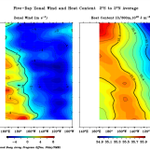
Strongest east Pacific westerly wind burst yet, and the warm water volume continues advancing eastward. The west side of the warm region is also maintaining, because the westerly winds keep piping warm water from off the equator onto the equator.

Paul Roundy retweeted

"You reduce crime by eliminating poverty."
This is one of the greatest intellectual confusions of our century. It sounds compassionate. It feels obvious. And the moment you actually test it, it falls apart.
Let's look at the data.
First, the correlation is real. Nobody serious denies that poorer areas have more crime. In Sweden, kids from the poorest 20% of families are about 7 times more likely to be convicted of a violent crime than kids from the richest 20%.
But correlation is not causation. So Swedish researchers did something brilliant: they compared siblings. Same parents, same home, same upbringing, but different family income at different points in their childhood, because parents' income moves over time.
Result, on more than 500,000 children (Sariaslan et al., British Journal of Psychiatry, 2014): once you account for what's shared inside the family, the effect of income on violent crime goes from 7x to nothing. The hazard ratio drops to 0.95. No effect.
Finland ran the same test on 650,000 people. Same result: the income-crime link disappears when you compare siblings.
What predicts crime isn't the bank balance. It's what travels inside families.
Second test: what happens when poverty spikes for everyone at once? 2008. US unemployment doubled from 5% to nearly 10%. 15% of Americans officially poor. If poverty creates crime, crime should have exploded. Instead it fell. Year after year. Robbery, the most "economic" crime of all, dropped 10% in 2010 alone. Criminologists literally said they were stumped. Same story in the Great Depression: 25% unemployment, and crime went down in many cities.
Third test: take families out of poverty and see. The US government ran a randomized lottery called Moving to Opportunity. Thousands of families in public housing got vouchers to move to low-poverty neighborhoods. For boys, violent arrests dropped at first, property crime arrests went up, and over time the effects faded. New zip code. Same behavior.
Fourth: the claim that police don't matter. This one is just false. Chalfin et al. (American Economic Review: Insights, 2022): each additional police officer prevents about 0.1 homicides. And per capita, the lives saved are twice as many among Black victims as among white victims. The people who suffer most from "police don't matter" are the poorest neighborhoods.
So what does predict crime? The Dunedin study followed 1,000 children from birth to age 32. Self-control measured between ages 3 and 11 predicted adult criminal convictions, even after controlling for social class and IQ (Moffitt et al., PNAS, 2011). Cognitive ability matters too: across 700,000 Swedish men, lower cognitive scores at 18 track with violent convictions, and the link barely moves when you control for childhood socioeconomic status (Frisell et al., 2012).
And here's the part nobody quotes: in Dunedin, kids whose self-control improved over time did better than predicted. Behavior can change. Which means responsibility is real.
Why does this matter? Because "poverty creates crime" isn't just wrong. It's toxic.
It turns criminals into victims. The man who robbed you becomes a symptom of "the system," and you, the real victim, become a footnote in someone else's narrative.
It merges two completely different things. "You're poor, we'll help you" is one policy. "You're poor and you committed a crime, so we'll excuse you" is another. Fusing them insults the millions of poor people who work, raise their kids, and never hurt anyone. The vast majority of poor people are not criminals. That alone kills the theory.
It removes responsibility. Build a political system on "your circumstances made you do it" and you destroy the one thing that actually changes behavior: the certainty that you own your choices. Every excuse the state manufactures is an incentive.
And it feeds the state forever. If every crime is a social failure, every crime justifies a new program, a new budget, a new agency. Crime becomes the business model of bureaucracy.
The alternative is simple and old.
A lighter state that protects instead of explains. The same rules for everyone, from the projects or from a gated community. Certain, swift punishment for anyone who commits a crime. And never, ever telling someone their crime was written in their social condition.
Treating someone as responsible is respecting them. Excusing someone because they're poor is the most condescending thing you can do to them.

This quoted post is unavailable.
Paul Roundy retweeted

Reality and satire are indistinguishable: the president-elect of the American Psychological Association has a paper on “#hotgirlscience”. Read the abstract; it’s real.
With this at center stage, imagine the biases, rotten assumptions and errors where no one’s looking


Paul Roundy retweeted

After you are abandoned by a trusted institution and publicly shamed, the headlines and mobs eventually fade. What you are left with is isolation.
People who claimed to be your friends abandon you. Very few will say anything positive about you. People generally pretend you are dead. Others dismiss or worse take credit for your work and try to write you out of history. Vultures swoop in from every direction.
This is what happens when fourth-rate administrators make decisions affecting people’s livelihoods without concern for what they are doing to their lives. These are scientists who were among the best in the world at what they did. They passed up careers in pharma, finance, tech and administration that could have paid them vastly more for their skills.
When I was younger, people in my programs who gave up on science early went on to make fortunes on Wall Street, in biotech, and in Silicon Valley. Those who stayed pursued their passion for the love of it at the cost of millions of dollars.
When an administrator steps in and dismantles that life’s work, far more than a job is erased. Laboratories take years to build, and scientific problems take years to develop and eventually solve. Experiments, research materials, collaborations, and accumulated expertise cannot simply be restarted somewhere else. The field keeps moving while your work is stopped. The time lost is also the time lost that could have been spent making money - that part a court will never be able to figure out because juries are ordinary people not dedicated scientists.
Then comes the gaslighting. People assume it must have been your fault because an institution like MIT or Duke is supposedly so trustworthy and meritorious that it would never do this to someone who was not guilty. Institutional prestige is a substitute for examining the evidence.
I recently attended a meeting on academic freedome at MIT where Dorian Abbot’s name kept coming up as their fallen hero. They cited a cancelled lecture of his at MIT as their rallying cray. It was treated as an institutional catastrophe. It was insane. David was an afterthought among people supposedly concerned about the climate at MIT and self-appointed to change the culture there.
They simply believed MIT’s PR messaging that they have always been focused on merit despite some small missteps like the canceling of a controversial lecture. I had to point out repeatedly that MIT is not the MIT they attended 30–50 years ago. The priorities reflected in its newer hires and leadership have moved far from the scientific excellence they associate with it.
